Key takeaways
- A manager can agree to a payment plan only within the authority your management agreement gives. Anything beyond it needs your approval.
- A plan fits a tenant with a clean record and a temporary, specific cause. It does not fit a tenant who is late every month.
- Put it in writing: the itemized balance, each date and amount, how late fees are treated, and what happens if a payment is missed.
- Texas Property Code 92.019 allows a late fee only if the lease gives notice of it, it is reasonable, and rent is still unpaid two full days after it was due.
- A plan does not replace the notice to vacate. Property Code 24.005 still requires at least three days' written notice before an eviction suit, unless the lease sets a different period.
Yes. A property manager can negotiate a payment plan with a tenant on a rental in Fort Worth, Keller or North Richland Hills, and a good one does it the same week rent goes unpaid. The authority comes from the management agreement, which should say what the manager may agree to without calling you. The judgment comes from the file: a tenant with years of on-time rent and a one-time setback is a candidate; a tenant who is late every month is not.
This guide covers when a plan is the right call, what it must contain to be worth signing, what Texas law says about late fees and notices while a plan is running, and the questions to ask before anyone signs.
What a written rent payment plan should say
Here are the terms a written rent payment plan needs, and the reason each one is there:
| Term in the plan | What it says | Why it matters |
|---|---|---|
| Itemized balance | Rent owed, late fees and any other charges, as of the plan date | Both sides start from the same number. Under Property Code 92.0191 a tenant can ask for a written statement of any late fee owed |
| Payment schedule | Each catch-up amount and the date it is due | A promise without dates cannot be kept or enforced |
| Current rent | Next month's rent is still due on its normal date, on top of the catch-up payments | Otherwise the plan just moves the shortfall forward a month |
| Late fee treatment | Charged as the lease allows, deferred, or waived on completion | Property Code 92.019 allows a late fee only if the written lease gives notice of it and the fee is reasonable |
| Lease stays in force | The plan does not change the lease, and the owner keeps every remedy in it | So that taking a payment is not read as giving up the right to act |
| Missed payment | The plan ends and the manager proceeds under the lease and Texas law | Property Code 24.005 still requires a written notice before an eviction suit is filed |
How to read this table: if a proposed plan is missing any row, it is not ready to sign. The last two rows are the ones that protect the owner, and the first row is the one that protects the tenant from a surprise balance later.
When a payment plan is the right answer
A plan is worth offering when three things are true. The tenant has a record of paying on time. The cause is identifiable and temporary: a delayed paycheck, a medical bill, a short gap between jobs with a start date in hand. And the tenant proposes something specific, with dates, rather than asking for time in general. When those line up, a plan usually gets you the full rent faster and cheaper than any notice, and it keeps a tenant you would otherwise have to replace.
A plan is the wrong answer when the cause is structural. A tenant whose income has dropped permanently cannot catch up on this month while paying next month; the plan fails by design and you have added a month of loss. The same goes for a tenant who has been late repeatedly, who does not answer calls, or who has already missed a promised date this cycle. For those, the schedule in what happens when a tenant pays late in Texas moves to the notice rather than the plan.
What the management agreement should authorize
The manager's power to agree to a plan comes from you. A well-drafted management agreement says in plain terms what the manager may do on late rent without asking: contact the tenant, assess the late fee the lease allows, serve the notice to vacate, and agree to a short catch-up plan within stated limits, such as a maximum number of days or a maximum balance carried. Anything beyond those limits needs your approval, and the agreement says how fast you will be asked.
That structure is what lets the manager act on day two instead of waiting for you to return a call, while keeping you in control of anything unusual. If a prospective manager cannot tell you where their authority on late rent ends, ask them to put it in writing before you sign. What you want to avoid is learning from a statement that the manager agreed to carry three months of arrears on your behalf. Our rent collection page describes the late process we follow; the limits of what we may agree to on your rental are written into your agreement.
What a written plan has to include
A plan that lives in a text thread is not a plan. The document the tenant signs should be short and leave nothing to interpretation.
- The balance as of the date of the plan, itemized: rent, late fees, anything else owed.
- Each payment amount and the date it is due, with the current month's rent still due on its normal date on top of the catch-up payments.
- How late fees are treated: charged as the lease allows, waived in part on completion, or deferred. Whatever it is, it is written.
- A statement that the plan does not modify the lease, that all other lease terms remain in force, and that the tenant remains in default until the balance is paid.
- What happens on a missed payment: the plan terminates and the manager proceeds under the lease and Texas law without further notice beyond what the law requires.
- Signatures and the date.
The fourth and fifth items are the ones that protect you. A tenant may argue that taking part of the rent after a notice to vacate gave up the notice, and whether that argument works depends on the lease and the circumstances. A plan that states in writing that payments are accepted without waiving the default or the owner's remedies is how a manager accepts money and keeps the right to act. Confirm the exact wording against your lease with an attorney.
What Texas law says about late fees and notices during a plan
The Property Code chapters on residential tenancies and evictions, 92 and 24, do not set out a rent payment plan procedure for a private rental. A plan is an agreement between landlord and tenant, and three sections of the Property Code shape it.
Late fees: Property Code 92.019. A landlord may not collect a late fee unless notice of the fee is in a written lease, the fee is reasonable, and some part of the rent has remained unpaid two full days after it was due. For a house or any building with four or fewer units, a late fee of up to 12 percent of the month's rent is considered reasonable. Subsection (e) adds that the late fee rules do not affect the landlord's right to terminate the lease or take other action the lease or the law permits.
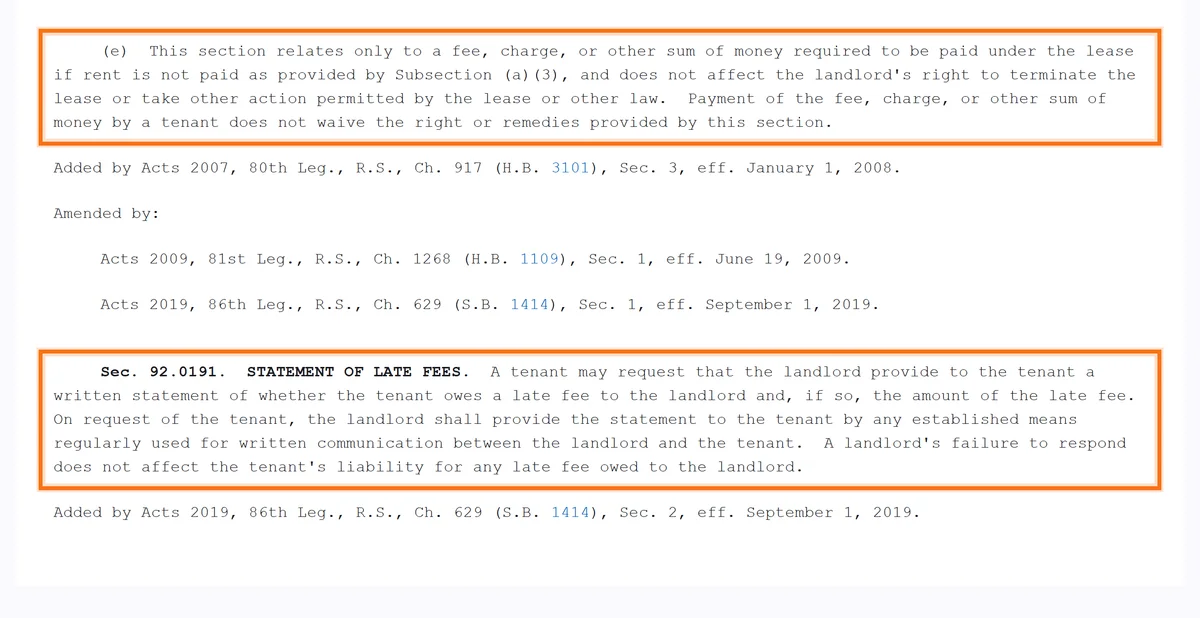
Statement of late fees: Property Code 92.0191. A tenant may ask for a written statement of whether a late fee is owed and the amount, and the landlord must provide it by the usual written channel. An itemized balance at the top of the plan answers that request before it is made.
Notice to vacate: Property Code 24.005. Before filing an eviction suit, the landlord must give at least three days' written notice to vacate, unless the written lease sets a shorter or longer period. As the section reads in November 2026, a tenant being removed only for nonpayment who was not late before the month of the notice must receive it as a notice to pay rent or vacate. For a tenant who was late before, either form may be used.
What the statute does not say is what happens to a notice when the landlord then accepts part of the rent. That depends on the lease wording and the facts, which is why the plan itself should state that payments are accepted without giving up the default or the owner's remedies. Have an attorney confirm that wording against your lease. More on the notice is in the Texas notice to vacate explained. This is general information, not legal advice.
A plan that works, and one that does not
Say rent is $2,000, due on the first. A tenant of three years with no late history calls on the third: a payroll error, fixed, with the deposit landing on the twelfth. The tenant proposes full rent plus the late fee on the twelfth. The manager documents it, you are told, the money arrives on the twelfth and the file notes a single late payment with cause. That is a plan.
Now a different tenant, late four of the last six months, calls on the eighth and asks for half now and half at the end of the month, with no reason given. Half now would carry $1,000 into the next cycle, when the next $2,000 is due. The pattern says the second half will slip, and the unpaid balance will be larger when the notice finally goes out.
Here the manager assesses the late fee, serves the notice to vacate on schedule, and tells the tenant a plan is available only for the full balance by a near date. The notice is what gets the tenant to find the money; the plan would have hidden the problem for a month.
The two tenants are also treated differently by Property Code 24.005. The first, never late before, would have to receive any notice as a notice to pay rent or vacate. The second, late in earlier months, can be given either that or a plain notice to vacate.
How a manager takes over an existing pattern like the second one, including a tenant who has been late every month under self-management, is covered in how a manager takes over a rent problem.
What happens when a plan is missed
A missed plan payment is handled exactly as the plan says, without a second negotiation. The manager gives the written notice Property Code 24.005 requires if one has not already been given, or proceeds to filing if it has, and tells you. There is no third plan.
What the manager should not do is accept another partial payment on the day the plan fails without clear written terms, because that is when a tenant can argue the notice was given up. If the tenant turns up with most of the money, the manager's answer is governed by the plan and the lease, and by the authority you granted, not by sympathy on the day. Whether a manager accepts partial payments at all, and on what terms, is a separate question answered in whether property managers accept partial rent payments.
This is general information, not legal advice. How partial payments and plans interact with notices depends on your lease and Texas law, so confirm with an attorney if you are unsure.
What you should see as the owner
Every plan should be visible to you before it is signed, or immediately after if it falls within the manager's pre-approved authority. Your statements should show the balance, the plan payments as they arrive and the late fees assessed. If a plan is missed, you should hear from the manager directly, with the next step already in motion.
A manager who offers plans freely and tracks them loosely is lending your money to tenants. A manager who offers them to the right tenant, in writing, with a consequence, is collecting your rent. For the homes we manage, monthly statements with income, expenses and documents are in the Owner Portal; how a specific plan is reported to you is something to agree in writing at the start.
What to ask your property manager before a rent payment plan is signed
Owners and tenants both ask us what to check before enrolling in a rent payment plan so nobody is surprised later. The questions are nearly the same from either side.
If you are the owner, ask your manager:
- Does my management agreement let you agree to this plan without me, and what is the limit?
- What is the itemized balance today, and what will it be if every payment is made?
- Are late fees being charged, deferred or waived, and is that written in the plan?
- Has a notice to vacate been given, and does the plan say payments are accepted without giving up my remedies?
- How and when will I be told if a payment is missed?
If you are the tenant, ask:
- What exactly do I owe, in writing, including any late fee? Property Code 92.0191 entitles you to that statement.
- Is next month's rent still due on the first on top of the plan payments?
- Will more late fees be added while I am on the plan?
- What happens if I am one day late on a plan payment?
- How do I pay, and will I get a receipt for each payment?
On the last point, online payments leave a dated record automatically. If a landlord takes a rent payment in cash, Property Code 92.011 requires a written receipt and an entry in a record book.
How Perpetual handles this
Perpetual Property Management is broker-owned, with our office at 5755 Rufe Snow Dr in North Richland Hills, and we manage homes in Keller, North Richland Hills, Fort Worth and nearby. We do not publish a payment-plan policy, because what we may agree to on your rental is set with you in the management agreement and confirmed in writing before you sign. What our site does state is the process around it.
Rent is paid online through the tenant portal, by bank transfer or card, with automatic receipts. Late rent follows a firm, documented late process: reminders, late fees applied per the lease, and escalation steps that are the same for every tenant, every time. You know quickly, not at month-end. When a tenancy is in trouble, we attempt resolution first, because a documented payment conversation resolves many situations faster and cheaper than court, and we pursue it without letting it become stalling.
If the plan fails, the notice Texas procedure requires is delivered and documented, and the ledger, lease, notices and communication history are already in order. Eviction service is included on the Full Service plan and optional at $7.95 a month on the others. The details are on the rent collection and evictions and problem tenants pages.
If you have a tenant asking for more time right now, we will tell you whether a plan fits and what it should say: call 682-593-7033.
The takeaway: A payment plan is a written tool for the right tenant and the right cause, with dates, amounts and a consequence, never a quiet extension that grows the balance.
Questions owners ask
Does a payment plan stop the eviction clock in Texas?
Not by itself. A plan is a private agreement, and Property Code 24.005 still requires at least three days' written notice to vacate before an eviction suit, unless the lease sets a different period. That is why the plan should state that the tenant remains in default until the balance is paid. If the plan is kept, the eviction never proceeds; if it is missed, the manager continues from where the process stood. Confirm the wording with an attorney, as this is general information.
Should late fees be waived as part of a payment plan?
They can be, as an incentive for keeping the plan, but only in writing and only on completion. Waiving the fee up front removes the tenant's reason to finish and sets a precedent for the next month. Under Property Code 92.019 a late fee must be in the written lease and reasonable in the first place. Many managers leave the fee in place and treat the plan as a courtesy on timing, not a discount on the amount.
Can the tenant ask for a plan every month?
A plan is a one-time response to a one-time problem. A tenant who needs a plan every month has a rent they cannot afford, and the right conversation is about the lease ending or the tenant finding somewhere cheaper, not another plan. The manager should flag the pattern to you well before renewal so the decision is made with the full history.
Who decides whether to offer a payment plan, the owner or the manager?
The management agreement decides. An agreement can let the manager agree to a short plan within stated limits without a call, because speed matters, and require owner approval for anything larger or longer. If you want to be asked before any plan is offered, say so before signing and have it written into the agreement. At Perpetual those limits are set with you in writing.
What should I ask my property manager before enrolling in a rent payment plan so I don't get surprised later?
Ask for the itemized balance in writing, including any late fee. Ask whether next month's rent is still due on its normal date, whether more late fees are added during the plan, what happens if a plan payment is late, and how each payment is receipted. In Texas a tenant may request a written statement of late fees owed under Property Code 92.0191.
Can a landlord charge late fees during a payment plan in Texas?
Yes, if the lease allows it and the plan does not say otherwise. Property Code 92.019 permits a late fee only when the written lease gives notice of it, the fee is reasonable, and rent is unpaid two full days after it was due. For a house, up to 12 percent of the month's rent is considered reasonable. The plan should say in writing whether fees continue, pause or are waived on completion.
Related services
Property management in Keller, North Richland Hills and Fort Worth. How full-service management works in Tarrant County →