Key takeaways
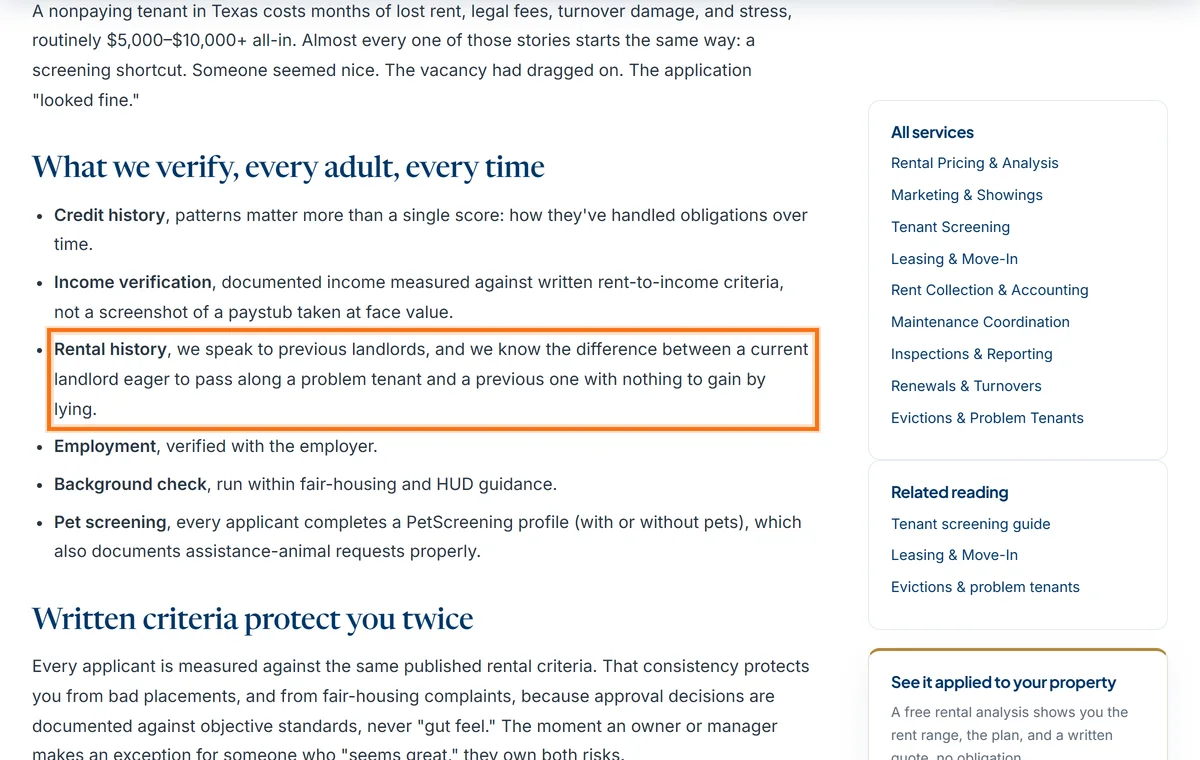
- Yes, careful landlords call previous landlords; we speak to previous landlords for every adult applicant.
- The landlord before the current one is usually the most honest reference, because they have nothing to gain.
- The reference is verified against public ownership records or the management company's published number before the answers count.
- Our published criteria ask for 3 years of residential history and rental references; an eviction or unpaid charges to a previous landlord are causes for rejection.
- Screening typically takes 1 to 3 business days once a complete application is in; landlord calls are what take the time.
Yes. Landlords and property managers who screen carefully call previous landlords, and apartment communities that verify rental history do it the same way, by phone or a written verification form. For the homes we lease in Fort Worth, Keller and North Richland Hills, rental history verification is part of every application: applicants list 3 years of residential history and rental references, and we speak to previous landlords.
A property manager who takes screening seriously makes that call, and the ones who do not are skipping the single most predictive part of an application. A credit report tells you how someone handles debt. A landlord tells you how they handled a house, which is the thing you are actually renting out. The catch is that a landlord reference is only worth something if the manager confirms who they are talking to and asks questions a vague answer cannot satisfy.
Here is how a real reference check works, why the landlord before the current one matters most, and what happens when nobody picks up the phone.
Why the landlord call matters more than the credit pull
Most of an application is paperwork the applicant chose to give you. The landlord reference is the one piece that comes from someone who has watched this person live in a house for a year or more. A score and an income number can both look fine on a tenant who paid on the tenth every month, kept two unauthorized dogs and left with a wall full of nail holes.
The call fills the gap between can they pay and will they pay, and how will they treat the property. It also catches the quiet problems a report never shows: repeated noise complaints, a notice to vacate that never became a filed eviction, a lease broken early with the deposit forfeited. None of that appears on a credit report, and all of it appears in a two-minute conversation with the right person.
If you want the full picture of what happens before and after that call, how tenant screening works walks through every step of the process from application to approval.
The prior landlord is usually more honest than the current one
A current landlord has a motive. If the tenant is a problem, the fastest way to be rid of them is to give a glowing reference so another owner takes them. If the tenant is excellent, the current landlord may shade the answer the other way to keep them. Neither is lying outright, but neither is a neutral source.
The landlord before that one has nothing to gain. The tenant is already gone, the deposit has been settled and the file is closed. That is the person who will tell you, without hesitation, whether rent came in on time and what the house looked like at move-out. A careful screen asks for both references and weighs the earlier one more heavily when the two disagree.
- Current landlord: confirms the tenancy exists, the rent amount and whether notice was given properly.
- Prior landlord: confirms payment history, condition at move-out and whether the deposit was returned in full.
- Both: would you rent to this person again, and why or why not.
How a manager confirms the landlord is real
Applicants with something to hide list a friend or relative as the landlord. The number rings, a friendly voice says the tenant was wonderful, and an unverified check records it as a pass. A manager who has been burned once does not take the phone number on the application at face value.
The first step is matching the address on the application to public records. Tarrant County and the neighboring appraisal districts publish ownership for every parcel, so the owner's name is a minute away. If the listed landlord is a management company, the company's own published number is used rather than the one the applicant supplied. If the owner's name does not match the reference, the applicant is asked to explain before anything else moves forward.
Small tells matter too. A real landlord knows the rent amount, the move-in date and the deposit without looking it up. A reference who hesitates on all three, or who answers every question with great tenant, no problems and nothing specific, gets a follow-up question that only a real landlord can answer, such as what the lease said about lawn care.
The questions that separate a real reference from a polite one
A reference check is not a yes-or-no call. The questions are specific, factual and the same for every applicant, which keeps the process consistent and defensible. The answers are typed into the file while the landlord is still talking, not reconstructed from memory later.
- What were the lease dates, the monthly rent and the deposit amount?
- How many times was rent paid after the due date, and were late fees charged?
- Were any notices served, including notices to vacate or lease violation letters?
- Were there complaints from neighbors or an HOA?
- Were the pets and occupants on the lease the same ones living in the house?
- What was the condition at move-out, and how much of the deposit was returned?
- Did the tenant give proper written notice before leaving?
- Would you rent to them again?
The last question is the one that matters. A landlord who answers the factual questions well but pauses before saying they would rent again is telling you something, and the manager's job is to ask what.
What each landlord question tells you
The standard questions, what each one reveals and how the answer is checked:
| Question | What it reveals | How it is checked |
|---|---|---|
| Lease dates, rent and deposit | Whether the reference really was the landlord | A real landlord answers without looking it up; the name is matched to public ownership records |
| Late payments and late fees | Payment habits a credit score can hide | Compared with bank statements showing rent paid; excessive late payments in the last 2 years are a cause for rejection |
| Notices to vacate or violation letters | Problems that never became a filed eviction | Asked directly; an eviction by a previous landlord is a cause for rejection |
| Pets and occupants | Whether the household on the lease matched the household in the home | Compared with the application, which must list every occupant and pet |
| Move-out condition and deposit returned | How the home was treated | Unpaid charges to a previous landlord are a cause for rejection |
| Would you rent to them again? | The landlord's overall verdict | A pause or a vague answer gets a follow-up question |
How to read this table: no single answer decides an application. The questions are the same for every applicant and the answers are written into the file, so the decision rests on facts measured against our written rental criteria, not on how friendly the call felt.
What happens when a landlord will not talk, or there is no landlord
Not every reference can be reached. Some large management companies only confirm dates by email. Some private landlords never return calls. Some applicants are leaving a parent's home, a military barracks or a house they owned and have no landlord at all.
None of those is a reason to approve or deny by itself. A missing reference is a gap, and gaps get filled another way: a longer bank statement history to confirm rent was actually paid, a mortgage statement for a former homeowner, a copy of the prior lease and move-out statement, or a written verification form the landlord can return in a minute. What a manager should not do is leave the field blank and move on, because an unreachable landlord is sometimes a landlord the applicant hoped you would not reach.
Written criteria state how each situation is handled, so the same gap is treated the same way for every applicant. That consistency is what keeps the process fair under fair housing rules, and tenant screening criteria in Texas explains how to set those standards before the first application arrives. The rental application process from the owner's side shows where the reference check fits in the sequence.
What you should see as the owner
You should never have to take a manager's word that the calls were made. Ask to see what a completed screening file looks like before you sign, and ask specifically where the landlord reference notes appear. A file with the landlord's name, the number called, the date, who answered and the answers to the standard questions is a file where the call happened.
When an applicant is presented to you, the summary should say in plain language what the references reported, not just references verified. If a reference could not be reached, the summary should say so and say what replaced it. You are approving a person to live in your house for a year; you deserve to know what the last person who rented to them had to say.
This is also where an honest manager earns trust. A reference that raised a concern should be reported to you as a concern, with the manager's recommendation, rather than smoothed over to fill the vacancy faster. If you want to see how a complete screening summary reads, the tenant screening service page explains what Perpetual sends owners before any lease is signed.
How Perpetual handles this
At Perpetual Property Management, broker-owned and local to Keller, North Richland Hills and Fort Worth, landlord references are called for every applicant, and the landlord is verified against public ownership records or the management company's published number before the conversation counts. The same written questions are asked of every reference, the answers are recorded in the applicant's file with the date and the person reached, and the prior landlord's answers are weighed alongside the current one's.
You receive a written summary of every reference before you are asked to approve a tenant, including any reference that could not be reached and what was used instead. Screening follows the same written criteria for every applicant, leases are Texas-compliant, and every fee is listed in your written quote before you sign. You can follow applications through the owner portal and see what was verified. If you want to know what a screening file looks like before committing, the leasing service page explains the whole process from listing to signed lease, or reach out and ask for a sample.
The takeaway: A landlord reference is only as good as the manager's willingness to verify who is on the phone and ask questions a vague answer cannot satisfy.
Questions owners ask
What questions can a landlord legally answer about a former tenant in Texas?
In general, a landlord can share factual information about the tenancy: dates, rent amount, payment history, notices served, condition at move-out and whether they would rent to the person again. What a careful landlord avoids is opinion that strays into protected characteristics or speculation about the tenant's personal life. A manager asks factual questions for exactly that reason, and this is general information rather than legal advice.
What if the applicant's previous landlord was a family member?
A relative's reference is treated as unverified, not as a failure. The manager asks for other proof the applicant paid for housing, such as bank statements showing regular rent transfers, and leans more heavily on the credit report, income verification and any earlier landlord who was not family. Written criteria should say how this case is handled so every applicant in that situation is treated the same way.
Can an applicant provide a written reference letter instead of a phone call?
A letter supplied by the applicant is the weakest form of reference, because the applicant chose what to hand over. A manager can accept it as a starting point but should still call the landlord directly using an independently sourced number. A letter that cannot be confirmed by a call is noted as unverified in the file.
How long does a landlord reference check take?
Usually a day or two, depending on how quickly the landlord responds. The manager typically starts the calls the same day the application is complete and follows up by phone and email. A reference that has not responded within a reasonable window is recorded as unreachable and the gap is filled with other documentation rather than holding the application indefinitely.
Do apartments call previous landlords?
Many do, but practices vary from one community or landlord to the next, so the reliable way to know is to read the landlord's written rental criteria. Perpetual's published criteria include rental history verification on every application, and we speak to previous landlords for every adult applicant.
How do landlords verify rental history?
By calling the previous landlords listed on the application, confirming each one really owns or manages the property through public ownership records or the company's published number, and asking the same factual questions every time. When a landlord cannot be reached, bank statements, the prior lease or a move-out statement fill the gap.
Related services
Property management in Keller, North Richland Hills and Fort Worth. How full-service management works in Tarrant County →