Key takeaways
- Many managers charge a renewal fee when a tenant signs again; some charge nothing. The owner pays it under the management agreement.
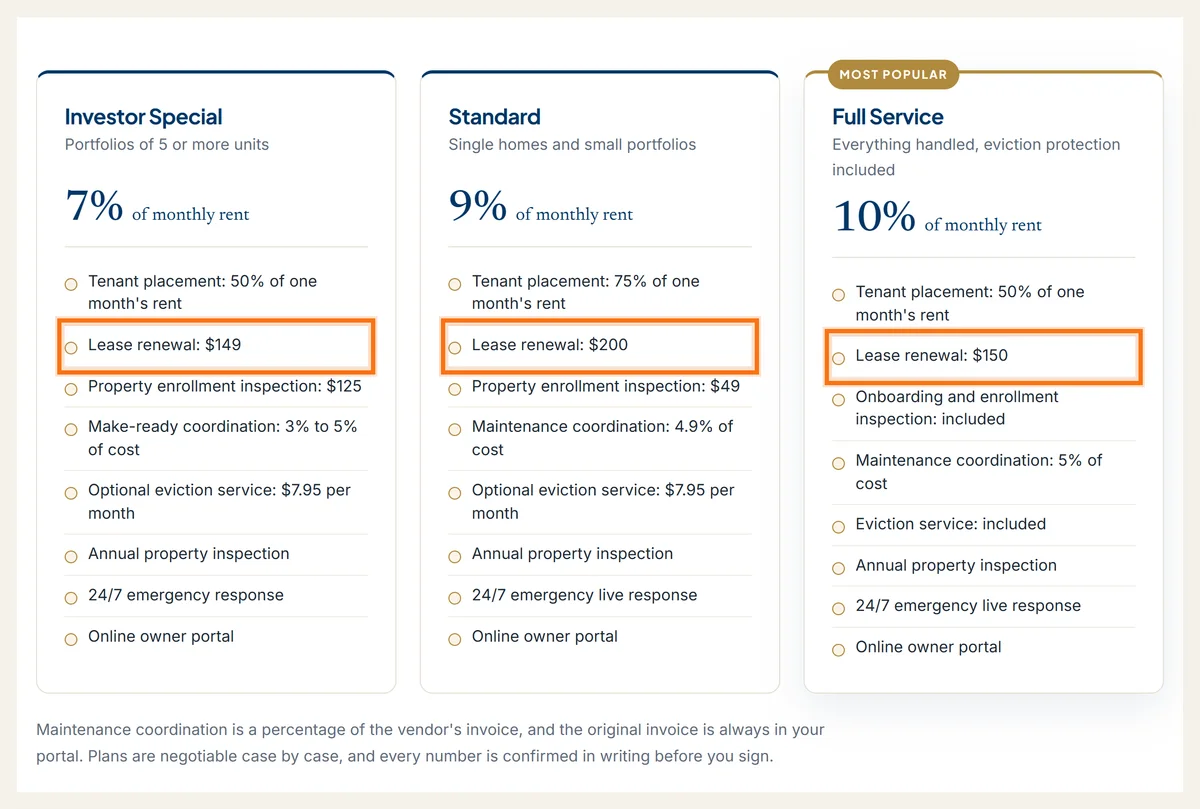
- Our published renewal fee is $200 on Standard, $150 on Full Service and $149 on Investor Special.
- A renewal fee should be a small fraction of the placement fee: on a $2,000 home ours is about 13% to 15% of it.
- A real renewal includes current leased comps, a recommendation and a new lease, with the decision left to you.
- Our renewals page puts a turnover at one to two months of rent, about $2,000 to $5,000 on a typical Tarrant County home.
Do property managers charge a separate lease renewal fee? Many do, and the owner pays it, usually out of the rent collected in the month the renewal is signed. For homes we manage in Fort Worth, Keller and North Richland Hills, the published renewal fee is $200 on the Standard plan, $150 on Full Service and $149 on Investor Special. Some companies charge nothing; others charge as much as a new lease-up.
The fee exists because a real renewal is work: a market check so the rent is not left behind, a review of how the tenant has paid, and a fresh lease with current addenda. Whether it is fair depends on whether that work happens and how the number compares with the fee for placing a new tenant.
The three ways managers handle renewals
Across management agreements you will see one of three approaches:
- No renewal fee. The monthly fee is considered to cover retention work. Common with managers who see keeping a tenant as part of the base job.
- A flat renewal fee. A fixed dollar amount per renewal, the same on every house. Easy to understand and easy to compare.
- A share of one month's rent. Quoted as a fraction of the new monthly rent. It rises with the rent, which ties the fee to the manager's success in raising it.
None of these is wrong on its own. What matters is that the fee is clearly smaller than the fee for placing a brand-new tenant, because a renewal is far less work and far less risk. If a renewal costs you as much as a lease-up, the manager has no financial reason to keep your tenant. The full reasoning on fair versus padded renewal fees is in our guide to lease renewal fees and when they are fair.
Our renewal fee next to the placement fee, by plan
Here is what a renewal costs on each of our plans for a home renting at $2,000 a month, compared with the fee for placing a new tenant in the same home:
| Plan | Monthly fee | Renewal fee | Tenant placement fee at $2,000 rent | Renewal as a share of placement |
|---|---|---|---|---|
| Investor Special (5 or more units) | 7% of monthly rent | $149 | $1,000 (50% of one month) | About 15% |
| Standard | 9% of monthly rent | $200 | $1,500 (75% of one month) | About 13% |
| Full Service | 10% of monthly rent | $150 | $1,000 (50% of one month) | About 15% |
How to read this table: the renewal column is the whole charge for keeping the tenant another term, and the placement column is what you would pay instead if the tenant left. On every plan the renewal is a small fraction of a new lease-up, which is the shape that gives a manager a reason to keep a good tenant. Fees come from our price sheet and are confirmed in writing before you sign.
Where to find it in the agreement, and the wording that hides it
Look at the fee schedule or compensation section first, not the body of the agreement. The renewal fee may be called a renewal fee, a lease extension fee, a re-lease fee, a retention fee or a lease administration fee. Some agreements fold it into a sentence that says the manager earns a fee "upon the execution of any lease, renewal or extension", which quietly sets the renewal fee equal to the leasing fee.
Read for three things: the amount, what triggers it, and whether a month-to-month holdover counts as a renewal. A tenant who simply stays on after the lease ends without signing anything should not generate a renewal fee, and if the agreement charges one at every monthly rollover you need to know before you sign.
If it is not in the fee schedule, ask the manager to put in writing that there is no renewal charge. A verbal "we do not really charge that" is not a term of the contract.
What a renewal fee should buy you
A fee is only worth paying if something happens for it. At a minimum, a renewal should include:
- A written recommendation on the new rent, based on comparable homes that actually leased nearby, not just advertised prices.
- A review of the tenant's payment and maintenance record, so you know whether this is a tenant worth keeping.
- An interior inspection with dated photos, ideally timed with the renewal so a problem can be fixed or the renewal declined.
- A new lease or extension with current Texas addenda, signed by every adult, uploaded to your owner portal.
If the renewal consists of an email asking the tenant to stay at the same rent, you paid for a form. Ask any manager you interview to describe their renewal process step by step. The answer tells you whether the fee is a service or a surcharge. Our renewals service page describes what that process should look like from the owner's side.
The renewal fee against the cost of a turnover
A renewal fee only makes sense next to the alternative. Our renewals page puts a turnover at one to two months of rent once vacancy, make-ready and leasing are counted, about $2,000 to $5,000 on a typical Tarrant County home. For a home renting at $2,000 on our Standard plan, the comparison looks like this:
| Cost line | Tenant renews | Tenant leaves |
|---|---|---|
| Manager's fee for the new lease | $200 renewal fee | $1,500 placement fee (75% of one month) |
| Rent lost while the home is empty | None | Depends on days vacant |
| Make-ready between tenants | None, beyond normal upkeep | Paint, cleaning and repairs as needed |
| Total, per our renewals page | $200 plus any repair you approve | One to two months of rent, about $2,000 to $5,000 |
How to read this table: the renewal column is nearly fixed and small, while the turnover column depends on how long the home sits and what the make-ready finds. That is why a modest renewal fee is one of the cheapest lines on a statement, provided the manager uses the renewal to keep the rent current. The detailed turnover costs are in our guide to what a turnover costs and how long it takes.
Three questions to settle before you sign
You can settle this in one conversation:
- "What is your renewal fee in dollars on a house at this rent, and what exactly do I get for it?"
- "Does a month-to-month holdover trigger the fee, and if so how often?"
- "If you recommend a rent increase and the tenant leaves because of it, is there a leasing fee for the replacement?"
The third question matters most. A manager who earns a full leasing fee every time a tenant leaves has a reason to push rent harder than the market supports. Combine the answers with the renewal section of the pricing page for whichever company you are considering, and compare dollar to dollar.
How Perpetual handles this
Every fee Perpetual charges, including the renewal fee, is listed in the written agreement before you sign, and if a fee is not in the agreement you do not pay it. I would rather keep a paying tenant in a house in Keller, North Richland Hills or Fort Worth than lease it again, and the renewal process is built around that.
Renewal conversations start well before the lease ends, typically 60 to 90 days ahead, so if the tenant is leaving, marketing starts early and the vacancy gap shrinks. Before every renewal we pull current leased comps and send a recommendation with the reasoning: keep at market, adjust moderately, or let the tenant go, with the turnover math shown. The decision is always yours, and the renewal shows as its own line on your owner statement.
If you want to see the full fee schedule for your house, ask for a written quote through the contact page and compare it with what you pay now.
The takeaway: Find the renewal fee in the fee schedule, make sure it is clearly smaller than the leasing fee, and confirm it buys a market check, an inspection and a new lease rather than an email.
Questions owners ask
Is a lease renewal fee the same as a leasing fee?
No. The leasing fee pays for finding, screening and placing a new tenant, which is weeks of marketing and showings. A renewal fee covers re-signing a tenant who is already in the house. It should be much smaller, and some managers do not charge one at all. If a company charges the same amount for both, ask why.
Can I refuse to renew and avoid the fee?
Yes, the decision to renew is yours. If you decline, there is no renewal and no renewal fee, but the house will turn over and you will pay for vacancy, make-ready and a leasing fee instead. Declining to renew to save a renewal fee is almost never the cheaper choice with a good tenant.
Does the renewal fee come out of my rent automatically?
Usually it is deducted from the rent collected in the month the renewal is signed, and it appears as its own line on that month's owner statement. Confirm the timing in the agreement so the lower disbursement that month is not a surprise.
Who decides the new rent at renewal?
The manager should recommend a rent with the comparable leased homes that support it, and the owner approves. A good manager will tell you when the market supports an increase and when holding rent flat is the smarter way to keep a reliable tenant for another year.
Who pays the lease renewal fee, the owner or the tenant?
A property manager's renewal fee is charged to the owner under the management agreement and is usually deducted from the rent collected in the month the renewal is signed. If any renewal charge is passed to the tenant, it has to be written into the lease, so ask your manager whether that happens on your home.
How much is Perpetual's lease renewal fee?
Our published renewal fee is $200 on the Standard plan, $150 on Full Service and $149 on Investor Special, for portfolios of 5 or more units. Each is well below the tenant placement fee on the same plan, and every fee is confirmed in writing before you sign.
Related services
Property management in Keller, North Richland Hills and Fort Worth. How full-service management works in Tarrant County →