Key takeaways
- A lease renewal fee is the manager's charge when an existing tenant signs for another term. The owner pays it.
- It is fair when it is clearly smaller than the leasing fee, charged once per renewal, and backed by a market check and new paperwork.
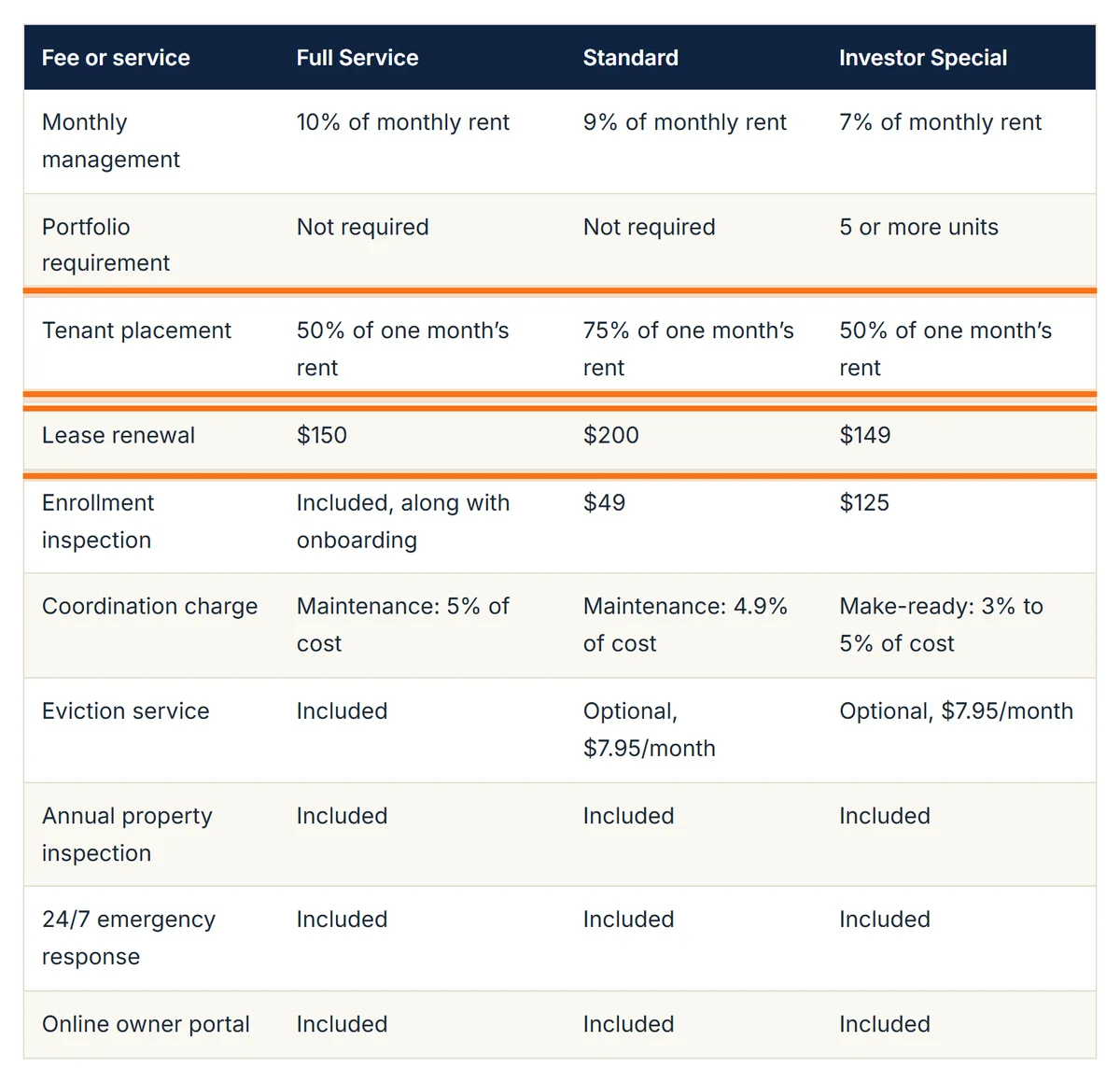
- Our published renewal fee is $150 on Full Service, $200 on Standard and $149 on Investor Special; tenant placement is 50% or 75% of one month's rent.
- Our renewal work starts 120 days before the lease ends with a rent check against leased comparables, and the decision is always the owner's.
- What a renewal avoids is a turnover, which typically costs one to two months of rent: about $2,000 to $5,000 on a typical Tarrant County home.
A lease renewal fee is what a manager charges when your existing tenant signs for another term. Whether it is fair, on a rental in Fort Worth, Keller or North Richland Hills or anywhere else, depends entirely on what was done to earn it. A real renewal involves a market check, a negotiation, an inspection and new paperwork. A renewal that is an automated email and an electronic signature is padding, and you should pay for it accordingly.
Renewals are also the most profitable event in the life of your rental, because a tenant who stays is a turnover you do not pay for. That is why the renewal process deserves more attention than the fee itself.
Lease renewal fee next to the placement fee: our Fort Worth area plans
Here is the first test of any renewal fee, applied to our own published price sheet: how it compares with the fee for placing a new tenant.
| Plan | Lease renewal fee | Tenant placement fee | Placement fee at $2,000 rent |
|---|---|---|---|
| Full Service (10% of monthly rent) | $150 | 50% of one month's rent | $1,000 |
| Standard (9% of monthly rent) | $200 | 75% of one month's rent | $1,500 |
| Investor Special (7%, portfolios of 5 or more units) | $149 | 50% of one month's rent | $1,000 |
How to read this table: compare the second column with the last one. On every plan the renewal fee is a small fraction of what a new placement costs, which is the gap you want to see in any quote. The last column is arithmetic on an example rent of $2,000, not a quote. Plans are negotiable case by case, and every number is confirmed in writing before you sign.
What a real renewal involves
Done properly, a renewal is a small lease-up without the vacancy. The manager should:
- Pull leased comps for the neighborhood and decide what the house would rent for today, not what it rented for last year.
- Review the tenant's payment history, maintenance requests and how they have treated the house.
- Decide on an increase, if any, that the market supports and the tenant will accept.
- Contact the tenant well before the lease ends, present the terms and handle the back-and-forth.
- Inspect the house, inside and out, with photos, before committing to another year.
- Prepare the renewal lease or addendum, update any changed terms, and get it signed and filed.
Each of those steps protects a different part of your return. The comps protect the rent. The inspection protects the asset. The paperwork protects you if the tenancy later goes wrong.
Why a renewal is worth more than a rent increase
Owners tend to judge a renewal by the size of the increase. The bigger number is the turnover you avoided. A tenant who leaves triggers a make-ready, weeks of vacancy, marketing, screening and a new leasing fee. A turnover typically costs one to two months of rent once you count vacancy, make-ready and leasing, about $2,000 to $5,000 on a typical Tarrant County home, which is more than a year of a small rent increase would earn.
So a renewal with a reasonable increase and a happy tenant is usually a better outcome than a larger increase that sends the tenant looking. The manager's job is to find the number that does both: keeps the rent at market and keeps the tenant in place. More on the retention side in how to keep good tenants longer.
When a renewal fee is fair
A renewal fee is reasonable when it is clearly smaller than the leasing fee, when it is charged once per renewal rather than per document, and when you can see the work behind it: the comps used and the signed lease in your portal.
Our own numbers show the gap. The renewal fee is $150, $200 or $149 depending on the plan, while placing a new tenant costs 50% or 75% of one month's rent. On a $2,000 home that is $1,000 to $1,500 for a placement against $200 or less for a renewal, before counting vacancy and make-ready.
A market check that supports even a modest increase can earn a fee of that size back within a few months. Our renewal process is built around that check, and the fee structure is listed on the pricing and fees page. Whether a manager should charge the fee at all is covered in do property managers charge a separate lease renewal fee.
When it is padding
The signs are easy to spot once you know them:
- The renewal fee is the same as, or close to, the leasing fee, for a fraction of the work.
- The renewal arrives as a form letter with last year's rent and no evidence anyone checked the market.
- No inspection happened, or the "inspection" was a request for the tenant to send photos.
- The fee is charged on month-to-month extensions, every month, or on every short extension.
- The rent never changes at renewal, year after year, while the neighborhood moves.
A manager who charges a renewal fee without doing a market check is charging you to leave money on the table. If the rent has not moved in several renewals, ask to see the comps.
The reverse failure also exists: a manager who pushes the maximum increase every year to justify the fee, loses the tenant, and collects a leasing fee on the turnover. Neither extreme serves the owner. The right increase is the one the comps support and the tenant accepts.
The incentive problem behind renewal fees
Fee structures shape behavior. A manager who earns a large leasing fee and a small renewal fee makes more money when your tenant leaves. That manager has little reason to negotiate hard to keep a good tenant, and may let a renewal slide into a move-out without much effort. A manager whose income comes mostly from monthly management of an occupied house wants your tenant to stay.
Compare the two fees side by side in any quote. If the renewal fee is nearly as large as the leasing fee, the manager is at least neutral about turnover. If there is no renewal fee at all, ask whether a market check still happens, because "free" sometimes means "skipped." The full list of fees worth comparing this way is in hidden property management fees to ask about.
When the renewal conversation should start
Early. A tenant deciding whether to stay is also looking at listings, and the manager who presents terms two or three months before the lease ends gets the first answer. Waiting until the final month hands the tenant a reason to shop and the owner a reason to panic. Our own renewal work starts 120 days before the lease ends, and conversations with the tenant typically happen 60 to 90 days out.
Early contact also gives time for the parts that take time: the inspection, a repair the tenant has been living with, and a negotiation if the first offer is declined. If a lease simply runs out, what happens next depends on its own terms, and many Texas leases continue month to month. Under Property Code 91.001, a month-to-month tenancy can then be ended by either side with one month's notice unless a signed agreement sets a different period.
That is fine for a short gap and poor as a long-term arrangement. A written renewal with a fixed term protects both sides, and it lets you line the lease end up with the stronger leasing months rather than the holidays.
Questions to ask about renewal fees
- How much is the renewal fee, and how does it compare to the leasing fee?
- What work is included: market comps, inspection, negotiation, paperwork?
- When do you start the renewal conversation with the tenant?
- Will I see the comps and the inspection report before I approve the terms?
- Is the fee charged on month-to-month extensions?
- Who decides the rent increase, and do I approve it?
You should approve the renewal terms. The manager recommends, with evidence, and you decide. If a manager renews leases without your sign-off, read the agreement to see whether you gave that authority away. How rent gets set in the first place, at listing and at renewal, is in how to price a rental in DFW.
What a well-run renewal looks like from the owner's chair
Months before the lease ends, you receive a short summary: what comparable houses in Keller, North Richland Hills or Fort Worth have leased for, how the tenant has performed, the recommended terms and the reason for them. You approve or adjust. The tenant receives the offer with time to consider it. The signed renewal follows, and your statement shows the renewal fee once, at the amount you were quoted.
That is the standard, and it is what we publish. Before every renewal we check current leased comparables, give you a recommendation with reasoning (keep at market, adjust moderately, or let them go) with the turnover math shown, and the decision is always yours. Every plan also includes an annual property inspection. The renewal fee is $150 on Full Service, $200 on Standard and $149 on Investor Special, and if a fee is not in your management agreement, you do not pay it.
If you are paying a renewal fee and not seeing that sequence, you are paying for a signature. If you would like to see what the market check looks like for your house, the same comps go into a free rental analysis, or call 682-593-7033.
The takeaway: Pay a renewal fee for a market check, an inspection and clean paperwork, never for a signature on last year's terms.
Questions owners ask
Do property managers charge a separate lease renewal fee?
Many do, and the fee is fair when it is clearly smaller than the leasing fee, charged once per renewal and backed by real work. A proper renewal involves pulling leased comps, reviewing the tenant's record, negotiating the terms and preparing the new paperwork. It is padding when it arrives as a form letter with last year's rent or when it is charged on every month-to-month extension. Perpetual's renewal fee is $150, $200 or $149 depending on the plan, listed in writing before you sign, and the recommendation comes with leased comps and the turnover math.
Is a lease renewal fee worth paying?
Yes, when the manager does the work: pulls leased comps, recommends a market-supported increase, inspects the house and prepares the documents. It is not worth paying for an automated email with last year's rent. Ask to see the comps and the inspection report.
Should rent go up at every renewal?
Not automatically. The increase should follow the market and the tenant's quality. A modest increase that keeps a reliable tenant usually beats a larger one that causes a move-out, because turnover costs far more than the difference. The decision should be yours, based on the manager's evidence.
What happens if the lease ends and nobody renews it?
It depends on the lease. Many Texas leases continue on a month-to-month basis after the term ends. Under Property Code 91.001, either side can then end a month-to-month tenancy with one month's notice, unless a signed agreement sets a different period. That is acceptable for a brief gap, but a written renewal with a fixed term protects both the owner and the tenant.
How much is a lease renewal fee?
It varies by company, and some charge nothing. Perpetual's published renewal fee is $150 on the Full Service plan, $200 on Standard and $149 on Investor Special. The useful comparison is with the same company's tenant placement fee, which on our plans is 50% or 75% of one month's rent. A renewal fee close to the placement fee is a warning sign.
Who pays the lease renewal fee, the owner or the tenant?
The owner. A lease renewal fee is a charge under the management agreement between the owner and the manager, and it shows on the owner statement once per renewal. It should be listed in the written quote before you sign; with Perpetual, if a fee is not in the management agreement, you do not pay it.
Related services
Property management in Keller, North Richland Hills and Fort Worth. How full-service management works in Tarrant County →