
Key takeaways
- Texas has no state income tax; rental income is reported on your federal return.
- The $140,000 school district homestead exemption and the 10% appraisal cap end from January 1 of the first year you no longer live there.
- You must tell the appraisal district in writing before May 1 after your homestead entitlement ends (Tax Code 11.43(g)).
- Protest by May 15, or 30 days after the notice of appraised value is delivered if later (Tax Code 41.44).
- Federal rules depreciate a rental house, not the land, over 27.5 years (IRS Publication 527).
Texas does not tax rental income at the state level, which is a real advantage, but a rental property still changes your tax picture in three ways: the property tax bill goes up when the homestead exemption and its 10% cap come off, the federal return gains a depreciation line most owners have never seen, and a long list of expenses becomes deductible if you kept the records.
I am a broker, not a CPA, and this is an overview written so that owners in Keller, North Richland Hills and Fort Worth walk into their accountant's office knowing which questions to ask. It is not tax advice.
Property tax: what changes when the home stops being your homestead
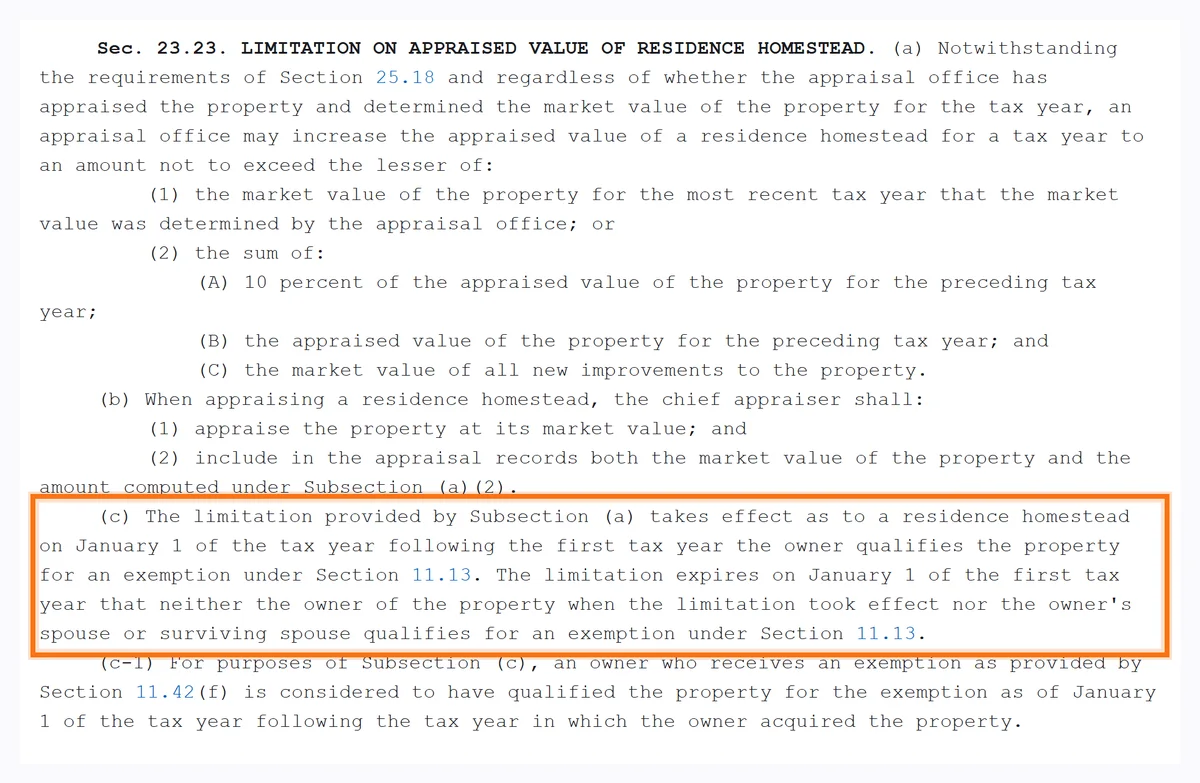
Texas property taxes are high because they carry the load the state income tax does not. A home you live in gets a residence homestead exemption: $140,000 off the appraised value for school district taxes under Tax Code 11.13(b), plus another $60,000 if you are 65 or older or disabled. It also gets a cap: under Section 23.23 the appraised value can rise no more than 10% a year, plus new improvements. When the home becomes a rental, both benefits go away.
The timing is set by the calendar, not the move-out date. Eligibility is judged on January 1 (Section 11.42), so if you lived there on January 1 you keep the exemption for that tax year. Under Section 23.23(c), the cap expires on January 1 of the first tax year that neither you nor your spouse qualifies. Section 11.43(g) also requires you to notify the appraisal district in writing before May 1 after your entitlement ends.
| Item | While it is your homestead | After it becomes a rental | Tax Code section |
|---|---|---|---|
| School district homestead exemption | $140,000 off the appraised value | None | 11.13(b) |
| Extra exemption at 65 or older, or disabled | $60,000 more for school taxes | None | 11.13(c) |
| Yearly limit on appraised value | 10% plus new improvements | Ends January 1 of the first year you no longer qualify | 23.23 |
| Limit on non-homestead property | Does not apply | 20% a year for real property at or under the threshold ($5 million for 2024, adjusted yearly); the section expires December 31, 2026 | 23.231 |
| Telling the appraisal district | Nothing to do | Written notice before May 1 after entitlement ends | 11.43(g) |
How to read this table: the first three rows are what you lose, and they arrive together on the first January 1 after you move out. The fourth row is a temporary cushion for most non-homestead property, so check with the appraisal district whether it applies to your home and remember it is scheduled to end after 2026. Build the full bill into your cash flow; a free rental analysis should include it, and our guide to whether to sell or rent treats it as a line item.
Protesting the appraisal: worth doing every year
Each spring the appraisal district mails a notice of appraised value. Under Tax Code 41.44, a protest must be filed by May 15 or the 30th day after the notice was delivered, whichever is later. For a rental, it is often worth filing, because the district values the home as if it were in retail condition and a rental with deferred items or dated finishes may not be.
A useful protest comes with evidence: recent sales of comparable homes that support a lower value, photos and estimates for condition issues, and, where the district uses an income approach, the actual rent and expenses. Some owners handle this themselves through the district's online process; others hire a protest firm that works on a share of the savings.
Keep the appraisal notice, the protest filing and the result with the property's records. If the home is sold later, the history of its assessed value is part of what a buyer and their lender will look at.
Depreciation: the deduction you take without spending anything
When a home becomes a rental, federal tax rules treat the building, but not the land, as an asset that wears out. IRS Publication 527 sets the recovery period for residential rental property at 27.5 years under the general depreciation system, using a mid-month convention, and states plainly that land cannot be depreciated. For many owners it is the largest deduction on Schedule E and the reason a property with positive cash flow can show little taxable income.
For a home you lived in first, Publication 527 sets the basis for depreciation at the lesser of your adjusted basis or the fair market value on the date you changed it to rental use. Appliances, carpeting and furniture used in the rental are 5-year property under the same publication.
Skipping depreciation does not avoid its effect. Publication 527 says that if you did not claim all the depreciation you were entitled to, you must still reduce your basis by the full amount you could have deducted. That lowers your basis when you sell, which is one more reason a rental owner should have a CPA from the first year.
Common deductible expenses on a Texas rental
Ordinary and necessary expenses of operating the rental are generally deductible against rental income. The list most owners run into:
- Property management fees and leasing fees, covered in more detail in our guide to whether management fees are deductible.
- Mortgage interest, but not principal.
- Property taxes and HOA dues.
- Landlord insurance premiums.
- Repairs and maintenance, such as a plumber's visit or a fresh coat of paint between tenants.
- Utilities the owner pays, lawn and pest service, and make-ready cleaning.
- Advertising, tenant screening costs and legal fees related to the rental.
- Travel to the property for management purposes, within the rules.
The line that trips owners up is repairs versus improvements. Fixing a section of fence is a repair, deducted in the year paid. Replacing the roof or installing a new HVAC system is generally an improvement, added to the basis and depreciated over time rather than deducted at once. Your CPA decides where each item lands, and the decision is easier when every invoice says exactly what was done.
Deduct this year or depreciate over time
Here is how common rental costs are usually treated on the federal return, following IRS Publication 527. Your CPA makes the final call on each item:
| Cost | Usual treatment | Note |
|---|---|---|
| Management, leasing and renewal fees | Deduct in the year paid | Shown on your owner statements |
| Repairs: a plumber visit, patching a fence | Deduct in the year paid | Keeps the property in working order |
| Mortgage interest and property tax | Deduct in the year paid | Principal is not deductible |
| Landlord insurance premiums and HOA dues | Deduct in the year paid | Split if a premium covers more than one year |
| New roof or new HVAC system | Depreciate as an improvement | Added to basis, not deducted at once |
| Appliances, carpeting, furniture in the rental | Depreciate as 5-year property | Publication 527 recovery period |
| The house itself | Depreciate over 27.5 years | The land is never depreciated |
How to read this table: the top four rows reduce this year's taxable rent directly, while the bottom three are spread over years. The line between a repair and an improvement is where most mistakes happen, and an invoice that says exactly what was done makes your CPA's decision easier.
Record keeping: what your CPA will ask for
The quality of your tax return is set by the quality of your records, and a managed rental produces them automatically. Each month the owner receives a statement listing rent collected, management fees, maintenance paid and the amount disbursed. At year end the manager issues a tax form reporting the rent collected and a summary of the year's income and expenses by category.
Those documents, plus the owner's own records for mortgage interest, property tax, insurance and any expenses paid directly, are what a CPA needs to prepare the rental schedule. Everything we produce is available in the owner portal, including every vendor invoice, so a question about a line item can be answered without a phone call.
Self-managing owners should keep the same structure: a separate bank account for the rental, every receipt filed by month, and a simple ledger. Reconstructing a year of expenses from a personal checking account in April is where deductions get lost.
Thinking ahead to the sale
Tax decisions on a rental do not end with the annual return. If you converted your primary residence, the home sale exclusion in IRS Publication 523 requires that you owned and lived in the home for at least 2 of the 5 years before the sale, so the window closes the longer it stays a rental. Depreciation taken after the conversion has to be accounted for at sale either way. If you hold it as a long-term investment, a like-kind exchange may allow you to defer the gain by rolling into another investment property.
These are the questions to put to a CPA before deciding to sell, not after signing a contract, because the timing can change the result. When owners are ready, our brokerage handles the sale of investment property, including selling with a tenant in place, and we coordinate with the owner's CPA on timing.
Ownership structure, and the line between information and advice
Owners often ask whether to hold a rental in an LLC. The answer involves liability protection, lender consent, insurance, Texas franchise tax filings and federal treatment, and it is different for a single rental than for a portfolio. It is an attorney and CPA conversation, and the right time to have it is before you buy or convert, not after.
This article is general information about taxes on rental property, not tax or legal advice. Rules change, and the details of your purchase, your residence history and your other income all matter, so confirm anything here with a CPA before relying on it. What a manager can do is hand your CPA clean, complete records every January, and our pricing and fees page describes what owners receive with their statements.
The takeaway: A Texas rental means a higher property tax bill, a depreciation deduction most owners have never used, and a set of records that decides how much of the rest you keep, so bring a CPA in from the first year.
Questions owners ask
Do I lose my homestead exemption if I rent out my house in Texas?
Yes. The homestead exemption covers only the home you occupy as your principal residence, and eligibility is judged on January 1, so it ends from the first January 1 you no longer live there. The 10% cap on appraised value ends the same day under Tax Code 23.23(c), and Section 11.43(g) requires you to notify the appraisal district in writing before May 1 after your entitlement ends.
Is rental income taxed in Texas?
Texas has no state income tax, so rental income is not taxed at the state level. It is reported on your federal return, where it is offset by deductible expenses and depreciation, and the property itself is subject to local property tax at the full, unexempted value.
What can I deduct on a rental property in Texas?
Ordinary expenses of operating the rental are generally deductible, including management and leasing fees, mortgage interest, property taxes, HOA dues, insurance, repairs, utilities you pay, advertising and screening costs, plus annual depreciation on the building. Improvements are usually depreciated rather than deducted in one year, and a CPA should make that call.
How long do you depreciate a rental house in Texas?
For federal taxes, 27.5 years. IRS Publication 527 sets that recovery period for residential rental property under the general depreciation system, with a mid-month convention. Only the building is depreciated; the land is not. Texas has no state income tax, so there is no separate state depreciation schedule.
When is the deadline to protest property tax on a Texas rental?
Under Tax Code 41.44, May 15 or the 30th day after the appraisal district delivered your notice of appraised value, whichever is later. Bring comparable sales and evidence of the home's condition; a rental is often appraised as if it were in retail condition.
Related services
Property management in Keller, North Richland Hills and Fort Worth. How full-service management works in Tarrant County →