
Key takeaways
- IRS Publication 527 lists "management fees" among the most common rental expenses, and the 2025 Schedule E reports them on line 11.
- Commissions, such as a fee for placing a tenant, have their own line 8. Repairs are line 14, insurance line 9, property taxes line 16.
- You generally deduct rental expenses in the year you pay them, so each fee belongs to the year it left your statement.
- Texas has no state income tax, so the deduction is taken on your federal return only.
- The record that makes it easy is the owner statement: every fee, every invoice and the rent collected, in one place for your CPA.
Yes. Property management fees are deductible rental expenses for a landlord: IRS Publication 527 lists "management fees" among the most common rental expenses, and Schedule E (Form 1040) reports them on line 11. That is true whether your rental is in Fort Worth, Keller or North Richland Hills, and because Texas has no state income tax, the federal return is the only place the deduction appears.
What follows is the overview I give owners who ask, so they walk into their CPA's office knowing which fees count, which line each expense uses and what to bring. Every federal statement here was read on irs.gov in November 2026. It is general information, not tax advice.
Where management fees and other rental expenses go on Schedule E
Here is where the common expenses of a Texas rental house are reported on the 2025 Schedule E (Form 1040), Part I, and where each number comes from:
| Expense | Schedule E line | What the IRS says | Where your number comes from |
|---|---|---|---|
| Management fees | Line 11 | Named in Publication 527 and in the Schedule E instructions as a deductible ordinary and necessary expense | Your monthly and year-end owner statements |
| Commissions, such as a fee for placing a tenant | Line 8 | The instructions list "agents' commissions" as deductible | The owner statement for the month the tenant was placed |
| Repairs | Line 14 | Costs that keep the property in an ordinarily efficient operating condition; improvements are not deducted here | Vendor invoices in the owner portal |
| Insurance | Line 9 | A premium paid more than one year ahead is deducted year by year, not all at once | Your insurer's bill |
| Taxes, including property tax | Line 16 | Taxes are on the IRS list of common rental expenses | The county tax statement |
| Mortgage interest paid to banks | Line 12 | Interest only; the lender reports it to you on Form 1098 or a similar statement | Your lender |
| Legal and other professional fees | Line 10 | Includes fees for tax advice and for preparing the tax forms for your rental | Your CPA's and attorney's invoices |
| Depreciation | Line 18 | The building, not the land, over 27.5 years under the general system | Form 4562, prepared with your CPA |
How to read this table: find the charge on your owner statement, match it to the first column, and you know which line your CPA will use. If a charge does not clearly match a row, hand over the statement and the invoice and let the CPA place it; the line can vary, the records you need do not.
Which management fees generally count
The IRS does not make you guess. Publication 527, Residential Rental Property, lists the most common rental expenses, and "management fees" is on the list by name. The Schedule E instructions say the same thing in one sentence: you can deduct all ordinary and necessary expenses, such as taxes, interest, repairs, insurance, management fees, agents' commissions and depreciation.
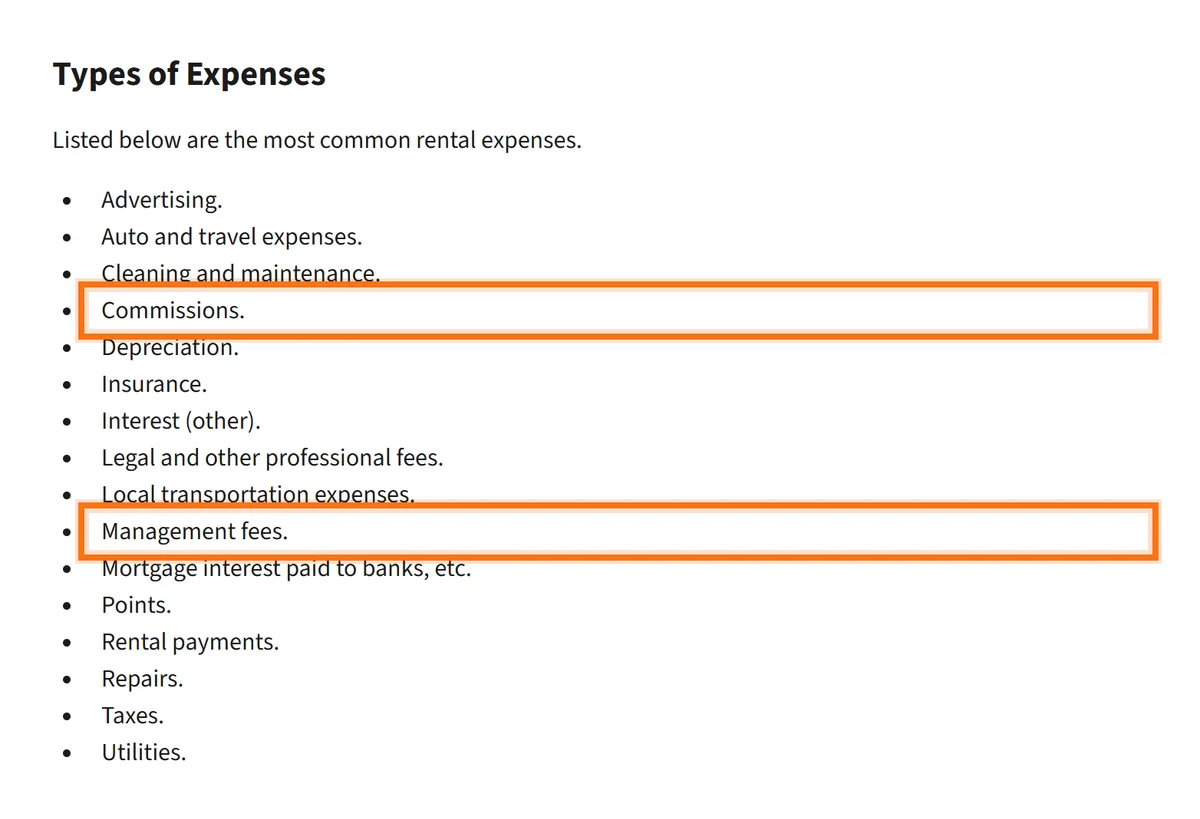
On a management statement, those words cover nearly everything a manager charges an owner:
- The monthly management fee.
- The leasing or tenant placement fee charged when a tenant is placed.
- Renewal fees, inspection fees and any administrative fees on your statement.
- Charges for coordinating maintenance, serving notices or handling an eviction.
The monthly fee goes on line 11 of Schedule E, "Management fees." A placement fee is the kind of charge line 8, "Commissions," exists for, though a preparer may put every manager charge on line 11 instead. Either way the expense is deductible, and which line is your CPA's call. What matters to you is that each charge is visible on a statement.
Timing is simple for most owners. Publication 527 says you generally deduct rental expenses in the year you pay them. The Schedule E instructions add two limits: do not deduct the value of your own labor, and do not deduct amounts paid for capital improvements, which follow the rules in the repairs section below. Our pricing and fees page lists each fee you would see on a Perpetual statement.
The other rental expenses that usually sit beside them
Management fees are one line among many. The common deductible operating expenses for a rental house in Texas generally include:
- Mortgage interest, but not the principal portion of the payment.
- Property taxes, which are a large line for a Tarrant County house.
- Landlord insurance premiums.
- Repairs and routine maintenance, including the vendor invoices your manager paid on your behalf.
- HOA dues, if the house is in an association.
- Utilities you pay during vacancy or by agreement.
- Advertising, screening and legal or professional fees.
- Local transportation to collect rent or to manage or maintain the property. Publication 527 adds a limit: trips between your home and the rental are generally nondeductible commuting unless your home is your principal place of business.
Publication 527 also covers the months with no tenant: if you hold the property for rent, you may be able to deduct the ordinary and necessary expenses of managing, conserving or maintaining it while it is vacant, but not the rent you did not collect.
A good manager's year-end reporting groups most of these for you. What it cannot do is categorize expenses you paid outside the management account, so keep those receipts in one place.
Two lines deserve a closer look. Mortgage interest comes from your lender's annual statement, not from the manager. And the property tax figure should match what the county actually collected, including any adjustment after a protest, which may differ from the escrow amount your lender collected during the year.
Repairs versus improvements: the distinction that trips owners up
A repair keeps the house in its current condition. The Schedule E instructions describe repairs and maintenance as costs that keep the property in an ordinarily efficient operating condition, and give fixing a broken lock or painting a room as examples. Those go on line 14 in the year you pay them.
An improvement is different. Publication 527 says you must capitalize an expense that results in a betterment to the property, restores it, or adapts it to a new or different use. Its table of examples includes a new roof, central air conditioning, a furnace, a water heater, flooring and kitchen modernization, and the Schedule E instructions name replacing an entire HVAC system. Improvements are recovered through depreciation over years, not deducted at once.
The line between the two is where owners most often get it wrong, in both directions. Treating a new roof as a repair invites a problem later. Capitalizing a small fix delays a deduction you could have taken right away. Publication 527 also describes a de minimis safe harbor and a routine maintenance safe harbor that your CPA may elect for you. Your manager's invoices should be itemized clearly enough that the CPA can tell which is which, which is one more reason to insist on original vendor invoices. See repair invoices and photos for owners.
Depreciation in one paragraph
The building, not the land, is depreciated every year, and that deduction goes on line 18 of Schedule E. Publication 527 sets the recovery period for residential rental property at 27.5 years under the general depreciation system, and improvements are depreciated as if they were separate property from the date they are placed in service. You cannot depreciate the cost of land, so the purchase price is split between land and building. If you are not certain of the split, Publication 527 lets you divide the cost based on the assessed values on the real estate tax assessment.
Depreciation can turn a rental that is cash-flow positive into a loss on paper, and it also affects the tax picture when you sell. This is the single most valuable conversation to have with a CPA before the first return, and it is beyond what a property manager should advise on. The mechanics in general terms are in the depreciation overview for Texas landlords.
What a manager can do is make the inputs easy: a clear record of when the house was made available for rent, the make-ready invoices from that period, and an itemized trail of every improvement since. Keep the closing statement from the purchase in the same folder, because the CPA will need it for the land and building split.
The records a manager should hand you
Tax time is simple when the records are already organized. From a properly run management account you should receive:
- A monthly statement showing rent collected, each fee, each repair and the amount sent to you.
- Year-end reporting that totals income and expenses for the year.
- Form 1099-MISC. The IRS instructions for that form say a real estate agent or property manager must use it to report the rent paid over to the property owner. Keep your copy with the return.
- Access to every vendor invoice behind the maintenance lines.
At Perpetual the statements and invoices live in the Owner Portal: income, expenses, invoices and documents in one place. The rent on your statements and the rent on the 1099-MISC should describe the same year, so compare them before the return is filed. How to read a monthly statement line by line is in how to read your monthly owner statement, and the year-end package is covered in year-end reporting for rental owners.
Texas-specific notes
Texas has no state income tax, so the deduction for management fees is taken on your federal return only.
What a Texas rental does carry is property tax, and for a Tarrant County house it is often the largest annual expense after the mortgage. On the federal side, taxes are on the IRS list of common rental expenses and are reported on line 16 of Schedule E. The Texas side of that bill, including the yearly protest, is covered in rental property taxes in Texas and protesting a rental's appraisal in Tarrant County.
If you hold the rental in an entity rather than personally, the forms can change. That is a CPA and attorney conversation before you form anything.
Where owners get it wrong
The mistakes I see are rarely about the rules and almost always about records:
- Mixing personal and rental spending in one account, then trying to separate them in April.
- Losing receipts for expenses paid outside the management account, such as a mower repair or a HOA fine.
- Forgetting that a repair paid from the reserve is still a deductible expense, because it never showed as a disbursement.
- Treating the security deposit as income when it is received. IRS Topic 414 says not to include a deposit in income if you may have to return it; the part you keep is income in the year you keep it.
- Deducting rent a tenant never paid. A cash-basis owner never counted it as income, so Publication 527 says it is not deductible.
- Skipping depreciation without asking a CPA what that does when the house is sold.
If you are converting your own home into a rental, the first year has a few extra steps, covered in converting your primary home into a rental. For what management costs in the first place, see the pricing and fees page and request a free rental analysis for a written quote on your house.
Confirm how any of this applies to you with a CPA. This is general information, not tax advice.
How Perpetual handles this
Perpetual Property Management is broker-owned, with our office at 5755 Rufe Snow Dr in North Richland Hills, and we manage homes in Keller, North Richland Hills, Fort Worth and nearby. Our published plans are 10% of monthly rent on Full Service, 9% on Standard and 7% on Investor Special for portfolios of 5 or more units, and every fee is in the management agreement before you sign. If a fee is not in the agreement, you do not pay it, which also means there is nothing on your statement that your CPA has to guess at.
Monthly statements sit in the AppFolio Owner Portal with income, expenses, invoices and documents in one place. Maintenance coordination is a percentage of the vendor's invoice, and the original invoice is always in the portal, so the repair and the fee can be told apart. Statements and year-end reporting export from the portal, and you can share access or documents with your CPA directly. The rent collection and owner accounting page shows the full process.
For a written quote that lists every fee you would be deducting, request a free rental analysis or call 682-593-7033.
The takeaway: Management fees are a named rental expense on line 11 of Schedule E, and the easiest tax year is the one where your manager's statements are clean enough to hand straight to your CPA.
Questions owners ask
Are property management fees tax deductible for landlords?
Yes. IRS Publication 527 lists management fees among the most common rental expenses, and the Schedule E instructions name them as a deductible ordinary and necessary expense. They are reported on line 11 of Schedule E (Form 1040), generally in the year you pay them. Leasing, renewal and inspection fees are costs of managing the rental too. Confirm the details for your situation with a CPA.
Is the leasing fee deductible in the year I pay it?
Publication 527 says you generally deduct rental expenses in the year you pay them, and the Schedule E instructions list agents' commissions as deductible. Schedule E has line 8 for commissions and line 11 for management fees, and your CPA decides which one a leasing fee belongs on. Keep the statement that shows the charge and the date it was paid.
Does Texas tax rental income?
Texas has no state income tax, so an individual landlord reports rental income on the federal return only, on Schedule E (Form 1040). Property tax on the house is a separate bill from the county, and on the federal return it is a rental expense reported on line 16.
What records do I need from my property manager for taxes?
Year-end reporting that totals rent and expenses, the monthly statements behind it, Form 1099-MISC showing the rent the manager paid over to you, and the vendor invoices behind each repair. At Perpetual, statements, invoices and documents are in the online Owner Portal, and you can share access or documents with your CPA directly.
Can I deduct property management fees on my taxes if I only own one rental house?
Yes. The deduction does not depend on how many rentals you own. Publication 527 covers a single residential rental the same way: management fees are a listed rental expense, reported on line 11 of Schedule E for that property. If you also used the house yourself during the year, expenses are divided between rental and personal use, which your CPA will work out.
Are property taxes on a rental property deductible?
Yes. Taxes are on the IRS list of common rental expenses in Publication 527 and are reported on line 16 of Schedule E. Use the amount actually paid for the year, from the county tax statement, not the escrow amount your lender collected. Charges for local improvements that raise the property's value, such as new streets or sidewalks, are added to basis instead.
Are asset management fees tax deductible?
It depends on what is being managed. A fee paid to manage a rental house is a rental expense on Schedule E, whatever the company calls it. A fee paid to manage a personal investment portfolio is different: IRS Publication 529 lists investment fees and expenses among the miscellaneous itemized deductions that can no longer be claimed. Ask your CPA which one your fee is.
Related services
Property management in Keller, North Richland Hills and Fort Worth. How full-service management works in Tarrant County →