
Key takeaways
- A residential rental building is depreciated over 27.5 years, straight line, under IRS Publication 527.
- Land is never depreciable. If you are not certain of the land and building values, the IRS lets you split the price by the assessed values used for property tax.
- Depreciation starts when the property is placed in service: ready and available for rent, not when the tenant moves in.
- Appliances, carpet and furniture are 5-year property and fences are 15-year property. A new roof goes on its own 27.5-year schedule.
- At sale, depreciation lowers your basis, and IRS Topic 409 taxes the unrecaptured section 1250 gain at a maximum 25% rate.
Depreciation is how the owner of a rental property in Fort Worth, Keller or North Richland Hills recovers the cost of the building: a yearly tax deduction, spread over 27.5 years, taken without any money leaving your account. It is the reason a rental that barely cash-flows can still show a loss on your tax return. It is not optional.
This guide explains how depreciation works on rental property, the IRS rules in one table, how the land and building split is set, what improvements do, and what the bill looks like when you sell. Every rule here comes from irs.gov; your CPA applies them to your return.
Rental property depreciation rules at a glance
These are the rental property depreciation rules from IRS Publication 527, Residential Rental Property, as published for 2025 returns:
| Question | What IRS Publication 527 says | What it means for your rental |
|---|---|---|
| What can be depreciated? | Property you own, use in a rental activity, that has a determinable useful life and is expected to last more than 1 year | The house and what is in it, not the lot |
| Is land depreciable? | No. Land generally does not wear out, become obsolete or get used up | The purchase price has to be split between land and building |
| When does it start? | When the property is placed in service: ready and available for rent | A house ready in July and rented in September starts in July |
| How long for the building? | 27.5 years under the general system, straight line, mid-month convention | About 3.6% of the building basis in each full year |
| Appliances, carpet, furniture | 5-year property | A shorter schedule, if the invoice lists them separately |
| Fences | 15-year property | Listed apart from the building |
| A new roof or an addition | Separate property with the same recovery period as the building, starting when it is placed in service | Its own 27.5-year line on the schedule |
| Where it is reported | Schedule E, line 18, with Form 4562 in the year property is placed in service | Your CPA needs the dates and the invoices |
How to read this table: the middle column is the rule and the right column is what to hand your CPA. The first three rows decide the starting number, and the starting number drives every year after it.
How does depreciation work on rental property?
Tax law treats a rental building as an asset that wears out. You do not deduct the full cost when you buy it. IRS Publication 527 says you recover the cost through yearly deductions, and three factors set the amount: your basis in the property, the recovery period, and the depreciation method. For a residential rental building the recovery period is 27.5 years and the method is straight line, so each full year's deduction is the same.
Here is the point owners miss: depreciation is a non-cash expense. Your tenant pays rent, your manager pays the bills, and the net lands in your bank. Depreciation then reduces the taxable version of that net on paper only. It does not work the other way: Publication 527 says you cannot deduct your mortgage principal payments as an expense.
The clock starts when the property is placed in service, which the IRS defines as ready and available for rent. In its example, a house bought April 6, ready on July 5 and rented from September 1 is placed in service in July.
Depreciation is also not optional in the way people hope. Publication 527 says your basis is decreased by the depreciation you deducted or could have deducted. Skip it and your basis still drops, so the gain at sale is larger and you never got the yearly benefit.
Basis: the number everything starts from
Depreciation is calculated on the property's basis. Publication 527 says the basis of property you buy is usually its cost, plus certain settlement fees and closing costs: abstract fees, charges for installing utility services, legal fees, recording fees, surveys, transfer taxes and title insurance. It also lists what cannot be added: fire insurance premiums, charges connected with getting a loan such as points, the credit report and a lender-required appraisal, and amounts placed in escrow for future taxes and insurance.
The purchase closing statement is the source document. Keep it permanently. If you bought the home years ago and have lost it, the title company or the lender may be able to reproduce it.
For a home you lived in and then converted to a rental, the rule is different. Publication 527 sets the basis for depreciation at the lesser of the fair market value or your adjusted basis on the date of the change. An owner whose home rose in value while they lived in it depreciates from the adjusted cost, not the higher value, and should document the conversion-date value anyway. The guide on converting your home to a rental covers the rest of that transition.
Land does not depreciate: how to split land and building
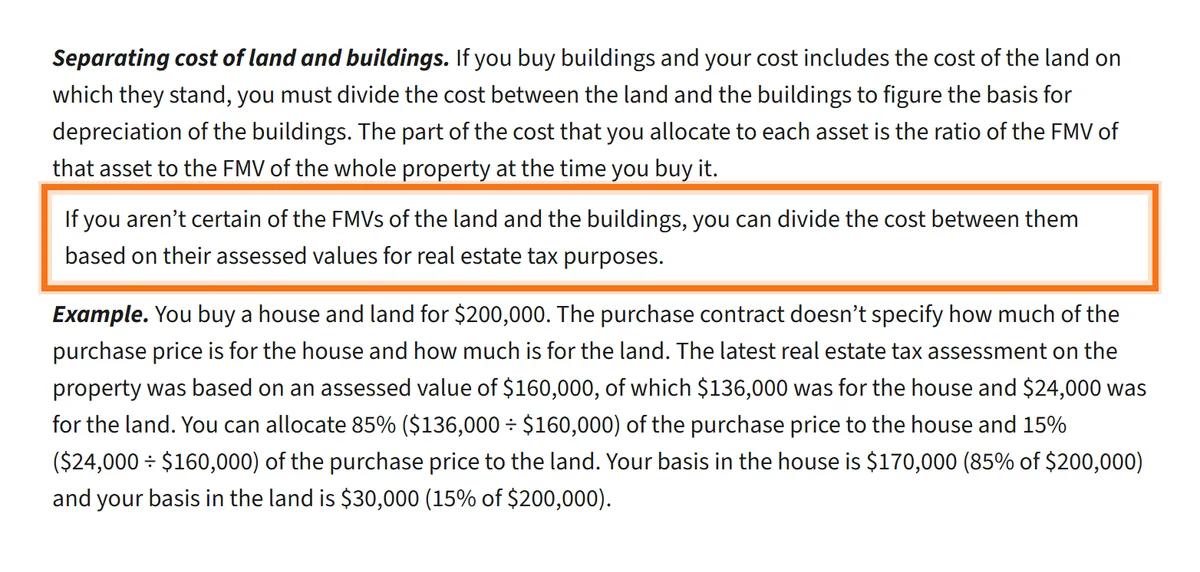
Land does not wear out, so it is not depreciable. Publication 527 requires you to divide the cost between the land and the building, in the ratio of each one's fair market value to the value of the whole property when you buy it. If you are not certain of those values, the IRS says you can divide the cost based on the assessed values for real estate tax purposes.
In Tarrant County, that means the land value and the improvement value on the Tarrant Appraisal District record for the property, applied as a ratio to your actual purchase price. An appraisal at purchase that values the land separately is another route. Whichever you use, write the method down with its source and keep it with the closing statement.
Here is the arithmetic on an illustrative purchase (illustrative numbers only, not tax advice, and closing costs are left out to keep it simple):
| Step | Illustrative number | How it is figured |
|---|---|---|
| Purchase price, house and lot | $300,000 | From the closing statement |
| Appraisal district values | Land $60,000, improvements $180,000 | Improvements are 75% of the $240,000 total |
| Building basis | $225,000 | 75% of $300,000 |
| Land, not depreciable | $75,000 | 25% of $300,000 |
| Depreciation in a full year | About $8,182 | $225,000 divided by 27.5 |
| First year, in service in February | About $7,160 | $225,000 x 3.182%, the IRS table percentage for February |
How to read this table: the land share is what moves the answer. A home on a large lot in an established Keller neighborhood may carry a higher land share than a similar home on a small lot in a newer Fort Worth subdivision, which means less depreciation per year for the same price. That is one reason two homes at the same price produce different after-tax returns, a point developed in how to calculate rental property ROI.
Not everything in the home depreciates at the same pace
The building depreciates over 27.5 years. Publication 527 puts certain items used in a residential rental in shorter classes: appliances, carpeting and furniture are 5-year property, and fences are 15-year property. Structural components such as furnaces and water pipes stay with the building. Landscaping is usually treated as part of the land and is not depreciable.
Identifying the short-life items separately, instead of lumping them into the building, moves more of the deduction into the early years. The information comes from you: a make-ready invoice that lists "new refrigerator, new carpet in three bedrooms, new fence section" lets the CPA classify each piece. One that says "make-ready" does not.
Two more provisions belong with your CPA. Publication 527 describes a de minimis safe harbor election for certain small purchases, and a special depreciation allowance for some property used with residential rentals. The special allowance rules changed during 2025, so ask your CPA whether either applies to you, and do not take a percentage from an old article.
Improvements add to basis and start their own clock
When you replace the roof or build an addition, that cost is generally not deducted in the year paid. Publication 527 says to treat additions and improvements as separate property, with the same recovery period as the building, starting when the improvement is placed in service. A new roof on a rental house therefore starts its own 27.5-year schedule. An expense for repairing or maintaining the property, by contrast, may generally be deducted if you are not required to capitalize it. The sort between them is described in year-end reporting for rental owners.
Practically, each improvement becomes a line on the depreciation schedule with its own date. A CPA maintains it, but only if they know about each item, which means the invoice for every capital project needs to reach them in the year it happened. The IRS says the same thing in one line: separate the costs of repairs and improvements, and keep accurate records.
Depreciation recapture: the bill when you sell
Depreciation lowers your tax each year, and the law collects part of that back when you sell. Publication 527 says depreciation reduces your basis for figuring gain or loss on a later sale. A lower basis means a larger gain, and the part of the gain that comes from the depreciation has its own ceiling: IRS Topic 409 says the portion of any unrecaptured section 1250 gain from selling section 1250 real property is taxed at a maximum 25% rate. Most other long-term capital gain is taxed at 0%, 15% or 20%, depending on income.
Owners sometimes hear this and conclude depreciation is a wash. It is not. The deduction comes now and the tax comes years later, and your basis drops whether you claim the deduction or not. There are also lawful ways to defer the tax, including exchanging into another investment property under the rules described in a 1031 exchange overview.
What recapture does mean is that the decision to sell should be made with a CPA's estimate of the tax in hand.
When the loss depreciation creates can and cannot be used
Depreciation often produces a paper loss on a rental, and whether that loss reduces your other income depends on the passive activity rules. Publication 527 treats rental real estate as a passive activity in most cases, and passive losses generally cannot offset wages or other nonpassive income.
The main exception fits most owners of one or a few rentals. If you actively participated, you may be able to deduct up to $25,000 of rental loss against nonpassive income. The allowance is full at a modified adjusted gross income of $100,000 or less, shrinks above that, and is generally gone at $150,000. Active participation means owning at least 10% and making management decisions such as approving new tenants, deciding rental terms and approving expenditures, so hiring a manager does not by itself take it away.
A loss you cannot use is not lost. Publication 527 says the excess is carried forward to the next tax year. Owners who qualify as real estate professionals, which requires more than 750 hours a year and more than half of their personal services in real property businesses, fall under different rules. Ask a CPA before the year starts, not after it ends.
What to ask a CPA
Bring these to the first meeting, with the closing statement and every improvement invoice:
- How was the land and building split determined, and is it documented?
- What date was the property placed in service?
- Which items are on their own schedule, and did the make-ready items get classified?
- Does my depreciation schedule include every improvement since purchase, with dates?
- Are my rental losses usable in the year they arise, or carried forward?
- If I sold soon, what would the tax on the depreciation be, and what are the options to defer it?
This is general information, not tax advice.
How Perpetual handles the records behind depreciation
We are property managers, not tax advisers. Your CPA handles tax advice and tax treatment; our role is to provide the management records that support that work. For a depreciation schedule, the records are most of the job.
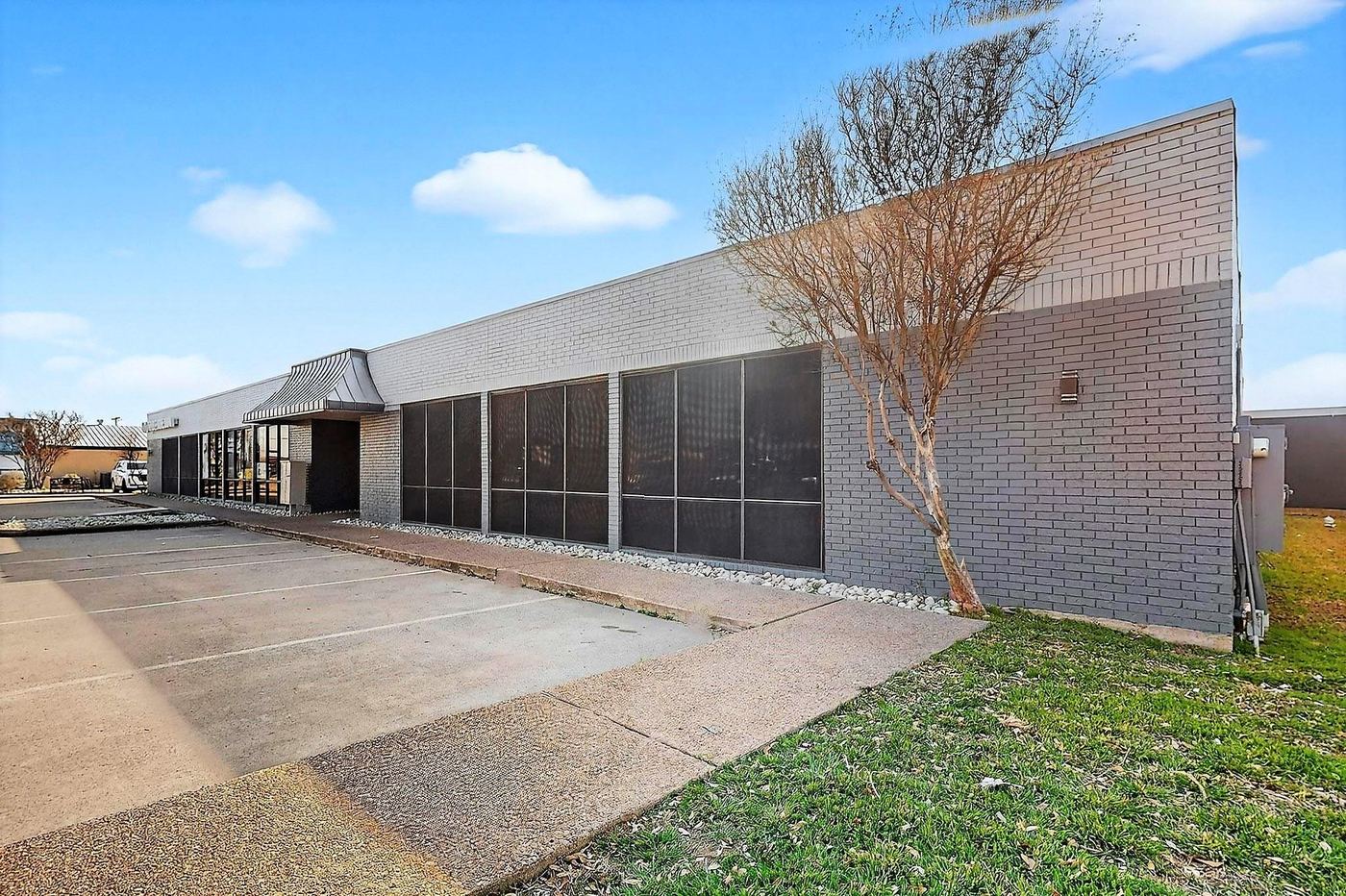
Perpetual Property Management is broker-owned and manages homes in Keller, North Richland Hills, Fort Worth and nearby. Monthly statements in the Owner Portal show income, expenses, invoices and documents in one place. When we coordinate maintenance, the vendor's original invoice is always in the portal, and every completed repair over $500 has photo or video proof. That is what lets a CPA sort a repair from an improvement and date each item.
The maintenance process and the full-service management pages describe the rest. How any single invoice is itemized is something we confirm with you in writing before you sign, so tell us at the start if your CPA wants appliances, flooring and fencing listed separately.
If you want the after-tax picture on a rental you own or are about to buy, start with a free rental analysis or call 682-593-7033.
The takeaway: Set the basis and the land split correctly in year one, itemize every improvement on the schedule, understand that recapture is coming at sale, and let a CPA apply the rates.
Questions owners ask
What is depreciation on a rental property?
Depreciation is a yearly tax deduction that recovers the cost of a rental building over time. Under IRS Publication 527, a residential rental building is depreciated over 27.5 years using the straight line method. It reduces taxable rental income without any cash leaving the owner's account, which is why a rental can show a tax loss while still producing positive cash flow.
Can you depreciate land on a rental property?
No. IRS Publication 527 says you cannot depreciate the cost of land because land generally does not wear out. The purchase price must be divided between land and building. If you are not certain of the fair market values, the IRS allows a split based on the assessed values for real estate tax purposes, which in Tarrant County are on the appraisal district record.
What happens to depreciation when you sell a rental property?
Depreciation reduces the property's basis, which increases the gain on sale. IRS Topic 409 says the portion of any unrecaptured section 1250 gain from selling real property is taxed at a maximum 25% rate. Deferral may be available through a like-kind exchange. A CPA should estimate the tax before you decide to sell.
Is depreciation mandatory on a rental property?
In practical terms, yes. IRS Publication 527 says your basis is decreased by depreciation you deducted or could have deducted. An owner who skips it has a lower basis and a larger gain at sale anyway, without having received the annual deduction, so the schedule should be set up in the first year.
How is depreciation calculated when you convert your home to a rental?
IRS Publication 527 sets the basis for depreciation on a converted home at the lesser of its fair market value or your adjusted basis on the date of the change, and only the house counts, not the land. The property is treated as placed in service on the conversion date. Document the value on that date and keep the purchase records and improvement receipts.
How many years do you depreciate a rental property?
27.5 years for a residential rental building under the general depreciation system, using the straight line method and a mid-month convention, according to IRS Publication 527. Appliances, carpeting and furniture used in the rental are 5-year property, fences are 15-year property, and an improvement such as a new roof is depreciated over 27.5 years from the date it is placed in service.
When does depreciation start on a rental property?
When the property is placed in service, which IRS Publication 527 defines as ready and available for rent. It does not wait for a tenant. In the IRS example, a house bought in April, ready for rent on July 5 and rented from September 1 is placed in service in July. In the first year you claim only the months it was in service.
Property management in Keller, North Richland Hills and Fort Worth. How full-service management works in Tarrant County →