Key takeaways
- Under full-service management, tenants pay the manager, and the manager pays you the balance with a statement.
- In Texas, controlling the acceptance or deposit of rent from a single-family tenant for someone else is real estate brokerage (Occupations Code 1101.002), and it takes a license (1101.351).
- Rent held for you is trust money. TREC Rule 535.146 requires a designated trust account, no commingling with the broker's own funds, and an accounting at least monthly when there is activity.
- A tenant can always find out who owns and who manages the home: Property Code 92.201 requires the landlord to disclose both on request.
- We disburse collected rent to owners by the 10th of each month, or that month's management fee is waived.
Do property managers collect rent? Yes. On a managed rental in Fort Worth, Keller or North Richland Hills, tenants pay rent to the property management company, not to you. From the day management starts, the lease or a written notice tells the tenant to pay the manager, the money lands in a trust account held for your benefit, and you receive the balance after fees and approved bills with a statement that shows every line.
Owners sometimes assume they could keep collecting rent and let the manager do everything else. A few companies will set it up that way, but in full-service management the manager collects, and for reasons that go well beyond convenience.
Where the rent goes on a managed Fort Worth rental, step by step
Here is the path one month's rent takes from the tenant to your bank account, who holds it at each step, and what you can check:
| Step | Who holds the money | What you can check |
|---|---|---|
| 1. Tenant pays, usually online | The manager, for you | The payment on the tenant ledger |
| 2. Deposit into the trust account | The broker's designated trust account; TREC Rule 535.146 sets the deadline at the close of business on the second working day | That the account is a trust account, not an operating account |
| 3. Management fee and approved bills are paid | Paid out of trust, as the management agreement allows | Each fee and invoice as its own line on the statement |
| 4. Reserve is held back | Still in trust, still your money | The reserve balance carried forward |
| 5. Balance is sent to you | Your bank account | The date against the one in your agreement |
| 6. Security deposit | In trust for the whole lease; it is the tenant's until move-out | The deposit balance; Property Code 92.103 gives 30 days to refund after move-out |
How to read this table: the money is yours or the tenant's at every step, never the manager's, until a fee the agreement allows is taken at step 3. The right column is your monthly check. If one of those items is missing from your statement, ask about that item by name.
Why the manager collects, not the owner
Three things only work when one party holds the money. The ledger has to be the single source of truth. If the tenant pays you one month and the manager the next, nobody can say with certainty what is owed, and the first time rent is late the manager cannot act because the record is split.
Second, enforcement needs clean evidence. A notice to vacate for nonpayment, and any case that follows in Justice Court, rests on a ledger that shows the due date, the amount, the payments received and the dates. A manager who did not receive the money cannot stand behind that record.
Third, the manager is accountable for the money only if the manager handles it. When rent comes to you, the manager cannot pay the plumber, hold the reserve or send a statement that matches reality. Collection is the job, and everything else in rent collection depends on it.
Where the money sits before it reaches you
In Texas, collecting rent on a house for someone else is a licensed activity. Occupations Code 1101.002 puts a person who "controls the acceptance or deposit of rent from a resident of a single-family residential real property unit" in the definition of a broker, and 1101.351 bars acting as a broker without a license. An owner collecting rent on their own house needs no license. A company doing it for you does.
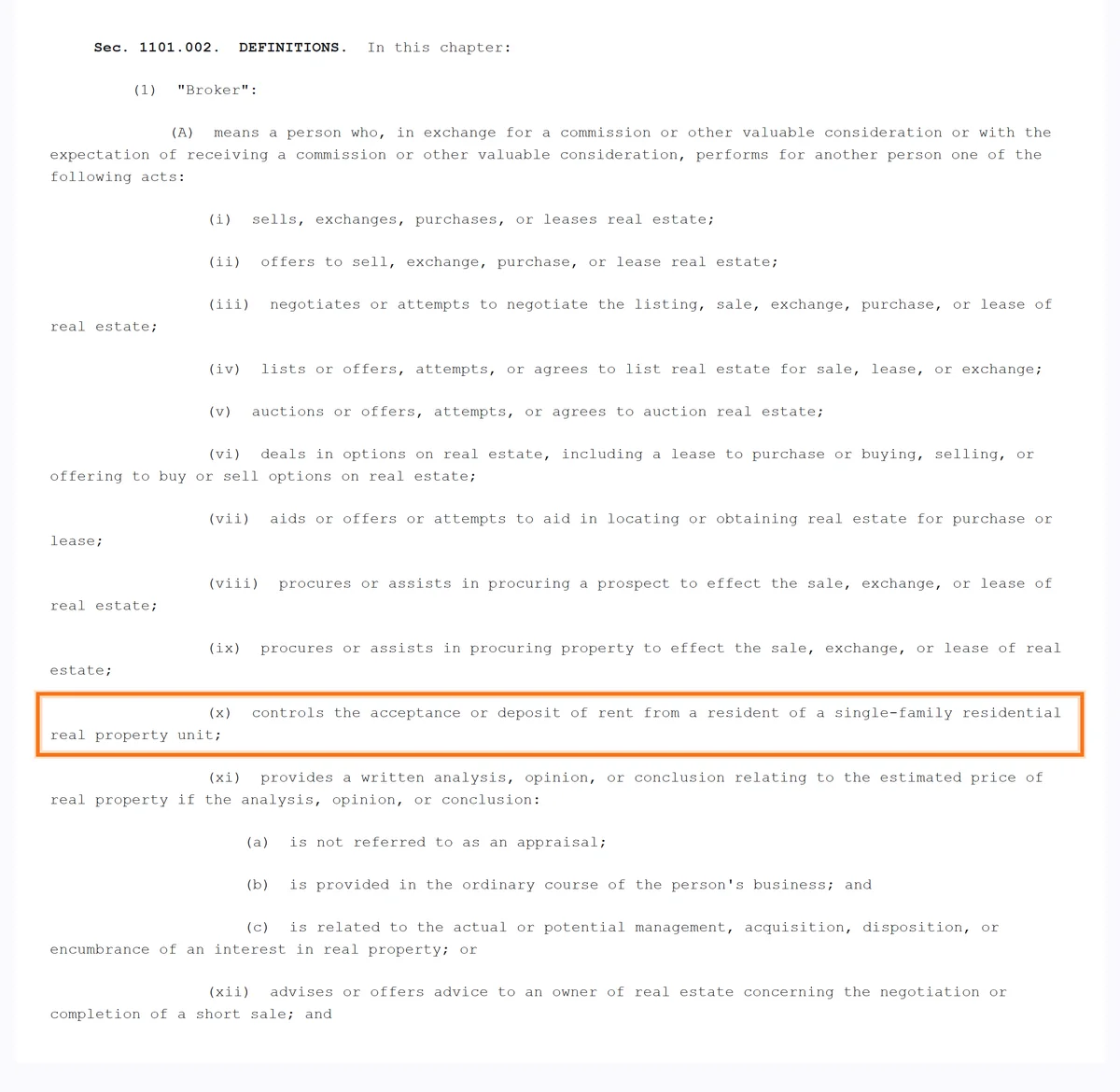
The license comes with rules about the money. Texas Real Estate Commission Rule 535.146 defines rent and security deposits held for others as trust money. It must sit in a designated trust account, deposited no later than the close of business on the second working day after the broker receives it unless a different time is agreed in writing, and it may not be mixed with the broker's personal or operating funds. The broker must also give each owner an accounting at least monthly if there has been any activity.
The trust account is also why the security deposit is not sitting in your checking account. The deposit belongs to the tenant until the lease ends and deductions are itemized, so it is held in trust and tracked on its own line. The guide on owner reserves and disbursements shows the whole flow, including the reserve the manager holds back for repairs.
A fair question for any company you interview: which bank holds the trust account, who reconciles it and how often. A straight answer takes ten seconds. A vague one tells you something.
How the tenant pays
Most tenants pay through an online portal by bank transfer or card, with the payment posting to their ledger. Some companies also accept money orders or payments at a retail location for tenants who do not use online banking. Cash is generally refused, because it cannot be traced and it invites disputes about who received what.
The tenant sees their own balance, the due date, any late fee that has posted and a receipt for each payment. That transparency matters more than it sounds. A tenant who can see the ledger rarely argues about it, and a tenant who is falling behind cannot claim surprise.
What the tenant should never have is a way to pay you. If a tenant texts asking where to send rent, the answer is the portal. Accepting a payment yourself, even once, muddies the record and can complicate a notice the manager has already served. Send the tenant back to the manager and let the ledger stay whole.
A tenant who wants to know who is on the other end of the payment has a right to ask. Property Code 92.201 requires a landlord to disclose, on request, the name and address of the record owner and of the off-site company primarily responsible for managing the home.
What comes out before you are paid
Rent does not pass straight through. Once it clears, the manager applies it to the tenant's ledger, then handles the owner's side in a set order that your management agreement spells out. Typically that is the management fee, any repair invoices approved that month, any reserve top-up, and then the disbursement to you.
An example with made-up numbers: say rent is $1,900 and a plumber was paid $240 that month. The statement shows $1,900 received, the fee and the $240 as separate lines, the reserve balance carried forward and the net amount sent to your bank. Nothing is netted silently. If a line looks wrong, you ask about that line, not about a lump sum. Reading those lines quickly is a skill worth having, and how to read your monthly owner statement walks through one line by line.
Every fee that can appear on that statement should have been in writing before you signed. If it was not on the pricing and fee schedule you were shown, it should not be on the statement.
The exception: owner collects, manager does the rest
A few companies will lease and maintain a property while the owner keeps collecting rent. It is a real arrangement with real trade-offs, covered in leasing and repairs with the owner collecting rent. The short version: it can save a little on fees, and it costs you the enforcement and accounting benefits above, because the manager no longer holds the record.
Here is the scenario that makes owners switch back. An owner collects rent directly. The tenant pays half by app on the fifth and promises the rest. The owner, not wanting to be difficult, says fine. By the time the manager hears about it, a partial payment has been accepted with no written agreement, the late fee was never charged, and the lease's rule on partial payments has been quietly waived. The next late month is harder to act on. When the manager collects, that conversation never reaches the owner, because the tenant knows the owner is not the one to call.
If you are weighing full service against a lighter arrangement, a written quote that lists every fee makes the comparison honest. Ask for one before deciding.
How Perpetual handles this
Perpetual Property Management is broker-owned, with our office at 5755 Rufe Snow Dr in North Richland Hills, and rent for the homes we manage in Keller, North Richland Hills and Fort Worth is paid to us. Tenants pay online through the tenant portal, by bank transfer or card, with automatic receipts. The late process is the same for every tenant: reminders, late fees applied per the lease, and documented escalation.
Rent we collect is disbursed to you by the 10th of each month. If it is not, that month's management fee is waived under The Perpetual Promise, subject to its Guarantee Addendum. Your monthly statements, documents and disbursement history are in the owner portal, which runs on AppFolio, and the original vendor invoice is always there when we coordinate a repair.
Before you sign, you get a written quote with every fee listed, and if a fee is not in the management agreement, you do not pay it. If a tenant ever contacts you about rent, send them to us at 682-593-7033 and we handle it under the lease.
The takeaway: Rent goes to the manager so that one ledger, one trust account and one statement tell the whole story, which is exactly what you need the day a tenant pays late.
Questions owners ask
Can I keep collecting rent myself and hire a manager for everything else?
Some companies offer leasing and maintenance without rent collection. You save a little on fees but lose the manager's ability to enforce the lease, because the payment record sits with you. If you want the manager to handle late rent and notices, the manager needs to collect.
What happens if the tenant pays me by mistake?
Tell the manager the same day and either forward the funds or ask how they want it recorded. Do not treat it as handled. An unrecorded payment can leave the ledger showing rent unpaid or a late fee charged in error, and either one creates a dispute later.
Is my rent money safe in the manager's trust account?
In Texas, rent and deposits a broker holds for others are trust money. TREC Rule 535.146 requires a designated trust account, bars commingling with the broker's own funds, and requires an accounting to each owner at least monthly when there has been activity. The money belongs to you, not the manager. Ask who reconciles the account and how often, and ask to see a sample statement.
Does the security deposit also go to the manager?
Yes, under full-service management the deposit is collected and held in trust by the manager, not sent to you. It stays the tenant's money until move-out, when deductions are itemized and the balance is refunded, which Property Code 92.103 requires on or before the 30th day after the tenant surrenders the home. Keeping it in trust protects you if the deposit ever has to be accounted for.
Do property managers collect rent?
Yes. Under full-service management the property manager collects rent from the tenant, deposits it in a trust account, pays the management fee and any approved bills, and sends the owner the balance with a monthly statement. At Perpetual, tenants pay online by bank transfer or card, and collected rent is disbursed to owners by the 10th of each month.
Does a property manager need a license to collect rent in Texas?
Yes, when it is someone else's house. Occupations Code 1101.002 includes controlling the acceptance or deposit of rent from a resident of a single-family rental in the definition of a broker, and 1101.351 prohibits acting as a broker without a license. An owner collecting rent on their own property does not need one.
Related services
Property management in Keller, North Richland Hills and Fort Worth. How full-service management works in Tarrant County →