Key takeaways
- Income is verified in two layers: documents from the applicant, then a confirmation with the employer through a contact you find yourself.
- A verification call to a phone number the applicant supplied is not a verification.
- Texas Property Code 92.3515 requires the landlord to make printed tenant selection criteria, including current income, available with the application.
- Our published criteria: income at least 3 times the rent, pay stubs covering a minimum of 6 weeks, 2 months of bank statements, and only the 2 highest earners counted.
- If a screening report leads to a denial, a co-signer requirement or a larger deposit, federal law requires an adverse action notice.
A property manager verifies income and employment in two layers: documents from the applicant, and an independent confirmation that does not rely on anything the applicant handed over. For a rental in Fort Worth, Keller or North Richland Hills, the documents are recent pay stubs, a new-job offer letter, bank statements showing deposits, or tax returns for someone self-employed. The confirmation is a call or written request to the employer at a number the manager finds independently.
The second layer exists because the first is easy to fake. A pay stub can be built from a template, and a phone number listed as "HR" on the application may ring a friend. This guide covers what to collect, what to ask the employer, how the ratio is applied and what Texas and federal law require along the way.
How to verify income, by how the applicant earns it
Here is what to collect for each kind of income, and how each one is confirmed independently of the applicant:
| How the applicant earns | Documents to collect | How it is confirmed | What to watch for |
|---|---|---|---|
| Salary or hourly wages | Recent pay stubs with employer name, pay period and year-to-date totals, plus bank statements | Call or write to the employer at a number from the company website, or use the employer's verification service | Year-to-date totals that do not add up across consecutive stubs; deposits that do not match net pay |
| New job or relocation | Signed offer letter with start date and pay | Confirm the offer with the employer's HR department | A start date after the move-in date |
| Self-employed or commission | Tax returns and recent bank statements | Compare deposits over several months with the returns | One strong month presented as the norm |
| Retirement or benefits | Award letter or benefit statement, plus bank statements | Match the stated amount to the deposits | An expired or outdated letter |
How to read this table: the third column is the part that cannot be skipped. A document proves only that a document exists, so every row needs a confirmation the applicant did not control. If none is possible, treat the income as unverified.
The documents a manager asks for
The document set depends on how the applicant earns a living. For a salaried or hourly employee: recent pay stubs showing employer name, pay period and year-to-date totals. Our own published criteria ask for pay stubs covering a minimum of 6 weeks and 2 months of bank statements, and state that screenshots of balances are not accepted. For someone starting a new job: a signed offer letter on company letterhead with start date and compensation. For self-employed or commission-based applicants: the last two years of tax returns and recent bank statements. For retirees and others with non-wage income: award letters, benefit statements or investment account statements.
A manager reads these for internal consistency before verifying anything externally. Year-to-date totals that do not add up across consecutive stubs, a round-number net pay, tax withholding that does not match the gross, or a stub that lists an employer at an address that does not exist are all signs the document was built rather than issued. How fakes are detected, and how self-employed and overseas applicants are handled, is covered in fake pay stubs, self-employed and overseas applicants.
Direct employer verification, found independently
The manager confirms employment with the employer, and the important word is independently. The number comes from the company's website, a business directory or a verification service, not from the application. For larger employers, verification often runs through an automated employment verification service that reports employer, title, start date and sometimes pay. For smaller companies, it is a phone call to the office or an email to a company domain, asking whether the applicant works there, in what role, since when, and whether employment is expected to continue.
Employers do not always disclose pay, and some will only confirm dates and title. That is fine; the pay stubs and bank statements carry the income number, and the employer confirms the job is real. A verification that goes to a cell number supplied by the applicant is not a verification.
Questions to ask when verifying employment for a rental
These are the questions to ask when verifying employment for a rental application, and what each answer tells you:
| Question for the employer | Why you ask it |
|---|---|
| Does this person currently work for you? | Confirms the job is real and has not ended since the last pay stub |
| What is the job title, and is it full time or part time? | Checks the application against the employer's own record |
| What was the start date? | A start date that conflicts with the stubs or the application is a reason to look closer |
| Is the position temporary, seasonal or expected to continue? | Income has to be expected to last for the lease term |
| Can you confirm the pay rate or salary? | Many employers decline; the stubs and bank statements then carry the number |
| For an offer letter: is the offer still in effect, and what is the start date? | An offer can be withdrawn or delayed before move-in |
How to read this table: the first four questions are the ones most employers will answer, and they are enough to confirm the job. Write down who you spoke to, the number you called and the date, and keep it with the application.
Bank-linked income verification
Many screening platforms now offer bank-linked verification: the applicant logs in to their bank through a secure connection and the platform reports recurring deposits, their source and their regularity, without the manager seeing the account itself. It is harder to fake than a pay stub, it captures income the stubs miss, such as a second job or regular freelance deposits, and it shows whether the stated pay actually lands in an account.
Where it is offered it is optional, and some applicants decline it, which is their right. A declined bank link simply means the manager leans harder on documents and direct verification. Full bank statements do much of the same work on paper, which is why our published criteria ask for 2 months of them. The full screening sequence this fits into is in how tenant screening works.
Applying the income-to-rent ratio
Verified income is then measured against the ratio in the written criteria, which states how many times the monthly rent an applicant's gross monthly income must be. The manager uses gross income, counts only income that is documented and expected to continue, and combines the income of all adult applicants on the lease when the criteria allow it. One-time bonuses, undocumented cash and a roommate who is not applying do not count.
Our published criteria set the ratio at 3 times the rent and count income from only the 2 highest earners toward it, so four roommates cannot stack four small incomes to qualify.
Borderline cases are handled by the criteria, not by negotiation: a stated alternative such as a guarantor or, where policy allows, a larger deposit. If that condition is imposed because of a screening report, it triggers the federal adverse action notice described below. What ratio is reasonable for this market, and why, is the subject of how much income a tenant should have compared with the rent.
New jobs, relocations, self-employment and gaps
Some applicants are strong but do not fit the standard document set. A relocating employee with an offer letter has no local stubs; the offer letter is verified with the employer's HR, and the start date is checked against the move-in date. A self-employed applicant shows income through tax returns and bank deposits rather than stubs, and the manager looks at consistency over time rather than a single good month. An applicant between jobs may have savings; some criteria accept documented liquid funds covering a stated number of months of rent, others do not.
Each of these is a situation the written criteria should already address, so the manager applies a rule rather than making one up. If the criteria are silent, the honest answer is to update them for everyone, not to improvise for one applicant. Our tenant screening service page describes what we verify on every adult applicant, and how property managers screen self-employed tenants goes deeper on that case.
What income verification cannot tell you
Verified income shows the applicant can afford the rent today. It does not show that they will choose to pay it, which is what rental history and the credit report address, and it does not guarantee the job lasts. That is why income is one check among several rather than the decision by itself. An applicant with a strong income and a prior eviction for non-payment is a worse risk than one with a thinner income and years of on-time rent.
For the owner, the practical takeaway is to ask a manager not what ratio they use but how they verify the number that goes into it. The ratio is only as good as the verification behind it. Once a tenant is in place, collection is its own process, described on the rent collection service page.

What Texas and federal law require around income screening
Income screening is mostly a matter of your own written criteria, but four rules frame it.
- Printed criteria (Texas Property Code 92.3515). When an applicant is given a rental application, the landlord must make available printed notice of the tenant selection criteria and the grounds for denial, including current income. The applicant signs an acknowledgment. If the landlord rejects an applicant without having made the notice available, the application fee and any application deposit must be returned.
- Seven days (92.352). An applicant is deemed rejected if the landlord does not give notice of acceptance on or before the seventh day after a completed application is submitted.
- Bad-faith refunds (92.354). A landlord who in bad faith fails to refund an application fee or deposit in violation of the subchapter is liable for $100, three times the amount wrongfully kept and the applicant's reasonable attorney's fees.
- Adverse action notice (federal Fair Credit Reporting Act). The Consumer Financial Protection Bureau explains that a landlord who denies an application because of information in a tenant screening report must tell the applicant, name the company that supplied the report and explain the right to a free copy and to dispute errors. Requiring a co-signer or a larger deposit for that reason counts too.
One more Texas rule concerns the source of income. Under Local Government Code 250.007, a city or county may not adopt an ordinance that prohibits an owner from refusing to rent to a person because the person's lawful source of income includes funding from a federal housing assistance program. The same section leaves in place ordinances that protect military veterans. Federal and Texas fair housing law still apply to every decision; fair housing for Texas landlords covers that side. This is general information, not legal advice.
How Perpetual handles this
Our rental criteria are published at perpetualpm.com/rental-criteria and applied to every applicant without exceptions. On income they say:
- Income must be at least 3 times the rent.
- Verifiable proof of income is required: pay stubs covering a minimum of 6 weeks and 2 months of bank statements. Screenshots of balances are not accepted.
- Income from only the 2 highest earners is counted toward the 3 times requirement.
- Each resident over 18 submits a separate application, and the fee is $60 per applicant.
- Insufficient or unverifiable income is a listed cause for rejection, and so is falsification of any kind on the application.
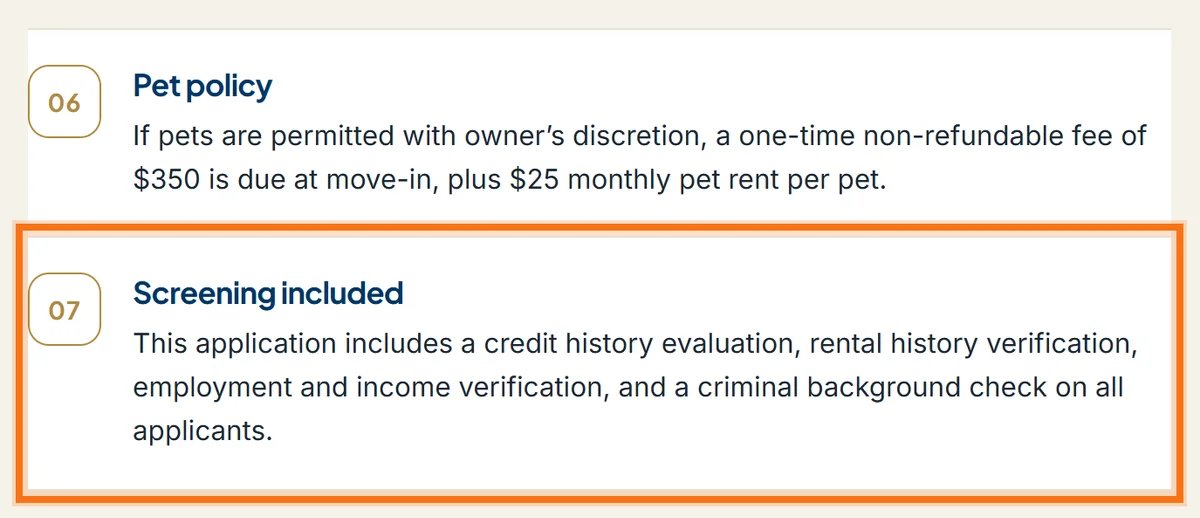
Employment is verified with the employer, and documented income is measured against the written ratio, not taken from a pay stub at face value. Screening typically takes 1 to 3 business days once a complete application is in, because verification with employers and previous landlords is the part that takes time.
We are broker-owned, with our office at 5755 Rufe Snow Dr in North Richland Hills, and we manage homes in Keller, North Richland Hills, Fort Worth and nearby. Screening sits inside our leasing service, and every fee connected to it is listed in your written quote before you sign anything. To talk through how applicants would be screened for your rental, call 682-593-7033.
The takeaway: To verify tenant income, read the documents critically, confirm the job with the employer at a number you found yourself, and measure the result against written criteria that are the same for every applicant.
Questions owners ask
What if an applicant's employer refuses to verify employment?
Some companies confirm only through an automated service, and some confirm nothing by phone. The manager uses the automated service where it exists, asks the applicant for an HR contact on a company email domain, and leans on pay stubs, bank statements and bank-linked verification. If no independent confirmation of any kind is possible, that is a gap the criteria should treat as unverified income.
Do property managers count income from a roommate who is not on the lease?
No. Only adults who apply, are screened and sign the lease have their income counted, because only they are obligated to pay. A roommate who is not on the lease can leave at any time, and the remaining tenant is then responsible for the full rent alone. Under our published criteria every resident over 18 submits a separate application, and income from only the 2 highest earners counts toward the 3 times rent requirement.
Can an applicant use savings instead of income to qualify?
Some criteria allow documented liquid savings covering a set number of months of rent as a substitute or supplement, often for retirees, people between jobs or applicants relocating with a sale behind them. Others do not. Whichever rule applies must be written in the criteria and offered to every applicant in that position, not negotiated case by case. Our published criteria state an income requirement and do not list a savings alternative, so ask us before you apply.
How is income verification conducted directly from an employer?
The manager contacts the employer through a number or address found independently, such as the company website, never one taken from the application. Large employers often answer through an employment verification service. Smaller ones answer by phone or from a company email address. The employer confirms that the person works there, the title and the start date, and sometimes the pay. Pay stubs and bank statements carry the income figure when the employer will not disclose it.
What questions should you ask when verifying employment for a rental?
Ask whether the applicant currently works there, the job title and whether it is full time or part time, the start date, whether the position is temporary or expected to continue, and the pay rate if the employer will share it. For a new job, ask whether the offer is still in effect and when it starts. Record who answered, the number you called and the date.
How much income does a tenant need to rent a Perpetual-managed home?
At least 3 times the monthly rent, shown with pay stubs covering a minimum of 6 weeks and 2 months of bank statements. Income from only the 2 highest earners is counted. The criteria are published on our rental criteria page and are the same for every applicant.
Related services
Property management in Keller, North Richland Hills and Fort Worth. How full-service management works in Tarrant County →