
Key takeaways
- No Texas statute sets how much income a tenant must have. The standard comes from the landlord's written tenant selection criteria.
- Perpetual's published criteria: income of at least 3x the rent, from only the 2 highest earners.
- Proof matters as much as the number: pay stubs covering at least 6 weeks and 2 months of bank statements. Screenshots of balances are not accepted.
- Property Code 92.3515 requires the criteria, including current income, to be made available with the rental application. Skip that and a rejected applicant gets the application fee back.
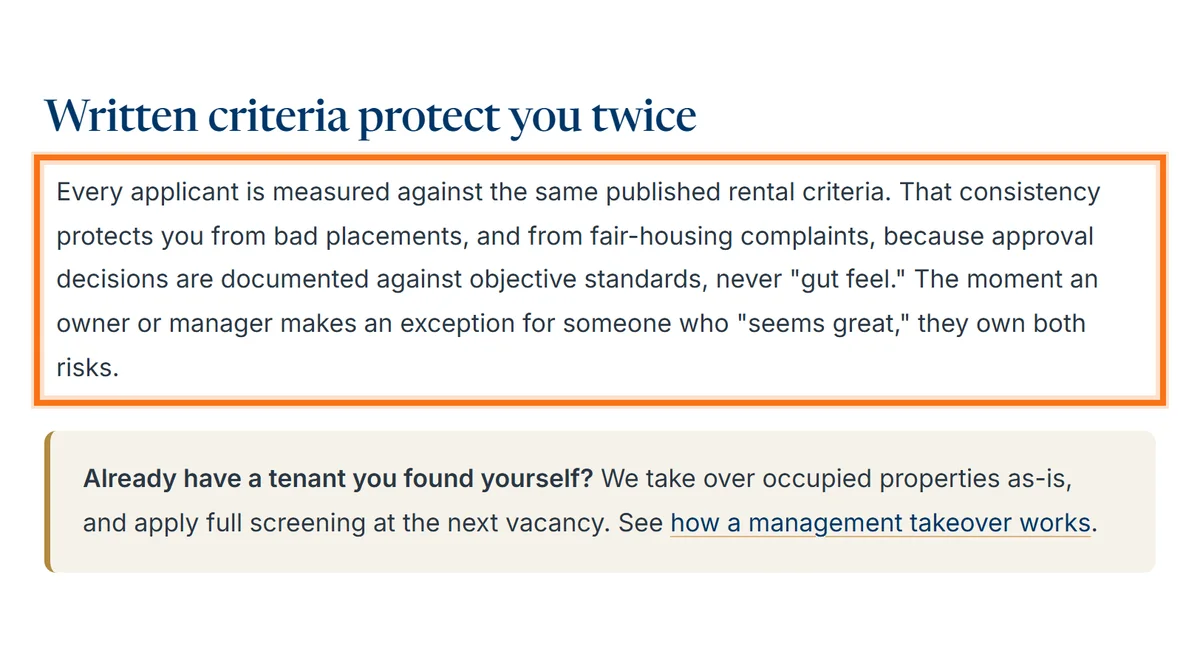
- Decide the multiple once, in writing, and apply it to everyone. Never decide it applicant by applicant.
For a rental in Fort Worth, Keller or North Richland Hills, the usual answer is three times the rent: a tenant applying for a $2,000 home should show $6,000 of verified gross income a month. No Texas law sets that number. It is a standard the landlord writes down before listing, and our own published criteria use it: income of at least 3x the rent, counting only the 2 highest earners.
The harder questions are what counts as income, whose income counts, what proof to ask for, and what Texas requires you to disclose. This guide answers each one.
How much tenant income 3x the rent means, by rent level
This table shows the gross income a household needs to meet a 3x standard at four rent levels (illustrative arithmetic, not a quote of market rents):
| Monthly rent | Income needed each month at 3x | Same figure per year | Share of income that goes to rent |
|---|---|---|---|
| $1,600 | $4,800 | $57,600 | One third |
| $2,000 | $6,000 | $72,000 | One third |
| $2,400 | $7,200 | $86,400 | One third |
| $3,000 | $9,000 | $108,000 | One third |
How to read this table: find the rent you plan to ask and read across. The income column is the floor an applicant must document, before taxes. If few households in the neighborhood earn that figure, the rent or the vacancy will have to give, which is why rent and income standard are set together.
Why the standard is a multiple of rent
The multiple exists because rent is only one bill. A household earning exactly the rent cannot pay it, and a household earning twice the rent is one car repair away from a late payment. At three times, rent takes about a third of gross pay, which leaves room for taxes, food, transport and the surprises every household meets.
The multiple is a floor, not a target. An applicant comfortably above it is a stronger approval, and an applicant exactly at it is where the rest of the file, especially rental history and credit, decides. What you cannot do is decide the number applicant by applicant. The full set of standards, and how they interact, is in tenant screening criteria in Texas.
What Texas law says about an income requirement
We know of no Texas statute that sets a rent-to-income ratio for a private rental. What Texas regulates is how you tell applicants about it. Under Property Code 92.3515, when an applicant is given a rental application the landlord must make available printed notice of the tenant selection criteria and the grounds for denial, and the statute lists "current income" among them. The applicant signs an acknowledgment. If you reject an applicant without having made that notice available, you must return the application fee and any application deposit (92.3515(e)).
Two more rules shape the process:
- Seven days. An applicant is deemed rejected if the landlord has not given notice of acceptance by the seventh day after a completed application is submitted (Property Code 92.352).
- Fair housing. The same written standard has to be applied to every applicant. An income rule that moves from one applicant to the next is the kind that draws a complaint.
This is general information, not legal advice.
What counts as income, and what does not
Only income that is verified and expected to continue should count toward the multiple. The written criteria should say what qualifies so nobody improvises.
- Counts: salary or hourly wages confirmed by pay stubs and the employer; self-employment income shown over several months of statements; retirement, disability and Social Security income shown on award letters; court-ordered support with a record of actual receipt.
- Counts with care: overtime, commission and bonuses, averaged over time rather than taken from one strong month.
- Does not count: a one-time gift, a loan, a savings balance, income from a job the applicant is leaving, or anything that cannot be verified.
Proof is half the standard. Our published criteria require pay stubs covering a minimum of 6 weeks and 2 months of bank statements, and state that screenshots of balances are not accepted. How each type of income is checked is covered in how a manager verifies an applicant's income and employment and verifying pay stubs, self-employed and overseas applicants.
Whose income is combined
Written criteria have to say whose income is added together, because households differ. Some landlords combine every adult on the lease. Our published criteria are stricter: income from only the 2 highest earners is counted toward the 3x requirement. A house rented to four adults who each contribute a little is a house whose rent depends on four people staying.
Here is how that rule works on a $2,000 rent, where the standard is $6,000 a month (illustrative only):
| Household | Income counted | Result at 3x of $2,000 |
|---|---|---|
| One earner at $6,200 | $6,200 | Meets the standard |
| Two earners at $3,500 and $3,000 | $6,500 | Meets the standard |
| Three roommates at $2,500 each | $5,000 (the two highest) | Does not meet it, although the household earns $7,500 |
How to read this table: the third row is the one owners do not expect. Under a two-highest-earners rule, a larger household does not qualify just by adding people.
Every adult still applies and is screened individually, and meeting the income number does not erase a problem elsewhere in the file: income and rental history are separate criteria. Who signs what is covered in roommates, co-signers and occupants.

When the multiple is met but the budget is not
Gross income is the standard because it can be verified, but it is not what the tenant lives on. A household at three times the rent with two car loans and credit card minimums may have less left over than a household just under the line with no debt. That is why income is never the only criterion: the credit history evaluation shows how the applicant has handled obligations over time.
If you want debt to count formally, write the rule, for example a limit on rent plus listed monthly debt payments as a share of gross income, and apply it to everyone. What a landlord should not do is quietly deny a high-debt applicant who met the published standard, because an unwritten rule is the kind that gets challenged.
Housing vouchers and assistance income
When a housing authority pays part of the rent, the tenant's share is what the tenant has to afford, and many criteria measure the multiple against that share. Decide which way your criteria work and write it down.
Whether to accept vouchers at all is a separate decision. Texas Local Government Code 250.007(a) says a city or county may not adopt or enforce an ordinance that prohibits an owner from refusing to rent to a person because the person's lawful source of income includes funding from a federal housing assistance program. Subsection (b) keeps local ordinances that protect a military veteran's source of income. The details are in housing vouchers and your Texas rental.
This is general information, not legal advice; ask an attorney how your criteria should treat assistance income.
Setting the standard for your house
Decide the income multiple at the same time as the rent, because the two move together. Set the rent too high and the pool of applicants who clear the multiple shrinks until the house sits. The rental analysis is the moment to settle both.
Ask any manager three things: what multiple their criteria use, what counts as income and whose, and where the criteria are published. Our rental pricing service page explains how the rent is set from leased comparables.
How Perpetual handles this
Perpetual Property Management is broker-owned, with an office in North Richland Hills and homes under management in Keller, North Richland Hills, Fort Worth and nearby. Our rental criteria are published and applied to every applicant:
- Income of at least 3x the rent.
- Income from only the 2 highest earners counts toward that requirement.
- Verifiable proof: pay stubs (minimum 6 weeks) and 2 months of bank statements. Screenshots of balances are not accepted.
- A separate application from every adult, at $60 per applicant, with credit history, rental history, employment and income verification and a criminal background check.
- "Insufficient or unverifiable income" is a published cause for rejection.
The published criteria do not address every case: a guarantor, a signed job offer, prepaid rent, or how the multiple is measured when a voucher pays part of the rent. How those are handled for your home is confirmed in writing before you sign. The tenant screening page shows what we verify for every adult. To settle the rent and the income standard together, request a free rental analysis or call 682-593-7033.
The takeaway: Set the income multiple in writing before you list, count only verified income, decide in advance whose income counts, and apply the same rule to every applicant.
Questions owners ask
Should the income standard use gross or net income?
Gross income is the usual basis because it is what pay stubs, tax returns and employers confirm, while net pay varies with withholdings and benefits that have nothing to do with ability to pay rent. Using gross consistently keeps the rule simple to verify and to apply. The credit history shows the monthly obligations that separate gross pay from what the household keeps.
Can I count a job offer letter as income if the applicant has not started yet?
Only if your written criteria say so. Some landlords accept a signed offer letter from an identifiable employer, confirmed with the employer, with a near start date. The risk is that the job falls through after move-in. Perpetual's published criteria ask for pay stubs covering at least 6 weeks and 2 months of bank statements and do not mention offer letters, so ask us about a relocating applicant before you count on it.
What if an applicant offers to prepay several months of rent to make up for low income?
Prepaid rent reduces risk for the months it covers and does nothing for the months after, when the same shortfall returns. It is not a substitute for the income standard. If you want to allow it, write it into the criteria as a condition that applies to everyone, and ask your manager how prepaid rent would be held and accounted for before agreeing.
Does the income standard apply to a guarantor the same way?
Only as the written criteria provide. Landlords that accept guarantors often hold them to a higher multiple than a tenant, because the guarantor is paying for their own housing too, and verify the guarantor's income the same way. Perpetual's published rental criteria do not mention guarantors, so do not assume one is accepted: ask before the applicant applies.
Is the 3x rent rule a law in Texas?
No. We know of no Texas statute that sets a rent-to-income ratio for a private rental. The rule comes from the landlord's own tenant selection criteria. What Property Code 92.3515 requires is that those criteria, including current income as a ground for denial, be made available in print when the applicant receives the rental application. If they were not and the applicant is rejected, the application fee must be returned.
Is tenant income combined for roommates or a couple?
It depends on the written criteria. Some landlords add up every adult on the lease. Perpetual's published criteria count income from only the 2 highest earners toward the 3x requirement, so a couple is combined, but three roommates are measured on the two largest incomes. Every adult still submits a separate application and is screened individually.
What proof of rent income does a tenant have to show?
Whatever the written criteria list. Perpetual's published criteria require verifiable proof of income: pay stubs covering a minimum of 6 weeks and 2 months of bank statements. Screenshots of balances are not accepted, and insufficient or unverifiable income is a listed cause for rejection. Employment and income verification is part of every application.
Related services
Property management in Keller, North Richland Hills and Fort Worth. How full-service management works in Tarrant County →