Key takeaways
- Screening stays your job: under 24 CFR 982.307 the owner, not the housing authority, is responsible for screening and selecting the tenant.
- The authority must inspect the home and find the rent reasonable before it approves the tenancy (24 CFR 982.305).
- You use your normal lease plus the HUD tenancy addendum, and sign a housing assistance payments (HAP) contract with the authority (24 CFR 982.308, 982.451).
- Texas does not require private landlords to accept vouchers, and cities and counties may not require it either, except to protect military veterans (Local Government Code 250.007).
- The authority pays only its share. The tenant's share is collected like any other rent.
A housing voucher pays part of a tenant's rent directly to the owner from a public housing authority, and the tenant pays the rest. For a landlord in Fort Worth, Keller or North Richland Hills it means one more inspection, one more contract and one more party at the table, in exchange for a portion of the rent that comes from a government agency. Accepting vouchers is your choice in Texas; how the program works is set by federal rules.
Here is the voucher process from the owner's side, what Texas law does and does not require of you, where owners get tripped up, and what a property manager can take off your desk.
How a voucher tenancy works, step by step
The program most owners meet is the federal Housing Choice Voucher program, often still called Section 8, run locally by a public housing authority. In Tarrant County that is usually Fort Worth Housing Solutions or the Tarrant County Housing Assistance Office, depending on who issued the voucher. The federal rules are in 24 CFR Part 982:
| Step | Who acts | Federal rule |
|---|---|---|
| 1. The applicant applies to your listing and you screen them | Owner or manager | 982.307(a)(2): the owner is responsible for screening and selection |
| 2. Tenant and owner submit a request for tenancy approval | Tenant and owner | 982.305(b): starts the authority's review |
| 3. The authority inspects the house | Housing authority | 982.305(a)(2): the unit must pass inspection |
| 4. The authority checks the rent against comparable unassisted units | Housing authority | 982.507: rent to owner must be reasonable |
| 5. Lease signed with the HUD tenancy addendum | Owner and tenant | 982.308(b): your standard lease plus the addendum |
| 6. HAP contract signed; payments begin | Owner and authority | 982.305(c), 982.451: no payment until the contract is executed |
How to read this table: steps 3 to 6 are the ones a regular tenancy does not have, and the authority may not approve the tenancy until all of them are satisfied. The house earns nothing from the authority while they are pending, so the time between approval of the applicant and a signed HAP contract is the first thing to plan for. The lease must also state which utilities and appliances the owner supplies and which the family supplies (982.308(d)).
What Texas law says about accepting vouchers
Texas does not require a private landlord to accept housing vouchers. Local Government Code 250.007(a) goes further: a city or county may not adopt or enforce an ordinance that prohibits an owner or managing agent from refusing to rent to a person because their lawful source of income includes funding from a federal housing assistance program.
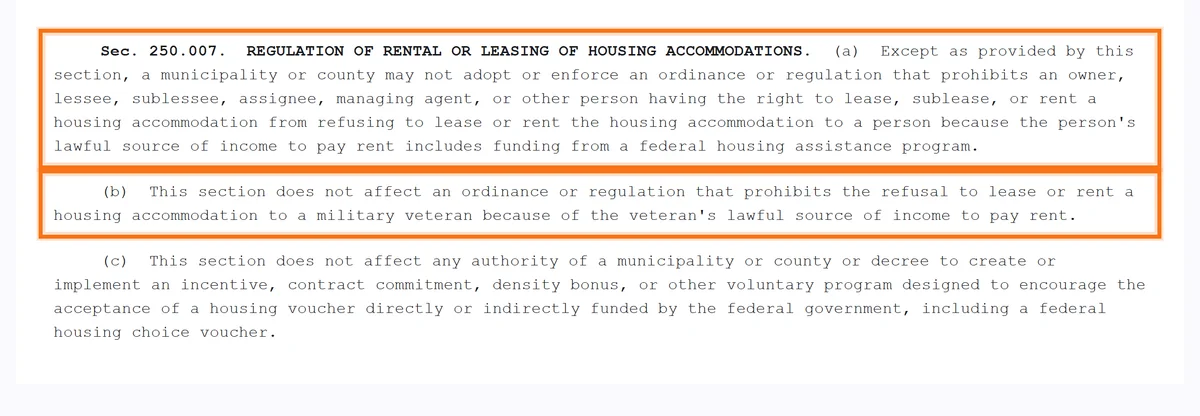
So for most owners in Keller, North Richland Hills and Fort Worth, taking part is a business decision. Two cautions. Subsection (b) leaves room for local rules protecting military veterans, and properties built or financed with certain housing programs carry their own acceptance rules, so check your financing documents.
Whatever you decide must be applied consistently, and declining vouchers as a policy must never be a cover for declining someone because of race, family status, disability or national origin. This is general information, not legal advice; confirm your policy with a Texas attorney. The guide to fair housing for Texas landlords covers the protected classes.
The housing authority inspection
Before it approves the tenancy, the authority inspects the house against the program's housing quality standards (24 CFR 982.305). The inspection is about basic health and safety, such as working smoke alarms, safe wiring, functioning heat and plumbing, and secure doors and windows. It is not a cosmetic inspection and it is not a buyer's home inspection.
Fail items are usually small and fixable: the inspector lists them, you fix them, and a re-inspection is scheduled. Each round adds days before move-in, so walk the house against the authority's checklist before the inspector arrives. Larger authorities must inspect within a reasonable time after the request, and to the extent practicable within 15 days (982.305(b)(2)).
Inspections repeat during the tenancy, and the authority can also inspect on complaint. The guide to city rental registration and inspection programs covers the separate city inspections some Tarrant County addresses also face.
Rent reasonableness and what it means for your number
Under 24 CFR 982.507 the authority may not approve a lease until it finds the rent reasonable compared with comparable unassisted units, looking at location, quality, size, unit type and age, plus the amenities, maintenance and utilities the owner provides. If your rent is above that, the authority asks you to lower it or the tenant cannot use the voucher on your house.
Two consequences. First, a voucher tenancy does not let you charge more than the market; the rule is built to prevent it, and the authority must redetermine reasonable rent before any increase. Second, your rent needs to be supported by comparables, which is the same work a rental analysis does anyway. An owner who priced from leased comparables rarely has a reasonableness problem.
The family's share is also limited at move-in: where the gross rent is above the authority's payment standard, the family share may not exceed 40 percent of its adjusted monthly income (982.305(a)(5)), so a house priced well above the payment standard may be out of reach for that applicant.
How the rent arrives: the payment split
Once the HAP contract is signed, the authority pays its share to the owner each month and the tenant pays the rest like any other tenant. The amount of the authority's payment can change during the contract (24 CFR 982.451(b)). The total of both payments may not be more than the approved rent, and the owner may not accept extra rent from the tenant on the side (982.451(b)(4)).
Your responsibilities for the tenant's share are the same as for any rent: track it, send notices if it is late, and follow the lease. The authority's share is not a guarantee of the tenant's share, and the authority does not collect it for you. The guide to what happens when a tenant pays late in Texas applies in full to that portion.
The HAP contract must be signed within 60 calendar days of the start of the lease, or it is void and the authority cannot pay (982.305(c)). If the tenant moves out, the authority's payments stop. Report changes promptly.
The lease, the tenancy addendum and your management agreement
You use your normal Texas lease with the HUD tenancy addendum attached: 24 CFR 982.308(b) says that if you use a standard lease for unassisted tenants, the voucher lease must be in that same form plus the addendum. The lease must name the owner and tenant, the unit, the term, the monthly rent to owner, and which utilities and appliances each side supplies. Read the addendum before signing, because it controls how the tenancy can end and how rent changes are handled.
If a manager handles the house, the management agreement should say who deals with the authority, who signs the HAP contract and where the authority's payment is sent. Otherwise the forms go to you and the manager is working blind.
Where owners get tripped up
The problems are predictable and all avoidable:
- Skipping screening because part of the rent comes from the authority. Federal rules put screening on the owner (24 CFR 982.307), and the authority has no responsibility for the family's behavior as a tenant. Screen exactly as you would anyone else.
- Not budgeting for the move-in gap. Inspection, reasonableness and contract signing take time. If the house is vacant, the gap is lost rent unless the timeline is managed tightly.
- Raising rent without notifying the authority. The authority must redetermine reasonable rent before any increase (24 CFR 982.507(a)(2)). A renewal increase sent only to the tenant does not take effect for the authority's share.
- Treating a voucher applicant differently in any other way. Different deposit, different questions or different lease terms than other applicants in the same position create fair housing exposure.
- Ignoring the authority's letters. Recertification notices, inspection scheduling and payment changes all arrive on paper or by email, and missing one can suspend the payment.
Deciding whether a voucher tenancy fits your house
Owners who do well with voucher tenancies tend to have a house in solid condition that passes inspection on the first try, a rent that sits comfortably within what the market supports, and patience for the initial paperwork. Owners who struggle are usually trying to use the program to fill a house that has not rented at a rent the market would not support, which is the one thing the program is designed to refuse.
The decision is yours, and a manager should give you the honest tradeoffs for your specific house rather than a blanket yes or no. If you want to talk it through for a house you own now, reach out and we will go through it with the comparables in front of us.
How Perpetual handles this
Whether to accept vouchers on your house is your decision, and we will give you the honest trade-offs for your address rather than a blanket yes or no. The parts of a voucher tenancy that overlap with what we do on every home are these: every adult applicant is screened against the same written, published criteria; the rent is set from leased comparables near your house, which is what a rent reasonableness review looks at; the lease uses current Texas forms with the addenda the property needs; and rent we collect appears on your monthly statement in the owner portal.
We are broker-owned, with our office in North Richland Hills, and every fee is in the written quote before you sign. See how our rent collection and tenant screening work, or call 682-593-7033 to talk through a specific house.

The takeaway: A voucher tenancy is an ordinary Texas tenancy with an inspection, a market-rent check and a split payment layered on top, and it goes smoothly for owners who screen normally, price from comparables and let the manager carry the housing authority paperwork.
Questions owners ask
Can a property manager handle tenants using housing vouchers?
Yes. A manager can screen the applicant against the usual written criteria, prepare the house for the housing authority inspection, propose a rent supported by leased comparables and deal with the authority if the management agreement says so. Federal rules still make the owner responsible for screening and selection (24 CFR 982.307), so the same criteria apply as for any applicant.
Do I have to accept housing vouchers on my rental in Texas?
No. Texas does not require private landlords to accept vouchers, and Local Government Code 250.007 bars cities and counties from requiring it, with an exception that lets them protect military veterans. Properties financed through certain housing programs carry their own rules. Whatever policy you adopt must be applied consistently and never be a cover for discrimination on a protected basis. This is general information, not legal advice.
Does a housing voucher guarantee the full rent?
No. The authority pays its share each month under the HAP contract; the tenant pays the rest like any other tenant, and the authority does not collect it for you. Late notices apply to the tenant's portion under the lease. The authority's payment can change during the contract.
Can I charge more rent to a voucher tenant?
No. Under 24 CFR 982.507 the housing authority compares your rent with comparable unassisted units and may not approve a lease above a reasonable rent, and it must redetermine reasonable rent before any increase. You also may not accept extra rent from the tenant beyond the approved amount.
How long does the voucher process take before move-in?
It depends on the authority's inspection schedule and how quickly any failed items are fixed and re-inspected, plus contract signing. Federal rules ask larger authorities to inspect within a reasonable time, and within 15 days of the request where practicable. If the house is vacant, that gap is the main cost to plan for.
Who screens a Section 8 tenant in Texas, the landlord or the housing authority?
The landlord. Under 24 CFR 982.307 the owner is responsible for screening and selecting the family, and the housing authority has no liability for the family's suitability as a tenant. The authority must give the owner the family's current and prior address and the name and address of those landlords, if known, so use them for rental history checks.
Related services
Property management in Keller, North Richland Hills and Fort Worth. How full-service management works in Tarrant County →