
Key takeaways
- Credit shows how someone handled debt; rental history shows how they handled a lease.
- Texas requires printed notice of the selection criteria, including credit history and previous rental history, with the application (Property Code 92.3515).
- A collection from a landlord or a utility is rental history, not just bad credit.
- Texas statute sets no cap on a residential security deposit, so a larger deposit can be the stated condition, applied to everyone in the tier.
- If a consumer report played any part in a denial, federal law requires an adverse action notice (15 U.S.C. 1681m).
Yes, and in many cases you should, provided the allowance is written into your screening criteria rather than invented for one applicant. That holds for a rental house in Fort Worth, Keller or North Richland Hills as much as anywhere in Texas. Credit measures how someone handled debt. Rental history measures how they handled a lease, which is the thing you are actually offering. A tenant who paid rent on time for five years through a bankruptcy, a divorce or a medical bill may be a safer bet than one with a clean score and no landlord willing to vouch for them.
The question is not whether to make the exception. It is how to build it into your criteria so it applies the same way every time, protects you if the tenant does not work out, and can be explained to the next applicant who asks why they were treated differently.
What credit and rental history each tell you
A credit report is a record of borrowing. It shows whether loans were repaid, how much debt is open and whether any account went to collection. It is useful because a household drowning in debt has less left for rent, and because a collection from a prior landlord shows up there. But it is built for lenders, and most of what drags a score down has little to do with housing.
Rental history is a record of exactly what you care about: did rent arrive on time, was the house respected, were notices served, was the deposit returned, would the landlord rent to them again. A verified, multi-year, on-time rental record is the closest thing to a prediction of the next lease that screening can produce. That is why most written criteria treat the two as separate tests, and why an owner is entitled to decide, in advance, that a strong result on one can offset a weak result on the other. The framework for setting those tests is in tenant screening criteria in Texas.
Look at what the bad credit is made of
Before you decide the rental history outweighs the credit, read what pulled the score down. Not all weak credit is equal, and the written criteria should distinguish between the kinds. Here is how the common items on an applicant's credit report relate to paying rent:
| What is on the report | What it says about rent | How written criteria usually treat it |
|---|---|---|
| Medical collections, old charge-offs, student loans | Little bearing on rent | A verified rental record can outweigh these |
| Recent late payments on everyday accounts | The budget is strained right now | Weigh against current verified income, not only past rent |
| A recent bankruptcy | Old debt may be cleared, or trouble may be ongoing | A waiting period; ours rejects a bankruptcy within the last year that is not discharged or dismissed |
| A collection or judgment from a landlord, apartment community or utility | This is rental history, and it is bad | Commonly a cause for rejection, and it is one in ours |
How to read this table: the first three rows are credit problems a strong landlord record can answer. The last row is not, because it contradicts the good references. An applicant whose current landlord says they are wonderful but whose report shows an apartment collection from three years ago has a story that needs to be heard and verified before anything moves forward.
Make sure the good rental history is real
The exception only works if the rental history has been verified hard, because it is now carrying the whole decision. A single friendly phone call to a number the applicant supplied is not enough. The manager should confirm the landlord through public ownership records or a management company's published number, speak to the prior landlord as well as the current one, and ask specific questions about payment dates, notices and move-out condition.
Bank statements can back up what the landlord says. Regular rent-sized transfers on or before the first of each month, across a year or more, are independent evidence that the reference is telling the truth. If the applicant paid cash and the landlord is a relative, the rental history is unverified, and an unverified history cannot carry a credit exception. The method is in whether property managers actually call previous landlords.
Build the exception into a conditional tier
The clean way to allow this is a written conditional tier: applicants whose credit falls below the standard minimum but above a denial floor, and who meet the income standard and show a verified rental history of a stated length with no landlord collections, may be approved with a fixed condition. The condition is the owner's protection, and the usual choices are:
- A larger security deposit, stated in the lease. Texas statute does not cap the amount of a residential security deposit, but the deposit accounting and return rules in Property Code Chapter 92 apply in full.
- A qualified guarantor who meets the full criteria and signs a guaranty covering the whole lease.
- A shorter initial term, where that fits your plans for the house.
Whichever condition you choose, it is the same for everyone in the tier. The manager cannot require a guarantor from one applicant and waive it for the next because the second applicant was more persuasive on the phone. Consistency is both the fair housing defense and the thing that keeps the exception from quietly becoming no standard at all.
Two rules sit around the tier. Property Code 92.3515 requires a landlord to make printed notice of the selection criteria available when the application is provided, and if an applicant is rejected without that notice having been made available, the application fee and any application deposit must be returned. And when a consumer report plays a part in a denial, the federal Fair Credit Reporting Act (15 U.S.C. 1681m) requires an adverse action notice naming the reporting agency. Ask your screening provider how it handles the notice on a conditional approval. For how a guarantor is screened, see whether to accept a co-signer or guarantor.
What the decision looks like on a real application
Say your house in Fort Worth rents for $2,000 a month. An applicant's score lands in your conditional band. The report shows a medical collection and a card charged off during a period of unemployment two years ago, nothing from a landlord. Income is verified well above your standard. The current landlord of three years confirms on-time rent, no notices and a full deposit return expected; the landlord before that says the same. Bank statements show rent transfers on the first of every month.
Under a written conditional tier this applicant is approved with the stated condition, and the manager's summary to you says exactly why: credit below standard, cause identified and unrelated to housing, rental history verified across two landlords and bank records, condition applied. You can approve with confidence, and if the next applicant in the same band has a landlord collection instead of a medical one, the same criteria produce a different answer for a reason you can state.
This is general information, not legal advice. Confirm the wording of your criteria and lease conditions with an attorney if you are unsure.

When the rental history should not rescue the credit
There are cases where a good reference should not carry the decision. If the credit report shows a landlord or utility collection, the references are contradicted and the file needs more than a story. If the weak credit is recent and active, with new late payments in the last few months, the household may be in trouble right now regardless of how rent was paid last year. If income is at or below the standard, there is no cushion, and the credit problems are the likely result.
And if the rental history cannot be verified independently, there is no good rental history, only a claim of one. In each of those cases the written criteria should produce a denial or a hold for more documents, and the applicant should hear the reason in writing. A manager who presents an applicant to you should say which of these risks were checked and ruled out, not just that the references were fine. The tenant screening service page describes what Perpetual verifies on every adult applicant.
How Perpetual handles this
Perpetual Property Management is broker-owned and local to Keller, North Richland Hills and Fort Worth. Every adult applicant is screened against the same published rental criteria: a credit history evaluation, rental history verification, employment and income verification and a criminal background check, with income of at least 3 times the rent. We speak to previous landlords, not only the current one.
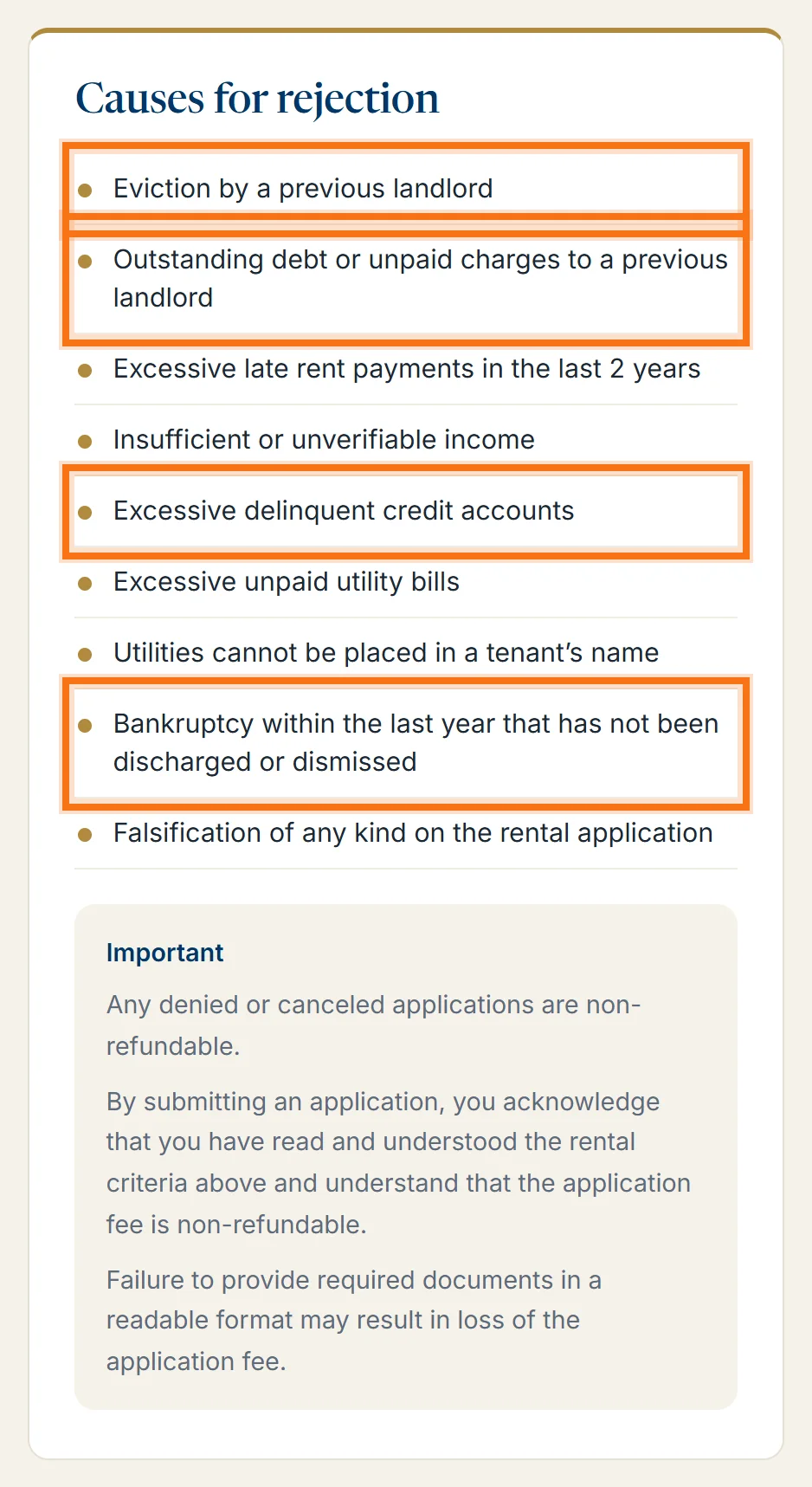
Those criteria treat the two questions in this article separately. Debt owed to a previous landlord, an eviction and excessive late rent payments in the last 2 years are rental history, and each is a cause for rejection. On the credit side the line is excessive delinquent credit accounts, plus a recent undischarged bankruptcy. You set the standards with us before the listing goes live, and we apply them to every applicant without exceptions, which is what protects you legally.
If you want weak credit with a strong rental record handled a particular way on your house, raise it when the criteria are set, not when an application is on the table. The tenant screening page explains what we verify, the leasing service page covers the lease, or reach out and we will talk it through.
The takeaway: A verified rental record can and often should outweigh a weak credit score, but only through a written conditional tier that applies the same condition to everyone in it.
Questions owners ask
Can I ask an applicant to explain the items on their credit report?
Yes, and a good manager does, in writing, for every applicant whose report raises the same question. The explanation is then checked against documents where possible, such as a bankruptcy discharge or a paid-collection letter. Asking is fair as long as every applicant with a similar item is asked, and the answer is weighed under the written criteria rather than on how sympathetic it sounds.
Does a larger deposit actually protect me if the tenant stops paying?
It covers more of the shortfall, but a deposit is not rent and Texas rules on applying and returning it still apply. A larger deposit helps most with damage and a short gap at the end of the lease; it does not stop a tenant from falling behind in month four. That is why the conditional tier pairs the deposit with verified income and a verified rental record rather than relying on cash alone.
Is it discrimination to approve one applicant with bad credit and deny another?
Not if the two applicants differed under the written criteria, for example one had a landlord collection and the other had medical debt, and the difference is documented. It becomes a problem when the criteria are silent and the manager decided case by case. Written criteria with a defined conditional tier are what let you make different decisions for stated reasons. This is general information, not legal advice.
Should I require renters insurance from a tenant approved on a credit exception?
Requiring renters insurance from every tenant is sound practice regardless of credit, because it covers the tenant's belongings and liability and keeps small incidents from becoming disputes with you. Requiring it only from conditional-tier tenants is possible if written into the criteria, but most owners find it simpler and fairer to require it of everyone.
Can a Texas landlord charge a higher deposit because of bad credit?
Yes, if the written selection criteria say so and the same condition applies to every applicant in that position. Texas statute does not cap a residential security deposit, and the Chapter 92 rules on holding, itemizing and returning it still apply. Because the decision rests on a credit report, ask your screening provider about the adverse action notice the Fair Credit Reporting Act requires.
Does rental history matter more than credit score to landlords?
For predicting how a lease will go, usually yes. A verified record of on-time rent and a clean move-out with two prior landlords speaks directly to the thing a landlord is offering. Credit still matters as a check on current debt load and because landlord and utility collections appear there. Texas Property Code 92.3515 lists both as criteria a landlord must disclose.
Related services
Property management in Keller, North Richland Hills and Fort Worth. How full-service management works in Tarrant County →