Key takeaways
- Supply the built-in kitchen appliances and, in most single-family rentals, the refrigerator.
- Washer and dryer are a rent-level decision: provide and maintain, leave out, or leave in place as-is.
- Texas law does not require a landlord to provide a refrigerator; the statutory repair duty covers conditions that materially affect health or safety, and hot water (Property Code 92.052).
- The lease decides who repairs each appliance, so list every unit and whether it is owner-maintained.
- The landlord has no duty to repair damage the tenant caused, unless it is normal wear and tear (92.052(b)).
Renters in Keller, North Richland Hills and Fort Worth expect a range, a dishwasher and a built-in microwave to come with a house, and they increasingly expect the refrigerator too. The washer and dryer are where owners get to choose. Texas law does not require you to supply any of them, so the decision is a market one: every appliance you provide is one you will repair, and every one you leave out is a reason some applicants scroll past the listing.
This guide walks through which appliances to supply in a DFW single-family rental, what Texas law and the lease say about repairs, what to buy, how to decide between repair and replacement, and how tenant-owned appliances are handled at move-in and move-out.
What DFW renters treat as part of the house
Anything built in is expected. A range, a dishwasher and an over-the-range microwave or vent hood are fixtures in the renter's mind, and a listing without them reads as unfinished. Water heater, HVAC and garbage disposal fall in the same category. Nobody asks whether these are included; they ask whether they work.
The refrigerator sits in the middle. In apartment living it is always provided, and renters coming out of apartments assume the same for a house. Renters coming from another house they rented may own one. In the single-family market in northeast Tarrant County, a listing without a refrigerator competes against listings that have one, so leaving it out can narrow the pool more than it saves.
Washer and dryer are the least expected. Hookups are expected; the machines are a bonus that matters most to relocating tenants and least to local movers who already own a set. The competitive rental guide covers how renters here compare listings side by side.
Appliance by appliance: what to supply in a Tarrant County rental
Here is a starting position for each appliance in a single-family rental, and what to write in the lease:
| Appliance | Supply it? | What the lease should say |
|---|---|---|
| Range, dishwasher, built-in microwave, disposal | Yes. Renters treat them as part of the house | Listed, owner-maintained |
| Refrigerator | Yes in most single-family rentals | Listed, owner-maintained; note any ice maker or water line |
| Washer and dryer | Optional. Depends on rent level and tenant profile | Either owner-maintained, tenant supplies, or left as-is with no repair obligation |
| Water heater | Always. Hot water is a statutory duty | Owner-maintained; Property Code 92.052 requires a working device supplying water of at least 120 degrees |
| Tenant-owned appliances | Tenant brings and removes them | Recorded as the tenant's on the move-in report; tenant responsible for safe hookup |
How to read this table: the middle column is market practice, not law, so adjust it to what competing listings in your neighborhood include. The right column is what prevents arguments. An appliance that sits in the house but is not mentioned in the lease is the one that ends up in a dispute when it fails.
The case for providing the refrigerator
Supply it in almost every case. The marketing benefit is immediate: the kitchen photographs as complete, the listing can say appliances included, and applicants relocating from out of state or out of an apartment do not have to buy one before move-in. That removes one friction point from a decision that often comes down to friction.
The repair exposure is modest. A basic top-freezer or bottom-freezer unit without an in-door ice and water dispenser has few failure points. The parts that break on refrigerators, the ice maker, the water line, the dispenser, are precisely the ones a rental unit does not need. A plain unit with a good interior layout is the right buy.
The one scenario where leaving it out makes sense is a tenant already in place who owns their own and asks you not to supply one. Then store or sell yours rather than leaving two in the house. In every other case the refrigerator belongs in the listing.
Washer and dryer: provide, leave out, or provide as-is
There are three honest options, and the right one depends on rent level and tenant profile.
- Provide and maintain. Fits higher-rent homes, corporate and relocation tenants, and furnished rentals, where the expectation is that everything works and the rent reflects it.
- Leave out. Fits workforce rentals and tenants who typically own their own set. The laundry room shows empty with hookups, and the lease says tenant supplies.
- Provide as a convenience, not warranted. The machines are in the house, the tenant may use them, and the lease states the owner does not repair or replace them. If one fails, the tenant can bring their own or ask for removal.
The third option works well for an owner who already has a decent set from when they lived in the home. It gives the tenant something without committing the owner to a service obligation. Make sure the lease wording actually says that, and that the move-in condition report records the machines and their condition on day one, since vague language here tends to resolve in the tenant's favor.
Repair responsibility and what the lease must say
The lease should list every appliance in the house by type, note whether each is owner-maintained or provided as-is, and state that the tenant must report problems promptly in writing. Commonly used Texas lease forms have a section for exactly this, and the choices made there decide who pays when something fails. Confirm the wording in your lease or with an attorney rather than relying on a verbal understanding.
Under a typical arrangement, the owner repairs or replaces owner-maintained appliances that fail through normal use, and the tenant pays for damage from misuse: a disposal jammed with bones, a dryer vent blocked because the lint screen was never cleaned, a dishwasher rack bent by overloading. The line between normal failure and misuse is drawn by the technician's note, so ask every vendor to state the cause on the invoice.
Most appliances are not a health or safety condition under Property Code 92.052 in the way hot water is, but a slow response still costs you the tenant's goodwill. Treat a dead refrigerator as urgent regardless of what the lease requires; the tenant's food is spoiling. The lease addenda guide covers the other clauses that belong alongside this one.
What Texas law requires a landlord to repair
No Texas statute requires a landlord to supply a refrigerator, a washer or any other particular appliance. What the Property Code does require is in Section 92.052:
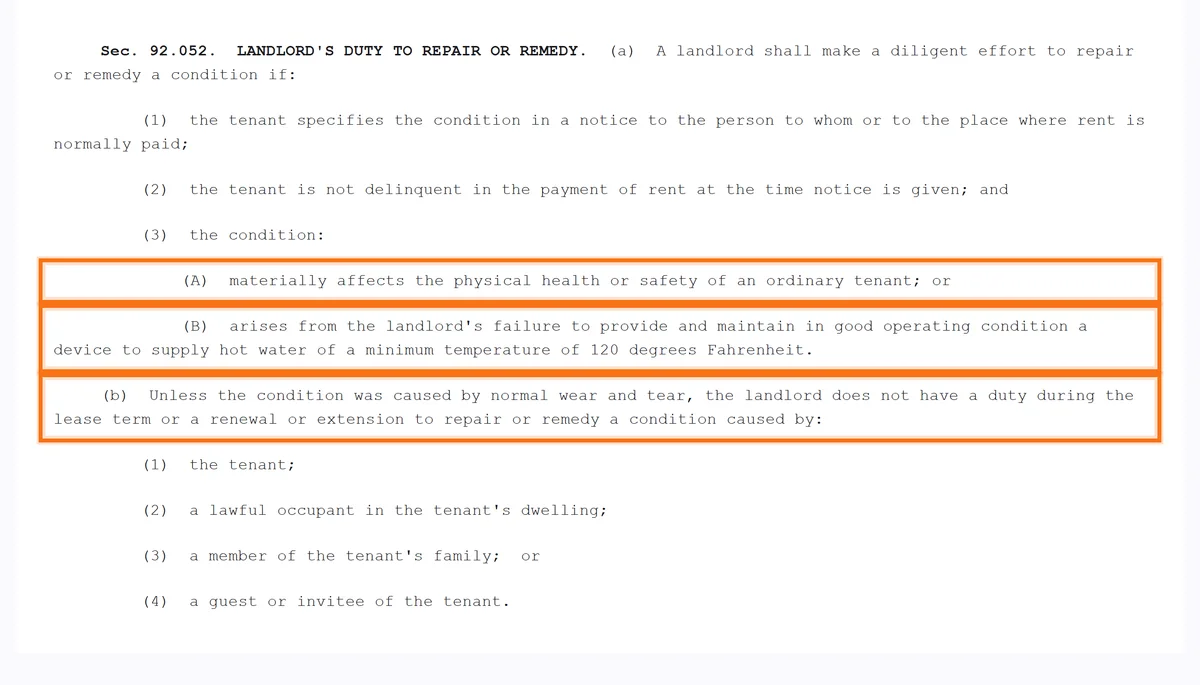
Three things follow for appliances. A broken dishwasher is usually a lease question, not a statutory one, because it rarely affects health or safety. A failed water heater is statutory. And under 92.052(b) the landlord has no duty to repair a condition caused by the tenant, an occupant or a guest, unless it is normal wear and tear. The duty applies when the tenant has given notice of the problem and is not behind on rent (92.052(a)).
Property Code 92.006(f) also lets a written lease make the tenant pay for a short list of repairs, including damage from wastewater stoppages caused by foreign or improper objects in lines serving only that home. The agreement must be specific, clear and underlined or in bold. That is the clause behind charging a tenant for a disposal jammed with the wrong things.
What to buy when you buy appliances for a rental
Buy mid-range, simple and standard. Features are what break, and a rental does not need them. Rules of thumb that hold up:
- No through-the-door ice and water on the refrigerator. It adds a water line and moving parts a rental does not need.
- Mechanical or simple electronic controls on the range and dryer. A failed control panel is an expensive part.
- Standard sizes so a replacement drops into the same opening without cabinet work.
- One finish across the kitchen. Stainless photographs well; white is fine in a workforce rental. Mixed finishes look like an afterthought.
- Top-load washer and a basic electric or gas dryer matched to the hookup. A front-load washer needs its door left open between loads to stay fresh, which tenants may not do.
Record the model and serial number of every unit in the property file along with the purchase date and the warranty terms. Avoid app-connected appliances entirely; they require accounts, updates and support that nobody wants to manage in a rental.
Repair or replace: a rule you can apply by phone
Most appliance decisions can be made from the technician's quote and the unit's age without a site visit. A common rule of thumb: if the repair costs more than about half the price of a comparable new unit, or the appliance is past the midpoint of its typical life and the repair is a major component, replace it. Otherwise repair it.
As an illustrative example, say a ten-year-old dishwasher needs a new pump and the quote is close to the price of a new basic model. Replacing wins, because the next failure on a unit that age is likely to be soon. A three-year-old range with a failed igniter is a repair, because the part is cheap and the rest of the unit has years left.
Keep an appliance schedule for each house: unit, age, last repair. When several items are past their expected life, plan to replace them at the next turnover rather than one by one during a tenancy. This is where the owner reserve earns its keep, as the reserve guide describes.
Tenant-owned appliances at move-in and move-out
When the tenant brings their own refrigerator or laundry set, three things need to be in writing. First, the move-in condition report records that the appliance is the tenant's, so there is no confusion at move-out about who owns what. Second, the tenant is responsible for connecting it correctly: a refrigerator water line that leaks behind the unit for months causes floor damage the tenant will be billed for, so many owners prohibit tenant-installed water lines unless done by a plumber. Third, the appliance leaves with the tenant, and the lease says what happens if it does not.
Dryer connections deserve attention. A tenant-installed dryer with a crushed or disconnected vent hose is a fire risk and a lint problem inside the wall. Ask that the dryer be connected with a rigid or semi-rigid vent and check it at the first periodic inspection.
At move-out, confirm the tenant's appliances are gone, the water line is capped, and the gas valve is closed if a gas dryer was removed. The move-in process guide covers the condition report that makes all of this clean.
Gas versus electric, and the dryer vent nobody cleans
Keep whatever hookup the house has. Converting a laundry room from gas to electric or back is rarely worth it, but you must tell applicants which one the house has so they bring the right dryer. Put it in the listing and in the lease.
The dryer vent is the maintenance item most owners never think about. Lint builds up in the duct between the wall and the roof or exterior cap, drying times stretch, the dryer works harder, and in the worst case the lint ignites. Have the vent cleaned at every turnover and, for a long tenancy, every couple of years. It is a small vendor charge that prevents a large one, and it belongs on the preventive maintenance calendar for every home.
While the vendor is there, confirm the exterior vent cap opens freely and is not a bird nest. A blocked cap produces the same symptoms as a clogged duct and gets missed because nobody looks at the outside of the house.
How a property manager handles appliances
On the homes we manage, tenants report an appliance problem through their portal with photos, which creates a documented record and lets us triage before dispatching anyone. Repairs under your pre-approved spending limit are fixed without waiting; anything larger, such as a replacement, comes to you with a description, photos and a recommendation. What was reported, what was done and what it cost are visible in your owner portal, with the vendor's original invoice.
Our move-in condition report is photo-documented room by room and acknowledged by the tenant, which is the baseline for any question about an appliance's condition at move-out. Our maintenance service describes the process, and our leasing process covers the lease and addenda. If you are deciding what to supply before a first tenant, a free rental analysis will tell you what the rent supports, or call 682-593-7033.
The takeaway: Supply the kitchen appliances and the refrigerator, treat the washer and dryer as a rent-level decision, write every unit and its repair responsibility into the lease, and keep an age schedule so replacements happen at turnover instead of in the middle of a tenancy.
Questions owners ask
Do landlords have to provide a refrigerator in Texas?
No. No Texas statute requires a landlord to supply a refrigerator or any other particular appliance. Property Code 92.052 requires repair of conditions that materially affect health or safety and a working water heater, not a full kitchen. What matters is what the lease says and what the market expects: in DFW single-family rentals a refrigerator is widely expected, so leaving it out narrows your applicant pool.
Who is responsible for appliance repairs in a rental?
Whoever the lease assigns. Typically the owner maintains appliances listed as owner-provided, and under Property Code 92.052(b) the landlord has no duty to repair damage the tenant caused beyond normal wear and tear. Appliances left as-is are the tenant's to live with or replace. Have the technician note the cause of each failure so the invoice answers the question.
Should I provide a washer and dryer in my rental?
Provide them in higher-rent homes and for relocation tenants, where they are expected. In workforce rentals, hookups are enough. A middle path is to leave an existing set in the house as a convenience, with lease language stating the owner will not repair or replace it.
How long do rental appliances last?
It varies by type and use, and nobody can promise a number for a specific unit. Keep a schedule of each appliance's age and repairs, and plan a replacement when a major component fails on a unit past the middle of its expected life, or when a repair quote approaches half the cost of a new one.
Does a landlord have to fix a broken appliance in Texas?
Only if the lease says the appliance is owner-maintained, or the failure materially affects the health or safety of an ordinary tenant. Property Code 92.052 covers conditions like that and the supply of hot water of at least 120 degrees; a dishwasher or microwave is normally a lease matter. The tenant must give notice and be current on rent for the statutory duty to apply.
Related services
Property management in Keller, North Richland Hills and Fort Worth. How full-service management works in Tarrant County →