Key takeaways
- Break-even rent = flat fee divided by the percentage. A $150 flat fee equals 9% of rent at about $1,667 a month.
- Below the break-even rent a percentage is cheaper; above it a flat fee can be cheaper, but only if it includes the same work.
- A flat fee charged during vacancy or non-payment can wipe out the saving in one turnover.
- A percentage of rent collected pays the manager only when you are paid, so it rewards full rent and short vacancies.
- Compare one full year: monthly fee x 12 + leasing or renewal fee + every extra billed on top.
Flat fee property management is worth it for some Fort Worth, Keller and North Richland Hills rentals and not for others, and the rent decides most of it. A flat monthly fee costs the same whether the house rents for $1,400 or $3,400, so it tends to favor higher-rent homes. A percentage of rent collected scales with the rent and disappears in a vacant month, so it tends to favor lower-rent homes and owners who want the manager paid only when they are.
The comparison most owners make, a flat dollar figure against a percentage, is the wrong one until two more facts are known: what each quote leaves out, and what each charges when the house is empty. This guide gives you the break-even math, a table against the percentages on our own published price sheet, the incentive argument and a ten-minute test for your own house.
How each model works
Under a percentage model, the monthly fee is a share of rent, ideally rent actually collected, so the fee rises with the rent and falls to zero in a vacant month. Under a flat-fee model, the monthly fee is a fixed dollar amount regardless of rent, and depending on the agreement it may or may not be charged while the house is vacant.
Both models usually sit alongside the same other fees: a leasing fee when a tenant is placed, sometimes a renewal fee, and various extras. The full guide to flat fee versus percentage management covers the models in depth; this page focuses on deciding between them for a specific house.
The break-even point, with illustrative numbers
The figures in this first example are made up to show the method. They are not quotes or averages; our own published percentages are in the table below.
Suppose one company offers a flat fee of $150 a month and another offers 8 percent of rent collected, and both charge the same leasing fee. The two cost the same when 8 percent of the rent equals $150, which is a rent of $1,875. Below that rent, the percentage is cheaper; above it, the flat fee is cheaper. For a house renting at $1,500, the percentage is $120 a month against $150 flat. For a house renting at $2,800, the percentage is $224 against $150 flat.
That is the whole break-even calculation, and you can do it for any pair of quotes in a minute: divide the flat fee by the percentage to find the rent at which they match, then see which side of it your house sits on. The free rental analysis gives you the rent figure to use.
Flat fee vs real Fort Worth percentages: monthly cost by rent
Here is the same break-even logic run against real numbers: the three monthly fees on our published price sheet (7% of monthly rent on the Investor Special plan for portfolios of 5 or more units, 9% on Standard and 10% on Full Service) next to an example flat fee of $150 a month. The $150 is only an illustration, not any company's quote; put in the flat number you were actually offered.
| Monthly rent | 7% (Investor Special) | 9% (Standard) | 10% (Full Service) | Example flat fee |
|---|---|---|---|---|
| $1,500 | $105 | $135 | $150 | $150 |
| $2,000 | $140 | $180 | $200 | $150 |
| $2,500 | $175 | $225 | $250 | $150 |
| $3,000 | $210 | $270 | $300 | $150 |
| Break-even rent vs $150 flat | about $2,143 | about $1,667 | $1,500 | n/a |
How to read this table: find your expected rent in the first column and compare across the row. At $1,500 rent every percentage costs the same or less than a $150 flat fee; at $3,000 the flat fee is $60 to $150 a month lower. That gap is the most a flat fee can save you, and it shrinks or reverses as soon as the flat quote bills separately for things a percentage plan includes, or keeps charging while the house is empty. The monthly fee is also only one line: on our sheet the tenant placement fee is 50% or 75% of one month's rent and renewals are $149 to $200, so add those before deciding.
What each model rewards
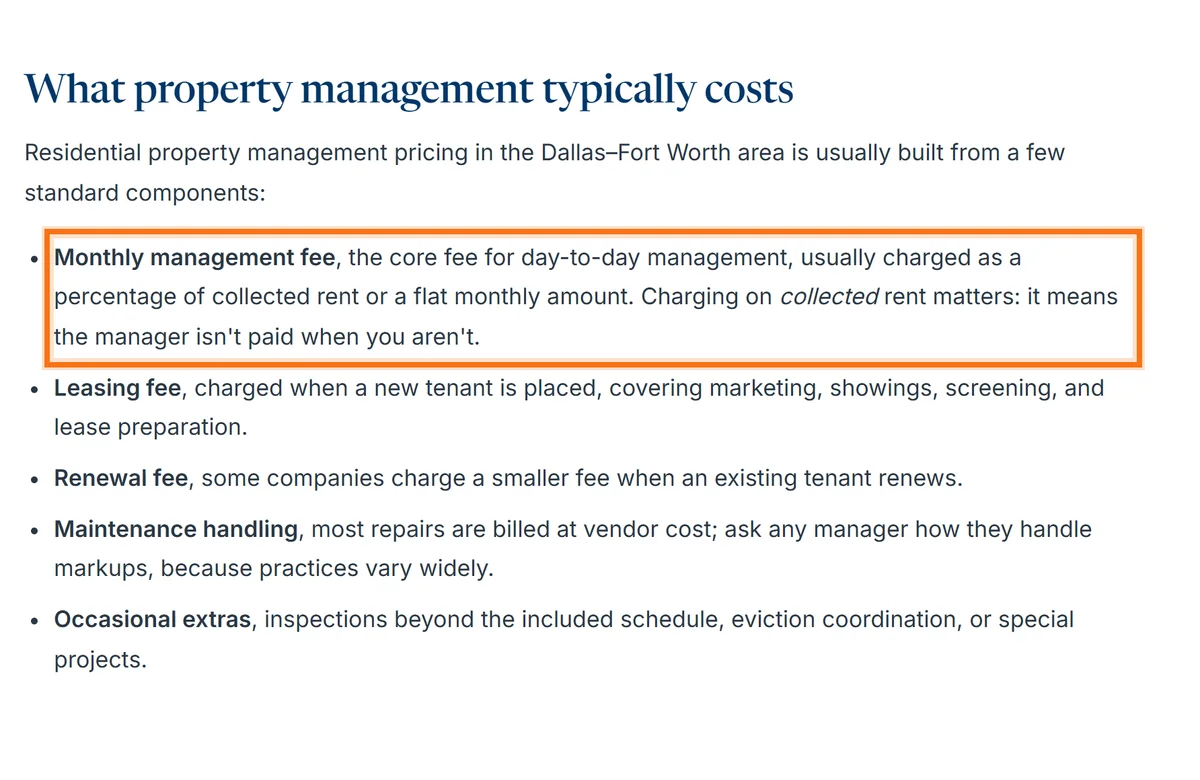
A percentage of rent collected gives the manager three incentives that match yours: to price the house at what the market will bear rather than low for a quick lease, to keep it occupied, and to collect the rent. In a vacant month or a non-payment month the manager earns nothing, so their attention goes where your money is.
A flat fee is neutral. The manager earns the same whether the rent is high or low and, under some agreements, whether the house is occupied or not. That neutrality is not a flaw in itself, and a good company behaves well under either model. But if you are choosing between two companies you do not yet know, the incentive structure is information about how they will behave in a hard month. The guide to how property managers get paid goes further into how fee structure shapes behavior.
What flat fees often leave out
A low flat fee is sometimes a base price with the service unbundled. Items that are inside a percentage fee at one company may be billed separately at a flat-fee company: inspections, maintenance coordination, renewals, after-hours handling, even statements. The monthly figure looks attractive until the year's invoices are added up.
The question to ask of any flat quote is what the fee includes, in writing, and what is billed on top. The pricing and fees page of any company you consider should answer that; if it does not, ask for the full list before comparing. Owners who compare a bundled percentage against an unbundled flat fee are comparing a car against a chassis.
The vacancy clause changes everything
A flat fee charged during vacancy can turn a cheaper quote into a more expensive one in a single turnover. If the house is empty for two months, a percentage of rent collected charges nothing, while a flat fee charged on the agreement rather than on rent charges two full months. Some flat-fee agreements pause the fee during vacancy; some do not. The wording decides.
Read the clause before deciding, and if it is unclear, ask the company to state in writing what you pay in a month with no tenant. For the same reason, ask what the fee is when a tenant stops paying, because a flat fee that continues through a non-payment month means you are paying the manager while receiving nothing.
A ten-minute test for your own house
- Get the expected rent for your house from a rental analysis.
- For each quote, list the monthly fee, the leasing fee, the renewal fee and every item billed separately.
- Calculate a placement year: twelve months of the monthly fee plus the leasing fee plus any extras you would expect, such as two inspections.
- Calculate a renewal year: twelve months plus the renewal fee plus extras.
- Subtract two months of the monthly fee from any quote that pauses during vacancy, to see the effect of a turnover.
- Compare the annual totals, not the models.
Owners who run this test usually find the difference between the models is smaller than the difference between what two companies include, which is the real lesson. Choose the quote whose annual total and service list you prefer, and let the model follow.
How Perpetual handles this
Perpetual Property Management is broker-owned and local to Keller, North Richland Hills and Fort Worth, and our published plans charge a percentage of monthly rent: 7%, 9% or 10% depending on the plan. Every fee is listed in the written quote before you sign: the monthly fee and what it is charged on, the placement and renewal fees, and every item that could ever be billed separately, so the ten-minute test can be run on it directly. If a fee is not in the agreement, you do not pay it. We are glad to sit down with the arithmetic and with any other quote you have.
The service behind the number is the same either way: tenant calls handled here, consistent screening criteria, Texas-compliant leases, vetted vendors with the invoice on your monthly statement, documented inspections with photos, and an owner portal showing every dollar. The full-service management page lists what is included so you can see what sits inside the fee rather than guessing from a model name.
The takeaway: Flat fee versus percentage is decided by your rent level, the vacancy clause and what each quote leaves out, so compare annual dollar totals for your house and let the model be a consequence rather than the choice.
Questions owners ask
Is flat-fee property management cheaper for a high-rent house?
Often, in dollar terms, because a percentage scales with rent while a flat fee does not. The break-even is the rent at which the percentage equals the flat fee. Above it, the flat fee is lower per month, but check what the flat fee excludes and whether it is charged during vacancy before concluding it is cheaper over a year.
Do flat-fee managers have less incentive to get the highest rent?
The fee structure gives them no direct financial stake in the rent level, whereas a percentage manager earns more when rent is higher. That does not mean a flat-fee company prices low, but it means the alignment comes from reputation rather than from the fee. If that concerns you, ask how they price and how they report comparable leased homes.
Can a management company charge a flat fee during vacancy?
Yes, if the agreement says so, and some do. Others pause the fee until a tenant is in place. This clause can matter more than the fee itself in a year with a turnover, so read it and ask the company to confirm in writing what you pay in a month with no rent.
Can I switch from a percentage fee to a flat fee with the same company?
Some companies offer both structures and will quote either; others offer one. If you have several properties or a high-rent house, it is reasonable to ask whether a different structure is available. Any change should be documented as an amendment to the management agreement with the new fee list attached.
Is flat fee property management worth it?
It can be for a higher-rent home, because a fixed fee does not grow with the rent. Find the break-even rent by dividing the flat fee by the percentage you were quoted: a $150 flat fee matches 9% of rent at about $1,667 a month. Above that rent the flat fee is cheaper per month, but only worth it if the quote includes the same services and does not charge during vacancy or non-payment.
What is the difference between a leasing fee and a management fee?
The management fee is charged every month for running the rental: rent collection, maintenance coordination, statements and tenant contact. The leasing or tenant placement fee is charged once, when a new tenant signs, for marketing, showings, screening and the lease. On Perpetual's published price sheet the monthly fee is 7%, 9% or 10% of rent and placement is 50% or 75% of one month's rent, depending on the plan.
Property management in Keller, North Richland Hills and Fort Worth. How full-service management works in Tarrant County →