Key takeaways
- The monthly management fee, a percentage of rent, is the base: 7%, 9% or 10% on our three published plans.
- Leasing (tenant placement) and renewal fees are paid when a tenant changes or stays; their ratio tells you whether a manager profits from turnover.
- Maintenance is the income owners see least: ask whether it is a stated coordination percentage on the original invoice, a hidden markup, or an in-house crew.
- Tenant-side fees (application, late, admin) never appear on your statement but shape how a manager enforces the lease.
- Owners are paid from a trust account: rent comes in, fees and approved bills come out, and the net is disbursed with a statement.
Property managers get paid from a handful of sources: a monthly fee that is a percentage of rent, a placement fee when a new tenant signs, a renewal fee, a share of the maintenance they coordinate, and sometimes tenant fees or commissions. On our published price sheet for homes in Fort Worth, Keller and North Richland Hills, the monthly fee is 7%, 9% or 10% of rent depending on the plan, and every other fee is listed beside it.
The fee schedule matters for more than cost. A company paid mostly by leasing fees needs turnover. A company that owns its maintenance crew needs repairs. A company that keeps the tenant's late fees needs late tenants. None of these companies is dishonest, and each will say it works for the owner. The fee schedule says what it actually works for. This guide lists every way a manager earns, what each source quietly encourages, and the terms that line the manager's interests up with yours.
Every source of property manager income
Most owners can name two: the monthly fee and the leasing fee. The full list is longer, and the later items are where behavior gets shaped:
- The monthly management fee, as a percentage of rent or a flat amount.
- The leasing or placement fee when a new tenant signs.
- The renewal fee when an existing tenant signs again.
- Maintenance markups, coordination fees or profit from an in-house repair company.
- Tenant-side charges: application fees, late fees, administrative fees, pet fees, lease change fees, often retained in whole or part by the manager.
- Vendor relationships: preferred-vendor arrangements, rebates or referral payments.
- Interest or earnings on funds held, where permitted and disclosed.
- Brokerage commissions when the manager's brokerage sells or buys a home for you.
- Program fees: eviction protection, inspection plans, technology or portal charges.
A manager is not required to earn from all of these, and the well-run ones earn from few. The agreement, plus the lease the manager uses with tenants, tells you which apply.
A real fee sheet: what we charge in Fort Worth, Keller and NRH
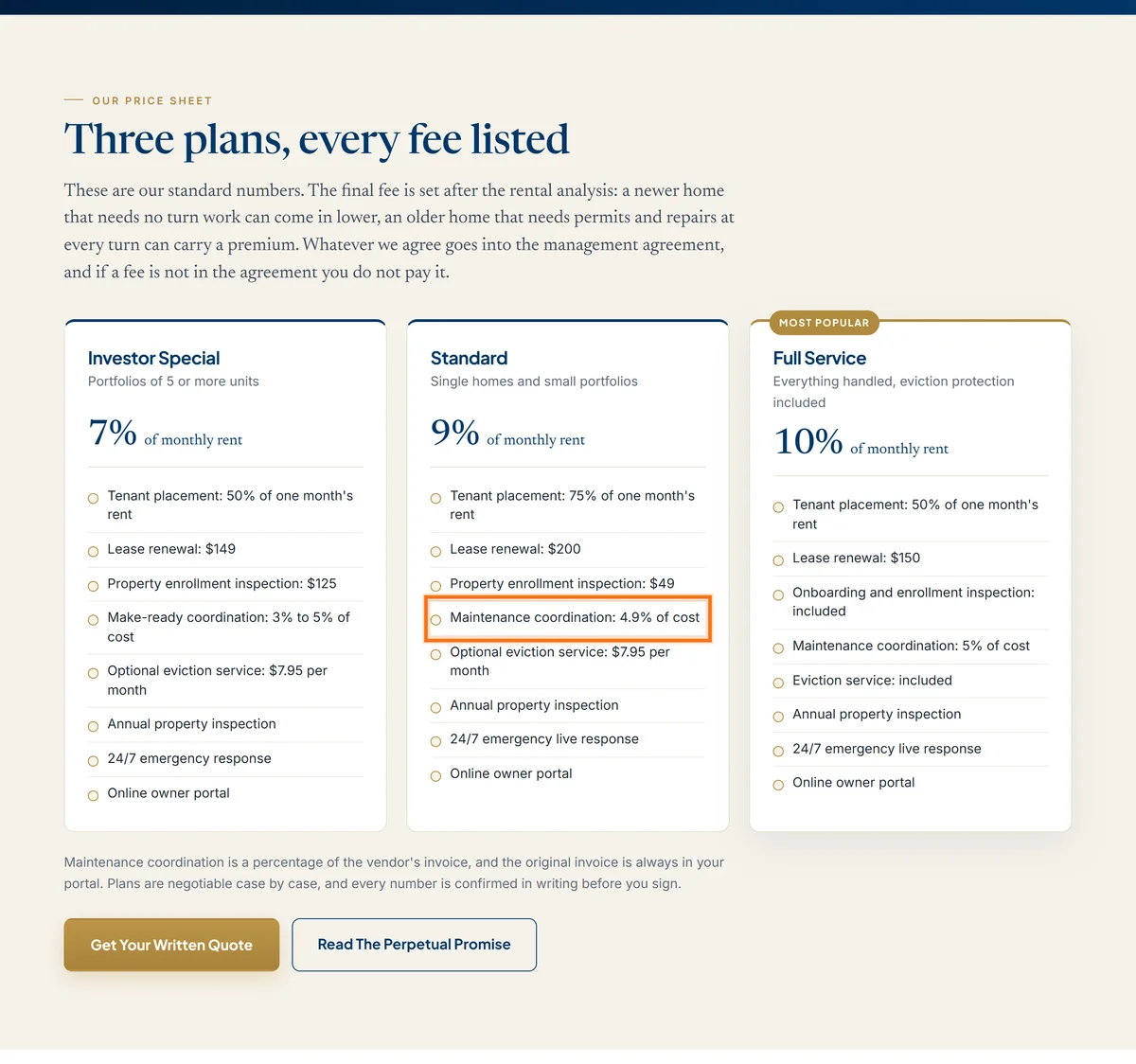
Talking about fee structures in the abstract only goes so far, so here is our own published price sheet. These are the standard numbers before the rental analysis; the final fee is confirmed in writing in the management agreement, and if a fee is not in the agreement you do not pay it.
| Fee | Investor Special (5+ units) | Standard | Full Service |
|---|---|---|---|
| Monthly management fee | 7% of monthly rent | 9% of monthly rent | 10% of monthly rent |
| Tenant placement | 50% of one month's rent | 75% of one month's rent | 50% of one month's rent |
| Lease renewal | $149 | $200 | $150 |
| Property enrollment inspection | $125 | $49 | Included |
| Maintenance or make-ready coordination | Make-ready: 3% to 5% of cost | 4.9% of cost | 5% of cost |
| Eviction service | Optional, $7.95 per month | Optional, $7.95 per month | Included |
| Also included | Annual inspection, 24/7 emergency response, owner portal | Annual inspection, 24/7 emergency live response, owner portal | Annual inspection, 24/7 emergency live response, owner portal |
How to read this table: the monthly fee is the money that pays for people, the placement fee is paid only when a tenant changes, and the renewal fee is paid when a good tenant stays, so the gap between placement and renewal shows how much a plan leans on turnover. The coordination line is how we earn on maintenance: a stated percentage of the vendor's invoice, with the original invoice in your portal, rather than a markup you cannot see. Plans are negotiable case by case.
The monthly fee: the base that pays for people
The monthly fee is the income that pays for the staff who answer the phone, run the trust accounting, inspect the house and handle the tenant. When it is calculated on rent collected, the manager earns nothing on a vacant home or a nonpaying tenant, which keeps the manager's attention where yours is. When it is a flat fee or calculated on rent due, the manager is paid in those months regardless.
A monthly fee set too low relative to the work has a predictable effect: the company needs the other income sources to survive, and the other sources are the ones that cost you more. That is the mechanism behind a cheap headline rate and an expensive year. The comparison of the two base structures, and what each does at renewal and during vacancy, is in flat fee versus percentage management.
Leasing and renewal fees: the turnover incentive
The leasing fee is the largest single payment most managers receive from an owner, and it is paid only when a tenant changes. A company whose income leans on leasing fees is a company that does better when tenants leave. It will not cause turnover deliberately, but it has little reason to prevent it: slow maintenance responses, aggressive renewal increases and a thin renewal process all nudge a good tenant toward moving.
The renewal fee is the counterweight when it is set correctly. A renewal fee that is much smaller than the leasing fee, and that is paid for a real market check and negotiation, gives the manager a reason to keep your tenant. A renewal fee equal to the leasing fee removes that reason. Look at the ratio between the two on the fee schedule; it is one of the clearest signals of what the company is built to do. The work behind the larger of the two is covered in leasing fees explained.
Maintenance income: the repair volume incentive
When a manager earns on repairs, through a markup, a coordination fee or an in-house crew, every service call is revenue. The effect is not usually fraud. It is a lower threshold for sending a technician, a preference for replacing over repairing, and a reluctance to seek a competing bid on larger work. Over years, on a home that needs a normal amount of upkeep, this is the income source that costs owners the most.
The in-house crew deserves a specific note. It can be faster and cheaper than outside vendors when it is run as a service and billed transparently. It becomes a problem when it is the only option, when its invoices are not itemized, or when its pricing is never tested against the market. Ask whether you can require an outside bid above a stated amount. Ours is a stated coordination percentage on the vendor's invoice, shown on the price sheet above, with the original invoice in your portal; the process is on the maintenance page, and the full set of questions is in maintenance markups explained.
Tenant-side fees: income you never see
The income source owners examine least is the money the manager collects from tenants and keeps. Application fees, late fees, returned payment fees, lease change fees, pet administration fees and a growing list of monthly "resident benefit" charges can add up to a meaningful share of a manager's revenue, and none of it appears on your statement.
Each of these pulls behavior in a direction. Retained late fees reduce the urgency to enforce on-time payment, since the late tenant is paying the manager. Application fees retained in full reward processing many applications rather than placing the right tenant quickly. Monthly tenant charges raise the effective cost of renting your home without raising your rent, which can make your listing less competitive against a home with no such add-ons.
Ask the manager to list every fee it charges tenants and which of them it keeps; who keeps late fees and pet fees goes through the usual arrangements. Then ask whether late fees are credited to you, as the party who was actually paid late. A manager who returns late fees to the owner has the right incentive on rent collection.
Vendor arrangements and brokerage commissions
Some managers receive payments from vendors for volume or referrals. Where that exists it should be disclosed,, in writing. The question to ask is simple: do you receive anything from any vendor who works on my home? A clean answer is no, or a disclosed arrangement that is passed to you as a lower price. This is general information, not legal advice.
Brokerage commissions are a different case. A broker-owned manager can list your home for sale, or help you buy the next one, and earn a commission on the transaction. That is a legitimate service and often a convenient one, since the manager already knows the home and the tenant. The incentive to watch for is a manager who recommends selling when the honest advice is to hold, or the reverse. Ask for the reasoning in writing and compare it to the numbers on your statements. More on how ownership structure shapes these decisions is in broker-owned versus franchise management.
How property managers pay owners
The other half of the question is how the money reaches you. Rent and security deposits for a managed home go into the broker's trust account, which is kept separate from the company's own operating money. Each month the manager posts the rent collected, takes out the management fee and any fees the agreement allows, pays approved vendor bills and keeps the reserve topped up, then sends the owner the net amount with a statement that shows every line.
- Tenant pays rent through the portal; it lands in the trust account.
- The management fee is calculated on that month's rent and deducted.
- Approved repair invoices, any coordination fee and HOA or other bills you asked the manager to pay come out.
- The reserve is refilled if a repair drew it down.
- The balance is sent to your bank account with the owner statement.
A late tenant or a large repair changes the amount and sometimes the date, which is why the statement matters more than the deposit itself. The timing and the reserve are explained in when a property manager sends your rent each month and owner reserves and disbursements.
The five moments where interests diverge
Most of the time an owner and a manager want the same thing: a paying tenant in a maintained home. The divergence shows up at specific decisions, and knowing them lets you watch for them.
- Renewal versus turnover. You want the good tenant to stay. A leasing-fee-heavy manager is paid more if they leave.
- Repair versus replace. You want the cheaper fix that lasts. A manager earning on repairs is paid more for the bigger job.
- Rent increase at renewal. You want the increase the market supports. A percentage manager wants it too; a flat-fee manager is indifferent; a leasing-fee manager may push too hard and cause a move.
- Late rent. You want it paid on time. A manager who keeps late fees is paid when it is not.
- Hold versus sell. You want the honest answer. A brokerage earns on the sale.
None of these makes a manager bad. They make the fee schedule worth reading as a prediction of behavior.
How to align the manager with the owner
Alignment is built in the agreement, not in the relationship. The terms that do most of the work:
- Monthly fee on rent collected, not rent due, so vacancy and nonpayment cost the manager too.
- Vendor invoices passed through with the originals visible, any coordination fee stated as a percentage in the agreement, and the right to an outside bid above a stated amount.
- A renewal fee that is a fraction of the leasing fee and is tied to a market check.
- Late fees credited to the owner, or at least shared.
- A full list of tenant-side fees, with any that raise the tenant's cost of renting your home kept modest.
- Disclosure of any vendor compensation, in writing.
- Every owner-side fee on one page before signing, with nothing added later without an addendum.
Then read your statements for a year with this list beside them. The statements show which income sources are active on your account. If a source appears that was not on the page, you have the conversation the agreement entitles you to.
What it looks like when the money is on your side
A manager whose income is mostly the monthly fee on collected rent, with a modest earned leasing fee and, at most, a small stated percentage on coordinated repairs with the original invoice in front of the owner, behaves in a recognizable way. Maintenance requests are handled quickly because an unhappy tenant is a future vacancy that costs the manager too. Renewals are worked early because a renewal is cheaper than a lease-up for everyone. Repairs are priced competitively because the owner sees the vendor's own invoice, so a larger job is visible and has to be justified. Rent collection is firm because the manager is paid only when you are.
That is the standard to compare against. It is why the fee schedule, more than the sales conversation, tells you how a company will treat your home in year three. Every fee we charge, and every one we do not, is listed on the pricing page, and the people responsible for it are on the about the broker page. Read both the way you would read any manager's: as a prediction.
The takeaway: Read a manager's fee schedule as a forecast of its behavior, and choose the one whose income rises only when yours does.
Questions owners ask
How do property managers make money?
From the monthly management fee, leasing and renewal fees, maintenance markups or in-house repair work, tenant-side charges such as application and late fees, occasionally vendor arrangements, and brokerage commissions when they sell or buy a home for an owner. The mix varies by company and shapes how it behaves.
Who keeps late fees and pet fees, the owner or the property manager?
It varies by company, and the management agreement or the lease will say. Some managers keep late fees in full as compensation for collection work, some split them with the owner and some credit them to the owner, who is the party that was actually paid late. Pet fees and other tenant-side charges such as application and administrative fees are often retained by the manager as well, and none of that appears on your statement. A manager who keeps late fees earns when rent is late, which weakens the incentive to enforce on-time payment. Ask for the full list of tenant charges and which ones the manager keeps, in writing.
Is it a conflict of interest for a property manager to do its own maintenance?
It can be. An in-house crew is fine when it is optional, itemized and priced against the market. It is a problem when it is the only choice, when invoices are not detailed, or when large jobs never get an outside bid. Ask for the right to a competing quote above a set amount.
What fee structure best aligns a property manager with the owner?
A monthly fee on rent collected, a leasing fee that is earned and partly refundable if the tenant leaves early, a small renewal fee tied to a market check, invoices at cost and late fees credited to the owner. Under that structure the manager is paid when you are.
Should I ask a property manager what they charge tenants?
Yes. Tenant-side fees never appear on your statement but affect how competitive your listing is and what the manager is motivated to do. Ask for the full list of tenant charges and which ones the manager keeps.
How do property managers get paid?
Mostly through a monthly management fee that is a percentage of the rent, plus a placement fee when a new tenant signs and a renewal fee when a tenant stays. Many also earn a percentage of the maintenance they coordinate. On Perpetual's published price sheet the monthly fee is 7%, 9% or 10% of rent, placement is 50% or 75% of one month's rent, and renewals are $149 to $200 depending on the plan.
Do property managers get paid commission?
In effect, yes. In Texas, leasing and managing someone else's property for a fee requires a real estate license under Texas Occupations Code chapter 1101, and the placement fee is a leasing commission paid when a tenant signs. The monthly fee is a percentage of rent rather than a commission, and a broker-owned manager can also earn a sales commission if it sells or buys a home for you.
How do property management companies make money on maintenance?
Three ways: a stated coordination fee that is a percentage of the vendor's invoice, a markup added to the invoice, or profit from an in-house repair crew. Ask which one applies and whether you see the original invoice. Perpetual charges a stated percentage, 4.9% of cost on the Standard plan and 5% on Full Service, and the original invoice is always in the owner portal.
How do property managers pay owners?
Rent goes into the broker's trust account. Each month the manager deducts the management fee, any fees the agreement allows and approved repair bills, refills the reserve if needed, and sends the owner the net amount with a statement. A late tenant or a large repair can change the amount or the date, so read the statement, not just the deposit.
Related services
Property management in Keller, North Richland Hills and Fort Worth. How full-service management works in Tarrant County →