Key takeaways
- Your management agreement, not Texas law, decides who keeps late fees and pet fees; get every destination in writing.
- Texas does limit the late fee: written in the lease, reasonable, and only after rent is two full days late (Property Code 92.019).
- A late fee of up to 12% of monthly rent is presumed reasonable for a home in a building of four units or fewer.
- Our rental criteria list a $350 one-time nonrefundable pet fee plus $25 a month pet rent per pet, and a $60 application fee per adult.
- A refundable pet deposit is the tenant's money until move-out; nobody keeps it unless there is damage.
Who keeps late fees and pet fees, the owner or the property manager? The management agreement decides, not Texas law, and the answer varies from company to company. The common pattern for homes in Fort Worth, Keller and North Richland Hills looks like this: the manager keeps some or all of the late fees as payment for the work of chasing rent; monthly pet rent goes to the owner as part of rent; a refundable pet deposit is the tenant's money and is held, not kept; and a nonrefundable pet fee goes to whichever side the agreement names. What Texas law does control is the late fee itself, under Property Code Section 92.019.
These are small amounts next to rent, but each one shapes how the manager behaves, and every one of them should be a line you can read in the fee schedule rather than a surprise on a statement.
Late fees: who keeps them and why it matters
Three arrangements are common. The manager keeps the entire late fee, the manager and owner split it, or the owner receives it all and the manager is paid only through the management fee. Managers who keep the late fee argue, reasonably, that the late fee pays for the extra work of calling, posting notices and tracking a late payment. The problem is the incentive: a manager who earns from late fees has a small reason to tolerate a tenant who is always late, because that tenant produces income every month.
A split is a fair middle ground, and an owner who receives the whole fee has a manager whose only income is on-time rent. Whichever arrangement you accept, confirm two things: the late fee amount and grace period are stated in the lease the way Texas law requires, and the fee appears on your statement as a tenant charge with a note on where it went. The wider picture of how each income source shapes a manager is in how property managers get paid, and why it changes how they behave.
Texas late fee limits, with examples
Property Code Section 92.019 allows a late fee only if notice of it is in a written lease, the fee is reasonable, and rent has remained unpaid two full days after the date it was due. A fee is presumed reasonable if it is no more than 12% of monthly rent for a home in a building with four or fewer units, or 10% in a larger building. Here is what that means for a single-family home:
| Monthly rent | Highest fee presumed reasonable (12%) | Earliest a fee can be charged if rent is due on the 1st |
|---|---|---|
| $1,500 | $180 | The 4th, if still unpaid after the 2nd and 3rd |
| $2,000 | $240 | The 4th, if still unpaid after the 2nd and 3rd |
| $2,500 | $300 | The 4th, if still unpaid after the 2nd and 3rd |
How to read this table: the middle column is the safe-harbor ceiling, and it includes any daily fees, because the statute counts an initial fee plus daily fees as one late fee. A landlord who charges more than the law allows owes the tenant $100, three times the improper fee and the tenant's attorney's fees, which is why the lease wording matters more than who keeps the money.
Pet rent, pet deposits and pet fees are three different things
Owners often lump these together, and managers sometimes let them. Pull them apart:
- Pet rent is a monthly amount added to rent for the animal. It is rent, it is yours, and the management fee is normally calculated on it along with the base rent.
- A pet deposit is refundable, held for the tenant, and returned or itemized at move-out under the same Texas deposit rules as the security deposit. Nobody keeps it unless there is damage.
- A nonrefundable pet fee is a one-time charge at move-in. It is the one that needs a named owner in the agreement. Many managers pass it to the owner as income to offset wear; some keep it as compensation for pet screening.
Ask which of the three the manager uses, in what amounts, and where each one lands. What the house actually needs from a pet policy, and how pet screening works, is covered in pets in your rental: screening, deposits and pet rent.
Every tenant charge, who pays it and where it goes
Here is each charge a tenant can pay on a home we lease, with the amount we list publicly and the rule that governs it:
| Charge | Amount (our published criteria) | Where it usually goes | Rule that applies |
|---|---|---|---|
| Late fee | Set in the lease, within Texas limits | Manager, owner or split, as the agreement says | Property Code 92.019: written lease, reasonable, after two full days |
| Pet rent | $25 a month per pet | Owner, as part of rent | Part of rent under the lease |
| Nonrefundable pet fee | $350 one time at move-in | Whoever the agreement names | Stated in the lease and in our rental criteria |
| Refundable pet or security deposit | Set per home | Held for the tenant; applied only to damage or charges owed | Property Code 92.103 to 92.109: refund or itemize within 30 days |
| Application fee | $60 per applicant 18 or older | Manager, to pay for screening | Nonrefundable, per our rental criteria |
How to read this table: the second column is what the tenant pays, the third is the column to check in your own agreement. Only the deposit row belongs to neither side; it is the tenant's money until the move-out itemization. If the agreement says nothing about where a charge goes, assume the manager keeps it and ask for it in writing.
Application fees and the other tenant-side charges
Late and pet fees are the two owners ask about, but a lease carries other tenant charges, and the agreement should name a destination for each:
- Application fees go to the manager, who pays the screening vendor. They are not owner income.
- Returned payment fees usually follow the late fee arrangement.
- Lease violation or administrative charges, such as an unauthorized pet fine or a lockout charge, vary widely; some managers keep them all.
- Utility billing or convenience fees charged to the tenant for paying online are usually the manager's or the software vendor's.
On an illustrative house, a tenant who pays late four times a year at a $75 late fee generates $300. If the manager keeps it, that is a real part of their income on your house that never appears in the quoted percentage. How a late payment is handled step by step is in what happens when a tenant pays late in Texas.
What to ask for, and what a fair agreement says
Ask for a list of every charge a tenant can be billed under the lease, with who receives each one. A fair agreement usually gives the owner pet rent and any nonrefundable pet fee, holds deposits for the tenant, gives the manager the application fee, and either splits the late fee or states clearly that the manager keeps it in exchange for handling collections. What you want to avoid is silence: an agreement that lists tenant charges in the lease but says nothing about them in the compensation section, which in practice means the manager keeps them.
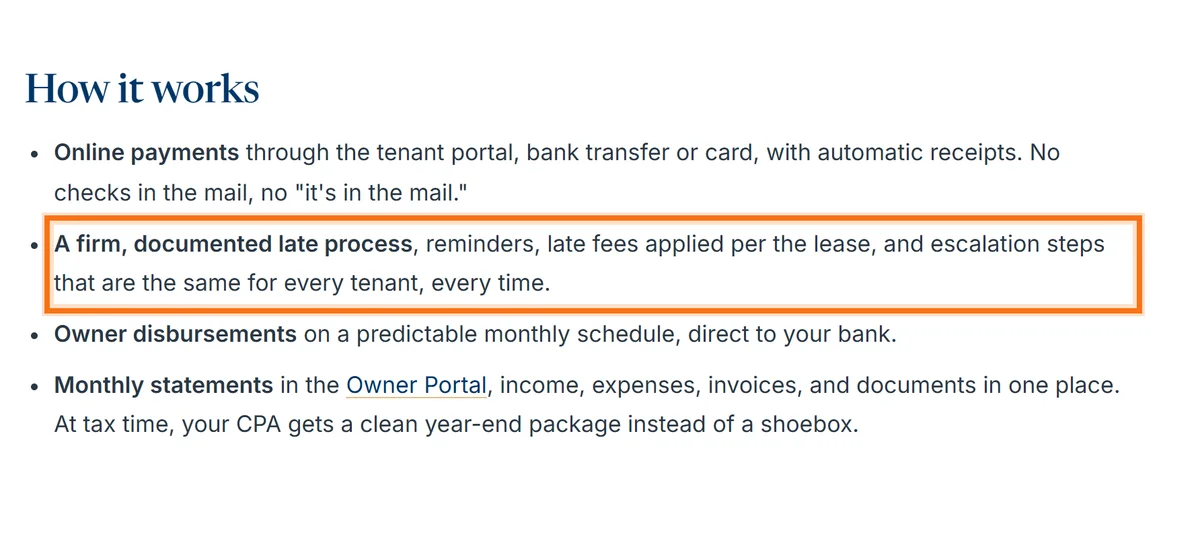
Then check your statement. Any tenant charge collected should appear on it, even if it goes to the manager, so you can see the tenant's payment behavior. The rent collection service page describes how Perpetual posts and reports those charges, and the pricing page is where every fee should already be visible.
Why the small money shapes the big money
A manager's income from your house is the management fee plus whatever tenant charges the agreement gives them. If a meaningful share comes from late fees and violation charges, the manager earns more from a difficult tenant than from a good one, which is backwards from your point of view. If the manager's income is almost entirely the management fee on rent collected, every incentive points at an on-time tenant who renews.
That is the real reason to read these lines. The dollars are small; the alignment is not. This is general information, not legal advice; late fee amounts and deposit handling in Texas are governed by the Property Code, so confirm your lease wording with the manager or an attorney.
How Perpetual handles this
Every tenant charge under a Perpetual lease, late fees, pet rent, pet deposits, pet fees and application fees, has a named destination in the written quote you receive before signing, so you never have to infer it from a statement. Perpetual Property Management is broker-owned and local to Keller, North Richland Hills and Fort Worth, and the leases are Texas-compliant, with the late fee and grace period stated the way the Property Code requires.
On the statement, every tenant charge is shown as its own line with where it went, so you can see whether a tenant is paying on time even when a fee did not come to you. Pet deposits are held in trust for the tenant and itemized at move-out with the documented inspection. My income from your house should come from rent arriving on time and a tenant renewing, which is why the rent collection process is built to get rent in, not to collect fees from a tenant who is behind.
The takeaway: Get a written list of every tenant charge and who receives it; the amounts are small, but they decide whether your manager earns more from a good tenant or a difficult one.
Questions owners ask
What is the maximum late fee a landlord can charge in Texas?
Texas Property Code Section 92.019 allows a late fee only if it is in a written lease, is reasonable, and rent has been unpaid two full days after it was due. A fee of no more than 12% of monthly rent is presumed reasonable for a home in a building with four or fewer units, and 10% for a larger building; a higher fee is allowed only if it does not exceed the landlord's uncertain damages from the late payment, such as the cost of collecting it. Charging an improper fee costs $100, three times the fee and the tenant's attorney's fees.
Does the management fee apply to pet rent?
Usually yes, since pet rent is part of the rent collected and the fee is a percentage of that figure. Some flat-fee managers do not charge on it. Check how the agreement defines rent for the purpose of the fee.
Can I ask that late fees come to me instead of the manager?
You can ask, and some managers will agree to a split or to pass them through. A manager who keeps the late fee in exchange for handling collections is making a reasonable trade, as long as it is written down and you can see the tenant's late payments on your statement.
Who keeps the pet deposit if the tenant causes damage?
The deposit is applied to the cost of repairing the pet damage, documented at the move-out inspection, and any remainder is returned to the tenant with an itemized list under Texas deposit rules. The owner receives the amount applied to repairs, since the owner is paying for them.
How do pet deposits and monthly pet fees work in Fort Worth rentals?
Most leases use up to three separate charges: a refundable pet deposit held with the security deposit, a one-time nonrefundable pet fee, and monthly pet rent. For homes we lease, our rental criteria list a $350 one-time nonrefundable fee and $25 a month pet rent per pet, when the owner allows pets. Assistance animals are a separate question and are not handled as pets.
Related services
Property management in Keller, North Richland Hills and Fort Worth. How full-service management works in Tarrant County →