Key takeaways
- Property management fees are negotiable, but the monthly percentage moves least; one-time fees and terms move most.
- Leverage is anything that lowers the manager's work or risk: more homes, a well-kept house, a paying tenant in place.
- On $2,000 rent, a 1-point discount is $240 a year; one avoidable vacant week costs about $460.
- Our plans are negotiable case by case, and the final fee is set after the rental analysis and put in writing.
- Get every agreed change written into the management agreement, not into an email.
You can negotiate property management fees, but owners who come out ahead rarely negotiate the number everyone focuses on. The monthly percentage is the fee a good manager defends, because it pays for the people who answer your calls. What moves are the one-time charges, the structure around maintenance and renewals, and the terms that decide what you pay when something goes wrong. That is as true for a single home in Fort Worth as for a portfolio across Tarrant County.
This guide covers what gives you leverage, how our own price sheet handles negotiation, and the specific things to ask for that are worth more than a discount.
What actually gives an owner leverage
A manager prices on expected work and expected risk. Anything that reduces either one is leverage, and anything that increases either one is the opposite, no matter how firmly you ask.
- Multiple properties. Several homes under one owner account mean one set of statements, one relationship and one disbursement. The manager's cost per door drops, and some of that can come back to you. How that is usually structured is in management pricing for multiple rentals.
- A home in good condition. Updated systems, durable flooring and a recent make-ready mean fewer repair calls and fewer vendor coordinations. That is less work.
- A tenant in place with a clean ledger. No leasing effort for a year or more, and a demonstrated payer.
- A longer initial term. A manager who knows you will stay can spread onboarding cost over more months.
- Low hassle. Owners who approve repairs promptly, keep a reserve funded and let the manager manage are cheaper to serve.
What does not give leverage: threatening to self-manage, quoting a competitor's headline fee without its add-ons, or asking for a discount before the manager has seen the home.
How our price sheet handles negotiation
Our published numbers are a starting point, and the price sheet says so: the final fee is set after the rental analysis. A newer home that needs no turn work can come in lower, and an older home that needs permits and repairs at every turn can carry a premium. Portfolios of 5 or more units qualify for the Investor Special plan.
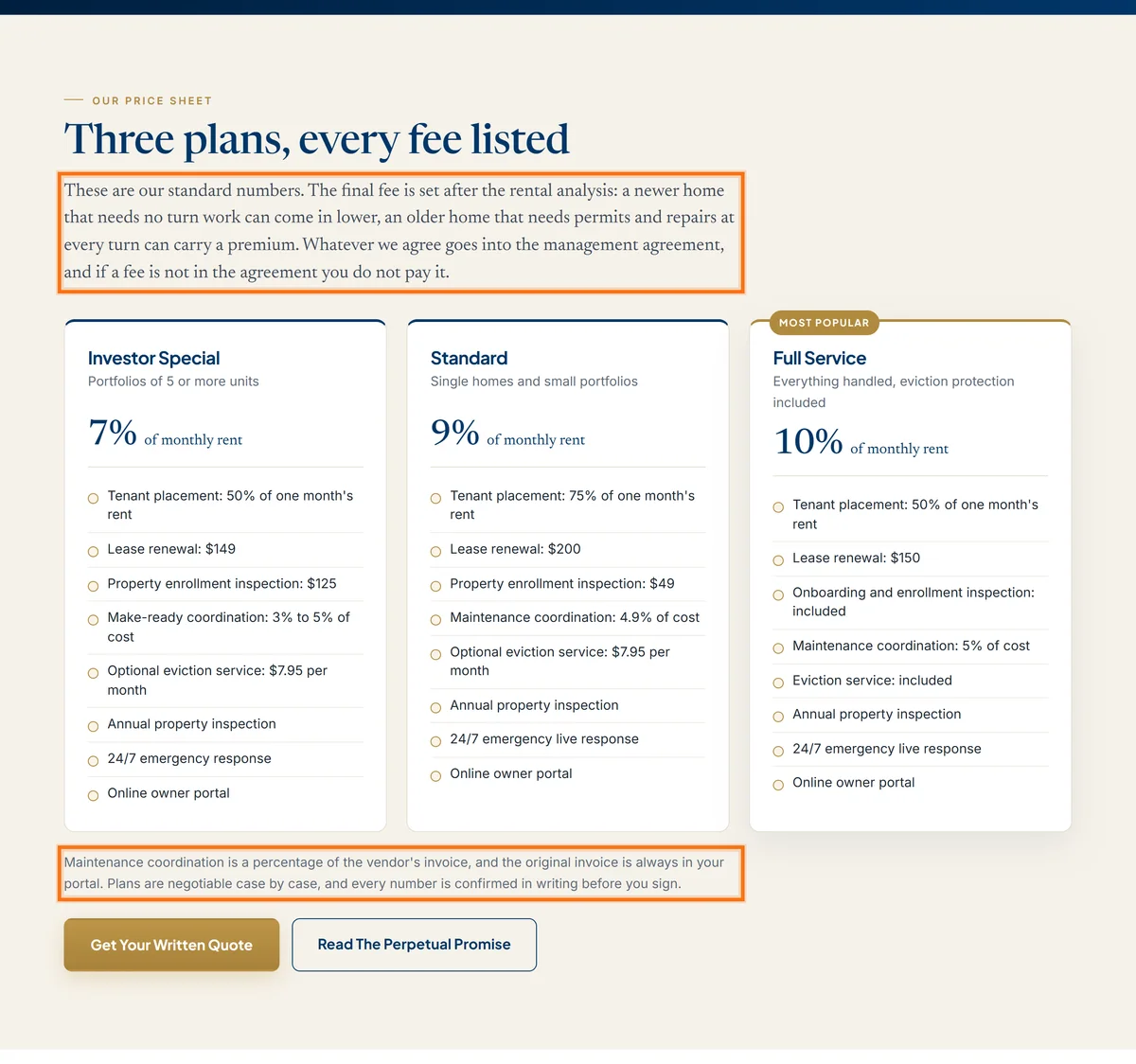
Whatever we agree goes into the management agreement, and if a fee is not in the agreement, you do not pay it. That is the right way to end any negotiation, with us or anyone else: the agreed number is in the signed document, not in a call.
Fees that usually move
One-time fees are the most flexible because they are the least connected to ongoing cost. A setup or onboarding fee is often reduced or waived for a transfer with a complete file, for a second property, or for a longer term. A leasing fee may be reduced on the second and later homes in a portfolio, or structured so it is not charged again if the manager's placed tenant leaves early.
Maintenance terms move more than owners expect. The percentage markup, if there is one, is often negotiable to a lower figure or to a flat coordination charge, and the approval threshold above which the manager must ask you is almost always adjustable. A renewal fee can sometimes be tied to an actual rent increase so you are not paying for a renewal that changed nothing.
Termination terms are negotiable and worth the effort. A shorter notice period, a lower early termination fee, or a clause that lets you leave without penalty if the manager fails a stated standard, such as not performing the inspections the agreement promises. The clause-by-clause view is in what to look for in a property management agreement.
What a good manager will not move on, and why that is good news
A well-run company holds its monthly fee close to its quoted figure, and the reason is worth understanding. That fee pays for the staff, the systems, the trust accounting, the inspections and the after-hours line. A manager who cuts it in half for one owner either loses money on that owner, which means that owner's calls get answered last, or recovers the money somewhere less visible. Neither is in your interest.
A manager will also not usually move on its screening standard, its reserve requirement or its inspection schedule. Those are the things that protect your asset, and an owner who negotiates them away has negotiated against themselves. If a manager folds on all of them the moment you push, ask what else folds under pressure from a tenant.
Treat a firm answer on the monthly fee as information. The company that says "this is what it costs to do it properly, and here is what you get" is telling you it has a cost structure it understands. The one that drops the price instantly either padded the first quote or does not know its costs.
Why a discount on the percentage is often the worst deal
Most owners negotiate hardest for a lower percentage. Here is what that is worth next to the other things on the table, using our Standard plan numbers and an example rent of $2,000 a month:
What each concession is worth in a year
| Concession | How it is calculated | Value per year |
|---|---|---|
| 1 point off the monthly fee | 1% of $2,000 x 12 months | $240 |
| One avoidable week of vacancy | About $460 a week at $2,000 rent | $460 |
| Renewal fee waived once | The Standard plan renewal fee | $200 |
| Coordination on $1,500 of repairs | 4.9% of $1,500 on the Standard plan | $73.50 |
| Moving from Standard to Investor Special | 9% to 7% on 5 or more units, $40 a month | $480 per home |
How to read this table: rent and repair totals are examples; the rates are our published price sheet. The single percentage point is real money but smaller than one week of vacancy, which is why a manager that fills the house faster is worth more than one that is a point cheaper. The last row shows where real leverage lives: more homes.
Run every quote through the fee comparison worksheet before and after the negotiation to see which concession was worth anything. If you would rather avoid percentage-based fees altogether, flat-fee vs percentage property management compares the two.
What to ask for instead of a lower percentage
These are the asks that change what you pay and what you receive, roughly in order of value:
- Invoices at cost. Vendor bills passed through with the original attached and no markup. On a home with a normal repair load this is worth more than any percentage point.
- A written inspection count. A stated number of in-person inspections per year, with photo reports, included in the fee.
- A leasing fee that is earned. A reduced or refunded leasing fee if a tenant the manager placed leaves or is evicted within the first months of the lease.
- A renewal fee tied to work. Charged only when the manager runs a market check and secures an increase, not for an automatic extension.
- A higher approval threshold only where you want it. Or a lower one, if you prefer to be asked. Either way, yours.
- A clean exit. A short notice period and no penalty if stated service standards are not met.
- Faster disbursement. An earlier payout date once rent has cleared.
Every one of these is a term, not a price. Terms are what you will live with for years. The price is what you will forget by the second statement.
How to have the conversation
Negotiate after the manager has seen the home and given you a written quote, not before. A quote given before the visit is a placeholder, and asking for a discount on a placeholder gets you a placeholder discount. Once the written quote is in hand, send your asks by email in one message, specific and in order of importance, with a short reason for each.
Reasons that work are the ones that lower the manager's cost: "I am bringing three homes, all updated in the last few years, all with tenants in place." Reasons that do not work are the ones about you: "I am on a tight budget" tells the manager you will be slow to approve repairs, which is the opposite of leverage.
Ask for the agreed changes to be written into the agreement or an addendum, not promised in an email. The person who quoted you may not be the person who runs your account next year. Then run the final numbers once more before you sign.
Renegotiating with a manager you already have
Most of the leverage in this guide applies just as well a year or two into a relationship, and owners rarely use it. The natural moment is when something about your account has changed: you added a second home, you replaced the roof and the HVAC so repair calls dropped, your tenant renewed for a third year, or the agreement is coming up for its own renewal.
Approach it the same way as a new negotiation: by email, specific, with the reason that lowers the manager's cost stated plainly. "Since the make-ready last year there have been two service calls in twelve months; I would like the maintenance coordination fee removed and the inspection count written in" is a request a reasonable manager can say yes to. A request for a general discount because you have been a client for a while is harder to grant and easier to resent.
If your current manager has been doing the work, the right ask may be nothing at all on price and something on terms: a faster disbursement, an added inspection, a lower approval threshold. If the manager has not been doing the work, the negotiation you want is the exit clause, and how to switch property managers covers the rest.
When the right move is not to negotiate
If a written quote is already clear, every fee is on one page, invoices are passed through with the original attached, inspections are counted and the agreement has a fair exit, there may be nothing worth negotiating. Pushing for a discount at that point mostly tells the manager you will be a price-first client.
There is also the quote far below the others. A fee that cannot cover the work gets recovered through add-ons or through neglect, and the neglect shows up as vacancy and deferred maintenance a year later. Compare on the full annual cost and on process. Our fees are on the pricing page and our written commitments on the guarantees page.
If you would like a written quote to negotiate from, ask us for one; we would rather discuss terms than trade percentage points.
The takeaway: Negotiate terms, not the percentage: invoices at cost, counted inspections, an earned leasing fee and a clean exit are worth more than any discount on the monthly number.
Questions owners ask
Are property management fees negotiable?
Some are. One-time fees, the leasing fee on a multi-property account, maintenance markups, renewal fees and termination terms move most often. The monthly management fee moves least, and a manager who discounts it deeply usually recovers the difference elsewhere.
What gives me leverage when negotiating with a property manager?
Bringing more than one property, a home in good condition with updated systems, a tenant in place with a clean payment history, a longer initial term and being an owner who approves repairs promptly. All of these reduce the manager's work or risk, which is what pricing is based on.
Should I choose the property manager with the lowest fee?
Not on the headline number alone. A low monthly fee is often balanced by higher per-event charges or by thinner service, and the cost of extra vacancy outweighs any fee difference. Compare the full annual cost and the process behind it.
What should I ask for instead of a discount?
Vendor invoices at cost with no markup, a written number of inspections per year, a leasing fee that is reduced if the tenant leaves early, a renewal fee tied to a real rent increase, your own repair approval threshold and a clean exit clause. These are worth more over time than a percentage point.
How do I avoid percentage-based property management fees?
Look for a manager that charges a flat monthly fee instead of a percentage of rent, and compare the full annual cost, since flat-fee plans often price leasing, renewals and repairs differently. Perpetual's plans are a percentage of monthly rent: 7%, 9% or 10% depending on the plan. The trade-offs are in our guide to flat-fee versus percentage management.
Can you refuse to pay property management fees?
Not fees you agreed to in a signed management agreement. You can question any fee that is not in the agreement, and with Perpetual a fee that is not in the agreement is not owed. Before signing, ask for every fee in writing and negotiate then.
Related services
Property management in Keller, North Richland Hills and Fort Worth. How full-service management works in Tarrant County →