Key takeaways
- Portfolio quotes come in three shapes: a per-door flat fee, a tiered percentage, or one blended rate for the whole account.
- With a tiered rate, ask in writing whether the lower rate applies to every door or only to the doors above the threshold.
- Per-event fees (tenant placement, renewals, inspections, repair coordination) decide more of the yearly total than a point on the monthly rate.
- Perpetual's Investor Special is 7% of monthly rent for portfolios of 5 or more units, with one agreement, one AppFolio owner portal and per-door reporting. Plans are negotiable case by case.
- Convert every quote to an annual dollar total for the whole account before you compare.
Property managers quote an owner with several rentals as one account, using a per-door flat fee, a tiered percentage that drops as doors are added, or a blended rate across the whole account. That holds whether the homes sit together in Keller, North Richland Hills and Fort Worth or are spread across DFW. The discount exists because the work per door drops when the statements, the banking and the relationship are shared.
This guide explains the ways managers structure pricing for multiple properties, what consolidated reporting and reserves should look like, the terms a portfolio owner should settle before the per-door number is even discussed, and how our own portfolio plan is priced.
How portfolio pricing strategies differ: the structures compared
These are the three structures a property manager can use to price an owner with several rentals, plus the named plan some companies publish, with the question each one should trigger:
| Structure | How it is written | Who it tends to favor | What to ask in writing |
|---|---|---|---|
| Per-door flat fee | The same dollar amount per home each month, whatever the rent | Owners whose homes rent at the higher end | Is the fee billed on a vacant home, and does it rise when rents rise? |
| Tiered percentage | One percentage up to a number of doors, a lower one above it | Owners at or just past a threshold | Does the lower rate apply to all doors or only the ones above the threshold? |
| Blended rate | One negotiated percentage for the whole account | Larger accounts with homes of similar condition | Which homes were priced into the blend, and what happens if one is sold or added? |
| A named portfolio plan | A published plan with a minimum number of units, such as our Investor Special at 7% for 5 or more units | Owners who meet the minimum | Which per-event fees come with the plan? |
How to read this table: the first column tells you which arithmetic to run, and the last column is the sentence to get answered before you compare rates. Two quotes with the same headline percentage can differ by more than a thousand dollars a year on the answers in that column.
What a manager sees when you bring several homes
From the manager's side, a portfolio is one owner account with several property records under it. One set of tax details, one disbursement, one statement, one person to call for approvals. That is where the savings come from, and it is why the discount is on the account rather than on each house.
The manager also sees the homes individually, and that is where the pricing gets careful. Five updated homes in Keller subdivisions with tenants in place are easy to price. Three of those plus two older houses with deferred maintenance and a tenant who is behind are not a volume discount; they are two problem properties that happen to arrive with three good ones.
Expect a good manager to want to see every property, or at least the inspection reports and rent ledgers, before quoting. A per-door number offered before anyone has looked at the doors is a marketing figure. How to think about growing past a few homes is in scaling a rental portfolio; this guide stays on how the management is priced.
The three structures managers use for portfolios
Most portfolio quotes take one of three shapes. The first is a per-door flat fee, the same dollar amount per home each month regardless of rent. It is simple and predictable, and it favors owners whose homes rent at the higher end. It does not reward the manager for raising rent, which is worth remembering at renewal time.
The second is a tiered percentage, where the rate drops once the account passes a certain number of doors. The tiers are usually written as thresholds: one rate up to a count, a lower rate above it. Ask whether the lower rate applies to all doors once the threshold is crossed or only to the doors above it, because the two readings produce different totals.
The third is a blended rate, a single percentage negotiated for the whole account that sits below the single-property rate. This is common for larger accounts and is the structure most open to negotiation on terms. Whichever shape is offered, the flat fee versus percentage trade-offs apply to each home inside it.
An illustrative example of how the structures compare
Say an owner has four homes renting at $1,800, $2,000, $2,200 and $2,600 a month, illustrative figures chosen to show the shape. Under a per-door flat fee, every home costs the same to manage, so the $2,600 home is managed at a lower effective rate than the $1,800 one. Under a percentage, the opposite: the higher-rent home carries more fee.
Now suppose the manager offers a tiered percentage with a lower rate above three doors. If the lower rate applies to all four, the owner saves on every home. If it applies only to the fourth, the saving is a fraction of that. Put illustrative rates on it: 10% dropping to 8%. If 8% applies to all four homes, the owner saves $172 a month, or $2,064 a year. If it applies only to the $2,600 home, the saving is $52 a month, or $624 a year. Same headline, a $1,440 difference, which is why the question has to be asked in writing.
The point of the example is not which structure wins, since that depends on the rents and the manager, but that the structure must be converted to an annual dollar total for the whole account before it can be compared. Running each quote through the fee comparison worksheet, one column per company with all four homes summed, is the fastest way to see it.
Leasing and renewal fees across several homes
The monthly fee gets the attention in a portfolio negotiation, but the per-event fees decide more of the total. With four homes and a new tenant every two or three years, there is a turnover somewhere in the account most years, so the leasing fee is effectively an annual cost rather than an occasional one.
Ask whether the leasing fee is reduced for the second and later homes, and whether it is reduced for homes that arrive with a tenant already in place and renew under the manager. Ask the same of the renewal fee. A portfolio with three renewals and one new lease in a year should not pay four full leasing fees.
Also ask what happens when the manager's own placed tenant leaves early. On a single home that is an occasional risk. Across a portfolio it will happen, and a leasing fee that is refunded or credited in that case is worth more than a point on the monthly rate.
Consolidated reporting: what the statement should show
At one door, an owner statement is a short list. At five, a statement that does not separate the homes is useless, and one that only separates them is almost as bad, because you cannot see the account as a whole. You need both views: a per-property section with rent, fees, maintenance and net for each home, and an account summary that totals them and shows the single disbursement.
Specific things to confirm before signing:
- Each home has its own ledger and its own maintenance history, visible in the owner portal.
- The monthly statement shows per-property net and an account total on the same document.
- Year-end reporting is produced per property as well as for the account, since your CPA will want both.
- Maintenance invoices are filed under the home they belong to, with the original attached.
- Inspection reports are stored by property with dates, so you can see which homes are due.
Ask for a sample portfolio statement, not a single-home one. A manager who has real portfolio clients will have one ready. For reference, we provide monthly statements and per-door reporting through one AppFolio owner portal that holds statements, documents and disbursement history. The anatomy of a single statement is explained in the owner statement explained.
Reserves: per property or pooled
Managers hold a reserve from each home's rent to pay for repairs without waiting for the owner. On a portfolio the question is whether the reserve is held per property or pooled across the account. Per property is cleaner for accounting and for the day you sell one home. Pooled is more efficient, because one home's quiet month funds another home's water heater without a call to you.
The practical answer for most owners is a per-property reserve with the manager's authority to move funds between homes on the same account when needed, with every transfer shown on the statement. Settle the reserve amount per home based on each one's age and systems rather than one figure for all. An older house with original HVAC needs a larger cushion than a newer build.
Reserve amounts and how they are held differ by company and are set in the management agreement, so get them in the written quote; how much reserve to keep per rental covers the sizing.
Confirm also how a negative balance on one home is handled: whether it is covered from the account's other homes, deducted from the next disbursement, or billed to you. All three are workable; surprises are not.
When one home in the portfolio is the problem
Portfolios accumulate, and most include one home that is older, further away or harder to rent than the rest. A manager pricing the account will price that home into the blended rate, so it pays to be honest about it up front and to decide what you want done.
Three options are reasonable. Bring the home up to the standard of the others before onboarding, which usually costs less than the extra vacancy and repairs it generates otherwise. Accept a different rate or a separate maintenance arrangement for that home while keeping the rest on the portfolio rate. Or sell it and redeploy the equity into something that fits the rest of the account; a broker-owned manager can handle the sale through its brokerage, and the mechanics are on the sell an investment property page.
What does not work is pretending the home is like the others and letting it quietly set the price for the whole account.
What to negotiate on a portfolio, beyond the rate
The rate is the visible lever. These matter more over a few years:
- One disbursement, one statement, one 1099 process, with per-property detail inside each.
- Leasing and renewal fees scaled for the second and later homes.
- Vendor invoices you can see: whether repairs are passed through at cost or carry a coordination percentage, with the original invoice attached either way.
- A single point of contact who knows every home on the account, rather than homes spread across several portfolio managers.
- Exit terms per property, so selling one home does not trigger an early termination fee on the account.
- An annual portfolio review covering rents, renewals, capital items coming due and which homes to hold or sell.
Most of these cost the manager little and are easy to say yes to for an owner bringing several homes. Our three plans, including the Investor Special for portfolios of 5 or more units, are on the pricing page, and if you want a quote built across your whole account, send us the addresses. If your homes sit in different cities, one property manager for houses in different DFW cities covers that decision.
Questions a portfolio owner should ask before signing
Ask these in one email and keep the answers with the agreement:
- Is the quoted rate per door, tiered, or blended, and if tiered, does the lower rate apply to all doors or only those above the threshold?
- How are leasing and renewal fees charged on the second and later homes?
- Is the reserve held per property or pooled, and how is a negative balance on one home handled?
- Will I receive one statement with per-property sections and an account total, and may I see a sample?
- Who is my single point of contact, and how many doors do they handle?
- What happens to the agreement and the fees if I sell one home or add another?
A manager with portfolio clients answers these without hesitation because the systems already exist. A manager who has mostly single-home owners will improvise, and improvisation across five homes is where statements stop reconciling.
How Perpetual handles this
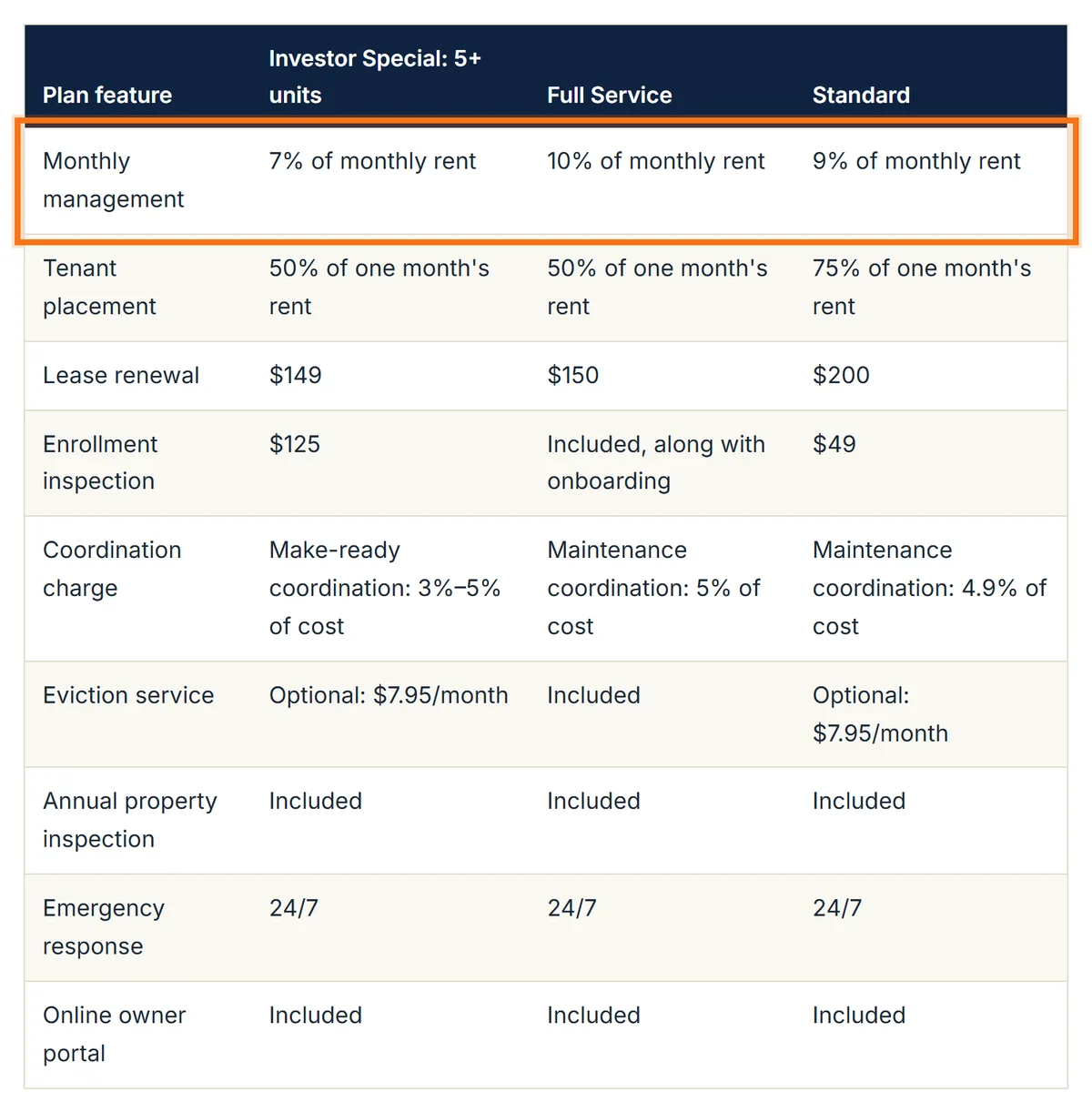
Our portfolio plan is the Investor Special: 7% of monthly rent for portfolios of 5 or more units, with one management agreement, one AppFolio owner portal and per-door reporting. That is where the conversation starts. Plans are negotiable case by case, the final fee is set after a free rental analysis, and every number is confirmed in writing before you sign. Here is the published plan next to our two other plans, with one line of arithmetic:
| Fee or service | Investor Special (5 or more units) | Full Service | Standard |
|---|---|---|---|
| Monthly management | 7% of monthly rent | 10% of monthly rent | 9% of monthly rent |
| Five homes at $2,000 rent each, per month (illustrative, not a quote) | $700 | $1,000 | $900 |
| Tenant placement | 50% of one month's rent | 50% of one month's rent | 75% of one month's rent |
| Lease renewal | $149 | $150 | $200 |
| Enrollment inspection | $125 | Included with onboarding | $49 |
| Coordination charge | Make-ready: 3% to 5% of cost | Maintenance: 5% of cost | Maintenance: 4.9% of cost |
| Eviction service | Optional, $7.95 a month | Included | Optional, $7.95 a month |
How to read this table: the first two rows are the monthly rate and what it comes to on an example account; the rows below are the per-event fees that this guide says decide more of the total. Ask us to confirm in the written quote which plan applies to each property and which charges apply at enrollment.
Three things sit behind the rate. Coordination is a percentage of the vendor's invoice, and the original invoice is always in your portal. Renewals start 120 days before each lease ends, with the rent checked against leased comparables. And The Perpetual Promise applies to every door: for example, if a tenant we place defaults and is removed, or breaks the lease, within the first 6 months, we find a new tenant with no additional leasing fee, subject to the Guarantee Addendum.
We are based in North Richland Hills, and for owners with several doors we manage portfolios across Tarrant, Dallas, Collin and Denton counties. Homes now split among several managers can be consolidated into one portal, each with its own handover; the switching managers page shows the order. Details for portfolio owners are on the portfolio management page. For a written quote across your whole package, call 682-593-7033.
The takeaway: Price a portfolio as one account with per-property detail, settle leasing fees, reserves and reporting before the rate, and make sure one home can leave without unsettling the rest.
Questions owners ask
Can I get a lower management rate if I have several rentals?
Often, because one owner account with several homes costs less per door to serve. The discount usually takes the form of a per-door flat fee, a tiered percentage that drops past a certain number of doors, or a blended rate. Ask whether a tiered rate applies to all doors or only those above the threshold, and how leasing and renewal fees are charged on each home. Perpetual's Investor Special is 7% of monthly rent for portfolios of 5 or more units, against 9% and 10% on our other plans, and the final fee is confirmed in writing.
How many rentals count as a portfolio for pricing?
It varies by company. Some adjust pricing from the second home, others set a threshold of several doors. Perpetual's Investor Special is for portfolios of 5 or more units; an owner with fewer starts on another plan and we revisit pricing as the holdings grow. The more useful question is what changes at each level: the rate, the leasing fee, the reporting or the point of contact.
Should the reserve be held separately for each rental?
A per-property reserve sized to each home's age and systems is the cleanest approach, with the manager allowed to move funds between homes on the same account when needed and every transfer shown on the statement. Confirm how a negative balance on one home is handled.
What should a portfolio owner statement include?
A section for each property showing rent, fees, maintenance and net, plus an account summary that totals them and shows the single disbursement. Year-end reporting should be available per property and for the account. Ask for a sample before signing.
What if I sell one of the homes under management?
The agreement should allow a single property to leave the account without an early termination fee on the others. Confirm that in writing, along with how the deposit, the lease and any reserve balance for that home are handled at closing.
How do portfolio pricing strategies differ for property managers?
Managers price a portfolio in one of three ways: a flat dollar fee per door, a tiered percentage that falls once the account passes a set number of doors, or one blended percentage for the whole account. They also differ on the per-event fees, such as tenant placement, renewals, inspections and repair coordination. Convert each quote to an annual total for all of your homes before comparing.
What costs should owners expect when transferring a residential portfolio to a new provider?
Three kinds. First, whatever each current agreement charges to leave, plus its notice period, property by property. Second, the new manager's enrollment charges: with Perpetual the enrollment inspection is $125 on the Investor Special, $49 on Standard and included with onboarding on Full Service. Third, later event fees such as a renewal or a new tenant placement. An occupied home does not need a new placement to be taken over. The written quote should show which charges apply at enrollment.
Can one company manage rentals in several DFW counties?
Some can; confirm the service area for every address before you compare rates. For owners with several doors, Perpetual manages portfolios across Tarrant, Dallas, Collin and Denton counties, and takes on a single property within about two hours of DFW when it is part of a package. We review the locations together to confirm the scope before you commit.
Related services
Property management in Keller, North Richland Hills and Fort Worth. How full-service management works in Tarrant County →