Key takeaways
- Portfolio scaling starts with one standard: the same lease, screening criteria, late-rent sequence and maintenance limit on every door.
- You need a statement for each property every month and a roll-up across all of them. A weak house hides inside a total.
- Tenant-specific clauses stay manageable when every exception is a written addendum listed per door, never a verbal promise.
- How much equity to keep in each rental is a trade-off between growth and cushion. The number belongs to your lender and CPA.
- Perpetual's Investor Special is 7% of monthly rent for portfolios of 5 or more units, across Tarrant, Dallas, Collin and Denton counties.
One rental can be run on effort. You remember the tenant's name, you know the water heater is old, you handle the renewal in an email. Somewhere between the third and the tenth door in Fort Worth, Keller or North Richland Hills, effort stops scaling and the portfolio starts running you: a repair in one house, a vacancy in another, a renewal you forgot, a statement you never reconciled.
Owners who grow past that point replace effort with systems. This guide covers what changes, how to move a portfolio onto one standard, how clauses and numbers are tracked across many leases, the equity question, and how to evaluate a property management company on scaling your rental portfolio.
What changes when you scale from one rental to a portfolio
Here is what changes between owning one rental and owning a portfolio, area by area:
| Area | With one rental | With a portfolio |
|---|---|---|
| Decisions | Made fresh each time, from memory | Made once and applied to every door: one lease, one screening standard, one late-rent sequence |
| Reporting | A bank statement and a folder | A statement for every door every month, plus a roll-up |
| Reserves | Covers one water heater | A reserve per door, plus a cushion for the month two systems fail |
| Lease dates | One renewal a year | Expirations spread across the year so homes are not vacant together |
| Lease exceptions | You remember them | Written as addenda and listed per door |
| Buying | Find a house, then find a manager | The manager reviews the house before the offer |
| Your job | Doing the work | Reading the reports and making the large decisions |
How to read this table: the right column is the system that has to exist before the next purchase, not after it. If a row is still in the middle column at five doors, that row is where the next problem will come from.
The shift from effort to systems
With one house, every decision can be made fresh. With ten, decisions have to be made once and applied every time: the screening standard, the lease, the late-rent sequence, the maintenance threshold, the renewal timing, the make-ready checklist. If each house has its own rules because they were bought at different times from different sellers, you have ten small businesses instead of one.
The first job of scaling is standardizing. Every property goes on the same lease, the same screening criteria, the same rent-collection method, the same inspection schedule. Tenants inherited with a purchase are brought onto the standard at their first renewal. It feels like bureaucracy until the month three things go wrong at once and the process handles two of them without you.
The same goes for documents. One lease template, one set of addenda, one screening form, one move-in checklist. When a question comes up about a property, the answer should be in the same place for every property, not in an email thread from the year you bought it.
Change management: moving a rental portfolio onto one standard
Change management for a rental portfolio is mostly sequencing. The houses were bought at different times, with different leases and sometimes different managers, and they cannot all change on the same day.
- Inventory each door: the lease and its end date, the deposit, the tenant ledger, keys, open repairs and any promises made to the tenant.
- Read each existing management agreement for its notice and termination terms before picking a date.
- Move tenants onto the standard lease at their next renewal, not mid-term. The lease in force stays in force until then.
- Tell each tenant in writing where to pay and how to request repairs, once.
- Check the first statement for each door against the lease and the ledger you started with.
If the homes sit with several companies, each one needs its own handover. Our switching page lays out the order we follow, and one property manager for several DFW cities covers the consolidation decision.
How do portfolio managers track tenant-specific clauses at scale?
By refusing to let a clause live anywhere except the lease file. At one house you remember that the tenant may keep a second dog or that the owner maintains the pool. At twenty, memory fails, and the exception surfaces as a dispute.
The method is plain. Every door starts from the same lease form. Anything different for one tenant, such as a pet approval, a lawn or pool arrangement, an appliance the owner will not repair, or a renewal option, is written as an addendum or special provision and signed. Then each door gets a one-line list of its exceptions, kept with the lease documents and read again when the renewal review starts. A promise that is not in the file does not exist for the next person who handles the home.
The guide to lease addenda for Texas landlords covers what belongs in writing.
Reporting and portfolio analytics: every door, every month
A single rental can survive on a bank statement and a shoebox. A portfolio needs a monthly view per property and a rolled-up view across all of them. Without that, the underperforming house hides inside the total.
Owners with larger books ask how to get portfolio analytics across a hundred leases. The answer is less about software than about recording the same few numbers for every door, the same way, every month: rent collected against rent scheduled, days vacant at each turnover, lease expirations by month, and maintenance cost per property. With those four in one sheet, a hundred leases sort themselves into the five that need attention. The rental performance KPIs guide defines each one.
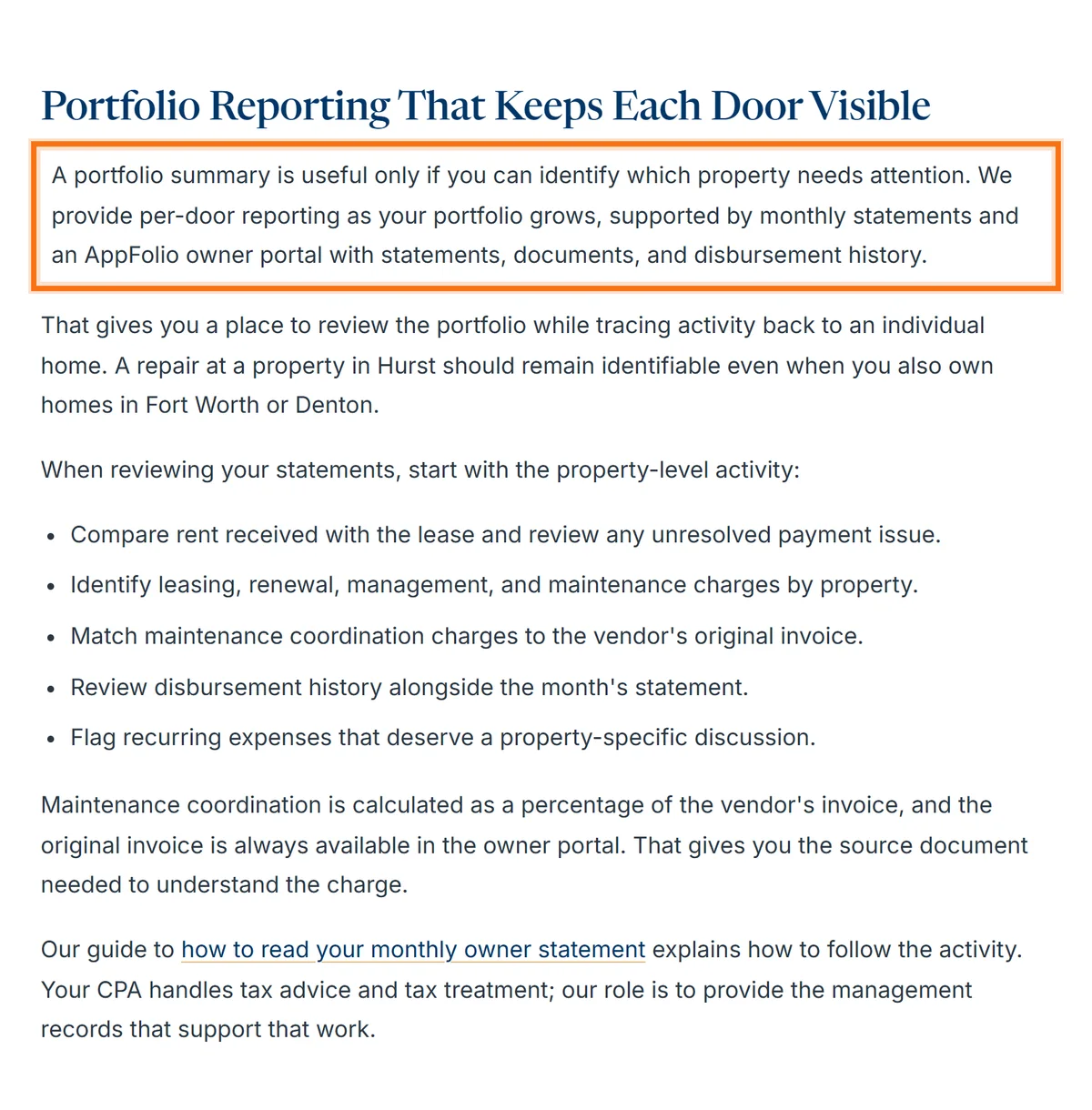
Review the roll-up monthly and the per-property detail quarterly; the roll-up tells you that something changed, the detail tells you where. See what the owner portal holds and how the monthly statement is laid out.
Reserves: one reserve per door, plus a portfolio cushion
With one house, a reserve covers the water heater. With fifteen, the question is not whether something expensive will fail in a given year but which house it will be in. HVAC replacements, roofs after a hail season and foundation work do not take turns, and a hail event or a hard freeze can hit several properties in the same week. Keep a per-property reserve for routine repairs, and a separate portfolio cushion in your own account sized to a major system replacement or two.
Vacancy works the same way. One empty house out of one is a crisis; one out of twelve is a line item. Budget a vacancy allowance across the portfolio and stop treating each turnover as an emergency. The reserves and disbursements guide explains how a manager-held reserve operates.
How much equity should I keep in each rental when scaling?
There is no official number, and we will not invent one. It is a trade-off, and you should see both sides before your lender and CPA help you set it.
More equity in each house means a smaller payment, so the home still carries itself through a vacant month or a large repair, and a refinance or sale is easier if plans change. The cost is slower growth, because the cash is tied up in houses you already own. Less equity frees cash for the next purchase and leaves a thinner margin on every door, which matters most in the month several things go wrong together.
Two practical points. The lender sets the floor: each loan has its own down payment and reserve requirements, and those are the lender's to state, not ours. And equity is not a substitute for cash reserves, because you cannot pay a roofer with equity. How you hold title also affects financing and liability; the LLC overview for Texas rentals covers that. This is general information, not legal or financial advice.
Buying the next door with the manager at the table
At scale, the acquisition process should run through the manager. Before you make an offer, ask for the rent range from leased comparables, a view on the make-ready work, and a read of the HOA rules. A house that is cheap to buy and slow to lease is not cheap. The guide to evaluating a rental before you buy is the checklist.
Because Perpetual is broker-owned, the buying side and the management side are the same conversation, and the house you are considering is judged by the people who will have to lease it.
From ten doors to forty: what the owner's job becomes
At ten doors a self-managing owner is a full-time landlord with another job. At forty, the work is a team's work. What the owner does at that size is different: review the portfolio report monthly, approve large repairs and capital items, set the renewal and rent strategy with the manager, decide what to buy and what to sell, and keep the financing and entity structure in order.
The owners who make this transition well stopped doing the work early and started reading the reports instead. They also keep their buying discipline: a house that does not pass the management-first checklist does not get an offer, however attractive the price. The management agreement should reflect scale too: consistent reporting across every property, a maintenance spending limit that fits a portfolio, and every fee listed in writing.
How to evaluate a property management company on scaling your rental portfolio
Ask every company the same questions and compare the written answers. These are the ones that matter at scale, with what Perpetual publishes for each:
| Question to ask | Why it matters at scale | What Perpetual publishes |
|---|---|---|
| Is there a portfolio rate, and from how many units? | The fee is multiplied by every door | Investor Special: 7% of monthly rent for portfolios of 5 or more units |
| Will I see each property separately? | A weak house hides inside a total | Per-door reporting, monthly statements, and an AppFolio owner portal with statements, documents and disbursement history |
| What do you charge on repairs, and can I see the invoice? | It repeats on every door, every year | Coordination is a percentage of the vendor's invoice (make-ready 3% to 5% of cost on the Investor Special), and the original invoice is always in the portal |
| Can you cover every city I own in? | Two managers means two standards | Portfolios across Tarrant, Dallas, Collin and Denton counties |
| When do renewals start? | Late renewals turn into stacked vacancies | 120 days before lease end, with rent checked against leased comparables |
| What happens if you miss your own standard? | A promise needs a consequence | Five written guarantees in The Perpetual Promise, subject to its Guarantee Addendum |
How to read this table: the left column works for any company. If an answer is not on the company's website or in its agreement, ask for it in writing before you compare prices. Portfolio pricing for multiple rentals walks through the fee comparison.
How Perpetual handles a growing portfolio
Perpetual Property Management is broker-owned, with our office at 5755 Rufe Snow Dr in North Richland Hills. Our home market is Keller, North Richland Hills and Fort Worth, and for owners with several doors we manage portfolios across Tarrant, Dallas, Collin and Denton counties under one management agreement and one owner portal.
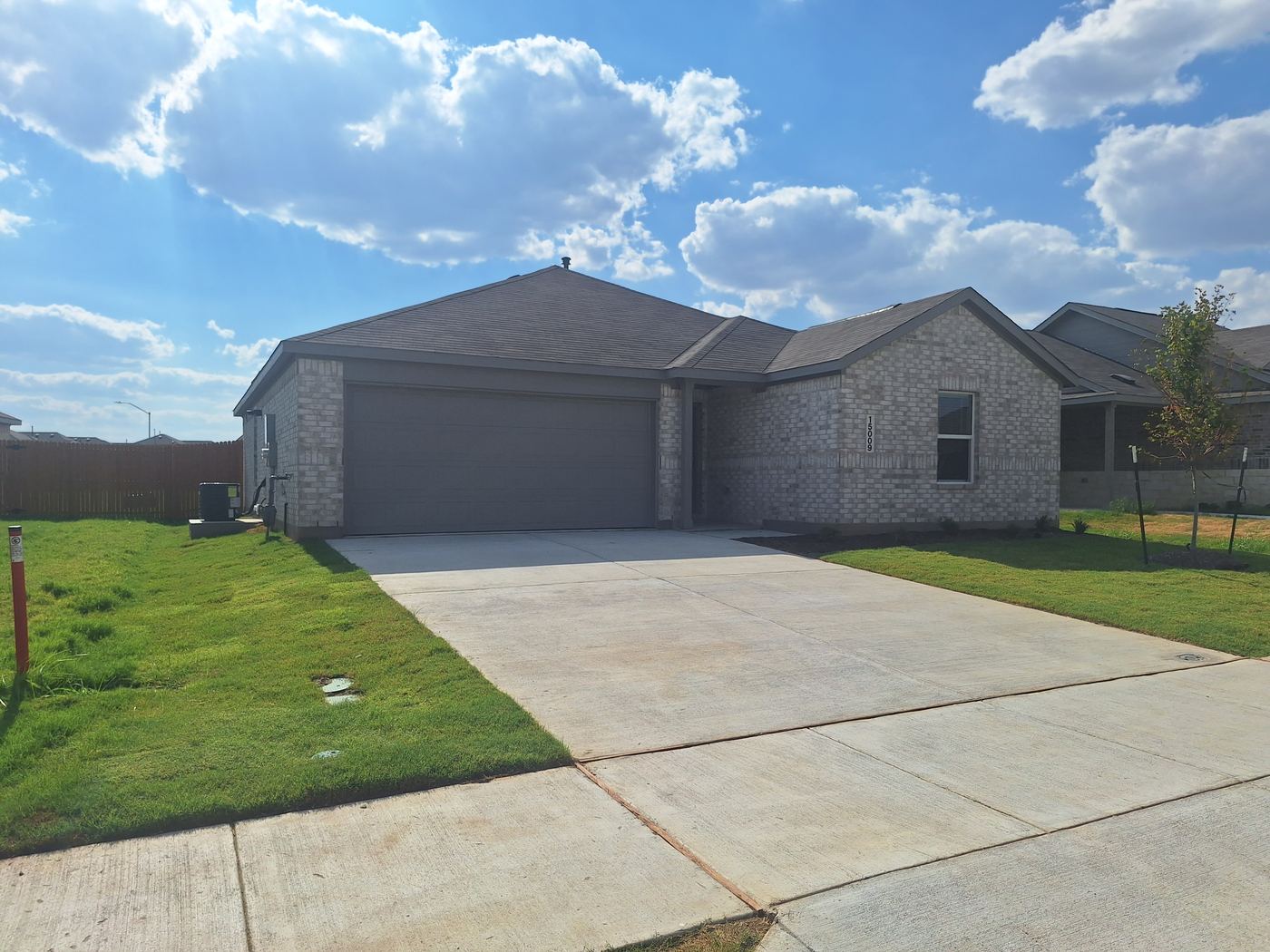
The Investor Special is 7% of monthly rent for portfolios of 5 or more units, with tenant placement at 50% of one month's rent, lease renewal at $149, a $125 enrollment inspection per property, and optional eviction service at $7.95 a month. If you own one rental today, we can start on another plan and revisit pricing as your holdings grow. The final fee is set after a free rental analysis.
Homes with tenants in place can move to us without waiting for a vacancy: the lease, deposit and records transfer, and tenants get new payment and maintenance instructions. Through our affiliated brokerage, Perpetual Realty Group, a property manager can review a prospective house before you buy it. What our site does not spell out, such as a custom report format or how lease exceptions are flagged for your homes, is confirmed in writing before you sign.
See portfolio property management and pricing, or to talk through the next door, call 682-593-7033.
The takeaway: Scaling a rental portfolio means replacing your effort with standard processes, monthly per-door reporting, layered reserves and a manager who is at the table before you buy the next door.
Questions owners ask
At what point should a rental owner hire a property manager?
When the time, distance or stress stops being worth the fee, which for many owners is the first house and for most owners is well before the fifth. Past ten doors, self-managing well is a full-time job, and past that it is a team's job.
How much should I keep in reserve for a rental portfolio?
A per-property reserve for routine repairs, plus a portfolio cushion in your own account sized to at least one major system replacement. Larger portfolios set the cushion with their CPA and lender. The point is that an HVAC failure in one house should never be a crisis.
Can a property manager handle properties across different cities?
Yes, within the manager's real service area. Perpetual's home market is Keller, North Richland Hills and Fort Worth, and for owners with several doors we manage portfolios across Tarrant, Dallas, Collin and Denton counties under one agreement with one portal. We review the locations together before you commit.
Do I need an LLC to scale a rental portfolio?
It depends on your liability, financing and tax situation, and the answer changes as the portfolio grows. Many owners move properties into an entity at some point, but it affects loans and insurance. Work it out with an attorney, a lender and a CPA before the next purchase.
Can a property manager track income and expenses separately for each of my rentals?
Yes, and a portfolio needs it, because without a per-property view the underperforming house hides inside the total. Perpetual provides per-door reporting, monthly statements and an AppFolio owner portal with statements, documents and disbursement history, and the vendor's original invoice is always in the portal. Lenders will want the same clean statements when you finance the next purchase.
Can a property manager help me plan for more rentals as my portfolio grows?
A good one should be at the table before you buy, not after. Before you make an offer, ask the manager for a rent range from leased comparables and a view on the make-ready work. Through our affiliated brokerage, Perpetual Realty Group, a property manager can review a prospective house before purchase, and we revisit portfolio pricing as your holdings grow.
How much equity should I keep in each rental when scaling?
There is no official number. More equity per house means a smaller payment and more cushion through a vacancy or a large repair, at the cost of slower growth. Less equity frees cash for the next purchase and thins the margin on every door. Your lender sets the minimum for each loan, and the target above it is a decision to make with your lender and CPA.
How do we get portfolio analytics across a hundred leases?
Record the same few numbers for every door every month: rent collected against scheduled, days vacant per turnover, lease expirations by month and maintenance cost per property. Then insist on per-door reporting from your manager, not only a total. With those in one place, the handful of leases that need attention stand out.
Property management in Keller, North Richland Hills and Fort Worth. How full-service management works in Tarrant County →