Key takeaways
- The lease is a contract between you and the tenant. A manager closing does not end it, change the rent or move the due date.
- What you need back, in writing and with a date: the security deposit, any reserve, rent not yet paid out, the lease, the tenant ledger and the keys.
- Texas Real Estate Commission rules treat rent and deposits a broker holds as trust money that must sit in a trust account, apart from the company's own funds.
- You remain the landlord. The tenant's deposit must still be refunded on time at move-out, whether or not the old company sends it to you.
- Tell the tenant where to pay before the next rent date. Rent sent to a closed company is the hardest money to get back.
Your rental does not go anywhere when the management company closes. If you own a rental in Fort Worth, Keller or North Richland Hills, the lease with your tenant is still a valid contract, the house is still yours, and the rent and the security deposit are still accounted to you. What ends is the management agreement, and with it the company's authority to collect rent, hold funds, order repairs and speak for you.
The practical problem is what the company was holding for you. This guide lists what to ask for and in what order, what Texas law says about that money, and how to tell a closing from a sale. The full guide to a manager closing or selling covers the longer version.
What to get back when a property management company closes
These are the items a closed company was holding for you, why each one matters and what to do if it does not arrive:
| Item | Why you need it | If it does not arrive |
|---|---|---|
| Security deposit and a written statement of the amount | You are still the landlord, and the deposit must be refunded or accounted for within 30 days after the tenant moves out (Property Code 92.103) | Demand it in writing from the broker named on the agreement; keep proof of the amount from the lease |
| Your reserve and any rent collected but not paid out | It is your money, held as trust money | Written demand with a date, then a complaint to the Texas Real Estate Commission and a talk with an attorney |
| Signed lease, addenda and the move-in condition report | They prove the rent, the deposit and the condition of the house at move-in | Ask the tenant for a copy of the lease; use your own emailed copies |
| Tenant ledger | It shows what the tenant has paid and what is owed | Rebuild it from your owner statements and bank deposits |
| Keys, codes and garage remotes | Access to your own house | Rekey and give the tenant the new key the same day |
| Open work orders, vendor invoices and warranties | So unfinished repairs are not paid twice or forgotten | Ask the tenant what is still open and call the vendors on your statements |
| Year-to-date income and expense statements | You need them for your tax return | Download every statement from the portal while it still works |
How to read this table: work from the top. The first two rows are money and the most urgent; the rest are records you can rebuild if you have to. Put all seven in one written request with a deadline, so there is a dated record of what you asked for.
The lease survives, the management agreement does not
A Texas residential lease is a contract between the owner and the tenant. The manager signs it as your agent, which is why the tenant's obligations run to you, not to the company. If the company disappears, the tenant still owes rent on the first, still has to give notice to move out, and still has the right to the quiet use of the house until the lease ends.
The management agreement is a separate contract between you and the company. Read its termination clause: many agreements let you end the contract for breach, and a company that has stopped collecting rent and answering you is not performing. Send written notice anyway, to the address in the agreement and to the broker's email, so there is a dated record of the end.
One consequence owners miss: until you or a new manager tells the tenant where to pay, the tenant will keep paying the old portal. Each rent payment that lands in a closed company's account is harder to recover than the last.
Where the risk actually sits: money the company holds
Managing rental property for others is real estate brokerage in Texas, so the company works under a broker's license. Texas Real Estate Commission rule 535.146 defines rent and security deposits held for someone else as trust money. A broker must keep it in a designated trust account and may not mix it with personal or operating funds. That separation is what protects your deposit and your reserve when a company fails. Whether the money was kept that way is what you find out when a company closes badly.
Three balances matter, in this order:
- The security deposit. You remain the landlord, and the landlord must refund the deposit within 30 days after the tenant surrenders the house (Property Code 92.103). Get a written statement of the balance and ask for its transfer first.
- Your reserve, the repair float the company held for you. Ask for the balance and the final statement that shows what it was spent on.
- Rent in transit, meaning rent the tenant paid this month that has not been sent to you yet. Ask for the date it was received and the date it will be paid out.
The same rule gives you a deadline to quote: after a written demand, a broker must pay trust money to the party entitled to it within a reasonable time, which the Commission sets at no later than the 30th day after the demand. A broker must also keep trust account records for four years, so the paperwork should exist even if the office is closed.
If the money is not returned
The broker named on the agreement is who you pursue, and a business entity's designated broker answers with it. Under Occupations Code 1101.652(b), failing to account for or remit money that belongs to another person within a reasonable time, and commingling it with the broker's own money, are grounds for the Commission to suspend or revoke the license. Section 1101.652(a)(5) adds failing to surrender a document the owner requests.
A complaint to the Texas Real Estate Commission is filed in writing through its online portal, with your name and copies of the agreement, statements and emails. The Commission says it cannot investigate an incident that is four or more years old, and it cannot order a license holder to pay you damages. Money is recovered in court.
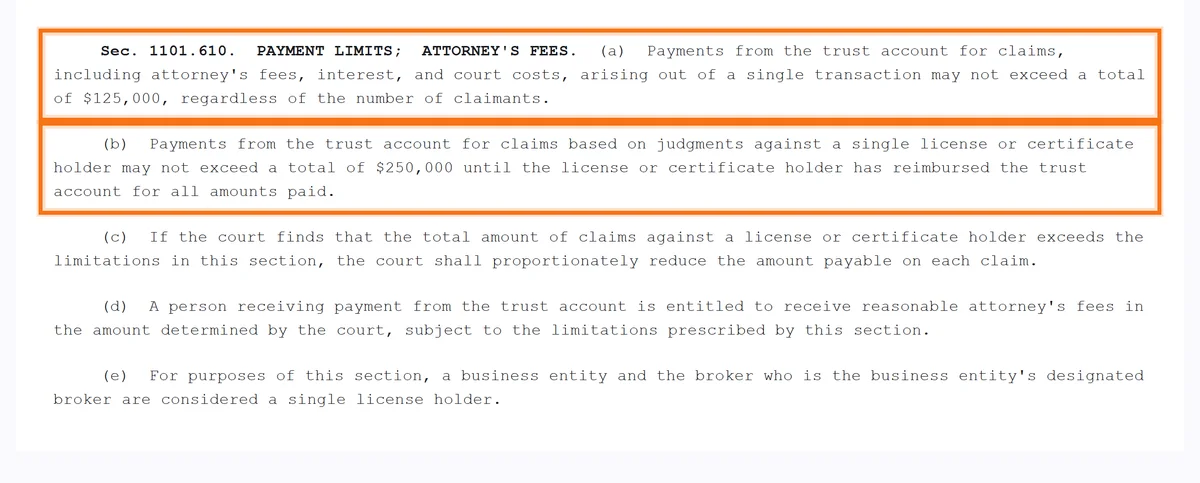
That account is a last resort, not a refund desk. You first need a court judgment against the license holder for conduct covered by section 1101.602, and you must show the judgment could not be collected (1101.606). The suit has to be filed within two years after the claim arises (1101.605). If many owners claim against the same broker, the court reduces each payment proportionately (1101.610(c)). This is general information, not legal advice. For a large unreturned balance, talk to an attorney early.
What to do in the first week
Work the list in order. Each step closes off a way to lose money or control.
- Send written termination to the company and keep a copy. Cite the termination clause and request the seven items in the table above by a stated date. Send it to the address in the agreement and to the broker's email.
- Write to your tenant the same day. Confirm the lease is unchanged, name the new payee and address for rent, and give one phone number for repairs. Until a new manager is in place, that number is yours.
- Rekey the house if you cannot confirm who holds keys, and give the tenant the new key the same day. The cost is small next to an unknown key in circulation.
- Call your insurance agent. If the company was named on your policy, confirm in writing that your landlord coverage stands on its own.
- Pull your own records: bank deposits from the company, every owner statement you were emailed, and the signed lease. You may need to rebuild the ledger from your side.
One more notice matters. Property Code 92.201 lets a tenant ask who owns and who manages the home, and the answer is due in writing within seven days. Your letter in step 2 answers that before the tenant has to ask. If you plan to hire a new company, the guide to switching without interrupting rent payments shows how the payment change is timed.
A closing is different from a sale to another company
Many "the company is gone" situations are actually a sale. The owner of the company retires or sells the portfolio, and a different company starts emailing you as if nothing happened. In a sale, your agreement is usually assigned to the buyer, and whether that is allowed without your consent depends on the assignment clause you signed.
You are not obliged to stay. A sale is a fair moment to ask the buyer the same things you would ask any new manager: who holds the broker's license, where the deposit sits, what the fees are now, and a copy of the agreement they intend to work under. If the answers are vague, the assignment clause does not trap you. The termination clause still works.
In a true closing there is no buyer, and the broker still has to account for everyone's funds and hand back owners' documents. That is where speed matters. The owners who write first, with a specific list and a date, get served first.
What protects you before it ever happens
You cannot stop a company from failing, but you can make a failure cheap. The protection is in the agreement and in your habits.
- Confirm the deposit is held in a broker trust account, and that the monthly statement shows it. A company that holds deposits in its operating account is the one that cannot return them later.
- Keep the signed lease, the move-in condition report and every monthly statement in your own storage, not only in the company's portal. Portals go dark when companies do.
- Read the termination and assignment clauses before signing. A short notice period and a right to terminate for breach are what let you leave quickly.
- Know who the broker is. A broker-owned company has one licensed person whose name is on the agreement and who answers for it. That is the person the regulator holds responsible.
The agreement checklist covers those clauses in detail, and the guide to how your money flows through a manager shows what a clean monthly statement looks like.
One habit costs nothing: once a year, look up the broker in the Commission's License Holder Search and confirm the license is active. Related reading: how to know your rent and deposit money is protected and what to do when an old manager will not release keys or records.
How Perpetual handles this
Perpetual Property Management is broker-owned. Justin Brown is a Texas broker and owns both Perpetual Property Management and our affiliated brokerage, so there is one accountable license holder, not a franchise office or a corporate parent. Our office is at 5755 Rufe Snow Dr in North Richland Hills, and we manage homes in Keller, North Richland Hills, Fort Worth and nearby. You receive monthly statements, and the AppFolio owner portal holds your statements, documents and disbursement history. Download them as you go, which is what you would want if any company ever stopped operating.
When an owner comes to us from a company that closed or was sold, we work the way our switching page describes. We review the old agreement and its notice terms, request the lease, security deposit, keys, tenant ledger, property records and open work orders, and give the tenant new payment and maintenance instructions. Then we complete an enrollment inspection so there is a condition record from the day we start. Homes with a tenant already in place are a normal takeover for us.
Our plans are 10%, 9% or 7% of monthly rent, and if a fee is not in your management agreement, you do not pay it. How your deposit and reserve are held, the reserve amount and the termination terms are confirmed in writing before you sign. If your manager has gone quiet or closed, call 682-593-7033 and we will tell you what to request from the old company first.
The takeaway: The lease and the money are yours and the company only held them, so get the deposit, the ledger and the keys back in writing this week and put the tenant's next payment somewhere that is accounted for.
Questions owners ask
Can a closed property management company keep my tenant's security deposit?
No. The deposit secures the tenant's lease with you, and as the landlord you must refund or account for it within 30 days after the tenant moves out (Property Code 92.103). If the company does not transfer it, you may have to refund the tenant from your own funds and pursue the broker for the money. Request the balance in writing first, and name the broker in any complaint to the Texas Real Estate Commission.
Do I need a new lease with my tenant if the management company closes?
No. The lease is between you and the tenant and stays in force on the same terms. What the tenant needs is a written notice naming the new person or company authorized to collect rent and receive repair requests. A new manager will usually send that notice with you and offer the tenant a new payment method the same week.
How do I find out who the broker was at a closed property management company?
The broker's name should be on your management agreement, and the Texas Real Estate Commission's License Holder Search on trec.texas.gov shows the broker and the license status. A license that is no longer active is a strong sign the business has ended. Save a copy of the lookup result with your records.
Should I hire a new property manager right away or manage it myself for a while?
Decide before the next rent date. Managing it yourself for a month can work if you can collect rent, answer repair calls and keep the deposit separate from your own money. The handover is simplest when one company replaces the other in a single tenant notice, and a new manager can request the old company's records as part of the takeover.
What happens to my rental if the property management company goes out of business in Texas?
The lease, the tenant and your ownership stay exactly as they were. The management agreement ends, so the company can no longer collect rent or approve repairs for you. Your job is to get back the deposit, any reserve and unpaid rent, plus the lease, ledger and keys, and to tell the tenant in writing where to pay next.
Should my tenant keep paying rent to the closed company?
No. As soon as you know the company has stopped operating, tell the tenant in writing where to pay: to you, or to the new manager. The lease and the rent amount do not change, only the payee. Ask the tenant for proof of any payment already sent this month so you can include it in your demand to the old company.
Can I recover money from the Texas Real Estate Recovery Trust Account?
Possibly, but only after a lawsuit. You need a court judgment against the license holder for conduct covered by Occupations Code 1101.602 and proof it could not be collected. Payments are capped at $125,000 per transaction and $250,000 per license holder (1101.610), and the suit must be filed within two years (1101.605). An attorney can tell you whether your claim fits.
Related services
Property management in Keller, North Richland Hills and Fort Worth. How full-service management works in Tarrant County →