Key takeaways
- No Texas statute sets a number of days for returning keys and records. The deadline is in your management agreement's termination clause.
- Failing to surrender an owner's document without just cause, or to account for money within a reasonable time, is a ground for license discipline (Occupations Code 1101.652).
- Address the demand to the broker, who is responsible for trust funds under Commission Rule 535.2.
- A TREC complaint can lead to discipline, not to a payment order.
- Do not wait on the keys. You can rekey, as long as the tenant is never locked out (Property Code 92.0081).
When an old property manager will not release keys or tenant records, send a written demand to the company's broker with a deadline, escalate to the Texas Real Estate Commission if it is ignored, and in the meantime rekey the house and rebuild the records from the tenant and your own bank statements. The usual scene on a rental in Fort Worth, Keller or North Richland Hills: the agreement has ended, and the keys are still in their lockbox, the lease is in their software and the deposit ledger has not arrived.
This guide covers what a departing Texas manager owes you, the escalation steps in the order that gets results, and how to rekey the house and rebuild the file if nothing ever comes.
The escalation steps, in order
Here are the escalation steps when a former manager will not release keys, tenant files, bank reconciliations or system access, what each one rests on and what it can realistically get you:
| Step | What it rests on | What it can get you |
|---|---|---|
| 1. Read the termination clause | Your management agreement | The list of what is owed and by when. No statute sets the number of days. |
| 2. Written demand to the broker | Occupations Code 1101.652; Commission Rules 535.2 and 535.146 | The file, the keys and a final accounting, often without going further |
| 3. Complaint to the Texas Real Estate Commission | Filed in writing through the Commission's online portal, within four years of the incident | An investigation and possible discipline. Not a payment order. |
| 4. Attorney letter or court claim | Your agreement; justice court hears claims up to $20,000 (Government Code 27.031) | Money that is owed: the deposit, the reserve, undisbursed rent |
| Meanwhile: rekey and rebuild | Your ownership; the tenant's copies; your bank records | A house that is not stuck while steps 2 to 4 run |
How to read this table: steps 1 to 4 run in order, and the last row runs alongside all of them from day one. Nothing in the first four steps is a reason to leave the old keys in circulation.
What a departing manager is obliged to hand over
Two things bind the old manager. The first is your management agreement. Read its termination section now: what is returned, and within how many days. That clause, not a statute, is where your deadline comes from.
The second is Texas licensing law. A company that leases homes and collects rent for owners works under a broker's license, and three rules sit behind a records request:
- Documents. Under Occupations Code 1101.652(a)(5), the Commission may suspend or revoke a license if the holder fails to surrender to the owner, without just cause, a document or instrument the owner requests that is in the license holder's possession.
- Money. Under 1101.652(b)(9), the same applies to failing within a reasonable time to properly account for or remit money that belongs to another person. Rule 535.146 treats rent and security deposits as trust money and requires a documentary record of every deposit and withdrawal.
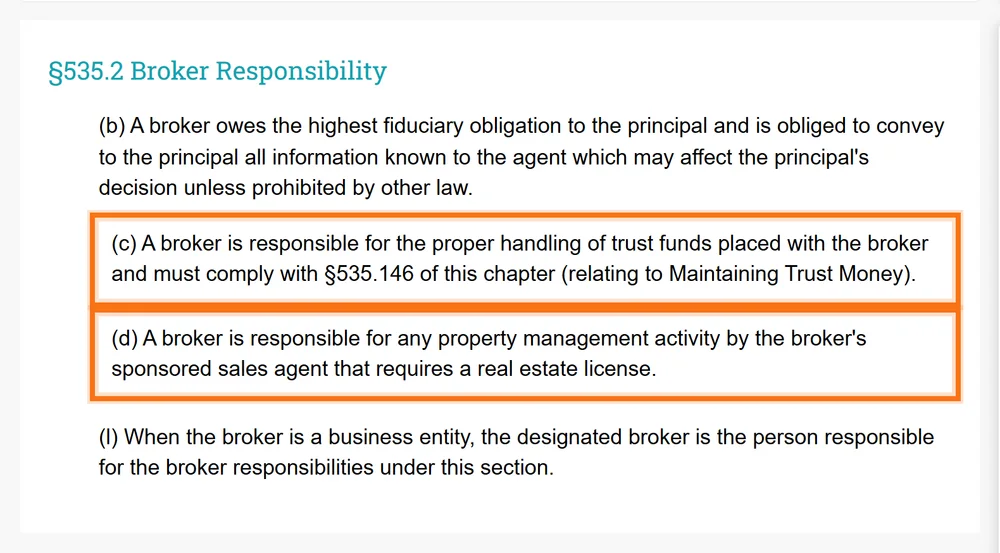
- The broker answers for it. Rule 535.2 makes the broker responsible for the proper handling of trust funds and for property management activity by sponsored sales agents.
In practice, ask for:
- All keys, remotes, gate cards, lockbox codes and smart-lock access.
- The signed lease, every addendum, the rent ledger and notices served.
- The security deposit, or its transfer to your new manager, with an accounting.
- Move-in condition reports, inspection reports and photos.
- Open work orders and vendor invoices.
- Your reserve balance, a final statement and, if your agreement provides for them, the bank reconciliations behind it.
A specific list is far harder to ignore than "send me everything." The normal handover is covered in how to switch property managers; this guide is for when it fails.
Step one: the written demand, to the broker
Many stalls are not malice: the person who handled your account left, or your file sits in a pile. A dated written demand moves it to the top. Send it by email and by a method that creates a delivery record, and address it to the company's broker, not the property manager you dealt with. For a company, that is the designated broker, whose name you can find in the Commission's license holder search (how to look up a license).
The demand should contain:
- The property address and the date the agreement ended.
- The termination clause, quoted word for word.
- The numbered list of items owed.
- A deadline that matches the agreement, or a week or so out if the agreement gives none.
- A plain sentence that you will file a complaint with the Texas Real Estate Commission if the items are not received.
Keep the tone flat: you are documenting, not arguing.
Step two: the Texas Real Estate Commission complaint
If the deadline passes, file a complaint with the Texas Real Estate Commission, the state agency that licenses brokers and sales agents. Its site says how:
- Complaints are filed online through the Commission's license management portal, in writing. It cannot take one by phone, and it cannot accept an anonymous one.
- You have four years after the incident to file.
- Attach copies, not originals: the agreement, the demand letter, proof of delivery, emails.
- You should hear within 30 days whether the Commission is moving forward.
Know the limits before you file. The Commission's page says contractual disputes with a license holder generally are not matters it can address, so build the complaint on the license rules above: documents not surrendered, money not accounted for. It also says the Commission has no authority to order a license holder to pay damages, and that it cannot say how long an investigation will take.
So a complaint is a record and a reason for the broker to answer, not a collection method. If money is missing, talk to an attorney about a demand under the agreement and, if needed, a court claim. This is general information, not legal advice.
Keys: rekey the house and move on
Do not wait for the keys. You own the house and can have the locks rekeyed, on one condition that matters more than any other: the tenant is never locked out. Property Code 92.0081 bars a landlord from intentionally preventing a tenant from entering the home except by judicial process, with narrow exceptions, and lets a landlord remove a lock only for a bona fide repair or replacement that is promptly performed. A violation can cost a civil penalty of one month's rent plus $1,000, actual damages and attorney's fees.
So do it the careful way:
- Tell the tenant in writing, ahead of time, that the locks are being rekeyed and why.
- Schedule it with the tenant and hand over the new keys on the spot.
- Record the key count and photograph the hardware.
- Reset smart-lock codes and remove the old manager's access; do the same for the gate, the mailbox and any garage keypad.

What Texas requires on exterior doors, and the seven-day rekey after every tenant turnover, is in rekeying, deadbolts and smoke alarms. A key you cannot account for is a liability, even if the old manager is honest.
Rebuilding the tenant file, the ledger and system access
Records can be rebuilt from the other side of every transaction. Here is where each missing item can come from if the old company never sends it:
| Missing item | Where to rebuild it from |
|---|---|
| Signed lease and addenda | The tenant, who signed it and has a copy; anything the old company ever emailed you |
| Rent ledger | Your bank deposits, the monthly statements you received and the tenant's own payment records |
| Bank reconciliations | Cannot be rebuilt by you. Rule 535.146 requires a broker to keep all documentation regarding a trust account for four years, so ask for it in the demand |
| Deposit amount | The lease and the tenant's payment record |
| Move-in condition report | The tenant's copy if one exists; otherwise a new dated inspection with photos |
| System access | New logins from each provider: smart locks, utilities, HOA portal, listing accounts |
How to read this table: only the bank reconciliations depend on the old company. Everything else has a second source, so ask for all of it but plan as if none of it will arrive.
To rebuild the ledger, line up your bank deposits against the statements you received; reading your monthly owner statement shows which lines to pull. A new inspection does not replace a missing move-in report, but it draws a dated line from which the rest of the tenancy is documented.
The deposit you may never see
The hardest case is a manager who has gone out of business, or who used trust money they should not have. The tenant still has a right to the deposit, and the duty to return it rests with the landlord, which under Property Code 92.001 is the owner unless the lease names the manager as the landlord. The refund or an itemized list is due within 30 days after the tenant surrenders the home (92.103).
So if the deposit never arrives from the old manager, plan to fund it yourself and pursue the old company separately. That is unfair, and it is the only safe course: a landlord who keeps a deposit in bad faith is liable for $100, three times the amount wrongfully withheld and the tenant's attorney's fees (92.109).
What can be recovered when a company shuts down is covered in what happens if your property manager closes, and how to tell that a manager is holding money properly in how to know your rent and deposit are protected.
Keeping the tenant on your side while this plays out
The tenant is your best source of records and your biggest risk if they feel caught in the middle. Have the new manager contact them early: management has changed, the lease is unchanged, here is where rent goes, and please send a copy of your lease and move-in form. Explain the rekey in the same message. More is in who tells the tenants when the manager changes.
Do not involve the tenant in the dispute with the old company. If the old manager contacts the tenant after termination, tell the tenant in writing to direct everything to the new manager.
Preventing this with the next agreement
The next management agreement you sign should make this hard to repeat. Look for:
- A termination clause that lists the items to be returned and a specific number of days to return them.
- A statement of who holds the tenant's deposit and in which account.
- A monthly statement that shows the deposit and reserve balances.
- Access to your own documents while the agreement is in force, not only on request.
If you can see every document today, nothing is held hostage tomorrow.
How Perpetual handles this
Perpetual Property Management is broker-owned, with our office at 5755 Rufe Snow Dr in North Richland Hills, and we take over occupied rentals in Keller, North Richland Hills, Fort Worth and nearby. What our site says about a handover:
- You give notice to your current manager after we review the agreement and its notice terms with you. After that, we handle the coordination with that company.
- We request the lease and related documents, the security deposit, keys, the tenant ledger, property records and open work orders.
- If keys or documents are missing, our switching page calls that a handover issue to address directly.
- Tenants receive new payment and maintenance instructions.
- An enrollment inspection sets the condition record as we begin: included on the Full Service plan, $49 on Standard and $125 on Investor Special (price sheet).
- Statements, documents and disbursement history are in the owner portal.
We are not a law firm, and a claim against your former manager is yours to bring. Who arranges and pays for a rekey, whether we draft the demand letter with you, and what our own agreement returns at termination and when are confirmed in writing before you sign.
See how full-service management is structured, or call 682-593-7033 if a handover has stalled.
The takeaway: Demand the items in writing from the broker, escalate to the licensing agency if ignored, and in the meantime rekey, get the lease from the tenant and rebuild the ledger from your own bank records so the house is never actually stuck.
Questions owners ask
What if my current manager won't release the keys or tenant records?
Send a dated written demand to the company's broker, quoting the termination clause of your agreement and listing each item owed with a deadline. If it is ignored, file a written complaint with the Texas Real Estate Commission and attach the agreement, the letter and proof of delivery. Do not wait on the keys: rekey, with new keys handed to the tenant.
Can I change the locks if my old property manager still has the keys?
Yes. As the owner you can have the locks rekeyed, provided the tenant is never locked out. Property Code 92.0081 bars a landlord from intentionally preventing a tenant from entering except by judicial process, with narrow exceptions, and a violation can cost one month's rent plus $1,000. Tell the tenant in writing beforehand and hand over the new keys on the spot.
Who is responsible for the tenant's deposit if the old manager never sends it?
You are, as the landlord. Under Property Code 92.001 the landlord is the owner unless the lease names the manager as the landlord, and 92.103 puts the duty to refund on the landlord. Plan to fund the deposit, document what the old company owes you, and pursue it through the licensing complaint and, if needed, a civil claim with an attorney.
Will a TREC complaint get my money back?
Not directly. The Commission's complaint page says it does not have the authority to order a license holder to pay damages to another person, and that such a claim belongs in another forum with a private attorney. A complaint can lead to a reprimand, an administrative penalty, or suspension or revocation of the license. It also maintains a Real Estate Recovery Trust Account that pays certain court judgments against brokers.
How do I get a copy of the lease if the old manager won't send it?
Ask the tenant. They signed it and almost always have a copy, often as a PDF or photo. The new manager can request it in the introduction letter along with the move-in form, then compare it to anything you were emailed during the old management.
How many days does a Texas property manager have to return keys and records after termination?
No Texas statute sets a number of days for keys and records. The deadline is the one in the termination section of your management agreement, which is why that clause is the first thing to read. For money, Occupations Code 1101.652(b)(9) speaks of accounting for and remitting it "within a reasonable time," and Commission Rule 535.2 requires a broker to keep property management contracts, among other records, for at least four years.
What are the escalation steps if a former manager won't release keys, bank reconciliations, tenant files or system access?
In order: read the termination clause; send a dated written demand to the broker with a numbered list and a deadline; file a written complaint with the Texas Real Estate Commission if it is ignored; and take a claim for money to an attorney. Alongside all four, rekey with the tenant holding new keys, get the tenant files from the tenant, rebuild the ledger from bank records and reset every login with the provider.
Property management in Keller, North Richland Hills and Fort Worth. How full-service management works in Tarrant County →