Key takeaways
- Tenant placement only means one leasing fee for pricing, marketing, showings, screening and the lease. After move-in, the tenant is yours to manage.
- In Texas, a company you pay to lease your house for you must hold a real estate license (Occupations Code 1101.002 and 1101.351).
- After move-in you handle rent, repairs, notices, the renewal and the deposit refund, which Texas Property Code 92.103 puts on a 30-day clock after the tenant surrenders the home.
- Perpetual's core service is full-service management. Inside it, tenant placement costs 50% of one month's rent on Full Service and Investor Special and 75% on Standard.
- Choose placement because you want the landlord work, not only because the invoice is smaller.
Yes. Many property management companies and real estate brokerages offer tenant placement only, sometimes called lease-only or leasing-only service: you pay a single leasing fee and they find, screen and sign the tenant. After move-in you manage the tenant yourself and pay nothing further. For an owner in Fort Worth, Keller or North Richland Hills who lives nearby and wants the landlord work, it is a legitimate choice.
The catch is not hidden; it is just underweighted. Finding the tenant is the busiest stretch of a rental's year, but it is not the riskiest. The risk lives in the months that follow, and under placement only those months are entirely yours. This guide covers what the fee buys, what ends at move-in, what it costs, and how we handle the request.
Tenant placement only vs full management: who does what
This is the split of work between you and the company under each arrangement, from the empty house to the deposit refund:
| The job | Tenant placement only | Full management |
|---|---|---|
| Set the rent, photograph and list the home | Company | Company |
| Showings, applications and screening | Company | Company |
| Lease, addenda and move-in condition report | Company | Company |
| Hold the security deposit during the lease | Usually you, after a handoff | Company |
| Collect rent and act on late payments | You | Company |
| Repair calls, vendors and emergencies | You | Company, within the spending limit you approve |
| Inspections and lease violations | You | Company |
| Renewal or re-leasing at the end of the term | You, or a new placement fee | Company |
| Move-out inspection and deposit itemization | You | Company |
| Notice to vacate and eviction, if it comes to that | You | Company coordinates; the cost depends on the plan |
How to read this table: the first three rows are what a placement fee buys, and they look the same in both columns. Every row below them is work you keep under placement only. Count how many of those rows you have done before, and how many you want to do at night or from out of town.
What tenant placement actually buys you
A placement service covers the front end of a tenancy, the part most owners find tedious and time-consuming. In a typical arrangement you should expect:
- A rental price recommendation based on comparable leased homes, not just listings.
- Photos, a listing description and syndication to the major rental sites.
- Inquiry handling and showings, including evenings and weekends.
- Applications, credit, criminal and eviction history reports, income verification and prior landlord calls, applied to a written set of criteria.
- A Texas-compliant lease and required addenda, signed with the tenant.
- Collection of the security deposit and first month's rent, then a handoff to you.
The leasing service page describes what this looks like when it is done thoroughly. The full guide comparing full-service management and tenant placement goes deeper on the trade-offs than this page can, and the leasing fee explained covers how the fee itself is set.
Who is allowed to find a tenant for you in Texas
A company you pay to lease your house must be licensed. Under Texas Occupations Code 1101.002, a person who, for another person and for compensation, leases real estate, lists it for lease, or procures a prospect to lease it is acting as a broker, and section 1101.351 says a person may not act as a broker or sales agent without a license. That covers tenant placement in North Texas whether the company calls itself a brokerage, a leasing service or a property manager. Section 1101.005 lists the exceptions, such as an attorney, or an owner or the owner's own employee leasing the owner's property.
So the first check on any placement-only offer is the license, which takes a minute on the Texas Real Estate Commission's site. How to verify a property manager's license in Texas walks through the lookup. This is general information, not legal advice.
What ends the day the tenant moves in
From move-in forward, you are the landlord in every practical sense. That means rent collection and late notices, the maintenance call at eleven at night, the vendor who does not show, the lease violation you have to document, the inspection you have to schedule, and the renewal conversation in month ten. It also means the move-out walkthrough and the security deposit: Texas Property Code 92.103 requires the refund on or before the 30th day after the tenant surrenders the home, and 92.104 requires a written, itemized list of any deductions. The Texas security deposit rules guide has the details.
None of that is a reason to avoid placement. It is a reason to be honest with yourself about whether you want those jobs. Owners who choose placement because they like the hands-on parts do well. Owners who choose it only because the fee is lower sometimes find that they have bought the easy half.
Who placement suits, and who it does not
Placement works well for an owner who lives near the property, has time during business hours, is comfortable with Texas landlord-tenant basics and has a reliable handyman and plumber already. If you self-managed the last tenant competently and the only part you dreaded was showings and screening, placement solves exactly that problem.
It suits less well if you live out of the area, travel, work hours that make vendor calls hard, or have never handled a late-rent situation. It also suits less well for a first rental, because the first year is where owners learn the rules the expensive way. The guide on managers who handle leasing and repairs while the owner collects rent describes a middle arrangement some owners ask about.

An example: two owners, same house
Picture two owners of similar houses in North Richland Hills. They are an illustration, not clients. The first is a retired contractor who lives ten minutes away, knows every vendor in town and enjoys the work. He hires placement, gets a well-screened tenant on a solid lease, and runs the year himself without trouble. Placement was right for him.
The second works shifts at a hospital and has a toddler. She hires placement to save money, and the first year is fine until the tenant's income changes in month seven. Rent arrives late, then partial, and she has to learn notices, payment plans and the Texas eviction sequence while working nights. The money she saved on management was spent in stress and a slower response, and the house sat for an extra month at the end. Full management would have cost her more in fees and less in everything else.
Questions to ask before paying a placement fee
Placement is a one-time transaction, so the terms matter more than they would in an ongoing relationship. Ask these in writing:
- Who holds the security deposit after move-in, and how is it transferred to me?
- Is the lease a current Texas form with the addenda I need, and do I receive an editable copy?
- If the tenant leaves or is evicted within the first months, is any part of the fee credited toward placing the next one?
- Do I receive the screening reports and the written criteria used, so I can show the decision was consistent?
- Can I convert to full management later, and on what terms?
A company that answers all five clearly, in writing, is worth considering for the front end. The screening service page shows what the reports and criteria should look like.
The cost logic owners get backwards
Owners compare a one-time leasing fee against twelve monthly management fees and conclude placement is cheaper. On the invoice, it is. But the monthly fee buys risk management: faster responses that keep small repairs small, documented inspections, consistent handling of late rent, and a renewal process that keeps good tenants from leaving over a slow reply. A single avoided vacancy or a single avoided legal misstep can outweigh a year of management fees.
Put numbers on it, illustrative only and not a quote. On a house renting at $2,000, a placement fee of 50% to 75% of one month's rent is $1,000 to $1,500, paid once. A management fee of 9% to 10% of monthly rent is $180 to $200 a month. One extra vacant month costs $2,000 in rent alone.
That does not make placement wrong. It makes the comparison a question of what you are good at and what you have time for, not a question of which invoice is smaller. Be honest about both and the choice gets easier.
How Perpetual handles this
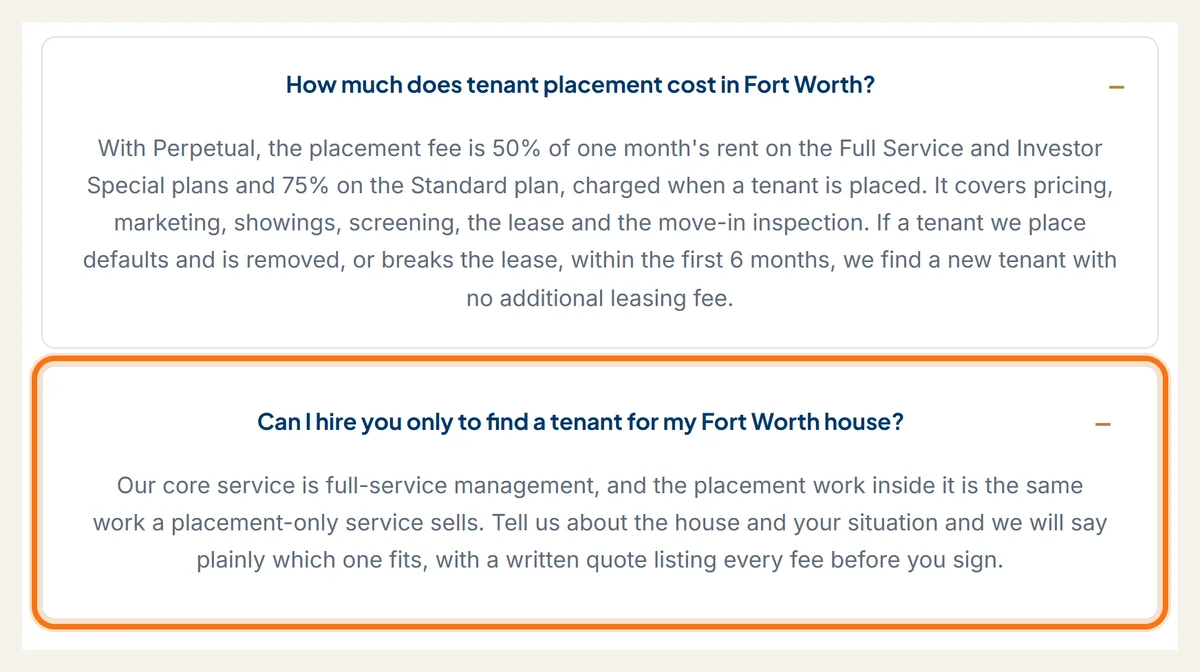
Here is the honest answer to "can I hire you only to find a tenant?" Our core service is full-service management, and the placement work inside it is the same work a placement-only service sells: rent set from comparable leased homes, a listing live on every major rental platform within 5 business days of being market-ready, screening of every adult against written criteria, a Texas-compliant lease and a photo-documented move-in report. Tell us about the house and your situation and we will say plainly which one fits, with a written quote listing every fee before you sign.
These are the published numbers for placement as part of management:
| Plan | Monthly management | Tenant placement fee | Placement fee at $2,000 rent (illustrative) | Lease renewal |
|---|---|---|---|---|
| Full Service | 10% of monthly rent | 50% of one month's rent | $1,000 | $150 |
| Standard | 9% of monthly rent | 75% of one month's rent | $1,500 | $200 |
| Investor Special (5 or more units) | 7% of monthly rent | 50% of one month's rent | $1,000 | $149 |
How to read this table: the placement fee is charged when a tenant is placed, and it is lower on the plans with the higher monthly fee. The $2,000 column is arithmetic, not a quote. Plans are negotiable case by case, and the final fee is set after the free rental analysis.
One thing a one-time placement cannot give you is in our guarantees: if a tenant we place defaults and is removed, or breaks the lease, within the first 6 months, we find a new tenant with no additional leasing fee, subject to the Guarantee Addendum. The full-service management page lays out everything else that is included, and the pricing page has every plan. To talk through which arrangement fits your house, call 682-593-7033.
The takeaway: You can pay once to have a tenant found and placed, but you are buying the busy weeks and keeping the risky months, so choose placement because you want those months, not because the invoice is smaller.
Questions owners ask
How much does tenant placement cost compared to full management?
Placement is usually priced as a one-time leasing fee tied to the rent, while full management adds a monthly fee for the life of the tenancy. The invoice comparison favors placement in year one. The fairer comparison includes the time and risk you take on after move-in. With Perpetual, placement is part of management: 50% of one month's rent on Full Service and Investor Special, 75% on Standard, with monthly management at 10%, 9% and 7% of rent.
Who holds the security deposit under a placement-only arrangement?
Usually the deposit is transferred to the owner after move-in, because the owner is the one who will handle move-out and the itemization. Confirm this before signing, and confirm the deadline and method of transfer. Once you hold it, the Texas rules on accounting for the deposit at move-out are your responsibility.
Can I switch from tenant placement to full management later?
Often yes, and it is a common path when the first year turns out to be more work than expected. Ask up front whether the company will take over mid-lease, whether a setup fee applies and whether it can manage the existing lease without changes. Perpetual takes over occupied homes: the lease, deposit and records transfer to us and the tenant gets new payment and maintenance instructions. The enrollment inspection charge depends on the plan.
Will a placement service screen tenants as carefully as a full-service manager?
A good one will, because the screening process is the same. The difference is in the incentive. A placement company is paid when a lease is signed; a full-service manager also lives with the tenant for the next year. Ask for the written criteria and the reports either way, and you will be able to judge the screening on its merits.
Does Perpetual offer tenant placement only?
Our core service is full-service management, and the placement work inside it is the same work a placement-only service sells. We do not publish a separate placement-only price. Tell us about the house and your situation and we will say plainly which arrangement fits, with a written quote listing every fee before you sign. Call 682-593-7033.
Which brokerage and leasing services handle tenant placement and marketing?
In Texas a company that leases homes for owners for a fee needs a real estate broker's license, so the choices are real estate brokerages that take rental listings and property management companies that lease homes. Compare them on the written screening criteria, where the home is advertised, who shows it, which lease form is used and what happens to the fee if the tenant leaves early.
Are there placement-only flat-fee packages that later convert to full management?
Some companies sell them, so ask each one for the terms in writing: the flat fee, what it covers, and what converting costs. Perpetual's placement fee is a percentage of one month's rent charged as part of management, not a flat package. If you placed a tenant yourself or through someone else, we can take over the occupied home under a management plan.
Property management in Keller, North Richland Hills and Fort Worth. How full-service management works in Tarrant County →