
Key takeaways
- The exemption and the 10% cap rest on one fact: the home is your principal residence on January 1 of the tax year.
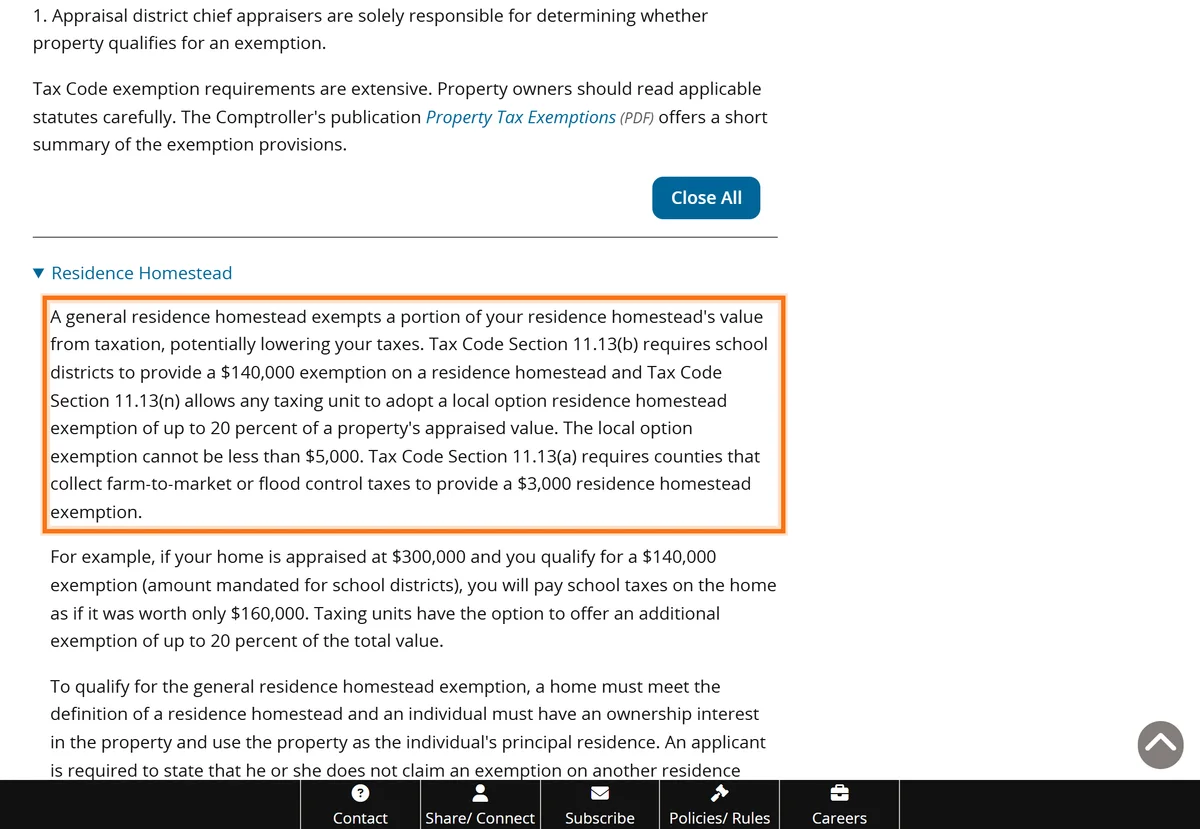
- School districts must exempt $140,000 of a homestead's value; on a $300,000 home that means school tax on $160,000 instead of $300,000.
- Notify the appraisal district in writing before May 1 after you stop qualifying (Tax Code §11.43(g)).
- A wrongly kept exemption can be added back for up to five prior years (Tax Code §11.43(i)).
- A temporary absence of less than two years keeps it only if you intend to return and do not establish another principal residence.
The homestead exemption is the largest property tax break most Texas homeowners have, and it goes away when the home stops being the place you live. Owners who move to a new house and keep the old one as a rental often do not realize this until the appraisal district catches up, which can mean back taxes, penalties and a sudden jump in the escrow payment. Others know but assume the rule is flexible. It mostly is not.
This guide covers what the exemption does in general terms, when a rental loses it, the narrow situations where it may survive a temporary absence, what you are required to tell the appraisal district, and how to plan for the tax bill that follows. It is written for the accidental landlord in Keller, North Richland Hills or Fort Worth who is deciding whether to rent the home they just left.
What the homestead exemption does
A Texas residence homestead exemption does two separate things for a home that is the owner's principal residence. First, it removes a portion of the home's appraised value from taxation for school district taxes, and often additional amounts for the county, city and other taxing units that have adopted their own homestead exemptions. Second, and often more valuable over time, it caps the annual increase in the home's appraised value for tax purposes at a fixed percentage, regardless of how fast market value rises.
That cap is why a long-time owner in an appreciating neighborhood may be taxed on a value well below what the home would sell for. Additional exemptions for owners over a certain age or with a disability sit on top of the homestead exemption and carry their own benefits, including a ceiling on school taxes.
None of this is tied to the home's use as an investment. It is tied to one fact: the owner lives there as their principal residence. The guide on rental property taxes in Texas covers the broader tax picture once that fact changes.
When renting the home ends the exemption
The exemption requires that the home be your principal residence. When you move out and a tenant moves in, the home is no longer your principal residence; it is theirs, under a lease. In general terms, you stop qualifying for the exemption on that home, and your eligibility shifts to the new home you actually live in, if you own it.
The appraisal district determines exemption status as of the start of each tax year. The practical effect is that if you were living in the home at the start of the year and rented it out mid-year, the exemption typically carries through that year and is lost for the following year. If you had already moved out before the year began, the exemption should not apply for that year at all. Those are general rules, and the appraisal district's own guidance governs the specifics.
Renting out a room while you continue to live in the home is a different situation from renting the whole home to a tenant, and owners doing the former should ask the appraisal district rather than assume. Renting the entire home, which is what a property manager handles, is the clear case.
What changes the year your home becomes a rental
Here is the same home before and after it becomes a rental:
| Item | While you live there | After you rent it out | Rule |
|---|---|---|---|
| School district exemption | $140,000 off the appraised value | None | Tax Code §11.13(b) |
| Local option exemption | Up to 20% where a city, county or other unit adopted it (at least $5,000) | None | Tax Code §11.13(n) |
| Cap on appraised value | Taxable value can rise at most 10% a year, plus new improvements | Cap ends; taxed on full market value | Tax Code §23.23 |
| Telling the appraisal district | Nothing to file | Written notice before May 1 after the right ends | Tax Code §11.43(g) |
| Exemption kept by mistake | Not applicable | Value added back for up to five prior years | Tax Code §11.43(i) |
| Value protest | May 15 or 30 days after the notice, whichever is later | Same deadline, and now worth filing every year | Tax Code §41.44 |
| Property tax on your income tax return | Personal itemized deduction, subject to limits | An expense against rental income | Federal tax rules; ask your CPA |
How to read this table: the first three rows are what raise the bill. On the Comptroller's own example of a $300,000 home, the school exemption alone means school tax is charged on $160,000; as a rental, the same home pays school tax on the full $300,000, before the lost cap is even counted. Put that difference into the rent you need before you sign a lease.
Temporary absences that may not end it
Texas law recognizes that an owner can be away from the homestead temporarily without losing it. In general terms, an absence can be treated as temporary if the owner intends to return and does not establish a principal residence elsewhere, with the law setting a maximum length for most situations and allowing longer absences for military service and certain other reasons.
This is where owners get into trouble by reading the rule generously. Leasing the home to a tenant on a lease, while buying and living in another home you claim as your homestead, is not a temporary absence in any reading. You cannot hold the exemption on two homes. An owner on a one-year overseas work assignment who leases the home and intends to move back is a closer case, and it is one to raise with the appraisal district directly, in writing, before relying on it.
Military owners who rent their home while stationed elsewhere have specific protections and should ask the appraisal district about them. The guide on renting your home when relocating covers the rest of that decision for owners who are moving for work.
Your obligation to notify the appraisal district
Texas law requires an owner to notify the appraisal district in writing when the owner's entitlement to an exemption ends. The district does not send a form asking; you are expected to tell them. In Tarrant County that is the county appraisal district, and the notice is a short written statement that the property is no longer your residence homestead, with the date you moved out.
Failing to notify is not a gray area. If the district later determines you received the exemption in years you did not qualify, it can add the taxes back for those years with interest and, in some cases, a penalty, and it can go back several years to do so. Appraisal districts cross-check driver's license addresses, voter registration, utility records and homestead applications on other properties, so the question is usually when, not whether.
At the same time, apply for the exemption on the new home you moved into. The two steps belong together: remove it from the rental, add it to the residence. The guide on the accidental landlord puts this on the list of first-month tasks for a reason.
What the tax bill looks like after
Two changes hit at once. The exempted portion of value comes back onto the tax roll, and the cap on appraised value disappears, so the home is taxed on its full market value as the district determines it. For a home that was under the cap for years, the second change is usually larger than the first. The appraised value can jump to market in a single year, and the tax follows.
Illustratively, say a home has been under the cap long enough that its taxable value sits well below what a buyer would pay. Remove the cap and the exemption and the taxable value resets to market, and the annual bill can rise by a noticeable amount that the rent has to cover. That number belongs in the rental analysis before you decide to lease the home, not in the first tax statement afterward.
The partial consolation is that property tax on a rental is a deductible expense against rental income, which it was not while the home was your residence, beyond the limits that apply to personal deductions. So the after-tax cost of the increase is smaller than the gross increase. A CPA can put a real number on it.
Escrow, insurance and the lender
If your mortgage escrows property taxes, the servicer will recalculate the monthly payment after the next tax bill arrives, and the increase can be sharp because escrow analysis also makes up any shortage from the prior year. Owners who did not plan for it see their payment jump and assume a mistake. It is usually the lost exemption and cap arriving together.
Two related items belong on the same list. Your homeowner's insurance policy was written for an owner-occupied home and generally does not cover a rental; it needs to become a landlord policy, as covered in landlord insurance versus homeowner's insurance. And most residential mortgages contain an occupancy clause requiring you to live in the home for a period after closing; renting before that period ends may require the lender's consent. Neither is a property tax matter, but they surface at the same moment, for the same reason.
Timing the move and the lease
Because exemption status is determined as of the start of the tax year, the timing of the move-out and the lease can shift the tax by a full year in either direction. An owner who moves out late in the year and leases the home right away loses the exemption for the coming year. An owner who stays through the turn of the year and leases afterward typically keeps it for that year. The difference can be meaningful, and it is legitimate planning, as long as you actually live in the home as your principal residence through the date the law looks at.
What is not legitimate is leaving the exemption in place after moving out and hoping the district does not notice, or claiming the home as your residence on paper while a tenant pays rent. Both expose you to back taxes and penalties and, if they involve a false statement on an application, to worse.
Vacancy also matters. A home that sits empty while you own another homestead is not your residence either; the exemption is tied to where you live, not to whether a tenant is present. If the decision is between renting and selling, the property tax change belongs on the same page as the mortgage, the insurance and the expected rent, because it is one of the inputs that can tip the answer.
Protesting value and managing the bill as a landlord
Once the home is a rental taxed at full value, the annual protest becomes worth your time. Without the cap, the appraisal district's market value drives the whole bill, and districts do get it wrong. Comparable sales, condition issues documented in your inspection reports, and the rental income the property actually produces are all evidence. The deadline to protest follows the notice of appraised value each spring, and missing it means a year at the district's number.
A manager's records help here more than owners expect. Dated photos from inspections showing foundation movement, an aging roof or a dated kitchen are the condition evidence appraisal review boards respond to. Perpetual's inspection reports are built to be usable for that purpose, and the annual statement on the owner portal shows the income side.
If you are weighing whether to rent the home you are leaving, a conversation with Perpetual about full-service management will include the property tax change in the numbers, because it is one of the three or four costs that decide whether the rental works.
This article is general information, not legal or tax advice. Confirm the details of your situation with a CPA or an attorney.
The takeaway: Renting the home means the exemption and the cap go away, so notify the appraisal district, claim the exemption on your new residence, plan for the higher bill in the rent, and start protesting value every year.
Questions owners ask
Do you lose the homestead exemption if you rent your house in Texas?
Generally yes. The exemption applies only to the owner's principal residence, so once you move out and a tenant moves in, you no longer qualify for it on that home. You must notify the appraisal district, and you lose both the exempted value and the cap on annual appraised value increases.
What happens if I keep the homestead exemption on a rental property?
If the appraisal district determines you received the exemption in years you did not qualify, it can add back the taxes for those years with interest and in some cases a penalty, and it can reach back several years. Districts cross-check license, voter and utility records, so the problem is typically discovered.
How do I remove the homestead exemption when I move out?
Send the county appraisal district a short written notice stating that the property is no longer your residence homestead and the date you moved out. At the same time, file a homestead application for the home you moved into, if you own it, so the exemption follows you.
Can I keep the homestead exemption if I rent my house temporarily?
Texas law allows a temporary absence without losing the exemption if you intend to return and do not establish a principal residence elsewhere, within limits the law sets, with longer allowances for military service. Leasing the home while living in another home you own as your homestead does not qualify. Ask the appraisal district in writing before relying on the temporary absence rule.
How much will my property taxes go up if I rent out my house?
It depends on how much value the exemption removed and how far the capped appraised value sat below market. Both come back at once, so a home that was under the cap for years can see a large increase. A free rental analysis should include that figure before you decide to lease.
How much is the homestead exemption in Texas now?
For school district taxes it is $140,000 of a homestead's appraised value, according to the Texas Comptroller. Cities, counties and other taxing units may add a local option exemption of up to 20 percent, at least $5,000, and owners who are 65 or older or disabled can qualify for more. None of it applies to a home rented to a tenant.
Property management in Keller, North Richland Hills and Fort Worth. How full-service management works in Tarrant County →