Key takeaways
- The reason the house did not sell predicts how it rents. Price and timing problems rent well. Condition problems follow you into the lease.
- Rent minus mortgage is not cash flow. Subtract taxes, insurance, maintenance, vacancy, HOA dues and management before you decide.
- The federal home sale exclusion needs two years of living in the home out of the five years before the sale (IRS Topic 701), so a rental period has a clock on it.
- Renting ends the Texas homestead exemption on the house, and the owner must tell the appraisal district in writing (Tax Code 11.43(g)).
- A lease commits you to this path for its full term. Choose the term with your exit in mind.
Renting out a house that did not sell in Fort Worth, Keller or North Richland Hills is sensible when the house failed on price or timing and would rent at a number that covers its real costs. It is a mistake when the house failed on condition, when you need the equity, or when the only reason is that renting feels less like defeat than cutting the price.
Here is how to tell which situation you are in, the cash-flow test to run before you decide, what changes for taxes and insurance, the steps to convert a sale listing into a lease, and what selling later with a tenant in place involves.
Rent it or cut the price: what the reason it did not sell tells you
This table matches the reason a house did not sell with how it usually does as a rental and the sensible next step:
| Why it did not sell | What you saw during the listing | How it does as a rental | Sensible next step |
|---|---|---|---|
| Price | Steady showings and feedback like "nice house, too high" | Usually rents well, because renters pay for location and function | Get a rent range from leased comparables and run the cash-flow test |
| Timing | Listed in a slow season, or buyers pulled back mid-listing | The best case: the house itself is fine | Lease it with a term that ends when you want to sell |
| Condition | Few showings, or feedback about the roof, foundation, kitchen or smell | Poorly: the same problems become repair calls and longer vacancy | Fix the condition first, or sell for what it is worth |
| You need the equity now | The next purchase or a debt depends on the sale | Renting leaves the cash locked in the house | Cut the price, or look at the other three doors below |
How to read this table: find the row that matches your listing feedback, not the one you wish were true. The top two rows are reasons to keep reading. The bottom two are reasons to sell, and a lease will not change them.
First, be honest about why it did not sell
Houses fail to sell for three reasons: price, condition or timing. The reason matters because it predicts how the house will do as a rental.
- Price: showings happened, feedback was "nice house, too high," and the house would have sold with a cut you did not want to make. These houses usually rent well. Renters pay for location and function, not for the premium you hoped a buyer would pay.
- Condition: showings were thin or feedback mentioned the roof, the foundation, the dated kitchen or the smell. These problems do not disappear in a lease. They become repair calls, lower rent and longer vacancy.
- Timing: you listed in a slow season, or rates moved against buyers mid-listing. Timing problems are the best case for a rental, because the house itself is fine and a lease buys you a year or two to sell into a better market.
Ask your listing agent for the showing count, the feedback and where the house sat against the competition. If the answer is price, keep reading. If the answer is condition, fix the condition or sell for what it is worth; a tenant will not pay you to ignore it.
Will it rent well? Five signals to check before anything else
A good sale house and a good rental house overlap, but not completely. Check these five things.
- Location that renters pay for: commute access, school district, retail nearby. The same things buyers wanted, minus the premium for a cul-de-sac or a view.
- A conventional layout: three or four bedrooms, two baths, a garage, a usable yard. Unusual layouts that narrowed the buyer pool narrow the renter pool the same way.
- Durable finishes: a rental does not need the new quartz, but it does need flooring and paint that survive a family and a dog.
- Systems in reasonable shape: HVAC, water heater, roof and plumbing that will not generate a repair call every month.
- Competition: how many similar homes are for lease nearby right now, and how long they have been sitting.
The quickest honest read is a rental analysis from someone who leases houses in your neighborhood. A free rental analysis gives you a rent range from comparable leases, not from a sale price, and notes on how fast comparable homes are leasing.
The cash-flow test, worked through
Rent minus mortgage is not cash flow. The honest version subtracts everything the house costs you as a rental, and the number that comes out is what you are choosing between renting and selling with.
Say, as an illustration only, the house would rent for $2,400 a month. Start there and subtract:
- The mortgage payment including taxes and insurance, using the property tax bill without the homestead exemption and the premium your carrier quotes for a tenant-occupied house
- A maintenance allowance every month, even in months nothing breaks, because something will
- A vacancy allowance, since the house will sit empty at every turnover and the first lease is not instant
- HOA dues, if any, and any utilities or lawn care you keep in your name
- Management fees if you will not self-manage, which the guide to management costs explains how to compare
If the result is comfortably positive, renting is a real option. If it is roughly zero, you are holding the house for appreciation and taking the risk that a bad month wipes out the year. If it is negative, you are paying every month for the right not to cut the sale price, and you should say that sentence out loud before you sign a lease.
The sell or rent guide goes further into the long-term comparison. The line-by-line version is in how to work out whether rent will cover the mortgage, taxes and insurance. This test is the short version: can the house carry itself as a rental, yes or no.
The costs that appear when a home becomes a rental
Several things change the day you lease the house, and most owners find out after the fact. Check each one before you commit.
- Homestead exemption: under Texas Tax Code 11.13(j), a residence homestead is a home an owner occupies as a principal residence. A leased house stops qualifying, the 10 percent yearly limit on appraised value increases in Tax Code 23.23 goes with it, and 11.43(g) requires you to notify the appraisal office in writing before May 1 after the entitlement ends.
- Insurance: your homeowners policy was written for a home you live in. Call the carrier before a tenant moves in and ask which policy fits a tenant-occupied house, and consider requiring renters insurance from the tenant.
- The lender: some loans carry occupancy requirements for a period after closing. Read the note or call the servicer before you lease.
- The HOA: some associations restrict or register rentals. Check the governing documents.
- The home sale exclusion: the federal exclusion of gain on a main home depends on how long you lived there in the five years before the sale. Renting has a clock on it, explained next.
The homestead rules are covered in the homestead exemption when you rent your home. This is general information, not tax or legal advice.
The tax clock: how long you can rent and still sell tax-free
This is where a lot of backup plans go wrong. If you have a gain when you sell your main home, federal law lets you exclude up to $250,000 of it from income, or up to $500,000 on a joint return (IRS Topic 701). To qualify you must pass an ownership test and a use test: you owned the home, and lived in it as your residence, for at least 24 months out of the 5 years ending on the date of the sale.
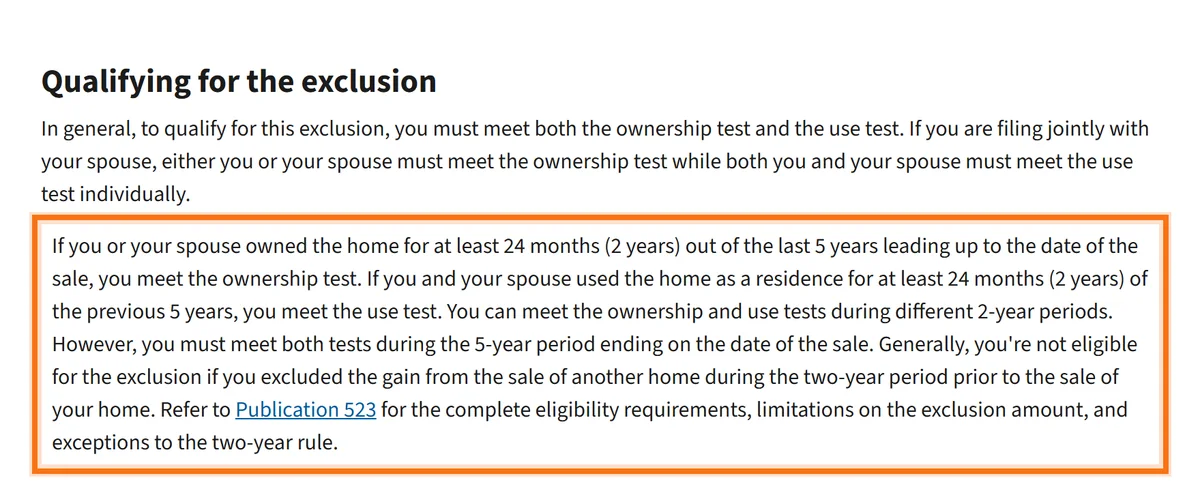
The two years do not have to be the most recent two. For an owner who lived in the house for at least two full years and then moved out and leased it, the arithmetic looks like this:
| When the sale closes | Years lived in the home during the 5-year window | Use test |
|---|---|---|
| Within 1 year of moving out | At least 2 | Met |
| 2 years after moving out | At least 2 | Met |
| Just under 3 years after moving out | 2 or slightly more | Met, with little margin |
| More than 3 years after moving out | Less than 2 | Not met |
How to read this table: it assumes you lived in the house for two years or more right before you moved out, and it is illustrative only. The practical message is that a one-year or two-year lease usually fits inside the window, and a third lease year needs a calendar check with a CPA before you sign it.
Two more points from IRS Publication 523. Rental time after you move out, inside that 5-year window, is not counted against you as "nonqualified use." But depreciation you claimed, or were entitled to claim, while the house was a rental cannot be excluded, so part of the gain is taxed even when you pass both tests. Publication 523 also lists exceptions for military and certain other service. This is general information, not tax advice.
From sale listing to lease, step by step
How long the conversion takes depends on the make-ready: a house that showed well for buyers needs little, and one that needs work takes longer. Do it in this order.
- Withdraw the sale listing fully. Do not market the house for sale and for lease at the same time; buyers assume distress and renters assume they will be displaced.
- Decide what stays. Staging furniture goes. Appliances you planned to take should be decided now, because the listing will promise them.
- Do a rental make-ready, not a sale make-ready. Durable paint, working everything, clean, safe, keyed. Skip the upgrades that only a buyer would pay for.
- Price from comparable leases, not from the failed sale price or your payment. Rent is what the market pays, not what you need.
- Photograph it empty and clean, then list on the rental syndication sites with a lease-ready date.
- Screen every applicant on the same written criteria, the way professional tenant screening does it, sign a Texas-compliant lease and document move-in condition with photos.
Owners coming off a sale listing often expect leasing to work like selling: an agent shows it, an offer comes in, done. Leasing is faster at the front and heavier at the back, because the lease is the start of a relationship, not the end of a transaction.
Selling later with a tenant in place
The backup plan usually includes the thought that you will sell when the market improves. You can, and the lease shapes how. A sale does not end the tenant's lease in the ordinary case, so a buyer takes the house with the tenant in it, and Texas Property Code 92.105 makes the new owner liable for the security deposit. That changes who the buyer is.
Investors will buy an occupied house and may value a good tenant. Owner-occupant buyers mostly will not, which means selling mid-lease narrows the pool to investors and the price that comes with it. The cleanest path is to time the sale listing to the lease end, give the tenant proper notice of non-renewal and sell vacant, or sell to the tenant if they are interested and qualified.
The guide to selling with a tenant in place covers notice, showings during occupancy and the options in detail. The point for the backup plan is simple: a one-year lease is a one-year commitment to this path, and an eighteen-month or two-year lease is a longer one. Choose the term with the exit in mind.
When renting is the wrong backup plan
Sometimes the sensible answer is to cut the price and close. Renting is the wrong move in these situations.
- You need the equity for the next house, and carrying two payments will strain you if the rental sits vacant for two months.
- The cash-flow test came out negative and your plan is to hope rents rise.
- The house has a condition problem you cannot afford to fix, which a tenant will report and Texas Property Code 92.052 will require you to repair if it materially affects health or safety.
- You cannot stand the thought of someone else living in your home with their dog and their kids' crayons. Wear is part of renting, and an owner who takes it personally makes a poor landlord.
- You would be an accidental landlord from a thousand miles away with no local help and no reserve.
None of those make you a bad owner. They make you a seller, and a price reduction that closes in thirty days is often cheaper than a year of thin margins and a sale with a tenant in place. The accidental landlord guide is the honest primer if you decide to go ahead anyway.
When renting fails the test: the other three doors
If the cash-flow test above comes back negative, or the house failed on condition rather than price, renting it out is a slow way to lose money. That does not mean another price cut is the only alternative.
An owner whose house is not selling has four doors at Perpetual: lease it through Perpetual Property Management, list it on the MLS yourself for a flat fee through DirectList so you can price under the builder without promising a large commission, a creative exit such as owner finance, subject-to or a wraparound where a buyer takes over a low-rate mortgage, or a full-service listing through Perpetual Realty Group. If the home is worth less than the note and you are facing a hardship, short sale assistance is the way out before foreclosure. Which door fits depends on your equity and your mortgage rate; the rent or sell page compares all four, and one discovery call settles it.
How Perpetual handles this
The first thing we do for an owner coming off a stalled sale listing is a free rental analysis: a rent range from leased comparables, notes on how fast similar homes are leasing, make-ready guidance on which improvements raise rent and which only cost money, and a written management quote. We typically respond within one business day, and the analysis is yours whether you hire us, self-manage or sell.
Because we are broker-owned, we can look at both sides: what the house would lease for and, through our affiliated brokerage Perpetual Realty Group, what it would sell for today. If the numbers say sell, we will say so.
If renting makes sense, the conversion runs through one agreement: marketing with professional photography, screening every adult against our published rental criteria, Texas-compliant lease documents and a photo-documented move-in report.
Under The Perpetual Promise, subject to its Guarantee Addendum, the home is listed on every major rental platform within 5 business days of being market-ready or the first month's management fee is waived. Every fee is on our pricing page and confirmed in writing before you sign.
Our office is at 5755 Rufe Snow Dr in North Richland Hills, and we manage homes in Keller, North Richland Hills, Fort Worth and nearby. To find out which path the numbers favor for your house, call 682-593-7033.
The takeaway: Rent the house that did not sell only if it failed on price or timing, passes an honest cash-flow test and fits a plan you can hold for a few years; otherwise a price cut that closes is the cheaper backup.
Questions owners ask
My house isn't selling. Would renting it out be a sensible backup plan?
It is sensible if the house failed to sell on price or timing and not on condition, if rent would cover the mortgage, taxes, insurance, maintenance, vacancy and management with room to spare, and if you can leave the equity in place for a few years. Get a rental analysis based on comparable leases, run the cash-flow test, and check the homestead, insurance, lender and home sale exclusion consequences before you withdraw the listing. If the house has a condition problem or the math is negative, a price cut that closes is usually the better plan.
Can I list my house for sale and for rent at the same time?
You can, but it works poorly. Buyers read a dual listing as distress and negotiate harder, and renters hesitate because they expect to be displaced by a sale. Choose one path, withdraw the other fully, and give the chosen listing a clean run.
How long should the first lease be if I plan to sell later?
Match the lease term to your exit. A twelve-month lease is the common choice and keeps the option to sell vacant at renewal time. A longer lease suits an owner who wants to hold through a slow market. Whatever you choose, a sale does not normally end the lease, so mid-lease you are selling mostly to investors.
Do I lose my homestead exemption if I rent out my house?
Yes, once the house is no longer your principal residence. Texas Tax Code 11.13(j) defines a residence homestead as a home an owner occupies as a principal residence, and the 10 percent limit on yearly appraisal increases in Tax Code 23.23 applies only to a homestead. Section 11.43(g) requires you to notify the appraisal office in writing before May 1 after your entitlement ends. Confirm the timing with the Tarrant Appraisal District. This is general information, not tax advice.
Will my homeowner's insurance cover the house once a tenant moves in?
Do not assume so. A homeowners policy is written for a home the owner lives in. Call your carrier before the lease starts, say the house will be tenant-occupied, and ask which policy fits and whether it includes liability coverage and loss of rents. Most owners also require renters insurance from the tenant. This is general information, not insurance advice.
How long can I rent out my house and still use the home sale exclusion when I sell?
The IRS test looks at the five years before the sale: you must have owned the home and lived in it as your main home for at least two of them (IRS Topic 701). If you lived there for two years or more right before renting, that leaves about three years to rent and sell. Depreciation you claimed or could have claimed as a landlord is not excludable (IRS Publication 523). Ask a CPA to check your dates. This is general information, not tax advice.
Should I lower the price or rent out my house?
Lower the price if the house failed on condition, if you need the equity for your next purchase, or if the cash-flow test comes out negative. Rent it if showings were steady, the feedback was about price or timing, the rent covers every real cost with room to spare, and you can hold for a few years. A rent range from leased comparables is the number that settles it.
Related services
Property management in Keller, North Richland Hills and Fort Worth. How full-service management works in Tarrant County →