Key takeaways
- A move-out fee is either a manager's charge to the owner at turnover or a charge to the tenant from the deposit. They are never the same money.
- Owner side: some managers charge for the move-out inspection, deposit accounting and coordination separately. Others include them. The fee schedule says which.
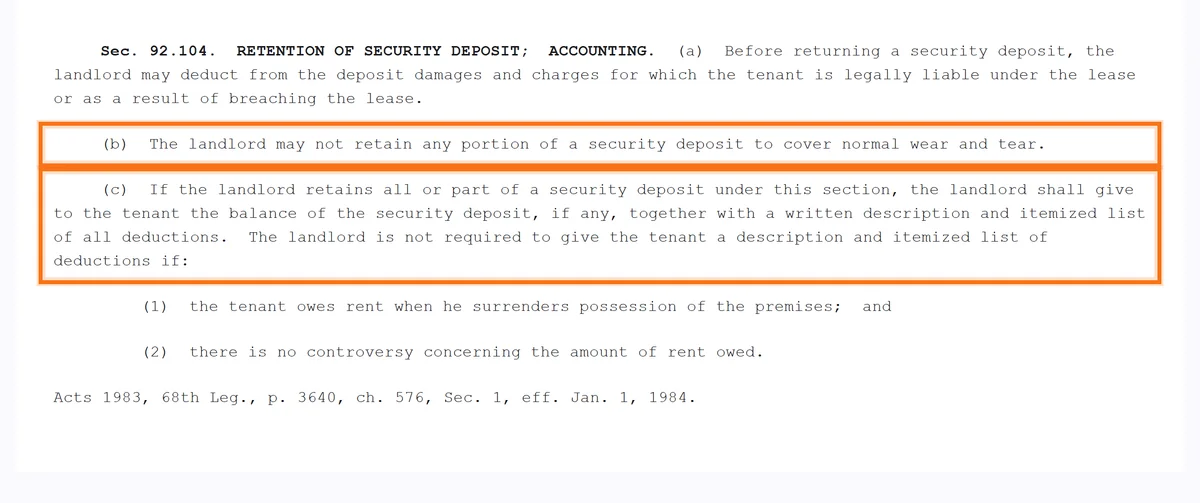
- Tenant side: Texas Property Code 92.104 allows deductions only for damages and charges the tenant is liable for under the lease, never normal wear and tear.
- The refund or an itemized list is due within 30 days after the tenant surrenders the home (92.103).
- Perpetual's price sheet lists no separate move-out fee; a 360-degree move-out inspection is one of our written guarantees.
What is a move-out fee? It depends on who is paying. For the owner of a rental in Fort Worth, Keller or North Richland Hills, it is whatever the property manager charges when a tenant leaves: some companies fold the move-out inspection, the deposit accounting and the turnover coordination into the monthly fee, and others bill each one as a separate line and then add the leasing fee for the next tenant. For a tenant, it is a charge taken out of the security deposit, and Texas law limits what that can be.
This guide separates the two, lists every owner-side charge that can attach to a move-out, shows what Texas law lets a landlord deduct from the deposit, and works one turnover through each of our plans. What the turnover itself costs in vacancy and repairs is covered in rental turnover: what it costs, how long it takes and how to shorten it.
What is a move-out fee, and who pays it?
Here are the charges that show up when a tenant leaves a Texas rental, who pays each one, and what controls it:
| Charge | Who pays | Paid from | What controls it |
|---|---|---|---|
| Move-out inspection fee | Owner | Owner's funds | The fee schedule in the management agreement |
| Deposit accounting or disposition fee | Owner | Owner's funds | The management agreement |
| Make-ready or turnover coordination | Owner | Owner's funds | The management agreement: a flat amount or a percentage of the vendor invoices |
| Rekeying the locks | Owner | Owner's funds | Property Code 92.156: at the landlord's expense, within 7 days after each tenant turnover date |
| Leasing or tenant placement fee | Owner | Owner's funds | The management agreement, each time a new tenant is placed |
| Unpaid rent, damage beyond normal wear, cleaning the lease assigns to the tenant | Tenant | Security deposit | The lease and Property Code 92.104, with an itemized list |
| A flat "move-out fee" or similar charge written in a lease | Tenant | Security deposit | Only a charge the lease makes the tenant liable for; it must appear on the itemized list |
How to read this table: the first five rows are between you and your manager, and the last two are between the landlord and the tenant. No row moves a manager's fee into the tenant's deposit.
Every owner-side charge that can attach to a move-out
These are the charges a management agreement can attach to a move-out. No single company charges all of them, but check each one against the agreement in front of you.
- Move-out inspection fee. A charge for walking the house after the tenant leaves, photographing it and producing the condition report.
- Security deposit accounting or disposition fee. A charge for itemizing deductions, preparing the written accounting Texas law requires, and sending the refund.
- Turnover or make-ready coordination fee. A charge for getting bids, scheduling vendors and checking the work between tenants, sometimes expressed as a percentage of the make-ready cost.
- Rekey fee. The locksmith's charge for rekeying, which Property Code 92.156 requires within seven days after each tenant turnover date, sometimes with a coordination charge on top.
- Utility transfer or vacancy utility fee. A charge for switching utilities into the manager's or owner's name while the house is empty.
- Vacancy or minimum monthly fee. A flat charge some agreements apply while the house is empty; it belongs on this list because it starts at move-out.
- Leasing fee. The charge for placing the next tenant, which is a separate matter and is almost always charged.
Add a maintenance markup on the make-ready invoices and you can have seven lines from one tenant leaving. The question is not whether any single one is fair. It is whether the work behind them is being paid for once.
Which move-out charges are fair
Some of these are real work that happens only at turnover, and charging for them is honest if the charge is disclosed. The rekey is a hard cost paid to a locksmith. A make-ready coordination fee can be fair when the turnover is substantial, say a full repaint, flooring and a dozen vendor visits, because managing that project is hours of work. The leasing fee is fair for the reasons covered in leasing fees explained.
Fairness has two tests. First, the charge must be in the written fee schedule, with an amount or a formula. Second, the work must not already be covered by another fee. A move-out inspection is a reasonable thing to pay for if inspections are not included in the monthly fee. It is not reasonable to pay for it twice, once as a move-out inspection and again as the move-in inspection inside the leasing fee for the same visit.
The three ways owners get charged twice at turnover
Double charging at move-out is rarely a single bold line. It is usually two fees that both claim the same hour of work. The three patterns to look for:
- Inspection counted twice. The move-out inspection and the move-in inspection for the next tenant are often the same walkthrough, done once after the make-ready. Paying a move-out inspection fee and a leasing fee that also lists the move-in inspection is paying for one walk twice.
- Coordination counted twice. A make-ready coordination fee plus a percentage markup on every make-ready invoice are both charges for the same supervision. One or the other can be defended. Both together is a doubled margin on your own repair bill.
- Deposit accounting counted twice. The deposit disposition letter is a legal step the manager must complete anyway. If the agreement already describes deposit handling as part of management, a separate accounting fee is charging for a duty already included.
When you see two fees around the same event, ask the manager to describe the specific work behind each one. If the descriptions overlap, one of the fees should go.
What Texas law lets a landlord deduct from the deposit
Where the money comes from is a separate question from whether a fee is fair. The security deposit is governed by Subchapter C of Property Code Chapter 92, and four sections do most of the work.
- 92.104(a): before returning a deposit, the landlord may deduct damages and charges for which the tenant is legally liable under the lease or as a result of breaching it.
- 92.104(b): no part of a deposit may be kept to cover normal wear and tear.
- 92.104(c): if anything is kept, the tenant gets the balance with a written description and itemized list of all deductions.
- 92.103 and 92.107: the refund is due on or before the 30th day after the tenant surrenders the home, once the tenant has given a forwarding address in writing.
A manager's own fee for inspecting the house or preparing the accounting is owed by the owner under the management agreement, not by the tenant under the lease, so it does not belong on that itemized list. It comes out of your funds or the next rent received.
The penalty for getting this wrong lands on the owner. Under 92.109, a landlord who keeps a deposit in bad faith owes $100, three times the amount wrongfully withheld and the tenant's attorney's fees, and a landlord who has not refunded or itemized by the 30th day is presumed to have acted in bad faith. Section 92.001 defines the landlord as the owner, lessor or sublessor of the dwelling, and a manager only if the manager purports to be one of those in the lease. How deductions are itemized is covered in the move-out inspection: how deposits get itemized fairly in Texas. This is general information, not legal advice.
A worked example: one turnover on each Perpetual plan
Illustrative only, not a quote. A tenant moves out of a house renting for $2,000 a month. The make-ready needs paint touch-up, carpet cleaning, a rekey and a yard cleanup, and the vendor invoices total $1,200. Here is what our published price sheet produces on each plan:
| Plan | Tenant placement | Coordination on $1,200 of vendor invoices | Separate move-out inspection or deposit accounting fee on the price sheet | Manager charges for this turnover |
|---|---|---|---|---|
| Full Service (10%) | 50% of one month's rent: $1,000 | Maintenance coordination 5%: $60 | None listed | $1,060 |
| Standard (9%) | 75% of one month's rent: $1,500 | Maintenance coordination 4.9%: $58.80 | None listed | $1,558.80 |
| Investor Special (7%, 5 or more units) | 50% of one month's rent: $1,000 | Make-ready coordination 3% to 5%: $36 to $60 | None listed | $1,036 to $1,060 |
How to read this table: the owner also pays the $1,200 of vendor work itself, and the example assumes the coordination percentage applies to every make-ready invoice. Which work it covers on your home is written in your agreement. Plans are negotiable case by case, and the final numbers are set after the rental analysis.
Run the same arithmetic on any other quote, and run it on a heavy turnover as well as an easy one. A $6,000 make-ready with a coordination fee and a separate markup both scaling with the bill is where two fee schedules that looked alike come apart.
What to ask before signing, and what to look for in the statement after
Before signing, ask these questions and get the answers in the fee schedule:
- List every charge that can occur between one tenant leaving and the next one paying rent.
- Is the move-out inspection included in the monthly fee, charged separately, or included in the leasing fee as the move-in inspection?
- Is there any fee on the make-ready beyond the vendor invoices, and if so is it a flat amount or a percentage?
- Is the deposit accounting included in management?
- Who pays the rekey, and is there a coordination charge on top of the locksmith?
After a turnover, read the statement for that month against the list. Every charge should map to a line in the fee schedule. If one does not, ask. A manager who provides the original vendor invoices and a clear owner portal makes that check take ten minutes. Our pricing and fees page shows what a schedule looks like with every plan's lines published.
The move-out fee that matters most is the one you avoid
Every charge in this guide is multiplied by the number of turnovers. An owner whose tenants stay four years pays the stack once. An owner whose tenants leave every year pays it four times, plus four vacancies and four make-readies.
So when you compare managers on move-out fees, also ask how they handle renewals and how long their tenants typically stay. The renewal side is in lease renewals and turnovers and in how to keep good tenants longer.
How Perpetual handles this
Perpetual Property Management is broker-owned, with our office at 5755 Rufe Snow Dr in North Richland Hills, and we manage homes in Keller, North Richland Hills, Fort Worth and nearby. Our price sheet is public, and it lists no line called a move-out fee, a move-out inspection fee or a deposit accounting fee. What it does list for a turnover:
- Tenant placement: 50% of one month's rent on Full Service and Investor Special, 75% on Standard, charged when a tenant is placed.
- Coordination: maintenance coordination at 5% of cost (Full Service) or 4.9% (Standard), and make-ready coordination at 3% to 5% of cost (Investor Special). It is a percentage of the vendor's invoice, and the original invoice is always in your portal.
- If the tenant renews instead: $150, $200 or $149 depending on the plan.
Under The Perpetual Promise, every move-in and move-out gets a 360-degree condition inspection, subject to the Guarantee Addendum. Deposits are held, accounted for and returned or itemized on the Property Code timeline. And if a tenant we place defaults and is removed, or breaks the lease, within the first 6 months, we find a new tenant with no additional leasing fee.
Plans are negotiable case by case, so the exact turnover lines for your home are confirmed in writing before you sign. To see them, request a free rental analysis or call 682-593-7033.
The takeaway: One tenant leaving should produce one set of charges for one set of work, listed in writing before you sign, and the best move-out fee is the turnover that never happens.
Questions owners ask
Is there a separate fee each time a tenant moves out?
With some managers, yes: a move-out inspection fee, a deposit accounting fee or a turnover coordination fee, each charged per move-out, in addition to the leasing fee for the next tenant. With others, those tasks are part of the monthly fee and only the leasing fee applies. The written fee schedule is the only reliable answer, so ask for a list of every charge between one tenant leaving and the next one paying rent.
Can the manager take their move-out fees out of the tenant's security deposit?
No. Texas Property Code 92.104 lets a landlord deduct only damages and charges the tenant is legally liable for under the lease or from breaching it, and never normal wear and tear. The manager's inspection, accounting or coordination fees are owed by the owner under the management agreement and are paid from the owner's funds. If a deposit accounting shows a manager fee charged to the tenant, the owner is the one exposed to a wrongful deduction claim under 92.109.
Is a make-ready coordination fee reasonable?
It can be on a heavy turnover with many vendors, where the manager is running a real project. It is not reasonable combined with a percentage markup on the same invoices, because that charges twice for one supervision. Ask whether the fee is flat or a percentage, when it applies, and whether vendor invoices are passed through at cost.
Do I pay the leasing fee again after every move-out?
Yes, in nearly every agreement. The leasing fee pays for marketing, showings, screening and the lease for a new tenant, so it is charged each time a new tenant is placed. With Perpetual it is 50% of one month's rent on Full Service and Investor Special and 75% on Standard, and a tenant we place who defaults and is removed, or breaks the lease, within 6 months is replaced with no additional leasing fee.
Who pays to rekey the house between tenants?
The owner. Texas Property Code 92.156 requires the landlord to rekey, at the landlord's expense, no later than the seventh day after each tenant turnover date. The cost can come out of the deposit only if the tenant vacated in breach of a written lease that has an underlined or boldface provision authorizing it. Check whether the manager adds a coordination charge on top of the locksmith, and that it is on the fee schedule.
What is a move-out fee?
It is one of two things. For an owner, it is a charge from the property manager when a tenant leaves, such as a move-out inspection, deposit accounting or turnover coordination fee. For a tenant, it is a charge the lease makes them liable for at move-out, taken from the security deposit and itemized in writing under Texas Property Code 92.104. Normal wear and tear can never be charged.
Which flat-fee managers include move-out inspections and security deposit settlement procedures?
It varies by company, so check three things in any quote, flat-fee or percentage: whether the move-out inspection has its own charge, whether deposit accounting has its own charge, and who prepares the itemized list within 30 days. Perpetual charges a percentage, not a flat fee. Our price sheet has no separate line for either task, and a 360-degree move-out inspection is in our written guarantees.
Related services
Property management in Keller, North Richland Hills and Fort Worth. How full-service management works in Tarrant County →