Key takeaways
- Our published placement fee is 50% of one month's rent on the Full Service and Investor Special plans and 75% on the Standard plan, charged when a tenant is placed.
- At $2,000 rent that is $1,000 or $1,500. The table below shows six rent levels.
- The fee covers pricing, marketing, showings, screening, the lease and the move-in inspection.
- If a tenant we place defaults and is removed, or breaks the lease, within the first 6 months, we find a new tenant with no additional leasing fee.
- The $60 application fee is paid by each adult applicant, not by you. Texas Property Code 92.351 to 92.355 sets the rules for application fees and deposits.
Property managers charge a one-time leasing fee to find a new tenant, and it is quoted one of three ways: a share of one month's rent, a full month's rent, or a flat dollar amount. For an owner in Fort Worth, Keller or North Richland Hills, our own number is published: 50% of one month's rent on the Full Service and Investor Special plans, and 75% on the Standard plan. The honest answer to "how much" is a formula, and it only means something once you apply it to your own rent.
This page turns the formula into dollars, shows what the fee pays for, explains who pays the application fee under Texas law, and lists what should never be added on top.
Tenant placement fee in dollars at six rent levels
This table applies our two published placement rates to six monthly rents, so you can find the row closest to your house:
| Monthly rent | Full Service or Investor Special (50%) | Standard (75%) | Difference |
|---|---|---|---|
| $1,600 | $800 | $1,200 | $400 |
| $1,800 | $900 | $1,350 | $450 |
| $2,000 | $1,000 | $1,500 | $500 |
| $2,200 | $1,100 | $1,650 | $550 |
| $2,500 | $1,250 | $1,875 | $625 |
| $3,000 | $1,500 | $2,250 | $750 |
How to read this table: find your expected rent, then read across. The fee is charged once, when a tenant is placed, not every year. The rent levels are examples chosen for the arithmetic, not a forecast for your house. Your rent is set from leased comparables in a free rental analysis, and your fee is confirmed in a written quote.
The percentages come from our price sheet. The Investor Special plan is for portfolios of 5 or more units. Plans are negotiable case by case, so treat the table as the standard numbers.
What the fee is paying for before you judge the number
A placement fee pays for the work between an empty house and a signed lease with a qualified tenant. On our leasing page the fee is described as covering six things: pricing, marketing, showings, screening, the lease and the move-in inspection. In practice that means:
- Pricing. The rent is set from comparable leased homes near yours.
- Marketing. Professional photography, a written description and syndication to the major rental sites, as our marketing page lists them.
- Showings. Self-guided and scheduled showings, with basic criteria checked before anyone gets access.
- Screening. Credit, income, rental history, criminal and eviction checks on every adult, against written criteria.
- The lease. Texas-compliant lease documents with the addenda your property needs.
- The move-in. A photo-documented move-in condition report, acknowledged by the tenant.
Judge any quote against that list, not in isolation. A low fee that leaves out photos or the move-in report is not cheap, it is incomplete. The full breakdown of what belongs inside the fee is in our guide to leasing fees and what you pay when a tenant moves in.
Turn every quote into dollars on your own house
Managers present the fee in whichever form sounds smallest. "Half a month" sounds modest, "$1,250 flat" sounds precise, and "one month's rent" sounds like a tradition rather than a charge. Put all three in the same currency before you compare anything.
Using an illustrative $2,000 rent (an example, not a quote):
- Share of a month. Half a month is $1,000, three quarters is $1,500. The fee rises automatically if the manager prices the house higher, which is a fair alignment of interests.
- Full month. $2,000. At this rent it is twice the half-month quote, so ask what else is included, such as a lower renewal fee or a re-leasing promise if the tenant leaves early.
- Flat amount. The same dollars whether the house rents for $1,600 or $2,600. Flat fees favor higher-rent homes and can be a poor deal on a modest one.
Write the dollar figure for each quote next to the company name. If you cannot get a dollar figure from a manager for a specific rent, that tells you something about how the rest of the relationship will go.
Compare the placement fee together with the monthly fee
A lower placement fee can sit on a plan with a higher monthly fee, so judge the two as one number. The table below assumes rent of $2,000, twelve months of rent collected, and counts only the placement fee and the monthly percentage (illustrative only, not a quote):
| Plan | Placement fee | Monthly fee x 12 | Both together |
|---|---|---|---|
| Standard (9%, placement 75%) | $1,500 | $180 x 12 = $2,160 | $3,660 |
| Full Service (10%, placement 50%) | $1,000 | $200 x 12 = $2,400 | $3,400 |
| Investor Special (7%, placement 50%, 5 or more units) | $1,000 | $140 x 12 = $1,680 | $2,680 |
How to read this table: in a year when a tenant is placed, the plan with the higher monthly percentage costs $260 less at this rent, because the placement fee is $500 lower. In a year with no placement the order flips: Standard is $2,160 and Full Service is $2,400 before any renewal fee. The other lines on the price sheet (renewal, enrollment inspection, coordination, eviction service) also differ by plan.
That is why the question "how much to find a tenant" should always be asked next to "how often do you expect to place one". A house with long tenancies pays the placement fee rarely. Our guide to comparing two management quotes fairly shows how to line up every fee the same way.
When the money comes out and what your first statement looks like
A common arrangement is that the placement fee comes out of the first month's rent the tenant pays. Your first disbursement is then small or zero, and owners who did not plan for that assume something went wrong. Nothing did; the fee landed in the same month as the first rent.
Other agreements invoice the fee separately, or split it between lease signing and move-in. None of these is wrong on its own, but you need to know which one you agreed to so you can hold back enough cash for the first month. The agreement should state the timing in one sentence. If it does not, ask for that sentence to be added before you sign.
Run the arithmetic for your own first month before the tenant moves in. With rent of $2,000 and a 50% placement fee, $1,000 is the placement fee, and the monthly management fee and any repair or reserve your agreement provides for come out as well. That is an example, not a quote.
The application fee is paid by the applicant, and Texas law has rules for it
The placement fee is your cost. The application fee is the applicant's. Our published rental criteria set it at $60 per applicant, and every applicant and co-applicant age 18 or older completes a separate application. It is not billed to you and it is not part of your placement fee.
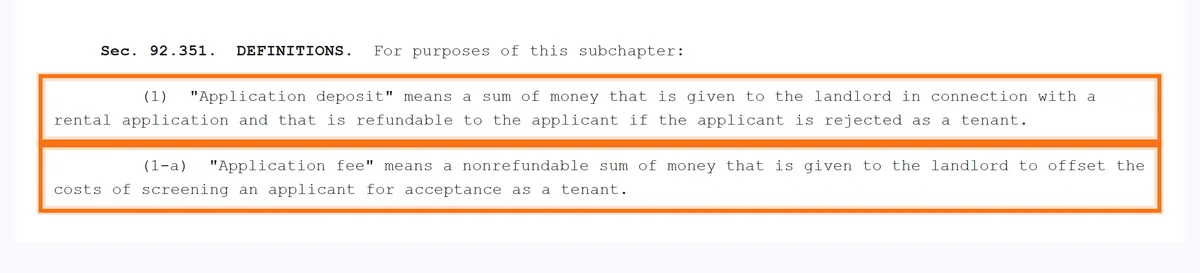
Texas Property Code chapter 92, subchapter I, draws a line between two kinds of money an applicant may hand over:
- Section 92.3515 requires the landlord to make printed notice of the tenant selection criteria available when the application is provided. If an applicant is rejected and that notice was not made available, the application fee and any application deposit must be returned.
- Section 92.352 treats an applicant as rejected if no notice of acceptance is given on or before the seventh day after a completed application is submitted.
- Section 92.354 makes a landlord who in bad faith fails to refund an application fee or deposit liable for $100, three times the amount wrongfully retained, and the applicant's reasonable attorney's fees.
- Section 92.355 voids any application clause that tries to waive these rights.
For you as the owner, the point is practical: the company taking applications in your name should publish its criteria, decide quickly and keep clean records. Our guide to the rental application process walks through the steps. This is general information, not legal advice.
What changes the price on a specific house
The same company will not always quote the same leasing fee, and the differences are usually reasonable:
- Occupied versus vacant. Taking over a house with a tenant already in place is not a lease-up. Our fee is charged when a tenant is placed, so ask any company to state in writing what applies to a takeover.
- You found the tenant yourself. Screening and papering a tenant you brought is less work than a full marketing campaign, and a fair manager charges less for it. See what a manager charges to screen and lease a tenant you found.
- Condition and rent level. A house that needs a long make-ready or sits at the top of the market takes more showings to lease. Ask whether the quote changes for that; a percentage fee already moves with the rent.
- Several houses. Portfolio owners can sometimes negotiate the leasing fee. Our Investor Special plan, for portfolios of 5 or more units, pairs a 7% monthly fee with the 50% placement fee.
A renewal with the same tenant is not a new placement and should never trigger the full leasing fee again. Our renewal fee is a flat $150, $200 or $149 depending on the plan, which our guide to lease renewal fees explains.
What happens to the fee if the tenant leaves early
This is the question that separates one placement fee from another. A fee paid in March buys much less if the tenant is gone by July and you are asked to pay it again. Ask every company what it does in that case, and ask to see the answer in the agreement, not in a brochure.
Ours is one of the five written guarantees: if a tenant we place defaults and is removed, or breaks the lease, within the first 6 months, we find you a new tenant with no additional leasing fee. The guarantees apply to properties under an active management agreement and are subject to the terms and exclusions in our Guarantee Addendum, so read the addendum with the agreement.
Note what the guarantee is and is not. It covers the cost of placing the next tenant. It is not a rent guarantee, and it does not pay the rent for the weeks the house is empty. Our guide on how management guarantees work explains how to read the remedy in any company's promise.
Add-ons that turn a fair fee into an expensive one
The leasing fee is only comparable between companies if it is the whole price of placing a tenant. Watch for separate line items that re-charge you for work the fee already covers: a marketing fee, a photo fee, a lease preparation fee, a move-in inspection fee or an administrative fee at move-in. Each one looks small, and together they change the real price of a placement that was quoted as "half a month".
Ask one question: "Is there any charge at all between listing the house and the tenant's first rent payment, other than the leasing fee?" Then confirm the answer against the fee schedule attached to the agreement. Our fee comparison worksheet lays the quotes side by side so the add-ons cannot hide.
If you want to see how the full fee structure fits together before talking to anyone, the pricing and fees page lists every charge in plain language.
How Perpetual handles this
Our placement fee is on the public price sheet: 50% of one month's rent on the Full Service and Investor Special plans, 75% on the Standard plan, charged when a tenant is placed. It covers pricing, marketing, showings, screening, the lease and the move-in inspection. The price sheet lists no separate marketing, photo or lease-preparation fee, and the rule in every agreement is plain: if a fee is not in the agreement, you do not pay it.
Two written guarantees sit behind the fee. Your home is live on every major rental platform within 5 business days of being market-ready, or we waive the first month's management fee. And a tenant we place who defaults and is removed, or breaks the lease, within the first 6 months is replaced with no additional leasing fee, subject to the Guarantee Addendum.
Perpetual Property Management is broker-owned, with our office at 5755 Rufe Snow Dr in North Richland Hills, and we lease homes in Keller, North Richland Hills, Fort Worth and nearby. Whether the fee is deducted from the first rent or invoiced, and what applies to a tenant you found yourself or a tenant already in place, is confirmed in writing before you sign. For the placement fee in dollars on your house, call 682-593-7033.
The takeaway: Ask for the leasing fee in dollars on your own rent, confirm nothing is charged on top of it, and plan for it to come out of the first month's rent.
Questions owners ask
Is the leasing fee charged again if the tenant renews?
No. A placement fee is earned by placing a new tenant, so a renewal with the same tenant should carry no placement fee. Many managers charge a smaller renewal fee for the market check and the new paperwork. Ours is a flat $150 on Full Service, $200 on Standard and $149 on Investor Special. If a company charges the full leasing fee at every renewal, keep looking.
Do I pay the leasing fee if the house never rents?
Read the agreement, because this is a contract term and not a rule of law. Our placement fee is charged when a tenant is placed. Check whether any agreement lets the manager bill marketing costs or a cancellation charge if you pull the house off the market yourself before it leases, and ask for the answer in writing.
Can I negotiate the leasing fee?
Sometimes. Owners with several rentals have the most room, and our plans are negotiable case by case, with the final fee set after the rental analysis and confirmed in writing. When a manager drops one fee sharply, compare the whole schedule again, because the total is what you pay.
Why is my first owner payment so small?
Usually because the placement fee was deducted from the first month's rent, along with the monthly management fee and any reserve your agreement sets. Your statement should show the rent received and each deduction as its own line. From the second month on, the deductions drop to the monthly fee and any repairs.
How much is a tenant placement fee in Fort Worth?
Our published fee is 50% of one month's rent on the Full Service and Investor Special plans and 75% on the Standard plan, charged when a tenant is placed. On a $2,000 rental in Fort Worth, Keller or North Richland Hills that is $1,000 or $1,500. Other companies quote a share of a month, a full month or a flat amount, so convert every quote to dollars on your own rent.
Who pays the application fee, the owner or the applicant?
The applicant. Under our published rental criteria each applicant age 18 or older pays $60 and completes a separate application. Texas Property Code 92.351 defines an application fee as a nonrefundable sum that offsets the cost of screening. It is the applicant's cost, not a charge to the owner.
Do I pay the placement fee again if the tenant breaks the lease?
With us, not within the first 6 months. Under our tenant placement guarantee, if a tenant we place defaults and is removed, or breaks the lease, within the first 6 months, we find you a new tenant with no additional leasing fee, subject to the Guarantee Addendum. After that window a new placement is a new fee. Ask any other company for its window in writing.
Related services
Property management in Keller, North Richland Hills and Fort Worth. How full-service management works in Tarrant County →