Key takeaways
- The new manager can run almost all of the handover: records request, tenant instructions, deposit transfer, inspection.
- Three steps are yours: the termination notice, the written release authorization and your name on the tenant letter.
- A Texas broker who fails, without just cause, to surrender a document the owner requests can be disciplined (Occupations Code 1101.652(a)(5)).
- So can one who fails to account for or remit money that belongs to another person within a reasonable time (1101.652(b)(9)).
- After the handover you still hold the mortgage, property tax, insurance, HOA dues and the big decisions.
Mostly, yes. Once you have signed with the new company for your rental in Fort Worth, Keller or North Richland Hills, it should run the handover: request the records from the old company, give the tenant new instructions, move the deposit, set up rent collection and inspect the house. The one thing it cannot do is end your agreement with the old company. That contract is between you and them, so the termination notice comes from you.
The rest of this article is the split: what the new manager does, what only you can do, what the old company must hand over under Texas law, and what stays with you afterward. The full guide to switching property managers covers the surrounding decisions.
What the new manager should do without being asked
A company that takes over houses regularly has a handover routine, and you should be able to hear it described in the first conversation. It covers five things.
- The records request. A written list sent to the old company, with your authorization attached: signed lease and addenda, tenant contact details and occupants, rent ledger, deposit amount and accounting, move-in condition report and photos, inspection reports, open work orders, vendor invoices and warranties, keys, remotes and codes.
- The tenant notice, naming the new company as the party authorized to collect rent and receive notices from a stated date, with new payment and maintenance instructions. Property Code 92.201 entitles a tenant to the name and street address of the management company on request, so put it in the letter.
- The deposit transfer into the new company's trust account, logged on your first owner statement with the date received.
- A documented inspection with photos in the first weeks, so the condition on handover is on record whether or not the old company ever supplies a move-in report.
- The maintenance line, utilities and any HOA or city registration updated to the new company's details.
A company that does all of this will be able to show you the list. If the answer to "how do you handle the handover" is vague, assume you will be doing it.
What only you can do
Three steps need your signature or your authority, and no manager can take them for you.
First, the termination. Read the notice clause in your current agreement, send the notice in the way it requires, and keep proof. The new manager can draft it and tell you what to cite, but the old company is entitled to hear it from you.
Second, the authorization. The old company will not release the tenant's file, the deposit or the keys to a third party without your written instruction to do so, and that instruction should name the new company and the items to be released. Third, the tenant letter. The tenant has a lease with you, and the notice of a new manager should carry your name, even when the new company sends it.
Do these three on the same day you sign with the new company, with the termination end date and the new start date matched. That single alignment removes most of what can go wrong in a handover.
Which responsibilities stay with the owner after a manager takes over
Handing over daily operations does not hand over ownership. After a management company takes over, these usually stay with you unless the agreement says otherwise:
- The mortgage, property tax and insurance. The loan, the appraisal district account and the landlord policy are in your name. A manager can pay bills from your funds if the agreement provides for it, but the obligations are yours.
- HOA dues and the owner's standing with the association. Fines are assessed against the owner.
- Decisions above the spending limit. Repairs over the pre-approved limit, replacements and improvements come to you for approval.
- The reserve. You fund it; the manager spends from it under the agreement.
- Your tax return. The manager supplies statements and the Form 1099-MISC for rent; filing is yours.
- The decision to renew, raise rent, sell or evict. The manager recommends and carries it out.
Everything between those lines, from collecting rent to dispatching a plumber, is what you are paying the manager to carry. If a duty is not written in the management agreement, ask which side it sits on before you sign.
What the old company owes you at the end
The old agreement does not end with silence. A Texas property manager works under a broker's license, and the license law says what a departing broker owes you. Under Occupations Code 1101.652(a)(5), the Texas Real Estate Commission may suspend or revoke a license if the holder fails to surrender to the owner, without just cause, a document or instrument the owner requests that is in the license holder's possession. Under 1101.652(b)(9) the same applies to a broker who fails within a reasonable time to properly account for or remit money that belongs to another person.
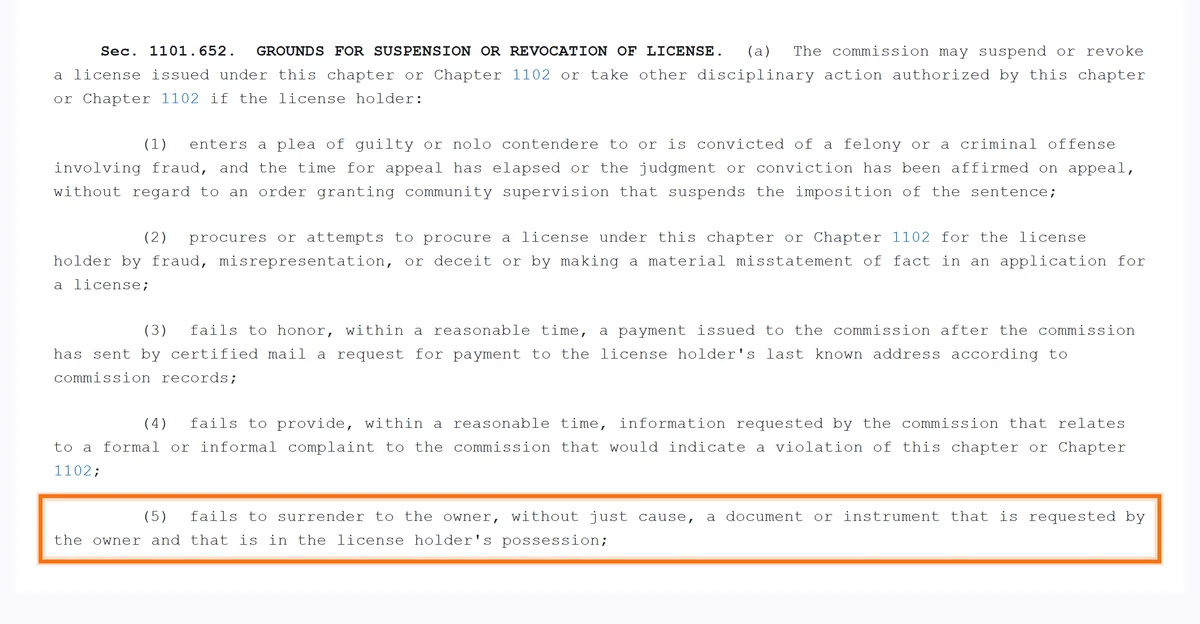
In practice that covers the signed lease and addenda, the tenant ledger, the move-in condition report and photos, inspection reports, open work orders and vendor invoices, and the money: the tenant's security deposit, your reserve and any rent collected but not yet disbursed. Commission Rule 535.146 treats rent and security deposits as trust money the broker holds in a fiduciary capacity, and Rule 535.2 makes a broker keep property management contracts, among other records, for at least four years after the contract ends.
Expect a final statement within the period your agreement states, with every charge itemized, including any termination fee it claims. Compare each line against the agreement. If the old company drags its feet, written requests copied to you build the record for a complaint to the Texas Real Estate Commission. The guide to an old manager who will not release keys or records covers that path. This is general information, not legal advice. For a large withheld balance, an attorney's letter is the next step.
A handover checklist, with who does what
Here is the whole handover for a Tarrant County rental on one page, with who carries each step:
| Step | Who does it | What to check |
|---|---|---|
| Sign the new management agreement | You | Start date matches the old agreement's end date |
| Send the termination notice to the old company | You | Sent the way the notice clause requires; keep proof |
| Authorize release of records, deposit and keys | You, in writing | Names the new company and lists the items |
| Request lease, ledger, deposit, keys, records and open work orders | New manager | You are copied on the request |
| Give the tenant new payment and maintenance instructions | New manager | Sent before the next rent due date |
| Receive the deposit, reserve and undisbursed rent | New manager | Shown on your first statement |
| Inspect and photograph the house | New manager | Report in your owner portal |
| Review the old company's final statement | You, with the new manager | Every charge matches the old agreement |
How to read this table: the first three rows are yours and should happen on the same day, with the dates matched. Everything below them belongs to the new manager, and the right column is what you look for to confirm each one happened. Owners who self-managed skip the termination, the release and the final statement, but the rest is identical. The handover timeline for self-managing owners lays out that version week by week.
What to ask the new manager before you sign
Four questions tell you whether the handover will be handled or merely promised.
- Can I see your records request template and the tenant notice you send?
- How many days after signing is the tenant usually paying you, and how do you time it to the rent date?
- Where does the deposit sit on arrival, and where will I see it on my statement?
- Who on your side is my contact during the handover, and who deals with the old company if it stalls?
A company with a routine answers all four without hesitating. If you want to put those questions to us, ask; our written quote lists every fee before you sign.
How Perpetual handles this
Our switching page sets out the order we follow. We start by reviewing your current agreement and its notice terms with you, and if it makes waiting the better decision, we tell you. You give notice to your current manager. After that we handle the coordination with that company: we request the lease and related documents, the security deposit, keys, the tenant ledger, property records and open work orders, and tenants receive new payment and maintenance instructions.
An enrollment inspection then sets the condition record as we begin. It is included on the Full Service plan, $49 on Standard and $125 on Investor Special. Your first monthly statement, in the AppFolio owner portal, is the checkpoint for transferred balances and charges. We take over occupied homes, so none of this waits for a vacancy.
Justin Brown is a Texas broker and owns the company, our office is at 5755 Rufe Snow Dr in North Richland Hills, and every fee is confirmed in writing before you sign. Call 682-593-7033 or request a free rental analysis for market rent and a written quote.

The takeaway: Sign the new company first, send the termination and the release authorization yourself the same day, and let the new manager carry everything else, which it should be able to show you on a list before you ever commit.
Questions owners ask
Will the old property manager talk to the new one directly?
Usually yes, once your written authorization is on file, because releasing records to a named party is routine. Some companies insist on sending everything to the owner, who then forwards it. Either way works as long as the request is specific and the deadline is clear. The new manager should copy you on every request so you can see what has been asked for and what has arrived.
What if the old company says I still owe it money before it releases anything?
Ask for the final statement that itemizes the claim and compare it with the agreement. Fees earned on rent actually collected are legitimate, and a termination fee may be if the agreement provides for it. Withholding your records or money that belongs to you is a different matter: Occupations Code 1101.652 makes failing to surrender an owner's documents, or to account for and remit another person's money, grounds for license discipline. If a written request does not resolve it, the Texas Real Estate Commission takes complaints.
How long does a handover between two property management companies take?
With a cooperative old company, the paperwork and the tenant switch fit inside the notice period, often a few weeks, and the first full month under the new manager runs normally. The slow items are usually the deposit transfer and the final statement, which arrive at the end of the old company's accounting cycle. Signing the new company early, with a matched start date, is what keeps the gap at zero.
Do I need to be present for the handover inspection?
No. The new manager schedules it with the tenant under the entry notice the lease provides and sends you the report with photos. Owners who live nearby sometimes attend the first inspection to see the process, which is fine. For out-of-state owners the report is the point: it records what the new company inherited, so that nothing from before the switch is later blamed on anyone.
What records does the old management company have to hand over?
The documents it holds for you: the signed lease and addenda, the tenant ledger, move-in condition report and photos, inspection reports, open work orders and vendor invoices, plus keys, remotes and codes. It must also account for and remit your money: the security deposit, your reserve and undisbursed rent. Under Texas Occupations Code 1101.652, failing to surrender an owner's documents or to account for an owner's money can cost a broker its license.
Which responsibilities stay with the property owner after a management company takes over?
The ones tied to ownership: the mortgage, property tax, the landlord insurance policy, HOA dues, funding the reserve, your own tax return, and approval of repairs above the spending limit, replacements and improvements. You also keep the decisions to renew, sell or evict. The manager carries daily operations: rent collection, maintenance coordination, inspections, tenant communication and monthly statements.
How soon can a new property manager take over after we sign?
As soon as the old agreement allows. The notice clause in your current management agreement sets the earliest end date, so the new start date is matched to it. If you self-manage, there is no notice period and the new manager can begin once the agreement is signed and the tenant has new payment instructions. Perpetual reviews your current agreement's notice terms with you first.
Related services
Property management in Keller, North Richland Hills and Fort Worth. How full-service management works in Tarrant County →