Key takeaways
- A property manager can take HOA notices and violations off your desk, but you remain the association member.
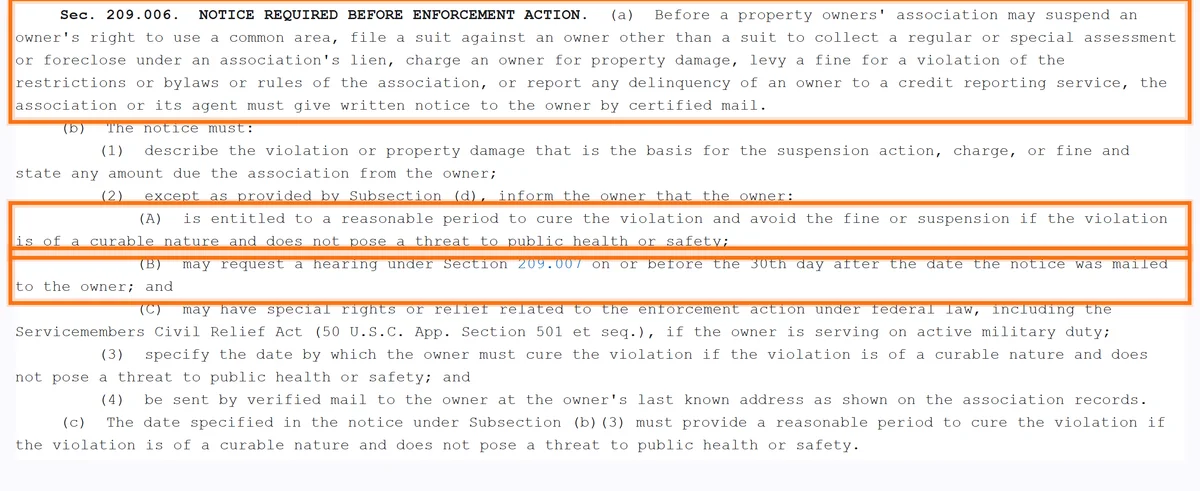
- Before most fines, a Texas HOA must send the owner a certified-mail notice describing the violation (Property Code 209.006).
- For a curable violation the notice must give a reasonable period to cure; cure it in time and no fine may be assessed (209.006(e)).
- The owner may request a hearing within 30 days after the notice was mailed (209.006(b)(2)(B)).
- A fine passes to the tenant only if the lease and its HOA addendum make the tenant responsible.
Yes. A property manager will handle HOA notices and violations for a rental in Keller, North Richland Hills or Fort Worth: get the notice to the tenant the day it arrives, make sure the violation is fixed before the cure deadline, confirm it with the association in writing, and charge any fine to the tenant where the lease allows. What a manager cannot do is take your place as the member: dues, assessments, votes and any fine the tenant does not pay remain the owner's.
Texas law gives you a window to fix most violations before a fine, which is why getting the notice to the right person quickly matters more than anything else. Here is how the process works, what has to be in place first, and where the owner still has to be involved.
What has to be in place before the first notice
Most HOA problems with rentals come from notices going to the wrong place. The association mails to the address on its records, which is often the owner's old home address or the rental itself, where a tenant may ignore it. By the time anyone acts, the cure period has passed and a fine has been added. The first job is to put the manager's address and email on the HOA's file as the contact for the property, with the owner copied if you want to see everything.
The manager also needs a copy of the governing documents and the current rules, so a tenant can be given the rules at lease signing and the manager can judge whether a notice is valid. Under Property Code 209.016(e), an association may ask for each tenant's contact information and the lease start date and term, but it may not require a tenant's credit report or rental application, or require the association to approve the tenant (209.016(b)). HOA rules and your rental property covers what to check in the documents before renting at all.
The lease has to make the tenant responsible
A manager can only pass a fine to a tenant if the lease says the tenant must follow the HOA rules and is responsible for violations and the resulting fines. A Texas lease for a home in an association should include an HOA addendum that attaches or references the rules, makes compliance a lease obligation, and allows fines caused by the tenant to be charged back as a lease charge. Without that, the owner pays the fine and has only an argument, not a clause.
The addendum also lets the manager treat repeated violations as a lease matter, with written notice and, if it continues, the usual remedies. Lease addenda every Texas landlord should consider covers the HOA addendum and the others that protect an owner.
How a violation is handled, start to finish
The sequence a manager should follow when a notice arrives:
- Log the notice with its date and the cure deadline the same day.
- Check whether the violation is the tenant's, such as a trash can left out, a trailer in the driveway or an overgrown lawn the lease assigns to them, or the owner's, such as a fence that needs repair or a paint color the architectural committee has flagged.
- For a tenant violation, contact the tenant in writing with the notice, the rule and the deadline, and follow up by phone if needed.
- For an owner violation, send the owner the notice with a recommendation and a vendor estimate if work is required.
- Confirm the cure, by photo or a visit, before the deadline, and tell the HOA in writing that it is resolved.
- If a fine is assessed, charge it to the tenant under the lease or pay it from owner funds, and record it on the statement.
Under Property Code 209.006, the association must give the owner written notice and, for a curable violation, a chance to cure before most fines can be charged, which is why getting the notice to the right person quickly matters so much. The rules are in the next section.
What Texas law requires before an HOA can fine you
Property Code 209.006 sets the steps a Texas property owners association must follow before it levies a fine, charges you for property damage or suspends your use of common areas:
| Step | What the law requires | Section |
|---|---|---|
| Notice | Written notice to the owner by certified mail, describing the violation and any amount due | 209.006(a), (b)(1) |
| Cure period | For a curable violation that is not a health or safety threat, a reasonable period to cure and a date by which to cure it | 209.006(b)(2)(A), (b)(3), (c) |
| No fine if cured | If the owner cures within that period, a fine may not be assessed | 209.006(e) |
| Hearing | The owner may request a hearing on or before the 30th day after the notice was mailed | 209.006(b)(2)(B) |
| Repeat violations | The notice steps do not apply to a violation already noticed in the preceding six months | 209.006(d) |
How to read this table: the third and fourth rows are where a manager earns its keep. A parking or maintenance violation is curable under the statute's own examples, so fixing it inside the cure period avoids the fine entirely. A violation the statute treats as uncurable, such as a garage sale the documents prohibit or a one-time noise violation, can be fined without a cure period, which is why the HOA rules belong in the lease from day one.
Which violations are the tenant's and which are yours
Tenant violations are behavior: parking, trash cans, noise, pets off leash, unapproved vehicles, holiday decorations left up, a lawn the lease makes them maintain. The manager handles those with the tenant, and the tenant pays the fine if the lease allows it.
Owner violations are the property itself: a fence leaning, a roof with mismatched shingles after a hail repair, trim that needs paint, a dead tree, an exterior change that needed architectural approval. The manager coordinates the repair with vetted vendors and the owner pays, because no tenant is responsible for a fence post. Some fall in between, such as a lawn that died because the tenant stopped watering but also because the irrigation system failed; the inspection history usually settles those. Regular inspections catch most owner-side items before the HOA does.
What the manager cannot take off your plate
You remain the member of the association. Dues and special assessments are yours, and while some managers will pay them from owner funds on request, many owners prefer to keep that direct. Votes, meetings, architectural applications and disputes with the board over the rules themselves are owner matters, though a manager can submit an application on your behalf with your authorization.
A fine the tenant refuses to pay or that is assessed after the tenant leaves is an owner cost first, recoverable from the tenant's deposit or by other means only if the lease and the documentation support it. And if the association moves to a lien or legal action over unpaid amounts, that is between the association and the owner, with the manager supplying the records. Repeated tenant violations that put you at odds with the board are usually a lease-enforcement question, and handling tenant complaints covers how a manager escalates without losing the tenant or the argument.
An example: the trailer in the driveway
Say a tenant in a Keller subdivision parks a utility trailer in the driveway. A courtesy notice reaches the manager, who forwards it to the tenant the same day with the rule and a deadline. The trailer is moved; the manager photographs the empty driveway and emails the HOA. No fine, ten minutes of work, and the owner sees a note in the portal.
Now say the notice had gone to the owner's old address instead. Nobody acts, the courtesy period and then the cure date in the certified notice pass, a fine is assessed, and the owner learns about it when the annual statement from the HOA arrives with a balance. The fine is now the owner's to pay and the tenant's to argue about. Same trailer, very different outcome, and the only difference was who was on the HOA's contact list.
This is general information, not legal advice. HOA powers and notice requirements have specifics under Texas law and your association's documents; confirm them with an attorney where it matters.
How Perpetual handles this
Perpetual Property Management manages homes in Keller, North Richland Hills and Fort Worth, where many neighborhoods have active HOAs. We manage lease-up and tenant communication with the HOA rules in view, and address violation notices quickly so they do not escalate into owner fines. Our leases use current Texas forms with the addenda a property needs, including HOA rules.
Owner-side items, such as a fence repair the HOA flags, go through our maintenance coordination: work under spending limits you set, larger jobs to you with a recommendation, and the original invoice in your owner portal. Every fee is listed in your management agreement; if a fee is not in it, you do not pay it. See our Keller property management page for how we work in HOA neighborhoods.
The takeaway: A manager can take HOA notices and violations off your desk, but only if the association has the manager's address and the lease makes the tenant responsible.
Questions owners ask
Can an HOA fine the owner for a tenant's violation in Texas?
Yes. The association's relationship is with the owner as the member, so fines are assessed against the owner regardless of who caused the violation. Under Property Code 209.006 the association must first send the owner a certified-mail notice and, for a curable violation, a reasonable period to cure. The owner recovers a fine from the tenant only if the lease makes the tenant responsible.
Does the HOA need to know my house is a rental?
Often yes. Many Texas associations ask owners to report a leased home. Under Property Code 209.016 an association may request each tenant's contact information and the lease start date and term, but it may not require the tenant's credit report or rental application, or require the association to approve the tenant. Check the documents before renting.
Who pays HOA dues when a house is rented, the owner or the tenant?
The owner, as the member, unless the lease specifically shifts a defined amount to the tenant, which is unusual for single-family rentals. Dues are normally built into the rent the owner charges. A manager can pay dues from owner funds if asked, but the obligation stays with the owner.
What if my tenant keeps violating HOA rules?
Treat it as a lease violation. The manager documents each notice, gives the tenant written warnings under the lease, charges fines back where allowed, and if the behavior continues, the lease's remedies apply, up to non-renewal or termination. Keeping the association informed that the owner is acting usually prevents the board from escalating against you.
How long do I have to fix an HOA violation in Texas?
For a curable violation that is not a threat to health or safety, Property Code 209.006 requires the association's certified-mail notice to give a reasonable period to cure and a date to cure by. If the violation is cured in that period, no fine may be assessed. The statute does not set a fixed number of days, so read the date on the notice.
Related services
Property management in Keller, North Richland Hills and Fort Worth. How full-service management works in Tarrant County →