Key takeaways
- The deposit comes first: Property Code 92.104 lets the landlord deduct unpaid rent and other charges the tenant is liable for under the lease.
- The refund or the itemized list is due within 30 days after the tenant surrenders the home (92.103, 92.109), once the tenant has given a written forwarding address (92.107).
- A tenant may not withhold the last month's rent because a deposit exists; doing so in bad faith costs three times the rent withheld (92.108).
- A balance of up to $20,000 can be sued for in justice court (Government Code 27.031). In Tarrant County the filing fee is $54 plus $90 to serve each defendant.
- A suit on a debt must be filed within four years (Civil Practice and Remedies Code 16.004).
Can a property manager help recover unpaid rent after a tenant moves out? Yes, and the help is worth more than owners expect, but it stops at a clear line. On a rental in Fort Worth, Keller or North Richland Hills, the manager applies the security deposit, produces the accounting Texas law requires, sends the written demand and hands you a complete, dated file. The manager does not decide to sue for you, does not enforce a judgment and cannot promise you will see the money.
This guide covers what happens in the weeks after a tenant leaves owing rent, the Texas deposit rules that decide whether your claim holds up, what justice court costs in Tarrant County and how to decide whether the balance is worth chasing.
Recovering unpaid rent after move-out: who does what
Here is each step after a tenant moves out owing rent, who normally handles it and the rule behind it:
| Step | Who handles it | The rule or source |
|---|---|---|
| Move-out inspection and final ledger | Manager | The lease and the move-in condition record |
| Apply the deposit to unpaid rent and charges | Manager, for the owner | Property Code 92.104(a): charges the tenant is legally liable for under the lease; never normal wear and tear |
| Refund or itemized list of deductions | Manager, for the owner | Within 30 days after surrender (92.103, 92.109(d)), once a written forwarding address is given (92.107) |
| Written demand for the remaining balance | Manager or owner | No statute requires it; it is the record a judge will want to see |
| Decision to sue | Owner | Your claim, your decision |
| Suit in justice court | Owner, or an attorney | Up to $20,000 (Government Code 27.031); Tarrant County filing fee $54 plus $90 service per defendant |
| Collecting on a judgment | Owner, or an attorney | Separate steps with separate court fees after the judgment |
How to read this table: the first four rows are paperwork a manager can do for you, and the last three are legal decisions that stay with the owner. If the deposit covers the balance, the process ends at row three.
The deposit is applied first, and Texas law sets how
Recovery starts with the security deposit, and the deposit accounting decides whether everything after it holds up. Four sections of the Texas Property Code do the work:
- 92.104. Before returning a deposit, the landlord may deduct damages and charges for which the tenant is legally liable under the lease or from breaching it, but nothing for normal wear and tear. If any part is kept, the tenant gets the balance with a written description and itemized list of all deductions.
- 92.103 and 92.109. The refund is due on or before the 30th day after the tenant surrenders the home. A landlord who neither refunds nor itemizes by then is presumed to have acted in bad faith, and bad faith can cost $100, three times the amount wrongfully withheld and the tenant's attorney's fees.
- 92.107. The landlord is not obligated to refund or itemize until the tenant gives a written forwarding address, but the tenant does not lose the right to either by failing to give one.
- 92.108. The tenant may not withhold any part of the last month's rent on the ground that the deposit covers it. A tenant who does so in bad faith is liable for three times the rent wrongfully withheld and the landlord's reasonable attorney's fees.
So the first thing a good manager does is produce a clean itemization: unpaid rent by month, late fees the lease allows, cleaning and repairs beyond normal wear with photos and invoices from the move-out inspection. If the deposit covers the balance, the recovery is finished here. If not, the itemization becomes the first exhibit in everything that follows. More detail is in the Texas security deposit guide.
What the manager does when the balance exceeds the deposit
With the deposit applied, the next moves are administrative, and they matter because a claim for money is decided on paperwork:
- A written demand to the tenant's forwarding address, or last known address, stating the balance, how it was calculated and a date to pay by.
- A current ledger, so every rent charge, late fee, payment and deposit credit is in one dated record.
- The file: signed lease, move-in and move-out inspection reports with photos, repair invoices, the deposit itemization, the demand letter and proof of mailing.
- If the tenant answers and offers to pay over time, the terms in writing, signed, with dates and amounts.
Illustrative only, not a real case. A tenant leaves owing two months of rent at $1,900, which is $3,800, plus $650 of cleaning and repairs beyond normal wear: $4,450 in total. The deposit is $1,900. After it is applied, the balance is $4,450 - $1,900 = $2,550. That figure, and the documents behind each line of it, is what the demand letter states.
One Texas rule applies when the lease had no security deposit at all: Property Code 92.110 requires written notice of the claim to the tenant on or before the date it is reported to a consumer reporting agency or a third-party debt collector, or the right to collect is forfeited, unless the tenant gave no forwarding address.
Where a manager's role ends and yours begins
A property manager is your agent for operating the rental. The manager is not your attorney, and the claim against the former tenant belongs to you. In practice:
- The decision to sue is the owner's, and so is the judgment.
- In an eviction suit in justice court, Property Code 24.011 lets the parties be represented by authorized agents who need not be attorneys. A suit only for money after the tenant has left is a different kind of case, so ask the court or an attorney who may appear for you.
- The manager can testify about the records the manager created: the ledger, the inspections and the notices.
- Collecting on a judgment is the owner's or an attorney's work.
- Any fee a manager charges for recovery work has to be in the management agreement in writing.
Self-help is not an option at any stage. While the tenant still lives in the home, Property Code 92.0081 bars a landlord from keeping a tenant out except by judicial process, with narrow exceptions that carry their own notice rules, and a violation costs a civil penalty of one month's rent plus $1,000. If a manager tells you they will "handle the collection" with no detail, ask exactly which steps they mean.
Justice court in Tarrant County: the limit, the deadline and the cost
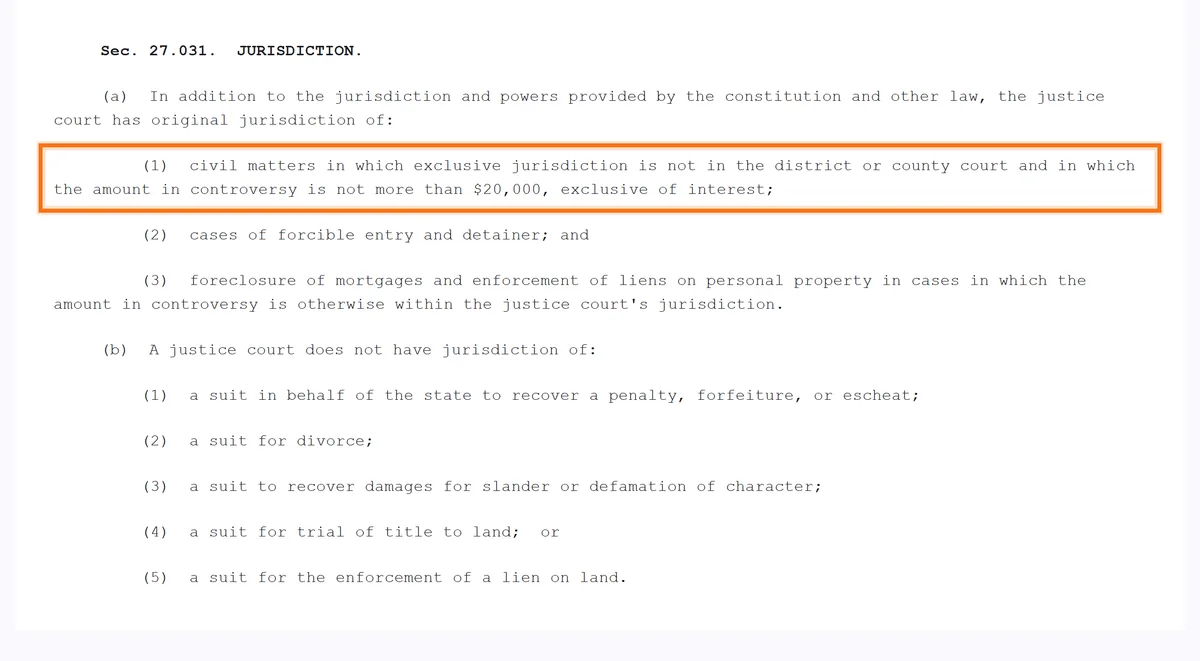
Most unpaid-rent claims fit in justice court. Government Code 27.031(a)(1) gives a justice court jurisdiction over civil matters in which the amount in controversy is not more than $20,000, exclusive of interest.
Three more numbers matter:
- The deadline. Civil Practice and Remedies Code 16.004(a)(3) requires a suit on a debt to be brought not later than four years after the day the cause of action accrues. Ask an attorney which date starts the clock for each unpaid month.
- The filing fee. Tarrant County's justice court fee schedule lists $54 for a justice suit with one defendant.
- Service. The county's 2026 sheriff and constable fee schedule lists $90 for a citation, so one former tenant costs $54 + $90 = $144 to sue, and two cost at least $54 + $180 = $234.
If the tenant is still in the home when you file, the rent claim can ride with the eviction suit: Property Code 24.0051(b) lets a landlord recover unpaid rent in that suit even if the tenant moves out after the petition is filed and before judgment. The court process is covered in recovering damage or unpaid rent beyond the deposit. Confirm current fees with the court before filing. This is general information, not legal advice.
Deciding whether the balance is worth chasing
This is the conversation a good manager has with you before anyone files anything. The inputs are the size of the balance, whether you have a forwarding address, whether the tenant is likely to be able to pay, and what a court date costs you in time. A judgment is a right to collect, not a payment, so ask an attorney what can actually be reached before spending money on one.
Take the $2,550 balance from the example above. A demand letter costs almost nothing. Filing in a Tarrant County justice court costs $144 for one defendant, about 6% of the balance, plus a morning of your time. Hiring an attorney for a balance that size may cost more than it recovers; for a balance several times larger, with damage photos and a tenant you can locate, the math changes. The manager's job is to lay those numbers out plainly, not to push you toward court.
Remember the duty to mitigate. Under Property Code 91.006, if a tenant abandons the home in violation of the lease, the landlord must mitigate damages, and a lease clause waiving that duty is void. Re-renting promptly shrinks the claim, and it also stops your loss. This is general information, not legal advice.
The recovery that works best is the one you never need
Every unpaid-rent recovery is a screening and lease conversation in disguise. Income checked against the rent, rental history checked, and a lease with clear late-fee terms are what keep balances small enough that the deposit covers them. Written screening criteria applied to every applicant is the biggest lever an owner has on this problem.
The second lever is speed during the tenancy. Rent collection that sends the notice on the day the lease allows, not three weeks later, keeps a late tenant from becoming a two-months-behind tenant who then disappears. Owners who self-manage tend to wait, out of kindness or discomfort, and the balance grows while they do. What happens when a tenant moves out without notice covers the first days after you find the house empty.
How Perpetual handles this
Perpetual Property Management is broker-owned, with our office at 5755 Rufe Snow Dr in North Richland Hills, and we manage homes in Keller, North Richland Hills, Fort Worth and nearby. What our site commits to on this subject:
- Every move-in and move-out gets a 360-degree condition inspection, one of the five written guarantees, subject to the Guarantee Addendum.
- The move-out inspection is compared against the move-in baseline, with fair, documented deposit handling.
- The late process is documented and the same for every tenant, so the ledger, lease, notices and communication history are organized before anyone needs them.
- Monthly statements, invoices and documents are in the owner portal.
- On evictions, our site says we are not a law firm and that we coordinate with an attorney experienced in landlord-tenant law where a matter needs one.
We do not offer a rent guarantee, and we do not promise that a former tenant's balance will be collected. Whether we send a demand letter, refer an account to a collection agency or appear in court for you, and any fee for that work, are confirmed in writing before you sign. Eviction service is included on our Full Service plan and optional at $7.95 a month on the others, as listed on the price sheet.
If a tenant has just left owing rent and you want the file put in order, call 682-593-7033.
The takeaway: A manager can apply the deposit, build the file and send the demand; the lawsuit, if the numbers justify one, is yours, and the manager's real value is making sure the paperwork is ready for it.
Questions owners ask
How long do I have to sue a former tenant for unpaid rent in Texas?
Civil Practice and Remedies Code 16.004(a)(3) requires a suit on a debt to be brought not later than four years after the day the cause of action accrues, and section 16.051 sets the same four years for any claim with no express period. The practical deadline is shorter: the sooner the demand letter and ledger are in order, the easier the tenant is to find. Ask an attorney which date starts the clock in your case. This is general information, not legal advice.
Can a property manager report a former tenant to the credit bureaus?
A manager does not report to the credit bureaus directly; that normally runs through a collection agency or a reporting service, and whether to use one is the owner's decision. One Texas rule to know: if the lease had no security deposit, Property Code 92.110 requires written notice of the claim to the tenant on or before it is reported to a consumer reporting agency or debt collector, or the right to collect is forfeited. Ask an attorney before reporting any debt.
Can I keep the whole security deposit if the tenant skipped out on rent?
You can apply the deposit to unpaid rent and other charges the tenant owes under the lease (Property Code 92.104). Send a written, itemized list within 30 days of surrender anyway. The statute excuses the list only when the tenant owes rent at surrender and there is no controversy about the amount, and you rarely know that in advance. If the tenant gave no forwarding address, prepare the list and keep it; 92.107 says the tenant does not lose the right to it.
What happens to the unpaid rent if the house is re-rented quickly?
The claim shrinks, and that is the better outcome. Under Property Code 91.006 a landlord has a duty to mitigate damages when a tenant abandons the home in violation of the lease, so rent from a new tenant reduces what the former tenant owes. What remains is the rent for the gap, any charge the lease allows and damage beyond normal wear. This is general information, not legal advice.
Can a tenant use the security deposit as the last month's rent in Texas?
No. Property Code 92.108 says a tenant may not withhold any portion of the last month's rent on the ground that the security deposit is security for unpaid rent. A tenant who does is presumed to have acted in bad faith, and a tenant who violates the section in bad faith is liable for three times the rent wrongfully withheld plus the landlord's reasonable attorney's fees in a suit to recover it.
How much does it cost to sue a former tenant in Tarrant County?
In justice court, Tarrant County's fee schedule lists a $54 filing fee for a justice suit with one defendant, and the county's 2026 constable fee schedule lists $90 to serve a citation. That is $144 for one former tenant and at least $234 for two. Justice court hears claims of up to $20,000 under Government Code 27.031. Confirm current fees with the court before you file.
Property management in Keller, North Richland Hills and Fort Worth. How full-service management works in Tarrant County →