Key takeaways
- A signed lease binds both sides. Hiring a manager does not change it, and the manager administers it as written until it ends.
- Texas law does allow a broker to complete a lease form the owner prepared and requires (Occupations Code 1101.654(b)), but a broker who is not an attorney may not draft or rewrite lease clauses for you.
- For new tenants and renewals, expect the manager's own lease. The management agreement usually says so, and it is worth reading that clause.
- Your house-specific rules go into addenda: pool, HOA rules, pets, lawn care, an off-limits outbuilding.
- No addendum can waive what the Texas Property Code protects, such as the security deposit rules or the ban on lockouts.
If you have a tenant in place, yes: the lease they signed is a binding contract, and the manager steps in as your agent under it until it ends. For the next tenant and at the current tenant's renewal, usually no: the manager will use its own Texas-compliant lease. That is the pattern on rentals in Fort Worth, Keller and North Richland Hills, because the manager's notices, late fee process, inspections and deposit accounting are built around that document.
Who drafts, who signs and what the owner still decides are covered in who prepares and signs the lease when you use a property manager. This article is the practical answer for each situation an owner is in.
Which lease applies: your situation at a glance
This table shows which lease governs in each situation an owner can be in when a manager starts, and what changes for the tenant:
| Your situation | Which lease applies | What changes for the tenant | When the manager's lease starts |
|---|---|---|---|
| Tenant in place, months left on the lease | The lease you and the tenant signed | Only where rent is paid and where repairs are reported | At renewal, if the tenant stays |
| Tenant in place, renewal coming up | Your lease until its end date | A new lease is offered with the renewal terms | On the renewal date |
| Tenant on a month-to-month tenancy | The existing terms, month to month | A new lease can be offered at any time; the tenant has to agree to it | When both sides sign |
| Vacant house, new tenant | The manager's lease, with your addenda | Nothing to change: the tenant starts on it | From day one |
How to read this table: the second column is the document a judge would read today, and the manager cannot swap it without the tenant's signature. The last column tells you when the weak spots in your current lease can be fixed. For most owners that date is the renewal.
Tenant in place: your lease stays until it ends
A signed lease binds both sides, and hiring a manager does not change it. The manager reviews it on takeover, confirms the rent, deposit, term, late fee and notice provisions, and then administers it as written. The tenant receives a written notice that rent is now paid to the manager and that maintenance requests go through the manager. That notice also keeps you in line with Property Code 92.201, which requires a landlord to disclose the name and street address of an off-site management company. Nothing in the lease changes without the tenant's agreement.
What the manager will do is tell you where the lease is weak. A downloaded form may be missing a reletting charge, a clear repair responsibility clause, an entry provision, or the notices the Texas Property Code requires. Entry is a good example: no Texas statute sets a notice period for a landlord to enter, so the lease is the only place that rule lives. Those gaps cannot be fixed mid-term, but they are the list of what will be fixed at renewal. The guide on how a property manager takes over mid-lease covers the rest of that handover.
New tenants: why the manager's lease, not yours
For the next tenant, the manager uses its own lease for reasons that benefit you:
- The manager's lease is kept current, so a change in the Texas Property Code is picked up once, in one document, for every home it manages.
- The manager's late notices, notice to vacate, inspection schedule and deposit itemization are written to match that lease's wording. Swapping the lease breaks those links.
- The notices and disclosures Texas law requires, such as the flood notice and the tenant's repair remedies, are already built in or attached as addenda.
- Every tenant in the manager's portfolio is on the same terms, so a question about what a clause means has been answered before.
An owner's custom lease, even a good one, costs the manager time on every notice and introduces wording nobody has tested. Most management agreements state that the manager will use its lease form, and it is worth reading that clause before you sign. Our leasing service page describes the lease documents we use and what is attached to them.
What Texas law says about which lease form a broker can use
Can a property manager legally use the lease you wrote or downloaded? Yes. A Texas property manager who leases homes for owners works under a real estate broker's license, and Occupations Code 1101.654(b) says a license holder who completes a lease form is not practicing law if the form was adopted by the Texas Real Estate Commission, prepared by a Texas attorney for that type of transaction, or "prepared by the property owner or by an attorney and required by the property owner." Section 1101.155(b) adds that the commission may not prohibit a license holder from using a lease form the owner prepared.
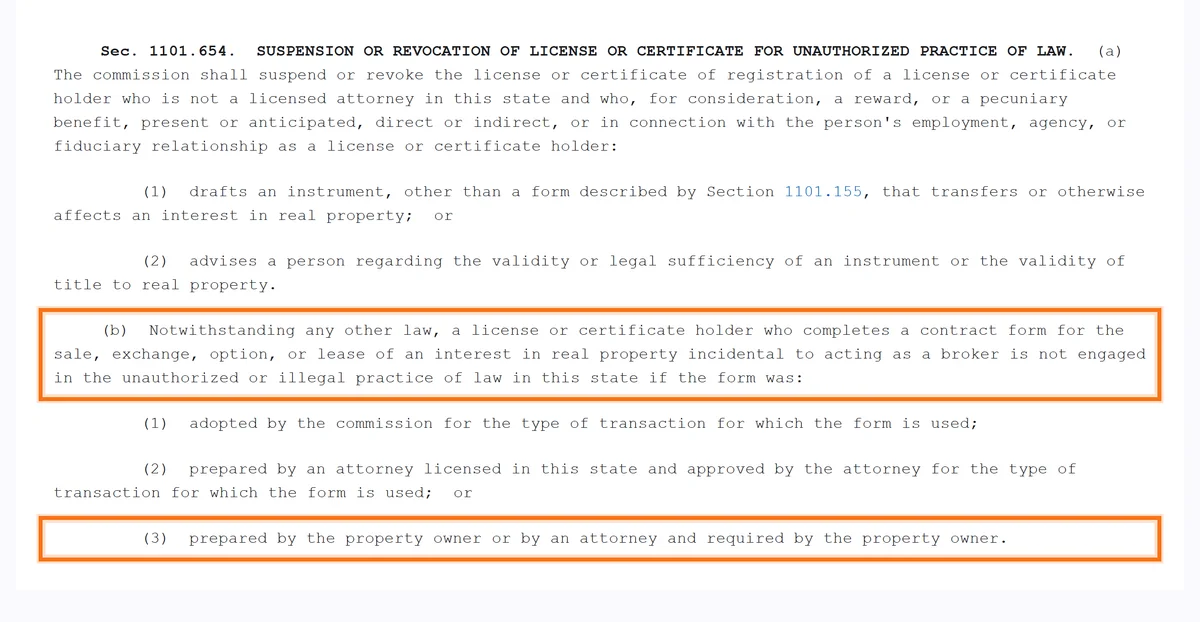
The same section explains why most managers still say no. Under 1101.654(a), a license holder who is not an attorney may not draft an instrument that affects an interest in real property, other than those forms, and may not advise you on the legal sufficiency of an instrument. So a manager can fill in the blanks on your lease, but cannot repair a clause that is missing or badly written, and cannot tell you your form will hold up. An attorney has to do that.
In practice, "required by the property owner" means you carry the risk of the form. If you want your own lease used for new tenants, have a Texas attorney review it first, and expect the manager to ask for that in writing. This is general information, not legal advice.
Where your specific terms go: the addenda
Using the manager's lease does not mean losing your terms. Anything specific to your house belongs in an addendum, and a good manager asks for the list before listing: pool rules and maintenance, a well or septic system, HOA rules the tenant must follow, lawn and tree care, a detached workshop the tenant may not use, an alarm system, a pet policy with named animals. The manager drafts these onto standard addendum forms or adds a special provisions section.
What you cannot put in an addendum is a term that conflicts with Texas law. Property Code 92.006 says the security deposit duties cannot be waived and limits how the repair duties can be shifted to a tenant, 92.0081 restricts lockouts, and 92.103 sets the deposit refund at 30 days after the tenant surrenders the home. The manager will say no to terms that cut against those, and that is a service, not an obstacle. Lease addenda for Texas landlords covers the common ones. The owner's checklist of what the lease must contain is in what a Texas residential lease must cover.
What the Texas Property Code expects to see in the lease
When a manager reviews an owner's lease at takeover, these are the statutory items it checks first, and where each one comes from:
| Item | What the statute says | Section |
|---|---|---|
| Late fee | A late fee may be collected only if notice of the fee is in a written lease, the fee is reasonable, and rent has remained unpaid two full days after it was due | Property Code 92.019 |
| Tenant repair remedies | The lease must contain language in underlined or bold print that informs the tenant of the remedies in 92.056 and 92.0561 | Property Code 92.056(g) |
| Flood notice | The floodplain notice must be in a paragraph of the lease, an addendum, or a separate signed document given at or before signing | Property Code 92.0135 |
| Advance notice of move-out | A rule that the tenant must give advance notice of surrender to get the deposit back works only if it is underlined or in conspicuous bold print | Property Code 92.103(b) |
| Copy of the lease | The landlord must give a tenant a complete copy within three business days after the lease is signed | Property Code 92.024 |
How to read this table: a lease that misses one of these is still a lease, but the missing item costs you something specific, such as the right to collect a late fee. These gaps are the first things a manager lists for correction at renewal. This is general information, not legal advice.
Renewal: the moment the old lease becomes the new one
If your tenant in place renews, the renewal is the point where the manager's lease replaces yours. The tenant signs a fresh lease on the manager's form, with the agreed rent and term, and the weaknesses found at takeover are closed. The manager explains the change to the tenant as a standard document update, which is what it is. The tenant is free to read it, ask questions and decline, in which case the choice is the old terms until the lease ends or no renewal.
Say you self-managed a house in North Richland Hills on a form you found online, with a tenant three months from renewal. The manager takes over under that form, sends the rent-redirection notice, and at the renewal window offers the tenant a new term on the manager's lease with a pet addendum for the dog that was never on paper. The deposit carries over, the renewal is documented, and the renewals service handles the timing and the notices.
What to check in the manager's lease before you sign with them
Ask to read the lease form and the standard addenda before signing the management agreement. You are looking for a few things: that it is a current, attorney-prepared or association form and not a homemade document, that the late fee and returned payment terms are reasonable and lawful, that there is a reletting charge and an early termination process, that entry and inspection rights are stated, and that the deposit section matches Texas rules. Ask how special provisions are added and whether you see the completed lease before it is signed.
A manager who will not show you the form, or who cannot tell you who prepared it, is telling you something. The management agreement itself deserves the same reading; what to look for in a property management agreement goes clause by clause.
This is general information, not legal advice. An attorney can review any lease or addendum you are unsure about.
How Perpetual handles this
If you have a tenant in place, we take over the occupied property: the lease, deposit and records transfer to us, and the tenant receives new payment and maintenance instructions. We administer the lease you signed as it is written. Renewal work starts 120 days before the lease ends, with a rent check against leased comparables and a recommendation, and the decision is always yours.
For new tenants and renewals, our leasing service uses current Texas-compliant lease documentation with property-specific addenda, the ones your property needs, such as HOA rules, a pool, pets or smart devices. You receive a copy of everything through the owner portal. Security deposits are held and accounted for under the Texas Property Code, and every move-in gets a photo-documented condition report.
The fees are simple to check. A lease renewal is $150 on the Full Service plan, $200 on Standard and $149 on Investor Special, and every number is confirmed in writing before you sign; if a fee is not in the management agreement, you do not pay it. See pricing and fees.
We are broker-owned and manage homes in Keller, North Richland Hills, Fort Worth and nearby. If you want to know how a takeover would work with the lease you have now, send it over or call 682-593-7033.
The takeaway: Your current lease stays until it ends; from the next signature on, the manager's Texas-compliant lease with your addenda is the better document.
Questions owners ask
Does hiring a property manager change my tenant's current lease?
No. The lease stays in force as written until it ends. The manager becomes your agent under it, sends the tenant notice of where to pay rent and report repairs, and administers the terms as they are. Changes to the terms happen at renewal, when the tenant signs the manager's lease.
Can I add my own rules to the property manager's lease?
Yes, through addenda or a special provisions section, as long as the rules are lawful. House-specific items such as pool care, HOA rules, lawn responsibility or an off-limits outbuilding are normal. Terms that conflict with Texas law, such as waiving repair duties, will be refused.
What lease form do Texas property managers use?
It varies by company. Under Texas Occupations Code 1101.654(b), a broker may complete a lease form adopted by the Texas Real Estate Commission, one prepared by a Texas attorney, or one prepared by the owner and required by the owner. In practice many managers use a trade association's lease or an attorney-prepared lease with addenda for pets, HOA rules and similar items. Ask to see the form before you sign the management agreement. Perpetual uses current Texas-compliant lease documentation with property-specific addenda.
Will I get to see the lease before the tenant signs it?
You should, and a good manager offers it. You are approving the completed special provisions and the addenda for your house, not negotiating the standard clauses. The manager then signs as your agent under the authority in the management agreement, or you sign personally if the agreement allows.
Can I insist that the property manager use my own lease for new tenants?
You can ask, and Texas law allows it: Occupations Code 1101.155(b) and 1101.654(b) let a broker complete a lease form prepared by the property owner or by an attorney and required by the owner. Many managers will still decline, because they cannot legally rewrite its clauses and their notices are built around their own lease. If you want yours used, have a Texas attorney review it first and raise it before you sign the management agreement.
Can a new property manager change the rent or the rules in the middle of my tenant's lease?
No. A fixed-term lease binds the owner, the tenant and the manager acting for the owner until it ends, so rent and rules stay as written unless the tenant agrees to a change in writing. What changes right away is administrative: where rent is paid and how repairs are reported. New terms arrive at renewal, on the new lease.
Related services
Property management in Keller, North Richland Hills and Fort Worth. How full-service management works in Tarrant County →