Key takeaways
- Can a property manager sign for the landlord? Yes, when the management agreement gives the manager that authority in writing.
- A license holder may complete a lease form but may not draft one. Occupations Code 1101.654 limits brokers to forms adopted by the Texas Real Estate Commission, prepared by a Texas attorney, or prepared and required by the owner.
- You still decide the terms: rent, deposit, pets, lease length and how much renewal authority the manager has.
- Property Code 92.024 requires a complete copy of the signed lease to reach a tenant within three business days.
- Property Code 92.201 gives the tenant the right to the name and address of the record owner and of the management company.
When you hire a property manager for a rental in Keller, North Richland Hills or Fort Worth, the manager prepares the lease and, in most arrangements, signs it as your agent. You approve the terms that matter to you: rent, deposit, pets and lease length. The manager handles the form, the addenda, the signatures and the enforcement. The authority to sign for you comes from one place, the management agreement.
Here is who does what, what Texas law says about each step, why your existing lease usually gets retired, and how Perpetual handles the lease.
Who does what on the lease: owner, manager and Texas law
This table shows each step of a lease under management, who does it, and the Texas rule or document behind it:
| Step | Who does it | Where the rule comes from |
|---|---|---|
| Set rent, deposit, pet rules and lease length | You approve them in writing; the manager recommends | The management agreement and your written instructions |
| Prepare the lease | The manager completes a form; a license holder does not draft one | Occupations Code 1101.654 |
| Sign as landlord | You, or the manager as your agent if the agreement authorizes it | The management agreement; Business and Commerce Code 26.01 for a lease longer than one year |
| Collect signatures electronically | The manager, when the parties have agreed to sign that way | Business and Commerce Code 322.007 |
| Give the tenant a complete copy of the lease | The landlord, in practice the manager, within three business days | Property Code 92.024 |
| Tell the tenant who owns and who manages the home | The landlord, on request or in the lease itself | Property Code 92.201 |
| Sign renewals and amendments | The manager, within the authority you gave | The management agreement |
How to read this table: the first and last rows are where you have control, and both depend on what the management agreement says. The middle rows are duties the law places on the landlord's side that a manager carries out for you.
Who drafts the lease
The manager prepares it, by completing a form built for Texas residential tenancies. The manager fills in the business terms you approved, attaches the addenda that apply to your house and sends it for signature.
What a licensed manager may not do is write a lease from scratch. Texas Occupations Code 1101.654 tells the Texas Real Estate Commission to suspend or revoke the license of a non-attorney license holder who drafts an instrument affecting an interest in real property. The same section says that completing a lease form is not the practice of law when the form was adopted by the commission, prepared by an attorney licensed in Texas, or prepared by the property owner or an attorney and required by the owner. That constraint is a feature: it keeps the lease on tested ground. The guide to what a Texas residential lease must cover lists what the form addresses.
Who signs as landlord, and where the authority comes from
In most management arrangements the manager signs on the landlord's line as your agent, and the lease identifies the management company. Some leases name the owner as landlord, others name the management company as the landlord's agent; ask which, and read the signature block before the first lease goes out.
The authority to sign comes from the management agreement. That document appoints the manager as your agent for leasing and management and sets the limits: the minimum rent, the maximum lease term, whether pets are allowed, whether the manager may sign renewals, and what needs your approval first. Read that clause before you sign the agreement, because it is the whole basis of the manager's signature. If the agreement is silent on something, the manager should ask you rather than assume.
You can sign the lease yourself if you prefer. It slows signing and gives the tenant a reason to call you directly, which is why most owners delegate it.
Can a property manager sign for the landlord? What Texas law says
Yes. Texas law recognizes a signature by an authorized agent. Under Business and Commerce Code 26.01, a lease of real estate for a term longer than one year is not enforceable unless it is in writing and signed by the person to be charged "or by someone lawfully authorized to sign for him." The management agreement is what makes the manager lawfully authorized. An electronic signature counts: under Business and Commerce Code 322.007, a signature may not be denied legal effect solely because it is in electronic form.
Two Property Code duties follow the signature:
- A copy of the lease. Not later than the third business day after each party has signed, the landlord must provide at least one complete copy of the lease to at least one tenant who is a party to it (92.024(a)). Email satisfies this if the parties have communicated by email about the lease (92.024(e)).
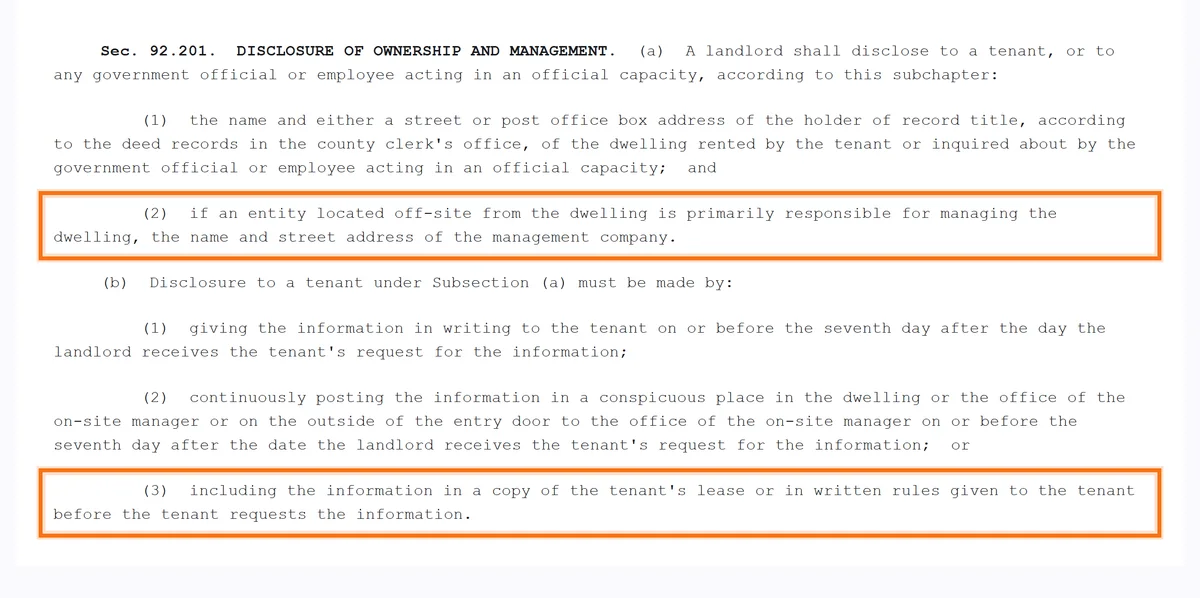
- Who owns and who manages. A landlord must disclose the name and address of the holder of record title and, when an off-site company manages the home, the name and street address of the management company (92.201(a)). Putting both in the lease satisfies the duty in advance (92.201(b)(3)).
The same notice does a second job. Under Property Code 92.003(b), once the tenant has written notice of the management company's name and business street address, the management company is the owner's sole agent for service of process in a lawsuit by the tenant. This is general information, not legal advice.
What you still decide
Delegating the paperwork does not mean losing control of the terms. Before a house is listed, the manager should confirm with you in writing:
- The list rent and the minimum you would accept.
- Deposit amount, and any pet deposit or pet rent.
- Whether pets are allowed, and any limits on type or size, applied within the rules on assistance animals.
- Lease length and whether you would accept shorter or longer terms.
- Who handles lawn, filters, pest control and minor repairs.
- Any house-specific rules: pool, HOA, parking, a storage building you want excluded.
- Whether the manager may sign renewals and modest rent changes without a fresh approval.
Those answers go into the lease and the addenda. From then on the manager applies them without coming back to you for each applicant. Keep the instructions in the management agreement or a written instruction sheet attached to it, not in an email thread, and change them in writing when you change your mind.
Can the manager use your existing lease?
Legally, yes. Occupations Code 1101.654(b)(3) lets a license holder complete a lease form "prepared by the property owner or by an attorney and required by the property owner." In practice most managers decline, for two reasons:
- Enforceability. The manager has to collect under the lease, serve notices under it and, if it comes to that, go to court on it. A lease downloaded from a general website or written years ago may contain clauses a Texas court will not enforce or lack notices Texas requires. Signing it does not fix that.
- Consistency. A manager runs every house on the same lease so the office, the vendors and the tenants all know the rules. A one-off lease for your house means a one-off process, and that is where mistakes happen.
What a manager will normally do is read your lease, carry over the business terms you want kept and add anything house-specific as an addendum. If a tenant is already in place under your lease, that lease stays in force until it ends. The guides to how a new manager reviews your existing lease and whether a manager can use your existing lease cover the transition.
The addenda: where your house's specifics live
The base lease handles what every tenancy needs. The addenda handle what yours needs: a pet addendum, an HOA addendum passing the association's rules to the tenant, a pool addendum, a lead-based paint disclosure for older homes, a move-in condition form, an inventory of appliances, and any house rules you set.
A manager's own addenda typically cover how rent is paid, how repairs are reported and what happens at move-out. The guide to lease addenda every Texas landlord should consider walks through each one.
How signing actually happens
Once an applicant is approved, the manager generates the lease package with the approved terms and sends it for signature to every adult who will live in the house. A careful sequence is: tenants sign, the deposit and first rent are received, the landlord's side signs, and keys are released. An applicant who signs on Tuesday and never sends the deposit should not be holding keys on Friday. Ask any manager what order they follow.
Every adult occupant signs, not just the one who applied, so each is responsible under the lease. A co-signer signs a separate guaranty. The guide to roommates, co-signers and occupants explains who goes where. After signing, the three-business-day clock for the tenant's copy under Property Code 92.024 starts.
Renewals, amendments and who signs those
Renewals follow the same pattern: the manager proposes terms within your standing instructions, you approve any rent change outside them, and the manager signs the renewal as agent if the agreement allows it. Mid-lease amendments, such as adding a pet or an occupant, are signed the same way and attached to the lease.
Where the management agreement does not give the manager renewal authority, every renewal comes back to you for a signature, and a slow reply can leave the tenancy running month to month. Decide at the start how much authority to delegate. How approvals work is covered in owner approval of lease renewals.
What to ask a manager about the lease before you sign with them
Four questions tell you whether a manager's lease practice is sound:
- Which lease form do you use, who prepared it, and may I read it and your addenda before I sign the management agreement?
- What terms do you need from me in writing before listing, and how do I change them later?
- What signing authority does your management agreement give you, and what still needs my approval?
- Where will I find the signed lease and every addendum once the tenant is in?
A manager who cannot produce the lease form on request is telling you something. This is general information, not legal advice; for questions about a specific lease clause, ask a Texas attorney.
How Perpetual handles this
Perpetual Property Management is broker-owned, with an office in North Richland Hills and homes under management in Keller, North Richland Hills, Fort Worth and nearby. The lease is part of our leasing service: current Texas-compliant lease documents with the addenda your property actually needs, such as HOA rules, a pool, pets or smart devices, not a generic template, plus a photo-documented move-in report. You receive a copy of everything through the owner portal.
We do not publish the name of the lease form or the signing-authority clause of our management agreement on the website. Which form we use, who signs as landlord and what needs your approval first are confirmed in writing before you sign, and you can ask to read the lease documents first.
Renewals are handled the same way: our renewal process starts 120 days before the lease ends with a recommendation, and the decision is always yours. If a tenant is already in place, we take over the existing lease, deposit and records. See how the lease fits into full-service management, or call 682-593-7033.
The takeaway: The manager completes a Texas lease form and signs as your agent only because the management agreement says so. You control the terms in writing, and the tenant is entitled to a copy of the lease and to know who owns and who manages the home.
Questions owners ask
Who prepares and signs the rental lease?
The property manager prepares it by completing a Texas lease form with the addenda your house needs and the terms you approved. The manager signs on the landlord's side as your agent when the management agreement gives that authority, within the rent floor, lease length and pet rules you set. You approve the business terms; you normally do not draft or sign.
Can a property manager use my existing lease, or do I need a new one?
Texas law allows a broker to complete a lease form prepared and required by the owner (Occupations Code 1101.654(b)(3)), but most managers use their own form because they must enforce every clause and run every house the same way. Your lease is read, the terms you want kept are carried over, and anything house-specific becomes an addendum. A lease already in force with a tenant stays in force until it ends.
Does the owner's name appear on the lease?
It depends on the form: some leases name the owner as landlord, others name the management company as the landlord's agent. Either way, Property Code 92.201 gives the tenant the right to the name and address of the holder of record title and of the management company, on request or in the lease itself.
Can I sign the lease myself if I want to?
Yes, if you prefer and the management agreement does not say otherwise. It slows the signing and gives the tenant a reason to contact you directly. Most owners delegate signing and keep control through the written terms they set.
Who signs lease renewals?
The manager, as agent, within the authority the management agreement grants. Rent changes outside your standing instructions come back to you for approval first. Setting a clear rent floor and lease-length range at the start avoids renewals stalling while a signature is chased.
Can a property manager sign for the landlord in Texas?
Yes, when the landlord has authorized it. Business and Commerce Code 26.01 requires a lease longer than one year to be in writing and signed by the person to be charged "or by someone lawfully authorized to sign for him." The management agreement is that authorization, so read its leasing clause: it should say what the manager may sign and within what limits.
Does the tenant have to get a copy of the signed lease?
Yes. Under Property Code 92.024, the landlord must provide at least one complete copy of the lease to at least one tenant who is a party to it not later than the third business day after every party has signed. Failing to do so does not void the lease, but a court must pause most actions to enforce it, other than for nonpayment of rent, until the copy is provided.
Property management in Keller, North Richland Hills and Fort Worth. How full-service management works in Tarrant County →