Key takeaways
- There are no state laws that regulate a landlord's entry in Texas; the lease is the rulebook (Texas State Law Library).
- Texas courts read a covenant of quiet enjoyment into every lease. Entering more often than necessary, at unreasonable times or against the lease can breach it.
- Good practice: written notice with a date and time window, reasonable hours, the tenant invited, photos of the house and not the tenant's things.
- A normal rhythm for a single-family home is move-in, one or two routine visits a year, and move-out.
- A dated report for every visit is the owner's answer to any later claim of improper entry.
A property manager arranges inspections without violating tenant privacy by writing the entry rules into the lease and then following them every time: advance written notice, reasonable daytime hours, a limited number of routine visits a year, and a visit that photographs the house's condition rather than the tenant's life. That is how it works on a rental in Fort Worth, Keller or North Richland Hills.
Texas does not set a statewide notice period for landlord entry, so the lease is the rulebook. That cuts both ways. A lease with no entry clause leaves the owner exposed to a claim of harassment; a lease with a clear clause, followed consistently, makes inspections routine for everyone.
What Texas law leaves to the lease
Unlike some states, Texas has no statute that says a landlord must give a set number of hours' notice before entering. The Texas State Law Library, a state agency, puts it plainly in its legal FAQ on the subject:
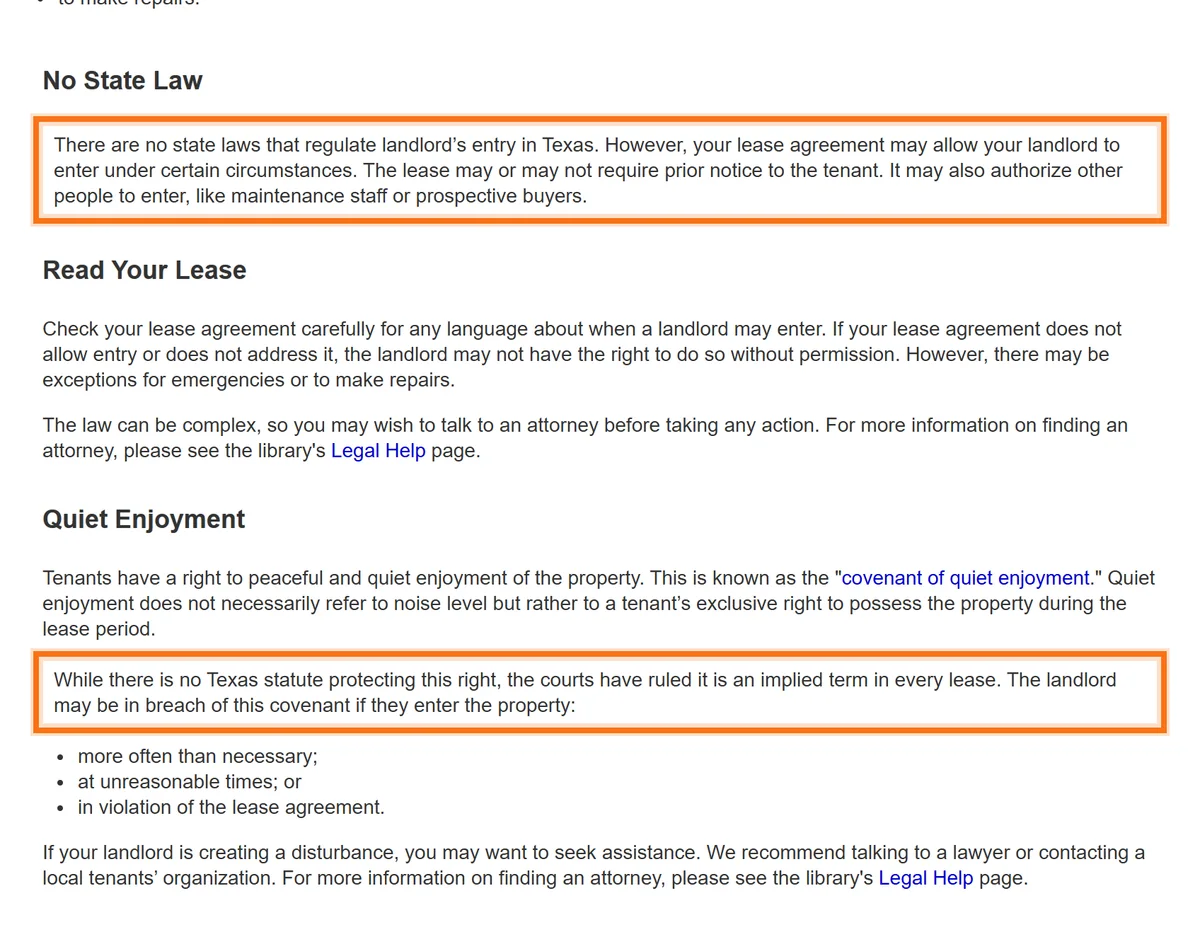
Two things follow. First, the lease may or may not require prior notice, and if it does not address entry at all, the landlord may not have the right to enter without permission, apart from possible exceptions for emergencies and repairs. A lease that is silent creates uncertainty on both sides, and uncertainty is where disputes start.
Second, the tenant's protection is the covenant of quiet enjoyment, which the library describes as the tenant's exclusive right to possess the property during the lease. No Texas statute creates it; the courts treat it as part of every lease. So a well-drafted Texas lease states when the landlord or manager may enter, how much notice is given and how, what hours are reasonable, and the exceptions for emergencies. Landlord entry rights in Texas sets out what that clause should contain.
This is general information, not legal advice. If a tenant has refused entry or alleged harassment, the lease wording and the facts matter, and a Texas attorney should look at both.
The practices that keep inspections respectful
The lease gives the right; the manager's habits decide how it feels. The practices that separate a routine inspection from an intrusive one:
- Written notice in advance, by the method the lease names, with a date and a window of time. Giving more notice than the lease requires costs nothing, and a tenant who had a week to tidy up is a cooperative tenant.
- Scheduling within reasonable hours, with flexibility for a tenant who works shifts or has young children at nap time.
- Inviting the tenant to be present, without requiring it.
- Knocking and announcing before entering, even with notice given and a key in hand.
- Photographing fixtures, surfaces, systems and any damage, not personal items, documents, screens or people. Where a belonging is in the frame, it is incidental, not the subject.
- Not opening drawers, personal closets or dressers. Under-sink cabinets, the water heater closet and the HVAC closet are part of the house; a nightstand is not.
- Leaving the house exactly as found and locking up.
Done this way, an inspection reads as a sign the owner cares about the house the tenant lives in.
How often is reasonable
Frequency is where good intentions tip into intrusion. A move-in inspection, one or two routine visits during a year-long lease, and a move-out inspection is a normal rhythm for a single-family house. Add a visit after a major repair or a reported leak, and a pre-renewal walk-through if the lease is about to be extended. How often rental inspections should happen explains the trade-offs in that schedule.
Monthly interior inspections of a well-kept house by a long-term tenant are not more diligent; they are a reason for a good tenant to leave at renewal. Exterior drive-bys, which involve no entry, can fill the gap between interior visits without bothering anyone.
The lease should state the number of routine inspections the manager may make, so the tenant knows what to expect and the owner's right is documented.
Inspection by inspection: notice, timing and what gets photographed
Here is a workable pattern for a single-family rental in Tarrant County. None of it is set by Texas statute; the notice and timing come from the lease, and the rest is good practice:
| Visit | Notice to the tenant | What is photographed | What is left alone |
|---|---|---|---|
| Move-in | Done with the tenant at the start of the lease | Every room, surface, appliance and fixture, as the baseline | Nothing yet: the house is empty |
| Routine interior, once or twice a year | Written, as the lease provides, with a date and time window | Walls, floors, ceilings, under sinks, filter, water heater, exterior | Drawers, dressers, personal closets, documents, screens, people |
| After a major repair or a reported leak | Written, tied to the repair | The repaired area and anything it affected | The rest of the home |
| Emergency: active leak, gas smell, safety hazard | As the lease allows; tenant told as soon as practical | The hazard and the damage | Everything not involved |
| Move-out | Scheduled around the surrender of keys | Every room again, compared with the move-in baseline | Not applicable: the tenant has left |
How to read this table: the second column is what keeps you inside the lease, and the last column is what keeps the visit from feeling like a search. If your lease does not support the notice in a row, fix the lease at renewal rather than improvising. Under-sink cabinets and the water heater closet are part of the house; a nightstand is not.
An example of a visit done right
Illustrative scenario. A manager schedules the mid-lease inspection of a North Richland Hills house. Ten days out, the tenant receives written notice naming a date and a two-hour window, with a note explaining what the visit covers and an invitation to be present or to suggest another time that week. The tenant replies asking for the afternoon instead; the manager agrees.
On the day, the inspector knocks, announces, and walks the house with the tenant. Photos cover walls, floors, ceilings, under each sink, the filter, the water heater and the exterior. The tenant's family photos and the laptop on the desk stay out of frame. A small drip under the kitchen sink is found; the inspector thanks the tenant, notes it, and a plumber is scheduled with the tenant's preferred time. The report reaches the owner two days later.
The tenant's experience: a polite twenty-minute visit that fixed a leak before it ruined the cabinet. The owner's experience: a documented report and a small repair instead of a large one.
When a tenant pushes back
Occasionally a tenant refuses entry, repeatedly reschedules or insists on no photos. The manager's response should stay in writing and stay calm: restate the lease clause, offer a choice of times, and explain what the visit covers and why. Most refusals dissolve when the tenant understands that the inspector is checking for leaks and safety items, not judging housekeeping.
A continued refusal after proper notice is a lease matter, and the manager documents each attempt before deciding on next steps, which depend on the lease and may need an attorney's input. What a manager should never do is enter over an explicit refusal in a non-emergency, or escalate by phone in a way that the tenant later describes as threatening. Professional tenant communication covers the boundaries that keep owners out of trouble in exactly these moments.
Emergencies are the one exception written into every good lease: an active leak, a gas smell or a safety hazard allows entry without the usual notice, with the tenant told as soon as practical.
Why respectful inspections protect the owner
The owner's interest and the tenant's privacy line up more often than people expect. A tenant who trusts the inspection process reports problems early, allows access without friction and renews. A tenant who feels watched hides problems, documents every visit and leaves.
The documentation also protects you if the relationship ever sours. A file of properly noticed visits, each with a report, is the answer to any later claim that the owner entered improperly. Entry done casually, by text and without a record, is the version that ends up in a dispute.
If you want to see the entry clause in the lease we use and how notice is given, ask us and we will walk through it with you.
How Perpetual handles this
Perpetual Property Management uses Texas-compliant leases on the homes we manage in Keller, North Richland Hills and Fort Worth. Our inspection program is published on the inspections page: move-in documentation as the photo baseline, scheduled interior inspections during the tenancy with proper notice and respect for the tenant, and a move-out inspection measured against the move-in baseline. The in-tenancy schedule is set in your management agreement, and every plan on our price sheet includes an annual property inspection.
After each inspection you receive a photo report in your owner portal with condition notes and any recommended actions, so there is a dated record of what was found. Anything found feeds into maintenance coordination or tenant communication with a recommendation. We are broker-owned and local, with our office at 5755 Rufe Snow Dr in North Richland Hills, and every fee is listed in the written quote before you sign. The leasing page explains how the lease and the move-in report fit together.
The takeaway: Texas leaves entry rules to the lease, so a good manager writes them in and follows them every time: written notice, reasonable hours, a limited schedule, and photos of the house rather than the tenant's life.
Questions owners ask
How much notice does a landlord have to give to enter in Texas?
Texas has no state law setting a notice period for a landlord's entry, so the lease governs. The Texas State Law Library notes that a lease may or may not require prior notice. A well-drafted lease states the notice, the method and reasonable hours, with an exception for emergencies. This is general information, not legal advice; check the lease wording.
Can a tenant refuse a rental inspection?
If the lease grants the landlord the right to enter for inspections with proper notice, a tenant who refuses without good reason is in breach of the lease. The right response is to document the notice and the refusal, offer alternative times in writing, and if it continues, treat it as a lease violation with an attorney's guidance. Entering over an explicit refusal in a non-emergency is not the answer.
Can a property manager take photos inside my rental while the tenant lives there?
Yes, when the lease allows inspections and the photos document the condition of the house. The limit is subject matter: fixtures, surfaces, systems and damage are appropriate; personal documents, screens, people and the contents of personal storage are not. A manager who follows that line rarely has a complaint, and the photos are what protect the deposit itemization later.
Does the tenant have to be home for an inspection?
No. With proper notice under the lease, the manager may enter with a key if the tenant is out. Good practice is to invite the tenant, knock and announce on arrival, and leave a note or send a message confirming the visit took place. Many tenants prefer to be present the first time and are happy for the manager to proceed alone after that.
What is quiet enjoyment in a Texas lease?
It is the tenant's exclusive right to possess the property during the lease, not a rule about noise. No Texas statute creates it; according to the Texas State Law Library, the courts have ruled it is an implied term in every lease. A landlord may breach it by entering more often than necessary, at unreasonable times or in violation of the lease.
How often can a landlord inspect a rental house in Texas?
State law sets no number, so the lease should. A normal rhythm for a single-family house is a move-in inspection, one or two routine interior visits during a year-long lease, and a move-out inspection, plus a visit after a major repair or a reported leak. Entering more often than necessary risks a quiet enjoyment claim.
Related services
Property management in Keller, North Richland Hills and Fort Worth. How full-service management works in Tarrant County →