Key takeaways
- No lease clause, no late fee: Property Code 92.019(a)(1) requires notice of the fee in a written lease.
- A late fee of up to 12% of the month's rent is considered reasonable for a home in a structure with four or fewer units; 10% for larger buildings.
- Nothing can be charged until some rent has remained unpaid two full days after the date it was originally due.
- An initial fee plus a daily fee is allowed, but together they count as one late fee for the 12% test.
- Collecting a late fee that breaks the statute costs the landlord $100, three times the fee and the tenant's attorney's fees.
Who sets late fees and makes sure they are collected? The lease sets the fee, you approve the lease, and the property manager charges and collects it. On a rental in Fort Worth, Keller or North Richland Hills the limits come from Texas Property Code 92.019: the fee must be in a written lease, it must be reasonable, and it cannot be charged until rent has stayed unpaid two full days after the due date. Inside those limits the amount is a business decision, and the manager's job is to apply it the same way to every tenant, every month.
This guide covers the statute, the math on the 12% safe harbor, how property management late fees are collected, what happens when the tenant still does not pay and what to check in your lease and management agreement.
Texas late fee rules at a glance (Property Code 92.019)
Here is what Texas Property Code 92.019 and 92.0191 say about a late fee on a residential lease, and what each rule means in practice:
| Rule | What the statute says | What it means for you |
|---|---|---|
| Written lease | Notice of the fee must be included in a written lease (92.019(a)(1)) | No clause, no fee. A fee cannot be added by letter in the middle of a lease |
| Reasonable amount | Considered reasonable at up to 12% of the rent for the rental period in a structure with not more than four units; 10% with more than four (92.019(a-1)(1)) | On a single-family house, 12% of one month's rent is the safe harbor |
| Above the safe harbor | Allowed only if not more than the landlord's uncertain damages from late payment, including costs and overhead of collection (92.019(a-1)(2)) | Possible, but you would have to justify it |
| Timing | Not until any portion of the rent has remained unpaid two full days after the date it was originally due (92.019(a)(3)) | Rent due on the 1st: the 2nd and 3rd must pass first |
| Initial plus daily fee | Allowed; the combined fees are a single late fee (92.019(b)) | The total for the month, not each piece, is tested against 12% |
| Penalty for a violation | $100, three times the late fee collected in violation, and the tenant's reasonable attorney's fees (92.019(c)) | An oversized fee can cost more than it earned |
| Tenant asks what is owed | The landlord must give a written statement of any late fee owed, on request (92.0191) | The ledger has to be accurate on any day |
How to read this table: the first four rows decide whether a fee can be charged at all, and the fifth decides how big it may grow. A lease can be stricter on the landlord than the statute, but section 92.019(d) makes any clause that waives these rules void.
The lease sets it, within Texas limits
Texas does not let a landlord invent a late fee after the fact. Under Property Code 92.019(a) a landlord may not collect a late fee unless three things are true: notice of the fee is included in a written lease, the fee is reasonable, and some portion of the rent has remained unpaid two full days after the date it was originally due.
"Reasonable" has a safe harbor. A late fee is considered reasonable if it is not more than 12% of the rent for the rental period for a dwelling in a structure with not more than four units, or 10% in a structure with more than four. A higher fee is allowed only if it is not more than the landlord's uncertain damages from the late payment, such as the costs and overhead of collection.
Two consequences follow. A lease with no late fee clause has no late fee, no matter what the owner intended. And a fee above the safe harbor is one the owner would have to justify with real costs, with a penalty of $100 plus three times the fee if it fails. What happens when a tenant pays late in Texas walks through the whole sequence.
The math: what 12% looks like, and when the fee starts
Here is the 12% safe harbor for a house or a building of up to four units, and the 10% figure for larger buildings, at four monthly rents (arithmetic only, not a recommended fee):
| Monthly rent | 12% (four units or fewer) | 10% (more than four units) |
|---|---|---|
| $1,500 | $180 | $150 |
| $1,700 | $204 | $170 |
| $2,000 | $240 | $200 |
| $2,400 | $288 | $240 |
How to read this table: the middle column is the most the initial fee and all daily fees for one month can add up to and still be presumed reasonable on a single-family rental. Many leases set the fee well below it.
A daily fee has to fit under the same ceiling. Illustrative only: rent of $1,700, an initial fee of $75 and $10 a day after that. The ceiling is $204, so the daily fee can run for 12 days ($75 + 12 x $10 = $195) before a 13th day would take the total to $205. A well-drafted clause states a cap so the software stops by itself.
On timing: if rent is due on the 1st, the two full days after the due date are the 2nd and the 3rd, so on a plain reading the earliest a late fee can be charged is the 4th. A lease can give a longer grace period, never a shorter one.
Property management late fees: where you and the manager each come in
You approve the lease, so you approve the fee. In practice the manager recommends a standard fee structure used across every home they manage and explains why. Most owners accept it, because a fee that is identical across the portfolio is easy to defend and easy to administer. If you want something different, it has to fit Property Code 92.019.
What the manager owns is the enforcement. The fee has to be charged on the right day, appear on the tenant's ledger, be included in any balance quoted to the tenant and carry into the final accounting at move-out. A manager who sets a fee and then forgets to charge it has set nothing.
Where the collected fee goes is a term in your management agreement, not the lease. Some companies pass it to the owner, some keep it as part of their compensation, some split it. The guide on who keeps late fees and pet fees covers the options, and the answer belongs in the written agreement you read before signing.
How the fee actually gets collected
Collection is mostly a ledger, not a phone call. Say rent is $1,700, due on the 1st, and the lease sets a late fee that applies once the statutory two full days have passed. On that day the fee is added to the tenant's account. The tenant's balance is now rent plus the fee, and the reminder that goes out states the full figure.
When the tenant pays, the lease decides how the money is applied. If the lease has a payment-application clause, a tenant who sends exactly $1,700 on the 6th may still show a balance, which keeps the fee from quietly disappearing. If the tenant asks, Property Code 92.0191 requires the landlord to give a written statement of whether a late fee is owed and how much.
If the tenant never pays the fee, it does not vanish. It stays on the ledger and is included in every balance quoted. At move-out, Property Code 92.104 lets the landlord deduct from the security deposit charges for which the tenant is legally liable under the lease, with a written, itemized list of the deductions. The rent collection process is what turns a line in the lease into money in the account.
When the tenant still does not pay: the notice
A late fee is an incentive, not a remedy. Property Code 92.019(e) says the fee does not affect the landlord's right to terminate the lease or take other action the lease or the law permits. If rent stays unpaid, the next step is a written notice under Property Code 24.005, and the rules changed on January 1, 2026:
- The landlord must give at least three days' written notice before filing an eviction suit, unless the lease sets a shorter or longer period.
- If the tenant was not late or delinquent before the month of the notice, it must be a notice to pay rent or vacate. For a tenant who was late before, either that form or a notice to vacate may be used.
- Delivery must be by mail or a delivery service, delivery inside the home in a conspicuous place, hand delivery to a tenant aged 16 or older, or, if agreed in writing, electronic communication (24.005(f-3)).
This is why an accurate ledger matters: the notice has to state what is owed. The steps after the notice are in how long a manager should wait before acting on unpaid rent. This is general information, not legal advice.
Waivers, exceptions and why consistency matters
Every owner is tempted to waive the fee once. The tenant had a hard month, they have always paid on time, it is only a few days. Sometimes that is the right call, and it is yours to make. What matters is how it is done. A waiver should be a written, one-time courtesy that states the lease has not changed, approved by you and recorded on the ledger as a credit, not a fee that was never posted.
The reason is not only the next late month. A manager who waives fees for some tenants and charges others, with no written standard, creates a fair housing risk, because the pattern of who got a break can look like a pattern of who the manager liked. Fair housing for Texas landlords explains why consistency protects the owner as much as the tenant. The safe practice is simple: the fee is charged to everyone, and any exception is documented. Payment does not cure a bad fee either: under 92.019(e), a tenant who pays a late fee keeps the rights and remedies the statute gives.
What to check in the lease and the management agreement
- In the lease: the fee amount, the day it applies (not before two full days after the due date), any daily charge and its cap, the total against 12% of the month's rent, and the payment-application order.
- In the management agreement: who keeps the fee, whether the manager may waive it without your approval, and whether any collection-related charge to you exists.
- In the process: that the fee is charged by the system and not by someone remembering, and how you are told when a tenant is late.
If you are bringing an existing lease to a new manager, ask them to read the late fee clause first. A fee that does not fit 92.019 can be found this way, and the fix is a compliant lease at the next renewal through the manager's leasing process.
How Perpetual handles this
Perpetual Property Management is broker-owned, with our office at 5755 Rufe Snow Dr in North Richland Hills, and we manage homes in Keller, North Richland Hills, Fort Worth and nearby. Our rent collection page describes the late process in one line: reminders, late fees applied per the lease, and escalation steps that are the same for every tenant, every time.
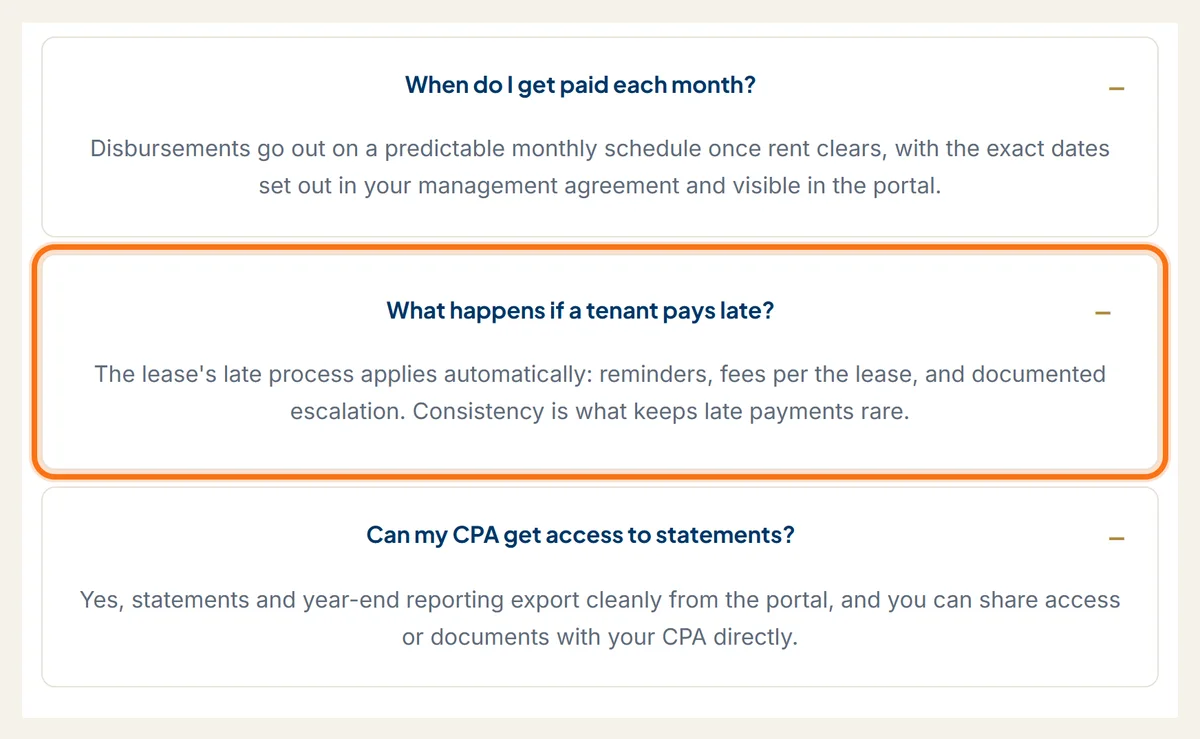
Tenants pay online through the tenant portal by bank transfer or card, with automatic receipts. When rent does not arrive, you know quickly, not at month-end: the documented process moves from reminder to notice on schedule and, if a tenancy is failing, feeds into the eviction process with the paper trail a court expects. Monthly statements in the owner portal show income, expenses, invoices and documents.
The late fee amount in the lease and how collected late fees are divided between you and us are confirmed in writing before you sign. Every fee you pay us is on the price sheet and in the management agreement, and if a fee is not in the agreement, you do not pay it.
To have the late fee clause in your current lease read against Property Code 92.019, call 682-593-7033.
The takeaway: A late fee is only as real as the lease clause that creates it and the ledger that records it: keep it inside Property Code 92.019, charge it the same way for every tenant, and know from your management agreement who keeps it.
Questions owners ask
Can I charge a daily late fee in Texas?
Yes. Property Code 92.019(b) allows an initial fee and a daily fee for each day rent remains unpaid, and treats the combined fees as a single late fee. The total must still be reasonable, which on a house means it is presumed reasonable up to 12% of the month's rent, and nothing can be charged until rent has remained unpaid two full days after the due date. A cap on the daily charge keeps the total under that line.
What if my current lease has no late fee clause?
Then there is no late fee to collect, because Property Code 92.019(a)(1) requires notice of the fee in a written lease, and one cannot be added mid-lease without the tenant's written agreement. The practical fix is a compliant lease at renewal. Until then the manager still sends reminders and can still serve the notice required for unpaid rent; the fee is simply not part of the balance.
Does the late fee come out of the security deposit if the tenant never pays it?
It can, if the lease makes the tenant liable for it. Property Code 92.104 lets a landlord deduct charges for which the tenant is legally liable under the lease, and requires a written description and itemized list of the deductions. The fee has to be on the ledger to be deducted, which is one more reason it must be recorded when it is charged. This is general information, not legal advice.
Will the manager tell me every time a late fee is charged?
You should not need a call for each one. Ask your manager how late payments are reported to you and where they appear on your monthly statement. A tenant who is late repeatedly is a different conversation, and a good manager raises it before renewal. Our rent collection page says you will know quickly when rent does not arrive, not at month-end.
How much can a landlord charge for a late fee in Texas?
There is no fixed dollar cap, but Property Code 92.019 requires the fee to be reasonable. It is considered reasonable at up to 12% of the rent for the rental period in a structure with four or fewer units, and up to 10% in a larger building. On a $2,000 house that is $240 for the month, initial and daily fees combined. A higher fee must be justified by the landlord's actual costs of late payment.
When can a late fee be charged if rent is due on the 1st?
Not until some portion of the rent has remained unpaid two full days after the date it was originally due (Property Code 92.019(a)(3)). With rent due on the 1st, the 2nd and 3rd are the two full days, so on a plain reading the 4th is the earliest. Your lease may give a longer grace period, and the lease controls if it does.
Who keeps the late fee, the owner or the property manager?
Your management agreement decides, not the lease and not the statute. Some companies pass late fees to the owner, some keep them and some split them. Ask before you sign and make sure the answer is written in the agreement. Ask us the same question when you request a quote.
Related services
Property management in Keller, North Richland Hills and Fort Worth. How full-service management works in Tarrant County →