Key takeaways
- Evaluate a property management company on what it will put in writing before you sign, not on how the meeting felt.
- Start with the broker's license: search the company and the broker on the Texas Real Estate Commission's License Holder Search and confirm the status is active.
- A real guarantee has three parts: the promise, a deadline and what you get if it is missed.
- Ask for the complete price sheet, the rental criteria, a sample invoice with a repair photo, and the date renewal work starts.
- Then test the product: read a live listing and call the leasing line as a tenant would.
A property management company is good if the documents it hands you, the way it treats tenants and the public record all match what it told you in the sales meeting. If you own a rental in Fort Worth, Keller or North Richland Hills, you can check every one of those before you sign, and most of the checks take minutes. The scorecard below lists eight of them.
Owners usually try to answer this question by asking the company, which gets you the company's view of itself. This guide is about the evidence a company gives you directly. Reviews are a separate subject, covered in our guide to reading property management reviews, and the interview scorecard grades the meeting itself.
How to evaluate a property management company: an eight-point scorecard
This scorecard lists eight things to check, where to verify each one, and what our own site publishes for it:
| What to check | Where to verify it | What Perpetual publishes |
|---|---|---|
| Broker license | License Holder Search on trec.texas.gov | Broker-owned; license numbers printed in the site footer |
| Written guarantees | The management agreement and any guarantee addendum: promise, deadline, remedy | Five guarantees, each with a stated remedy, subject to the Guarantee Addendum |
| Price sheet | The complete fee schedule attached to the agreement | Three plans at 7%, 9% and 10% of monthly rent with every fee listed |
| Rental criteria | The printed criteria an applicant receives | Income at least 3x the rent counting the two highest earners; $60 per applicant; the same written criteria for every applicant |
| Proof of repairs | A sample vendor invoice and completion photo | The original vendor invoice in the owner portal; photo or video proof of every completed repair over $500 |
| Renewal process | Ask for the day renewal work starts | Renewals start 120 days before lease expiration, with a rent check against leased comparables |
| Owner payout date | The disbursement clause in the agreement | Rent we collect is disbursed by the 10th, or that month's management fee is waived |
| Listing speed | Ask how soon a market-ready home is listed | Live on every major rental platform within 5 business days, or the first month's management fee is waived |
How to read this table: use the first two columns on any company. Score a row only when the company gives you a document or a page, not a verbal answer. The third column is our own answer, so you can see what a complete row looks like and hold us to it.
Check the license record, not the website badge
Start with the Texas Real Estate Commission's public License Holder Search. A company needs a Texas broker license to lease homes and handle rent for owners (Occupations Code 1101.351), so there is always a record to find. Search the company name and the broker's name. You are confirming two things: the license status is active, and the broker named in the meeting is the broker on the record.
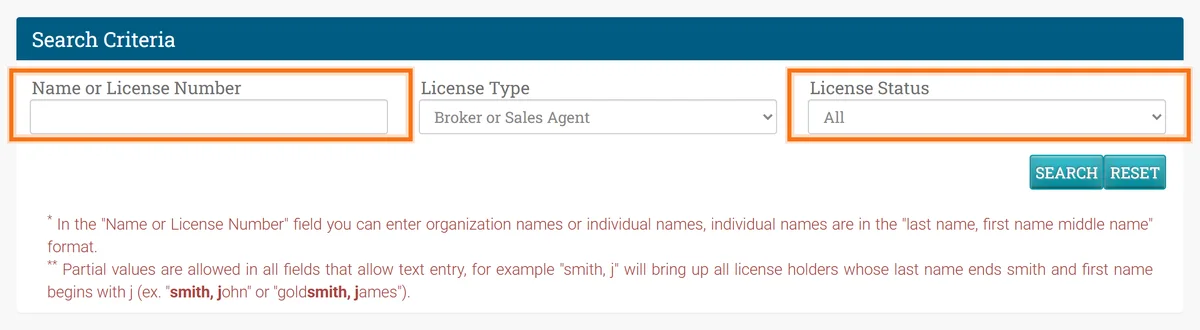
The status filter on that form lists what a license can be: active, inactive, un-sponsored, expired, suspended, surrendered or revoked. Only one of those is the answer you want. A company that is good at the work will often give you the license number unprompted. The license verification guide walks through the lookup step by step.
Check whether each promise comes with a remedy
Every company promises fast leasing, good communication and on-time payment. The test is whether the promise is written into the agreement with a deadline and a consequence. A guarantee without a remedy is a slogan. Ask three questions about each one: what exactly is promised, by when, and what do I receive if it is missed?
Then read the exclusions. Guarantees usually sit in an addendum with conditions, and those conditions are part of the promise. Ours, The Perpetual Promise, is five written guarantees in every management agreement, each with a stated remedy, and it says in plain words that it is subject to the terms and exclusions in our Guarantee Addendum. Our guide to management guarantees shows how to compare one company's wording with another's.
Ask for the price sheet and the rental criteria before the meeting
Two documents tell you how a company treats money and people, and both exist before you ever call.
The price sheet. Ask for the complete fee schedule, including the fees that only appear at leasing, renewal, inspection and repair. A company that will not send it before a meeting is asking you to decide first and read later. Our price sheet is public, and the rule in our agreement is that if a fee is not in the agreement, you do not pay it.
The rental criteria. Texas Property Code 92.3515 requires a landlord to make printed notice of the tenant selection criteria available when an applicant is given a rental application. So the criteria must already exist on paper. Ask for them. You are checking that the standard is written, specific and the same for everyone, which is also what keeps screening consistent with fair housing law. Ours are on the rental criteria page. This is general information, not legal advice.
Ask what proof you get for a repair and when renewal work starts
Repairs and renewals are where a rental quietly makes or loses money, and both can be checked with one question each.
For repairs, ask: what do I see for each job? The answer you want is the vendor's own invoice, not a summary line, plus a photo of the finished work on larger jobs. With us the original vendor invoice is in your portal, and every completed repair over $500 gets photo or video proof. Repairs under the spending limit you pre-approve go ahead without waiting; anything larger comes to you with a description, photos and a recommendation.
For renewals, ask: on what day does the work start? A company with a process gives you a number. We start renewals 120 days before lease expiration with a rent check against leased comparables, and the conversation with the tenant typically happens 60 to 90 days before lease end. The decision is always yours. Our guide to lease renewal fees covers the cost side.
Look at the company's live listings as if you were a tenant
Search the rental sites for houses the company has listed right now. You are looking at the product it would produce for your house. Are the photos bright, straight and taken on a clear day, or dim and shot from a doorway? Is the description specific about the house, or generic? Is the rent in line with similar homes nearby, or sitting well above them?
Then count how many listings have been up a long time. A few slow listings are normal; a pattern of stale, overpriced listings suggests the company prices to win owners rather than to lease houses. The marketing guide describes what a well-run listing looks like so you know what you are comparing against.
Call the leasing line the way a tenant would
Call the number on one of those listings and ask a tenant's questions: is the house still available, what are the requirements, how do I see it. Note how long it takes to reach a person, whether the person knows the requirements, and whether they are courteous. Try it once during business hours and once in the early evening, because a vacancy does not keep office hours and neither do the tenants looking at your listing after work.
This is the most revealing test I know, because the tenant experience is the product. A company that answers prospective tenants promptly and clearly will lease your house faster. A company that leaves a tenant waiting two days for a call back will treat the inquiries on your vacancy the same way, whatever it promised you in the meeting.
Ask for four documents and read them that evening
Before you sign, ask for a sample owner statement, a sample lease with its addenda, a redacted inspection report, and the complete fee schedule. A good company produces these on request because it produces them every day. A company that hesitates, or says the documents are only available after signing, has told you something.
- The statement should be readable without a phone call: rent in, each expense out, the management fee, and the amount sent to you.
- The lease should be a current Texas form with addenda for pets, HOA rules and anything specific to your house.
- The inspection report should have dated photos of every room and the exterior, not three pictures and a checkbox.
- The fee schedule should list every charge, including the ones that are zero.
Ask where those records will live once you are a client. Ours are in the AppFolio owner portal: statements, documents and disbursement history in one place.
Use reviews as a cross-check, not the main test
Reviews are the one kind of evidence the company does not hand you, so treat them as a cross-check on the documents and not as the main test. Read owner reviews for specific events, sort tenant complaints into lease enforcement and service failure, and read how the company replies. Our guide to reading property management reviews covers the method in full.
Ask one hard question and watch how it is handled
In the meeting, ask something the company would rather not answer: "What is your most common owner complaint?" or "Tell me about a tenant placement that went wrong." A good company has an honest story and can tell you what changed afterward. A company that claims it has never had a problem is new, or not being straight.
Then ask a question you already know the answer to from your research, such as how long one of its listings has been on the market. You are not trying to catch anyone out. You are checking whether the company tells the truth when the truth is inconvenient, because that is what you will depend on when your house has a problem.
How Perpetual handles this
Run every check above on Perpetual Property Management. We are broker-owned: Justin Brown is the broker, and the license numbers are printed in the footer of our site so you can search them. Our office is at 5755 Rufe Snow Dr in North Richland Hills, and our listings in Keller, North Richland Hills and Fort Worth are on the rental sites for you to judge.
The documents are public before you call. The price sheet lists three plans and every fee. The Perpetual Promise lists five written guarantees with their remedies. The rental criteria are the ones every applicant is measured against. Our management page describes what one agreement covers, from pricing and screening to monthly statements in the owner portal.
A sample statement, the lease form, an inspection report and who answers the leasing line are confirmed in writing before you sign. We would rather you verify us than take our word for it. To go through the scorecard for your house, call 682-593-7033.
The takeaway: A good property management company looks the same from every angle, so check the license record, the live listings, the tenant line and the documents, and hire the company whose evidence matches its pitch.
Questions owners ask
Does a high review rating mean a property management company is good?
Not on its own. Ratings mix owner reviews with tenant reviews, and a company that enforces leases for its owners will collect some unhappy tenant reviews along the way. Read the text for specific events and check the dates. Then weigh the rating against the documents: license, fee schedule, guarantees and criteria.
Can I visit a property management company's office before hiring them?
Yes, and it is worth doing if the office is nearby. You are not inspecting the furniture. You are seeing whether there are people handling calls, whether the staff know the properties, and whether the person you met is the person who will manage your house. A company with no office and no staff you can meet needs more questions.
How long should a property management company have been in business?
There is no magic number of years. A newer company can be good if the broker has years of experience elsewhere, so ask about the broker's background and look up the license. What matters is whether the people and systems have handled the problems your house will eventually have: a vacancy, a renewal, a hard repair and a tenant who stops paying.
How do I evaluate a property management company?
Check eight things and ask for each in writing: the broker's Texas license status, guarantees with a remedy, the complete price sheet, the rental criteria, proof of repairs, the day renewal work starts, the owner payout date and how fast a market-ready home is listed. Then read one live listing and call the leasing line as a tenant would.
What should a property management company give me before I sign?
At minimum the management agreement with its complete fee schedule, any guarantee addendum, the rental criteria applicants receive, a sample owner statement, the lease form and a sample inspection report. Read them the same evening. A company that says a document is only available after signing has told you something.
What is the fastest check on a property manager in Fort Worth?
The license lookup. Search the company and its broker in the Texas Real Estate Commission's License Holder Search on trec.texas.gov and confirm the status is active. It takes about five minutes, and it tells you who is legally accountable for your rent and deposit money before you spend an hour in a meeting.
Related services
Property management in Keller, North Richland Hills and Fort Worth. How full-service management works in Tarrant County →