Key takeaways
- Hire the manager the day you decide to rent, before you paint a wall or call a contractor. The house does not need to be rent-ready.
- The make-ready is a leasing decision: spend on what raises rent or shortens vacancy, and skip what tenants will not pay extra for.
- As a planning allowance, not a promise, allow four to eight weeks from the first call to a tenant moving in. Major repairs and permits take longer.
- Ask when the management fee starts and get the answer in the written quote. Vendor invoices for the make-ready are the owner's cost with any manager.
- Perpetual's free rental analysis includes make-ready guidance and a written quote before you sign anything.
The right time to hire a property manager is the day you decide the house will be a rental, before you have painted a wall or called a contractor, whether it is in Fort Worth, Keller or North Richland Hills. Owners who wait until the house is "ready" usually arrive with work done that a tenant would not have paid for, work left undone that a tenant will complain about, and a later listing date.
This guide explains what a manager does during the preparation weeks, how much lead time to allow before listing, what you pay during that period, and why a house that is nowhere near rent-ready is still the right time to call.
From first call to move-in: who does what, stage by stage
This table shows the stages between deciding to rent and a tenant moving in, what the manager does in each one and what is left for you:
| Stage | What the manager does | What you do | What slows it down |
|---|---|---|---|
| 1. First call and rental analysis | Sets a rent range from leased comparables and tells you which make-ready items are worth doing | Give the address, your timing and what you already know needs work | Waiting until the work is finished to call |
| 2. Agreement and scope | Puts every fee in writing, documents the starting condition and orders the work by its effect on rent | Sign the agreement and set a spending limit | An undecided budget, or several owners who have not agreed |
| 3. Make-ready | Sequences the trades: repairs, then paint, then flooring, then cleaning | Approve anything above your limit and pay the vendor invoices | Permits, insurance claims and HOA approvals |
| 4. Photos and listing | Photographs the clean house and lists it | Keep the utilities on | Listing before the house is clean |
| 5. Screening, lease and move-in | Screens every adult against written criteria, prepares the lease and documents the move-in condition | Nothing, unless the manager has a question for you | Rent set from asking prices and not from leased homes |
How to read this table: the earlier the first row happens, the shorter the whole sequence is, because stages two to four are planned around a rent number and not around guesses. The last column is where weeks are lost, and the first entry in it is the most common one.
Why the manager should see the house before the contractor does
A make-ready has one purpose: to put the house in the condition that gets the best qualified tenant at the right rent, as fast as possible. That is a leasing judgment, and the person who leases houses every week makes it better than a contractor whose job is to do what they are asked, or an owner choosing finishes they would want in their own home.
When the manager walks the house first, the scope changes in predictable ways. Items that affect rent and leasing speed move to the top: paint, flooring condition, working appliances, a clean and safe yard, every light and lock working. Items tenants rarely pay extra for come off the list: a kitchen remodel, new countertops, a fence that is ugly but sound. The manager is scoping the work to the rent, not to taste.
There is a second reason. A manager who has seen the house empty has the condition baseline for the move-in inspection, knows which systems are old, and can set the maintenance expectations with you before the first tenant call rather than during it. The full make-ready sequence itself is covered in the make-ready guide; this article is about who should be in the room when that list is written.
What the manager does during the prep weeks
Between the agreement and the listing, the manager's work runs on a parallel track to the contractors. The owner usually sees only the end result, so it is worth listing what happens:
- Pulls leased comparables and sets the rent range, so the make-ready budget is measured against a real number. Perpetual does this as a free rental analysis before the agreement is signed.
- Writes the make-ready scope, orders it by effect on rent, and gets vendor bids where the owner does not already have a contractor.
- Schedules the trades in the right order: repairs before paint, paint before flooring, cleaning last, photos the day after cleaning.
- Confirms utilities are on and in the right name so vendors can work and showings can happen.
- Checks HOA leasing rules and any city rental registration requirement so neither surfaces after a tenant is approved.
- Prepares the lease, the screening criteria and the listing copy so they are ready the day the photos are.
- Sets the listing date against the completion date, so the house goes live as the last vendor leaves, not two weeks later.
None of that requires the house to be in good condition. All of it requires time, which is why the lead time matters more than the condition.
How much lead time to allow before listing
As a planning example, not a promise: a house that needs paint, carpet and a general clean can typically go from first walk-through to live listing in two to three weeks if vendors are scheduled immediately. A house that needs a roof repair, a water heater, or foundation work needs longer, and the schedule depends on the trade.
Work backward from the date you want rent to start:
- Allow time from listing to a signed lease. This varies by season and price; how long it takes to rent a house in DFW explains the range and what moves it.
- Add the make-ready duration from the scope the manager writes, plus a few days of slack for a vendor who runs late.
- Add a week at the front for the rental analysis, the agreement, and vendor bids.
As a planning allowance, and not a promise or a market statistic, that adds up to four to eight weeks from the first call to a tenant moving in for a house that needs ordinary work. Call at eight weeks and the manager can run the timeline without rushing. Call at two weeks with a house that still needs paint and the listing date slips, or the work gets done badly, or both.
No, the house does not need to be rent-ready before you hire a manager
Owners ask this because they assume a manager wants a finished product. The opposite is true. A manager would rather define "rent-ready" for your house than inherit someone else's definition.
Rent-ready, in practice, means: clean, safe, every system working, every fixture present, paint and floors in condition a tenant will accept without a concession, locks rekeyed, utilities on, and the house photographed. Texas Property Code 92.156 requires a rekey within seven days after each tenant turnover date in any case. Nothing on that list requires you to know anything about rentals; it requires someone to decide what "acceptable" means for the rent you are asking.
If the house currently has a tenant, a family member, or your own belongings in it, that is also fine. The manager plans the handover, schedules the make-ready for the gap, and may start marketing before the current occupant leaves. If you are not sure the house is even worth renting in its current shape, that is the first question a rental analysis answers, and it costs nothing to ask.
When a manager will tell you to wait
Hiring early does not mean listing early. A good manager will sometimes tell you the house should not go on the market yet, and that advice is worth the call by itself.
The usual reasons:
- An active leak, a foundation movement with visible symptoms, or an electrical issue that a tenant could be hurt by. These are fixed before a listing, not disclosed around.
- Work that needs a city permit, where an inspection date controls the schedule.
- A roof with hail damage and an open insurance claim, where the contractor cannot start until the adjuster has been.
- An HOA that requires approval of a lease or a tenant, with a board that meets monthly.
In each case the manager's job during the wait is to keep the sequence moving: getting bids, chasing the permit, coordinating with the adjuster, and preparing everything else so the listing can go live the day the blocker clears. An owner managing this alone usually loses weeks between steps.
What it costs to hire after the house is ready
The cost is rarely a single large mistake. It is a set of small ones that each take a few days or a few hundred dollars, and together push the first rent check out by a month.
Say the house would rent for $2,000 a month, as an illustration only and not a quote. Common patterns:
- The owner installs a finish the manager would have advised against, and a cheaper option would have leased just as fast. Money spent, no rent gained.
- The owner skips something that matters, such as a yard clean-up or a working garage door opener, and the manager has to schedule it after the listing is live. Showings happen on a house that is not ready, and a week passes.
- Photos are taken by the owner on a phone, and the manager reshoots. Another few days.
- Rent is set from asking prices on listing sites rather than leased comparables, and the house sits at the wrong number for two or three weeks before a reduction.
Each week of vacancy on that example house is roughly $460 of rent ($2,000 times 12, divided by 52) that does not come back. Three or four of those small delays cost more than most owners expected to save by doing the prep themselves. The full picture of vacancy cost is in what vacancy really costs.
What you pay during the preparation period
Ask every manager you interview one plain question: when does your management fee start? Companies differ. Some begin the monthly fee when the agreement is signed, some when the house is listed, some when rent is first collected. The written quote should say which, and it should also say what the leasing fee covers, so you know whether the preparation work is included or billed separately.
Vendor invoices for the make-ready are the owner's cost whichever manager you use. What changes is whether the work is scoped and scheduled by someone who leases houses, and whether the invoices are stored where you can see them. As an example of how the fees around a new rental can be laid out, these are the standard numbers on Perpetual's price sheet:
| Fee | Investor Special (5 or more units) | Standard | Full Service |
|---|---|---|---|
| Monthly management fee | 7% of monthly rent | 9% of monthly rent | 10% of monthly rent |
| Property enrollment inspection | $125 | $49 | Included with onboarding |
| Coordination of work, as a share of the vendor invoice | Make-ready: 3% to 5% of cost | Maintenance: 4.9% of cost | Maintenance: 5% of cost |
| Tenant placement, charged when a tenant is placed | 50% of one month's rent | 75% of one month's rent | 50% of one month's rent |
How to read this table: these are standard numbers and plans are negotiable case by case. The final fee is set after the rental analysis, the original vendor invoice is always in your portal, and if a fee is not in the management agreement, you do not pay it. Our pricing and fees page shows the full sheet.
Owners sometimes ask whether they should finish the make-ready themselves to avoid any coordination charge. You can, and the manager will still tell you afterward what is missing. The trade is the one this guide describes: you keep control of the prep and accept the risk of doing part of it twice.
What to have ready for the first call
You do not need photos, measurements or a finished house. You need a few facts so the manager can give you a rent range and a rough scope on the first conversation:
- The address and whether anyone is living there now, and until when.
- Roughly when you want rent to start.
- What you already know needs work, and anything you have already scheduled.
- Whether there is an HOA and whether you have its rules.
- Whether you plan to sell or move back within a few years, which changes how much to spend on the make-ready.
With those answers the manager can tell you whether the timeline is realistic, what to stop doing, and what to start. The rest, including the marketing and leasing work, runs on the schedule you set together. If the house was your own home until now, converting your home to a rental covers the insurance, tax and lender steps that run alongside the make-ready.
How Perpetual handles this
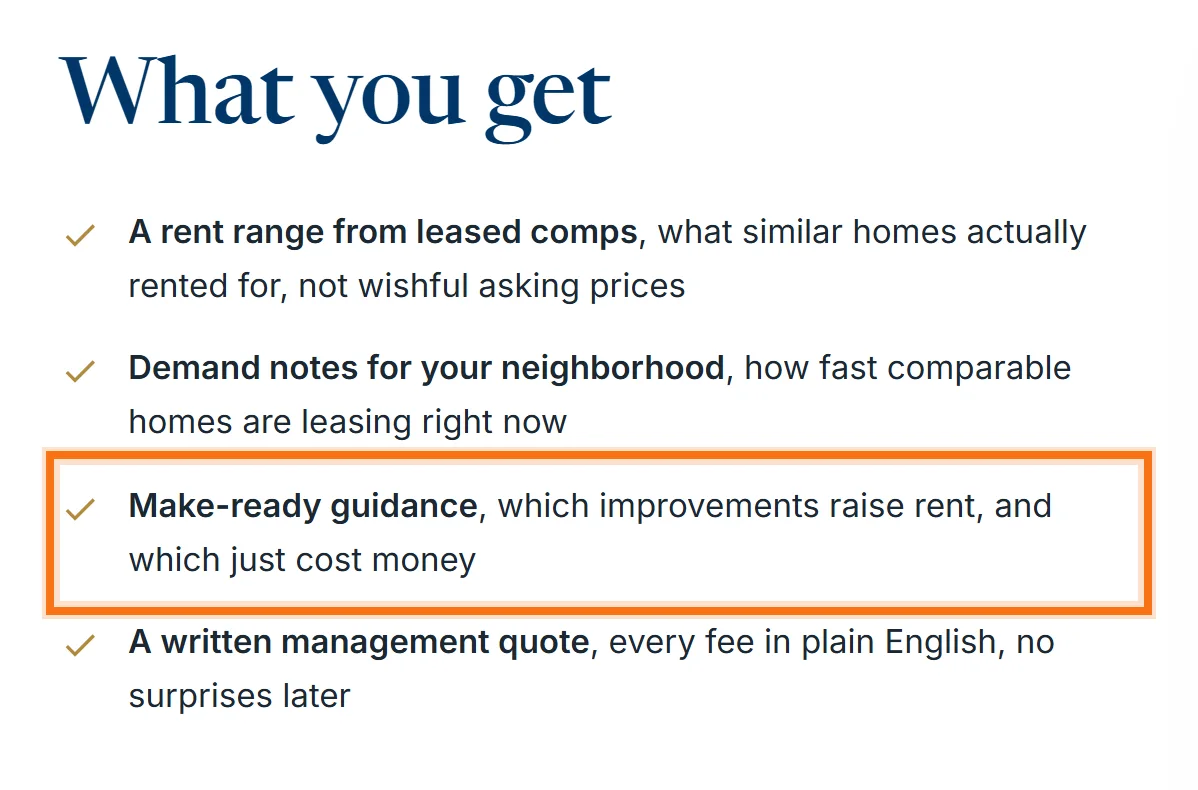
When an owner calls before the house is ready, the first step is our free rental analysis. You get a rent range from leased comparables, demand notes for the neighborhood, make-ready guidance and a written management quote, and we typically respond within one business day. It is free whether you hire us, self-manage or go elsewhere.
Once the agreement is signed, with every fee in writing, the property is enrolled with an inspection and the make-ready is coordinated: paint, clean, repair and refresh, sequenced so the house is photo-ready fast. Repairs under the spending limit you pre-approve are done without waiting, and anything larger comes to you with a description, photos and a recommendation. Invoices and documents sit in your owner portal.
When the house is market-ready, the clock in The Perpetual Promise starts: it is listed on every major rental platform within 5 business days or the first month's management fee is waived, subject to the Guarantee Addendum. That is why we care about the make-ready date as much as you do.
We are broker-owned, with our office at 5755 Rufe Snow Dr in North Richland Hills, and we manage homes in Keller, North Richland Hills, Fort Worth and nearby. If the house should wait, we will tell you that too. To start before the work does, call 682-593-7033.
The takeaway: Call the manager when you decide to rent, not when the house is done, and the house will be done sooner and for the right reasons.
Questions owners ask
How early should I hire a property manager before my house is ready to rent?
As soon as you decide the house will be a rental. As a planning allowance, that is four to eight weeks before you want a tenant moving in. The window gives the manager time to set the rent from leased comparables, scope the make-ready to what tenants pay for, schedule the work in the right order, and time the listing so it goes live as the last vendor leaves. Houses needing major repairs or permits need longer.
Does my house need to be rent-ready before I hire a manager?
No. A manager would rather define rent-ready for your house than inherit work that was done to someone else's standard. Hiring before the prep means the make-ready list is written by the person who leases the house, which usually removes items tenants will not pay for and adds items that would otherwise cause complaints. A house with a current occupant or your own belongings still in it is fine; the manager plans around the handover.
What does a property manager do while the house is being prepared?
The manager pulls leased comparables and sets the rent, writes and prioritizes the make-ready scope, gets vendor bids, schedules trades in the right order, confirms utilities and HOA or city rental requirements, prepares the lease and screening criteria, and times the photos and listing to the completion date. The owner sees the result; the manager runs the sequence.
Should I do the make-ready myself before calling a manager?
You can, but you take on the risk of doing some of it twice. Owners working alone often install finishes a tenant would not pay extra for, skip small items that cause showing complaints, and set rent from asking prices rather than leased data. If you want to do the work yourself, at least get the manager's scope first so you are working from the same list.
When does the management fee start if the house is not rented yet?
It depends on the company, so ask directly and get the answer in the written quote. Some managers start the monthly fee at signing, some at listing and some when rent is first collected. The quote should also say what the leasing fee covers, so you know whether the preparation coordination is included or billed separately.
What does a property manager charge to coordinate make-ready work?
It varies by company, so ask for it in writing. At Perpetual the standard numbers are a percentage of the vendor's invoice: make-ready coordination of 3% to 5% of cost on the Investor Special plan, and maintenance coordination of 4.9% on Standard and 5% on Full Service. The original vendor invoice is always in your owner portal, plans are negotiable case by case, and every number is confirmed in writing before you sign.
How long does it take to get a house ready to rent?
It depends on the scope. As a planning example and not a promise, a house that needs paint, flooring and a thorough clean can be listed within a few weeks when the work is scheduled right away. A roof repair, foundation work, anything that needs a city permit, an open insurance claim or an HOA approval takes longer, and the manager can tell you how much once the scope is written.
Related services
Property management in Keller, North Richland Hills and Fort Worth. How full-service management works in Tarrant County →