Key takeaways
- A maintenance emergency is a safety risk or damage that grows by the hour. Everything else is urgent or routine.
- No hot water with a dry tank is urgent, not an after-hours emergency, but Texas Property Code 92.052 does put a working water heater inside the landlord's duty to repair.
- No air conditioning is an emergency in dangerous heat or with vulnerable people in the home; in mild weather it is urgent.
- Texas presumes seven days is a reasonable time to repair a health or safety condition (Property Code 92.056(d)), but severity counts, so a real emergency is handled far faster.
- Texas requires a 24-hour emergency number only from landlords with an on-site management office (92.020); for a rental house, the lease and the manager's process decide who answers at night.
A maintenance emergency at a rental in Fort Worth, Keller or North Richland Hills is any problem that threatens a person's safety or causes damage that grows every hour it waits. Everything else, however unpleasant, is urgent or routine and gets fixed at normal rates in daylight. That one-sentence test sorts most calls correctly, and the handful it does not are the ones this article decides for you.
The distinction is not academic. An after-hours dispatch costs you a premium rate, and a tenant told that a dead dishwasher is not an emergency needs to hear why in a way that keeps the relationship intact. The full guide to rental maintenance emergencies covers who pays and how fast things get fixed. This article is the sorting tool.
Emergency, urgent or routine: common rental calls sorted
Here is how the calls a Fort Worth area rental actually gets are sorted, and what happens next for each:
| The call | Tier | What happens | Why |
|---|---|---|---|
| Burst pipe, or a water heater flooding a closet | Emergency | Tenant shuts the water off; a plumber is dispatched now | Damage grows by the hour |
| Sewage backing up into a tub or toilet | Emergency | Dispatched now | A health hazard; Property Code 92.0561 treats sewage and flooding as the most urgent repairs |
| Gas smell | Emergency | Tenant leaves the house and calls the gas company first, then the emergency line | Life safety |
| Sparking outlet or a burning smell at the panel | Emergency | Breaker off if it is safe to reach; electrician dispatched | Fire risk |
| No heat at or below freezing | Emergency | HVAC dispatched now | Safety, and frozen pipes |
| No AC in dangerous heat, or with an infant, an elderly tenant or a medical condition in the home | Emergency | HVAC dispatched the same day | Health risk |
| No AC in mild weather | Urgent | Same day or next business day, with fans or a window unit meanwhile | Uncomfortable, not dangerous |
| No hot water, tank not leaking | Urgent | Plumber booked for the next business day | Nothing is being damaged, but a working water heater is part of the landlord's duty (92.052) |
| Dead refrigerator, or the only toilet not working | Urgent | Same day or next business day | Stable, but cannot wait a week |
| Dripping faucet, dishwasher, one stove burner, a lockout | Routine | Normal work order | No safety risk and no growing damage |
How to read this table: the second column decides the cost. Emergency rows are dispatched at whatever hour the call comes in, urgent rows are booked for the next business day at normal rates, and routine rows join the regular schedule. If a call is not listed, run it through the three questions below.
The three-question test
Before a vendor is dispatched at night, a manager asks three things:
- Is anyone in danger? Gas, fire, electrical sparking, carbon monoxide alarm, a door or window that cannot be secured, a ceiling sagging with water.
- Is the damage growing by the hour? Water running where it should not, sewage backing up, a roof leaking during a storm, a freeze with no heat and pipes at risk.
- Can it be made safe by the tenant right now? Shutting the water valve under the sink turns a leak into a morning repair. Flipping a breaker turns a sparking outlet into a daytime electrician call.
Yes to the first or second, and no to the third, is an emergency. Yes to the third is a tenant instruction and a morning work order. No to all three is routine. The test is worth writing into your lease and your tenant's move-in packet, because a tenant who knows it calls less often and calls correctly.
The clear emergencies
These get an after-hours dispatch without debate:
- Water you cannot stop: a burst supply line, a failed water heater flooding a closet, a slab leak surfacing through the floor.
- Sewage backing up into tubs or toilets.
- A gas smell. The tenant leaves the house and calls the gas company first, then the emergency line.
- Electrical sparking, a burning smell from an outlet or panel, or a total loss of power that the utility confirms is on the house side.
- No heat when outside temperatures are at or below freezing, which in North Texas is a pipe risk as much as a comfort issue.
- No cooling during dangerous heat, especially with infants, elderly tenants or anyone with a medical condition in the home.
- A break-in, a door that will not lock, or a window broken in a way that leaves the house open.
- A tree or storm debris through the roof, or a roof leak during active rain.
- Fire, after the fire department.
Texas law puts a duty on landlords to make a diligent effort to repair conditions that materially affect the health or safety of an ordinary tenant (Property Code 92.052), and the items on that list are the plainest examples. The guide to Texas landlord repair obligations explains the notice and timing rules.
What Texas law says about emergency repairs
The Texas Property Code never uses the phrase "maintenance emergency." It works with a different test, and it helps to know it. Under Property Code 92.052, a landlord must make a diligent effort to repair a condition the tenant has reported if it materially affects the physical health or safety of an ordinary tenant. The same section names one appliance directly: a device to supply hot water at a minimum of 120 degrees Fahrenheit.
How fast is fast enough? Section 92.056(d) presumes that seven days is a reasonable time to repair, and says the severity and nature of the condition and the availability of materials, labor and utilities must be considered. Seven days is a ceiling for ordinary problems, not a target for a flooding house.
The statute also ranks problems by what a tenant may do about them. Under 92.0561, a tenant who has followed the written notice steps may have a sewage backup or flooding inside the home repaired immediately and deduct the cost, and may do the same after three days for a total loss of water service the landlord agreed to furnish, or for inadequate heat or cooling that a local official has put in writing as a health or safety risk. Other health and safety conditions carry a seven-day wait.
One more rule is often misquoted. Section 92.020 requires a telephone number answered 24 hours a day only from a landlord that has an on-site management or superintendent's office. A rental house has no such office, so the lease and the manager's process decide who picks up at 2 a.m. This is general information, not legal advice.
The urgent middle tier most owners forget
Between emergency and routine sits a tier that causes most of the arguments: problems that are stable but cannot reasonably wait a week. A good manager treats these as same-day or next-business-day work at normal rates:
- No hot water, with the tank not leaking.
- A dead refrigerator, where the tenant's food is at risk but nothing is unsafe.
- Air conditioning out in warm but not dangerous weather, with a window unit or fans as a stopgap. How fast a broken AC should be fixed in Texas covers that case specifically.
- The only toilet in the house not working.
- A garage door stuck shut with the tenant's car inside.
- A pest problem that is sudden and severe.
Is no hot water a maintenance emergency? Not at night, as long as the tank is dry: cold water still runs, the house is safe and nothing is being damaged. It is not optional either. Property Code 92.052 lists a water heater that supplies water at 120 degrees or more as part of the landlord's duty to repair, which is why it belongs in the urgent tier and not the routine one.
The urgent tier is where response time, not dispatch time, protects you. Nobody needs a premium-rate plumber at midnight for a water heater that is cold but dry; everybody needs one the next morning, booked before the office opens.
What is not an emergency, and how to say so
A dripping faucet, a dishwasher that will not drain, a slow bathroom sink, a single burner out on the stove, a ceiling fan wobble, a sprinkler head, a running toilet that can be shut at the valve, a lockout when the tenant has lost keys. These are routine work orders, and the lockout is usually the tenant's cost under the lease.
How the tenant is told matters. The right message names the problem, explains why it can wait, gives any workaround and states when it will be handled: "The dishwasher is on tomorrow's list; use the sink tonight and we will have someone out by Thursday." A tenant who hears that from a calm, specific manager accepts it. A tenant who hears "that is not an emergency" and nothing else starts calling the owner.
Why the sorting matters to your bottom line
Every misclassified call costs money in one direction or the other. A non-emergency dispatched at night pays a premium rate for a job that would have cost the normal rate at nine the next morning. An emergency treated as routine turns a hundred-dollar valve into a flooring and drywall claim, and under Property Code 92.056(e) a tenant with an unrepaired health or safety condition has remedies that include ending the lease and, in some cases, repairing the problem and deducting the cost from rent.
A manager earns their fee here twice: once by saying no to the midnight dishwasher call, and once by saying yes, immediately, to the leak. Both require a written standard, a tenant who was taught it at move-in, and a person on the line who can apply it. If you want to know how a call on a house like yours would be handled, ask us.
How Perpetual handles this
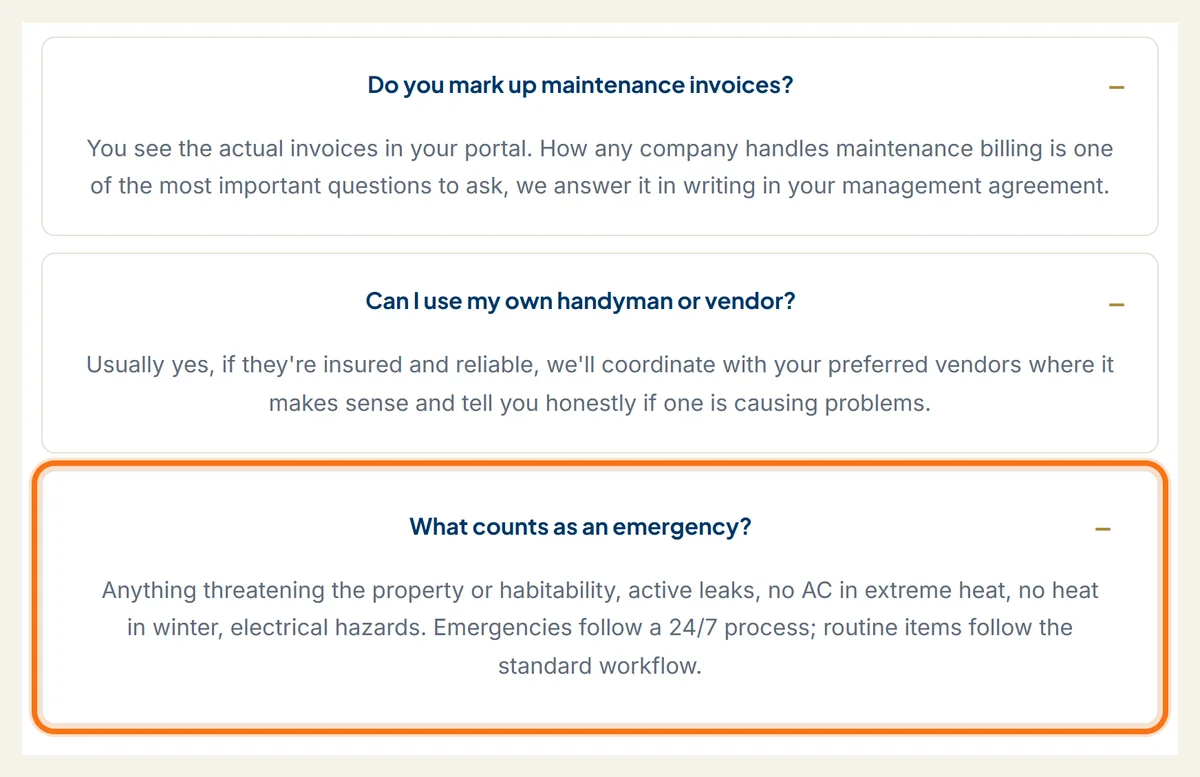
Tenants in the homes we manage report repairs through their online portal with photos, which creates a documented record and lets us triage before anyone is dispatched. All three of our plans include 24/7 emergency response. Our own definition is short: anything threatening the property or habitability, such as active leaks, no AC in extreme heat, no heat in winter and electrical hazards, follows the 24/7 process, and routine items follow the standard workflow.
Routine repairs under the spending limit you pre-approve get fixed without waiting on you, and anything larger comes to you with a description, photos and a recommendation. Every job is documented in your owner portal, the original vendor invoice is always there, and every completed repair over $500 gets photo or video proof under The Perpetual Promise, subject to its Guarantee Addendum.
We are broker-owned, with our office at 5755 Rufe Snow Dr in North Richland Hills, and we manage homes in Keller, North Richland Hills, Fort Worth and nearby. Our maintenance service describes the process in full, and every fee connected to it is listed in writing before you sign. To talk through how emergencies would be handled on your rental, call 682-593-7033.
The takeaway: A rental emergency is a safety risk or damage that grows by the hour; everything else is urgent or routine, and the money is in sorting the three correctly and telling the tenant why.
Questions owners ask
Is no air conditioning an emergency in a Texas rental?
It depends on the heat and the people in the house. During dangerous summer heat, or with infants, elderly tenants or anyone with a medical condition, a total loss of cooling is treated as an emergency. In milder weather it is urgent, meaning same-day or next-day service at normal rates, often with fans or a window unit as a stopgap. Either way it should not wait for the weekend to end.
Is no hot water an emergency at a rental?
Not usually, as long as the water heater is not leaking. Cold water still runs, the house is safe and nothing is being damaged, so it sits in the urgent tier: a plumber booked for the next business day at normal rates. It still has to be fixed promptly, because Texas Property Code 92.052 includes a water heater that supplies water at 120 degrees or more in the landlord's duty to repair. A leaking or failed tank flooding a closet is different and is treated as an emergency because the damage grows by the hour.
Who pays for an emergency repair at a rental in Texas?
The owner pays for repairs to the owner's property, including the after-hours rate when a true emergency requires it. The tenant pays when the lease makes the cause their responsibility, such as a lockout, a drain clogged by grease, or damage from misuse. A manager documents the cause with photos and the vendor's notes so the charge lands on the right side of the ledger.
Can a tenant call a repair company directly in an emergency?
Only if the lease allows it, and most leases direct the tenant to the manager's emergency line instead, because an unvetted vendor at an after-hours rate is a cost nobody controlled. Texas Property Code 92.0561 does give tenants a repair-and-deduct remedy for certain conditions, capped at one month's rent or $500, whichever is greater, but it requires written notice and specific steps first. A manager with a working emergency line makes that remedy unnecessary.
What is considered emergency maintenance in an apartment or a rental house?
The same test applies to both: a problem that puts someone in danger or causes damage that grows by the hour. Active water leaks, sewage backups, a gas smell, electrical sparking, no heat in freezing weather, no cooling in dangerous heat, a door that will not lock and fire all qualify as an emergency repair. A problem that is stable and can be made safe until morning is urgent or routine.
Does Texas law require a 24-hour emergency maintenance number?
Only in one case. Property Code 92.020 requires a landlord that has an on-site management or superintendent's office to give tenants a phone number answered 24 hours a day for emergencies that materially affect health or safety. A single-family rental has no on-site office, so the lease and the manager's own process govern. All Perpetual plans include 24/7 emergency response.
Related services
Property management in Keller, North Richland Hills and Fort Worth. How full-service management works in Tarrant County →