Key takeaways
- At night a rental emergency needs three people: someone who answers, someone who decides and someone who shows up. With a manager, none of them is you.
- Texas Property Code 92.020 requires a number answered 24 hours a day only from landlords with an on-site management office. Every other landlord must still give tenants an emergency number (92.020(d)).
- No Texas statute sets a response time in hours. The duty is a diligent effort to repair health and safety conditions (92.052), and severity counts when a court asks what was reasonable (92.056(d)).
- What a manager may spend at night without calling you comes from two written terms: your pre-approved spending limit and the emergency clause.
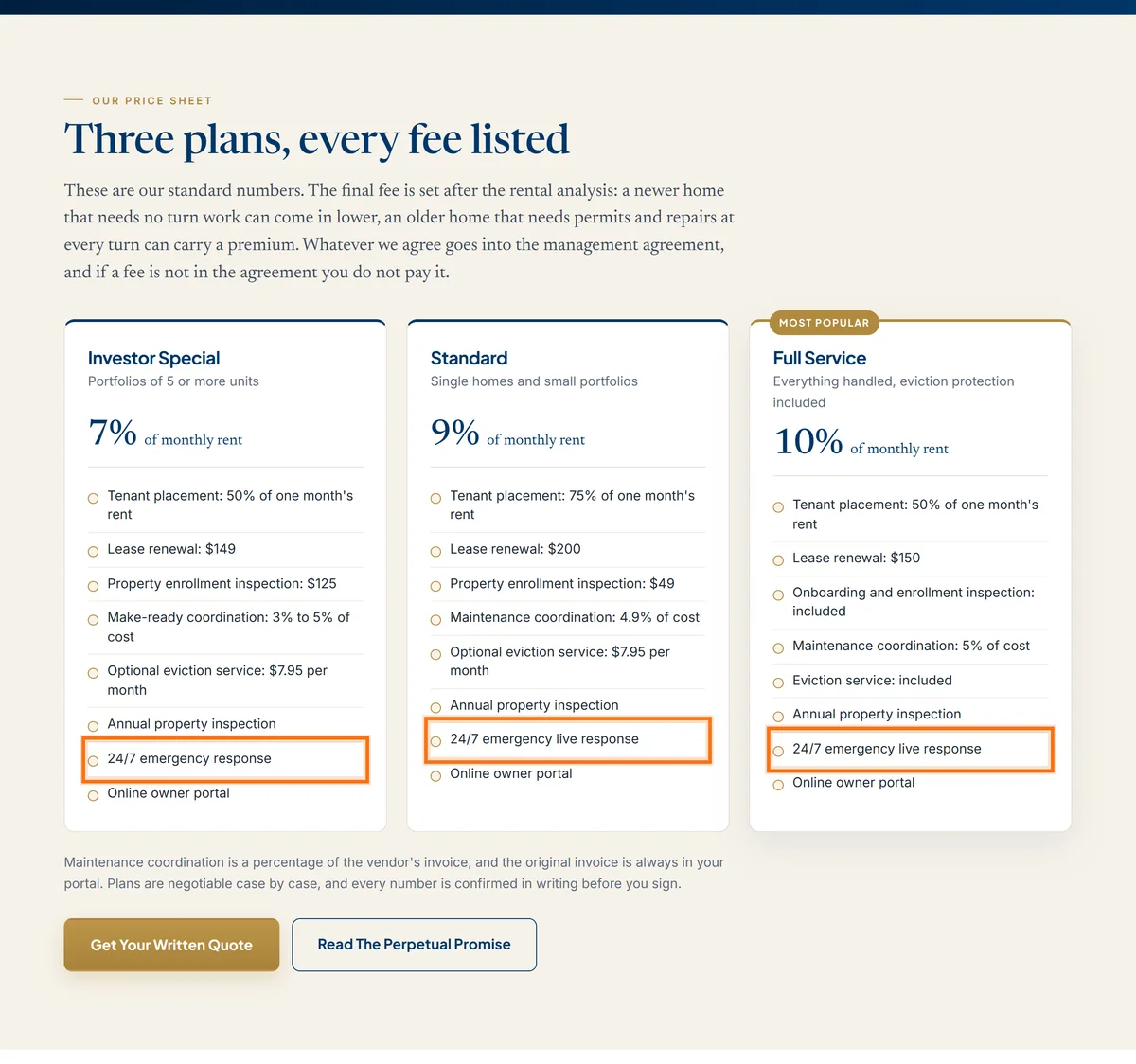
- All three Perpetual plans include 24/7 emergency response.
If you have a property manager, a night or weekend emergency at a rental in Fort Worth, Keller or North Richland Hills is handled by three people: whoever answers the emergency line, whoever decides and dispatches, and the vendor who shows up. You are the fourth person, and your part happens the next morning. If you do not have a manager, all four of those people are you, at 2 a.m., with a tenant on the phone.
This guide walks through that chain, what each person is allowed to do, what Texas law requires after hours, and the terms to settle in writing before the first late-night call.
Who does what in a night or weekend rental emergency
Here is each step of an after-hours emergency, who handles it with and without a property manager, and the term that should be settled in writing before it happens:
| Step | With a property manager | If you self-manage | Settle in writing beforehand |
|---|---|---|---|
| The tenant reports it | Calls the emergency number the manager gave at move-in | Calls your personal phone | Which number the tenant uses after hours. Property Code 92.020(d) requires every landlord to give tenants an emergency number |
| Someone decides: emergency, or can it wait? | The manager's after-hours process sorts the call | You decide, half asleep | What counts as an emergency |
| A vendor is sent | A plumber, electrician or HVAC company the manager uses repeatedly | You call until somebody picks up | Who pays the after-hours rate (the owner, as a repair to the property) |
| The spending is authorized | Under the emergency clause and your pre-approved limit, without waking you | You approve on the spot | The dollar limit and the wording of the emergency clause |
| The owner is told | After the house is safe: what happened, what was done, the cost | You were there | How and when you are notified, and a backup contact |
| The permanent repair | Next business day at normal rates; anything over your limit comes to you first | You schedule it and meet the vendor | The approval threshold for the follow-up work |
How to read this table: the second column is what you are paying a manager for, and the last column is the list of terms to find in the management agreement before you sign. If any of them is missing or vague, ask for it in writing.
The first voice: who answers the line
The tenant's call has to reach a person, not a mailbox. Companies do this three ways: a staffed answering service with a script that pages the on-call manager, a manager's own cell phone on rotation, or a software line that routes to whoever is on duty. Any of the three works if two things are true: the person answering can reach someone with authority within minutes, and the tenant is told what to do right now, such as where the water shutoff is or to leave the house if they smell gas.
What does not work is an office number with an after-hours greeting that says to call back Monday, or an agent who manages a few houses on the side and has their phone on silent. Ask any manager you interview who physically picks up at midnight on a holiday weekend, and ask for the answer in writing. The answer tells you whether coverage is a process or a promise. The guide to how property managers handle after-hours emergencies describes the full process from first ring to next-morning follow-up.
The decision maker: the on-call manager
The person who decides is a manager with access to the property file, the lease, the owner's approval limit and the vendor list from a phone. Their job in the first few minutes is triage: is this a true emergency, meaning a safety risk or active damage that gets worse by the hour, or a problem that is unpleasant but can wait for daylight at normal rates? What counts as a maintenance emergency sorts the common calls into emergency, urgent and routine.
If it is an emergency, the manager dispatches under the emergency clause in your agreement, which allows a make-safe repair without waking you. If it is not, the tenant gets a clear explanation, a ticket for the morning and, where it helps, a workaround. That second outcome is as valuable as the first, because every unnecessary after-hours dispatch is paid at after-hours rates, and by you. After-hours maintenance call fees explains who pays for which kind of call.
The responder: a vendor who picks up at night
A plumber who will answer at 1 a.m. for a stranger is rare. A plumber who will answer for a management company that sends them steady daytime work and pays invoices on time is normal. That relationship is the real asset a manager brings to an emergency, and it is built in daylight, with agreed after-hours rates, insurance on file and a short list of trades: plumbing, electrical, HVAC, locksmith, water extraction and board-up.
The vendor's job at night is narrow: stop the damage and make the house safe. Shut the water, cap the line, restore power to the panel, secure the door. The proper repair, with parts, estimates and a tenant who is awake, happens the next business day at normal rates. Owners who understand that split stop worrying about a night call turning into a blank check.
The owner: what you are asked to do, and when
During the emergency, nothing. That is the point of the emergency clause: it lets the manager act inside a defined scope so a burst line is not waiting on a voicemail. What you receive is a notification, usually the same night by text or email for a serious event and otherwise first thing in the morning, with what happened, what was done and what it cost.
Your part comes next: approving the proper repair if it exceeds your limit, deciding on any replacement the event revealed, calling your insurance agent if the damage is large, and reading the invoice when it lands on your statement in the owner portal. If you are traveling or unreachable, the emergency clause and a backup contact you named in the agreement cover the gap. What happens when an emergency repair is needed and the manager cannot reach you goes through that case.
Without a manager: what the night actually looks like
Self-managing owners handle emergencies too, and some do it well. But be honest about what it requires: your personal number given to the tenant, your phone on loud every night, a plumber and an electrician who already know you, enough knowledge to tell a tenant how to find the water shutoff, and the judgment to say no to a non-emergency without souring the relationship. Owners who live out of town, travel for work or have a day job that cannot be interrupted usually discover the gap the first time it matters.
Texas law expects a landlord to make a diligent effort to repair conditions that materially affect health or safety once the tenant gives notice (Property Code 92.052). An owner who cannot be reached is not excused by being asleep. This is one of the clearest cases where a maintenance service with real after-hours coverage earns its fee.
What Texas law requires after hours
Texas does not tell a landlord to answer the phone within a set number of minutes, and no statute names a response time in hours. Three sections of the Property Code do apply.
- Section 92.020(a): a landlord that has an on-site management or superintendent's office must give tenants a telephone number answered 24 hours a day for emergencies that materially affect health or safety. That describes an apartment community, not a rental house.
- Section 92.020(d): every other landlord must still give the tenant a telephone number for reporting those emergencies. The statute does not say it must be answered around the clock.
- Sections 92.052 and 92.056(d): after notice, the landlord must make a diligent effort to repair a condition that materially affects the physical health or safety of an ordinary tenant. Seven days is presumed a reasonable time, and the severity and nature of the condition are weighed against that presumption.
In practice the lease and the manager's process decide who picks up at midnight, and the statute decides what happens if nobody acts. Texas landlord repair obligations covers the notice and timing rules in full. This is general information, not legal advice.
How Perpetual handles this
All three of our plans include 24/7 emergency response, and the Standard and Full Service plans list it as "24/7 emergency live response." Our definition of an emergency is published on our maintenance page: anything threatening the property or habitability, such as active leaks, no AC in extreme heat, no heat in winter and electrical hazards. Those calls follow the 24/7 process. Routine items follow the standard workflow.
Spending works the same way at night as in daylight. Repairs under the limit you pre-approve get fixed without waiting on you, and anything larger comes to you with a description, photos and a recommendation. Every job is documented in your owner portal, the original vendor invoice is always there, and every completed repair over $500 gets photo or video proof under The Perpetual Promise, subject to its Guarantee Addendum.
What we do not publish on the website is who is on call on a given night or a response time in minutes. Ask us, and the answer goes into your management agreement along with your spending limit, before you sign. Every plan and fee is on our pricing page, and if a fee is not in the agreement, you do not pay it.
We are broker-owned, with our office at 5755 Rufe Snow Dr in North Richland Hills, and we manage homes in Keller, North Richland Hills, Fort Worth and nearby. Our maintenance service describes the full process. To talk through how a night or weekend emergency would be handled on your rental, call 682-593-7033.
The takeaway: At night a rental emergency is handled by whoever answers, whoever decides and whoever shows up. The value of a property manager is that none of those three people has to be you, and the place to confirm it is the written agreement.
Questions owners ask
Is a property manager available 24 hours a day?
A full-service manager should provide an emergency line that reaches a decision maker at any hour, but that is not the same as the office being open. Routine requests and non-urgent repairs are handled during business hours. Texas requires a number answered 24 hours a day only from landlords with an on-site management office (Property Code 92.020), so for a rental house the management agreement is where 24-hour coverage is promised. All Perpetual plans include 24/7 emergency response.
Do I get charged extra when the manager handles an emergency at night?
You pay the vendor's after-hours rate for the emergency work itself, because it is a repair to your property. Whether the manager charges anything for taking the call depends on the management agreement, and it should be listed there in writing. Ask any manager you interview whether after-hours coordination is included in the monthly fee or billed separately. With Perpetual, every fee is confirmed in writing before you sign, and if a fee is not in the agreement, you do not pay it.
What should a tenant do before calling the emergency line?
Make the situation safe first: shut off the water at the fixture or the main for a leak, leave the house and call the gas company for a gas smell, and switch off the breaker for a sparking outlet. A good manager teaches tenants where the shutoffs are at move-in and reminds them in the lease. Then the tenant calls the line, describes the problem and sends photos if it is safe to do so.
Will I be woken up if something happens at my rental?
Usually not. The emergency clause in the management agreement lets the manager make the house safe without reaching you first. You receive a notice afterward with what happened, what was done and the cost. If you prefer to be called immediately for anything, say so and have it written into the agreement.
How are urgent repair requests handled overnight or on weekends?
The tenant calls the emergency number in the lease and is told what to do right away, such as shutting off the water. Whoever is responsible for the home then decides whether it is a true emergency. If it is, a vendor is sent to stop the damage and make the house safe, and the permanent repair follows on the next business day at normal rates. If it is not, the request is booked for business hours.
Does Texas law require a landlord to answer emergency calls 24 hours a day?
Only a landlord with an on-site management or superintendent's office must provide a number answered 24 hours a day (Property Code 92.020(a)). Every other landlord must give tenants a telephone number for reporting emergencies (92.020(d)), and must make a diligent effort to repair health and safety conditions after notice (92.052). This is general information, not legal advice.
Related services
Property management in Keller, North Richland Hills and Fort Worth. How full-service management works in Tarrant County →