Key takeaways
- Unpaid rent is owed to the owner under the lease. Changing managers does not cancel it or reset it.
- Before an eviction suit, Property Code 24.005 requires at least three days' written notice unless the lease sets a different period.
- Late fees on the old balance are only what the written lease allows (Property Code 92.019). A new manager cannot add fees the lease does not have.
- A suit on a debt must be brought within four years (Civil Practice and Remedies Code 16.004), and justice court hears claims up to $20,000.
- Read the old agreement's termination section: it decides whether the old company can claim a fee on rent collected later.
Can a new property manager take over collecting unpaid rent from before the switch? Yes. The rent your tenant did not pay is owed to you, not to the company that failed to collect it, so a new manager can pursue it from the day it takes over your rental in Fort Worth, Keller or North Richland Hills. The debt does not reset, and the tenant's obligation does not depend on who is asking.
Two things make it work: an accurate ledger from before the switch, and a clear separation between the old balance and new rent. This guide covers the Texas rules on an inherited balance, the records the new manager needs, how collection runs and what changes if the tenant has already moved out.
Collecting inherited unpaid rent: what the new manager can do
Here is each step a new manager can take on a balance from before the switch, the Texas rule behind it and what the step depends on:
| Step | The rule | What it depends on |
|---|---|---|
| Demand the unpaid rent in writing | The lease: rent is owed to the landlord | A ledger that shows the balance month by month |
| Charge late fees on it | Property Code 92.019: only if the written lease gives notice of the fee, the fee is reasonable, and rent is unpaid two full days after it was due | The late-fee clause in the existing lease |
| Give notice before an eviction suit | Property Code 24.005: at least three days' written notice unless the lease sets a shorter or longer period | The lease's notice clause and proof of delivery |
| Claim the rent in the eviction suit | Property Code 24.0051; justice court limit of $20,000 (Government Code 27.031) | A sworn petition and the ledger |
| Apply the deposit after move-out | Property Code 92.104, with the itemized list due within 30 days of surrender | The deposit having transferred with the file |
| Sue a former tenant for the balance | Four years to bring suit on a debt (Civil Practice and Remedies Code 16.004) | A forwarding address and the owner's decision |
How to read this table: every step exists whether or not the manager changed. What the switch changes is the right-hand column, because each step depends on a record the old company has to hand over.
Whose debt it is, and why that settles the question
A management company collects rent as the owner's agent. Under the Texas Real Estate Commission's Rule 535.146, rent a broker holds is trust money, held on your behalf until it is paid out. Rent the tenant never paid is simply money the tenant still owes you under the lease. The old company's departure does not forgive it, and the old company has no claim to it as its own.
That means the new manager, as your new agent, can demand the balance, apply the late fees the lease allows, send notices and, if it comes to it, start the eviction process, including for the months from before the switch.
One thing to check first: some management agreements give the old company a fee on rent that fell due during its term, whenever it is paid. That does not stop the new manager from collecting. It may mean an invoice from the old company. Read the termination section of the old agreement before the new manager starts. The other money questions in a handover are in deposits, unpaid rent and repair bills when you switch managers.
Is there a law for this? The Texas rules on an old balance
No Texas statute deals with a change of property manager and unpaid rent. The ordinary landlord-tenant rules apply to the old balance exactly as they would have under the old company:
- Notice before eviction. Under Property Code 24.005(a), a tenant who defaults must get at least three days' written notice before the landlord files suit, unless the lease sets a different period. Since January 1, 2026, when unpaid rent is the only ground, a tenant who was not late before the month of the notice must get a notice to pay rent or vacate; a tenant who was late before can get either that or a notice to vacate. The old ledger is what shows which applies.
- How the notice is delivered. Section 24.005(f-3) lists the methods: mail or a delivery service, delivery inside the home in a conspicuous place, hand delivery to a tenant 16 or older, or electronic communication if the parties agreed to it in writing.
- Late fees. Section 92.019 allows a late fee only if notice of it is in a written lease, it is reasonable, and rent has stayed unpaid two full days after it was due. For a house or a building of up to four units, a fee of not more than 12 percent of the month's rent is considered reasonable.
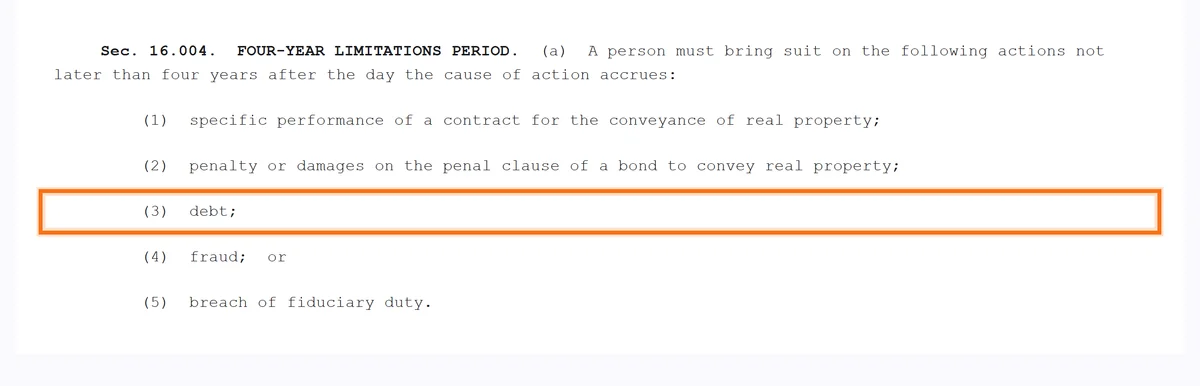
- The deadline to sue. Civil Practice and Remedies Code 16.004(a)(3) requires a suit on a debt to be brought not later than four years after the cause of action accrues.
Ask an attorney which date starts the four-year clock for each unpaid month. This is general information, not legal advice.
What the new manager needs to collect it
Collection stands on records. Without them the tenant can dispute every number, and in an eviction hearing the judge will want to see how the balance was built.
- The tenant ledger from the old company: each charge, each payment and the running balance, with dates.
- Copies of every late notice, demand letter or notice to vacate the old company sent, and proof of how each was delivered.
- Any payment plan or promise the old company made to the tenant, in writing or by email.
- Your bank records of disbursements, to reconcile what the old company collected against what it reported.
- The lease, to confirm the late fee, the due date and the notice period it actually contains.

If the old company will not hand over the ledger, the new manager can rebuild it from your disbursements, the tenant's own payment records and a written confirmation of the balance from the tenant. It is slower, but it puts the number in writing with the tenant's acknowledgment. The escalation steps are in when your old manager will not release keys or records.
How collection runs under the new manager
The sequence is the same one a manager uses for any late rent, started from the inherited balance rather than from zero:
- A written statement of the balance, itemized by month, with a demand for payment by a stated date. This often produces payment on its own.
- A written payment plan, if you approve one, with fixed dates, current rent paid on time alongside it, and a clause that the plan ends if a payment is missed.
- The notice Property Code 24.005 requires, delivered by one of the listed methods, if the tenant does not pay or does not keep the plan, followed by an eviction suit in justice court if the tenant stays.
Illustrative only, not a real case. A tenant paying $1,800 a month owes two months from before the switch: 2 x $1,800 = $3,600. You approve a plan of $600 a month for six months, which clears 6 x $600 = $3,600, so the tenant pays $1,800 + $600 = $2,400 each month until it is done. If the lease sets its late fee at the 12 percent line, a late month adds $1,800 x 12% = $216.
If the tenant keeps the plan, you recover the money without a vacancy; if not, the record is ready for court. Each step is explained in what happens when a tenant pays late in Texas, and the choice between a plan and an eviction in how a manager takes over a rent problem.
Keeping the old balance separate from new rent
The most common mistake with inherited arrears is mixing the old balance into the new ledger so that nobody can tell which month a payment covered. That matters in court, where the claim is for specific unpaid months, and it matters under the current notice rule, which turns on whether the tenant was late before the month of the notice.
A good manager opens the tenant's account with the inherited balance as a dated opening entry, then posts current rent and payments against the right month. Payments are applied the way the lease says. Ask for the arrears recovered and the current rent collected to appear as separate lines on your owner statement, so you can see how much of the old debt has come in.
Decide early what you will accept. Some owners would rather forgive part of an old balance to keep a tenant who is now paying on time. That is a legitimate choice; make it in writing, once.
If the tenant has already moved out
The new manager can still help, but the tools change. With no tenant to evict, the first step is the security deposit. Property Code 92.104 lets the landlord deduct charges the tenant is legally liable for under the lease, and unpaid rent is one. The itemized list of deductions goes to the tenant's forwarding address within 30 days after surrender. This only works if the deposit actually transferred from the old company with the file.
For the amount beyond the deposit, the options are a demand letter, a suit in justice court or a collection agency. The manager can prepare the file for any of them; you, as the creditor, decide. In Tarrant County, the justice court fee schedule lists $54 to file a justice suit and the constable fee schedule lists $90 to serve a citation, so suing one former tenant costs $54 + $90 = $144 before any attorney. Confirm current fees with the court.
Whether that is worth it depends on the balance and on whether the former tenant can be found. The full process is in recovering unpaid rent after a tenant moves out.
How Perpetual handles this
Perpetual Property Management is broker-owned, with our office at 5755 Rufe Snow Dr in North Richland Hills, and we take over occupied homes in Keller, North Richland Hills, Fort Worth and nearby. What our site commits to on an inherited balance:
- The ledger comes with the lease. In a takeover we request the lease and related documents, the security deposit, keys, the tenant ledger, property records and open work orders. Our switching page says a balance needs to be understood before it can be carried forward accurately.
- The same late process for every tenant. Rent collection runs on reminders, late fees applied per the lease and documented escalation steps.
- Distressed tenancies are taken over mid-stream. Our evictions page says the first step is assessing the file (lease, ledger, notices already sent), and that we attempt a documented payment conversation before court. We are not a law firm and coordinate with a landlord-tenant attorney where a matter needs one.
- Eviction service is included on the Full Service plan and optional at $7.95 a month on the others, as listed on the price sheet.
We offer no rent guarantee and do not promise that an old balance will be collected. Whether we pursue rent owed from before our management starts, the payment plans we will administer and any fee on arrears we collect are confirmed in writing before you sign.
If you are inheriting a balance with a switch, tell us the numbers or call 682-593-7033.
The takeaway: The arrears are yours, so hand the new manager the ledger and the notices, keep the old balance as its own line, and let a written demand and a dated plan do what the old company did not.
Questions owners ask
Can the new manager evict a tenant for rent that went unpaid under the old manager?
Yes, if the balance is still owed and the lease and Property Code 24.005 are followed. The new manager gives the written notice for you, at least three days before filing unless the lease sets another period, and a tenant who was not late before that month must get a notice to pay rent or vacate. If the tenant neither pays nor leaves, the suit is filed in justice court, where Property Code 24.0051 lets the landlord claim unpaid rent with possession. The court will want the ledger and the notices.
Does the old property manager get a fee on unpaid rent that the new manager collects?
Only if its agreement says so, and that clause is worth reading closely. Some agreements pay the management fee only on rent collected during the term. Others claim a fee on amounts that fell due during the term whenever they are paid. If the old company invoices you, compare the claim to the termination section before paying, and ask an attorney if the amount is large.
Should I forgive old unpaid rent to keep a tenant who is paying on time now?
Sometimes, and it should be a deliberate written decision rather than a drift. Compare the balance against the cost of a vacancy, make-ready and re-leasing. If the tenant is reliable now and the balance is modest, a written settlement that clears part of it in exchange for prompt payment can be sensible.
What if the tenant says the old manager agreed to waive the rent?
Ask for it in writing. A manager acts with the owner's authority, so start with what your old agreement let the company do. If there is an email or a signed plan from the old company, the new manager reviews it with you, and honoring it is often cheaper than a dispute. If nothing is in writing, the new manager proceeds with the itemized demand. Ask an attorney before filing suit over a balance the tenant says was waived.
Is there a law for this in Texas?
No statute covers a change of manager and unpaid rent specifically. The debt comes from the lease, and the ordinary rules apply to it: written notice before an eviction suit (Property Code 24.005), late fees only as a written lease allows (92.019), deposit deductions and the itemized list (92.104), a $20,000 limit in justice court (Government Code 27.031) and four years to sue on a debt (Civil Practice and Remedies Code 16.004).
Can a new property manager add late fees to rent that went unpaid under the old manager?
Only the fees the existing lease provides for. Property Code 92.019 allows a late fee only if notice of it is in a written lease, it is reasonable and rent is unpaid two full days after the due date. A new manager cannot invent a fee or raise one mid-lease. A landlord who collects a late fee in violation of the section is liable for $100, three times the fee and the tenant's attorney's fees.
How long do I have to collect unpaid rent from before the switch?
Civil Practice and Remedies Code 16.004 requires a suit on a debt to be brought not later than four years after the day the cause of action accrues. The practical deadline is much shorter: records get lost in a handover and former tenants get harder to find. Ask an attorney which date starts the clock for each month.
Related services
Property management in Keller, North Richland Hills and Fort Worth. How full-service management works in Tarrant County →