Key takeaways
- The floor is three kinds of visit: a documented move-in inspection, at least one interior inspection a year, and a move-out inspection compared with move-in.
- Texas has no state law that sets how often a landlord may enter or how much notice is due. The lease decides both.
- Frequency should follow risk: a new tenant, pets, an older home, a pool or a strict HOA justify more visits than a long-term tenant in a newer house.
- Perpetual's price sheet lists an annual property inspection on every plan, and our guarantees include a 360-degree inspection at every move-in and move-out.
- Read the agreement for a countable schedule. "May inspect periodically" promises nothing.
How often will a property manager physically inspect your rental? At move-in, at least once a year during the lease, and at move-out. That is the floor for a managed home in Fort Worth, Keller or North Richland Hills, and anything less is not management. Above the floor, frequency should follow risk, and the number in your agreement should fit your house rather than a company-wide default.
This guide covers what counts as a physical inspection, what Texas law says about entering to inspect, the factors that should raise the frequency, the visits that are triggered rather than scheduled, and how to read the inspection language in a management agreement.
How often a managed rental is inspected: the schedule at a glance
Here is each kind of inspection, when it happens and what Perpetual's own site and price sheet say about it:
| Inspection | When | What our site states | Cost on our price sheet |
|---|---|---|---|
| Enrollment inspection | When we begin managing the home | A condition record at the start of management | Included on Full Service, $49 on Standard, $125 on Investor Special |
| Move-in inspection | Every move-in | A 360-degree condition inspection, the photo baseline for everything after | The move-in inspection is covered by the tenant placement fee |
| Annual property inspection | Once a year | Listed on all three plans | Listed as part of every plan |
| Other scheduled interior inspections | On the schedule in your management agreement | Done with notice to the tenant, with a photo report in your owner portal | Not on the price sheet |
| Extra inspection | When something warrants a look | Can be arranged | Not on the price sheet |
| Move-out inspection | Every move-out | A 360-degree inspection measured against the move-in baseline | No separate charge is listed |
How to read this table: rows two, three and six are the floor, so a tenant who stays one year is seen at move-in, at the annual inspection and at move-out. Rows four and five are where your house's risk should set the number.
What counts as a physical inspection
A physical inspection is a person inside the home, walking every room with a checklist and a camera, after the tenant has been notified the way the lease provides. It is not a vendor visit, not a drive-by and not a photo survey the tenant fills in, although all three have a place. The guide to rental property inspections describes the kinds of visit and what each one covers, and interior inspections versus drive-by checks explains the difference in what they catch.
The definition matters because managers use the word loosely. "We inspect regularly" can mean an interior walk every six months or a drive past the house on the way to another one. When you ask about frequency, ask how many times a year someone will be inside with a camera.
What Texas law says about entering a rental to inspect
Less than most owners and tenants assume. The Texas State Law Library's landlord entry page states it directly: there are no state laws that regulate a landlord's entry in Texas. No statute sets a notice period, and none sets a maximum number of inspections. The page lists the usual grounds for entry as the conditions specified in the lease, an emergency, or making repairs.
That puts the weight on two things:
- The lease. It should say that the landlord or the manager may enter to inspect, on what notice and at what times. The law library's wording: if the lease does not allow entry or does not address it, the landlord may not have the right to enter without permission.
- Quiet enjoyment. The law library explains that Texas courts treat the tenant's right to peaceful possession as an implied term of every lease, and that a landlord may breach it by entering more often than necessary, at unreasonable times or in violation of the lease.
So the legal limit on frequency is not a number. It is whether each visit has a reason and follows the lease. One duty does carry a date: under Property Code 92.258 the landlord must test each smoke alarm at the beginning of the tenant's possession, and during the lease must inspect or repair one when the tenant reports a malfunction or asks. This is general information, not legal advice. How entry is handled day to day is covered in arranging inspections without violating tenant privacy.
The factors that should raise the inspection frequency
Two homes on the same street in Keller can justify different schedules. The factors that push a manager toward more interior visits:
- A new tenant. The first months show how someone actually lives in the house, and an early visit catches problems while the lease is fresh.
- Pets. Approved pets justify a look at floors, doors and the yard. Signs of a pet that is not on the lease justify a visit on their own.
- An older home. Our maintenance page notes that much of Northeast Tarrant's housing stock is 30 to 50 years old, which means more plumbing, roof and HVAC to watch.
- A pool or a large lot. Each adds a system that fails expensively when ignored.
- A strict HOA. Violations can pile up between visits.
- History. A lease-violation notice, a pattern of late payments or a neighbor complaint earns closer attention.
A long-term tenant with a clean record in a newer home is the opposite case. Once a year inside is often enough, and more than that costs goodwill without buying information. What a visit is looking for is covered in how inspections catch unauthorized occupants, pets and changes.
Inspections that are triggered, not scheduled
Beyond the calendar, specific events should bring someone to the house:
- A neighbor complaint, a city notice or an HOA violation letter.
- A vendor who reports something odd on a service call.
- A tenant's request to add an occupant or a pet.
- A renewal decision, which should not be made without a recent look inside.
- A severe storm, which calls for the visit described in what a manager checks after a hailstorm.
These visits are where many mid-lease problems are actually caught, and they are the reason the scheduled count matters less than owners think. A manager who responds to signals finds more than one who only follows a calendar. Ask how the manager decides to go out between scheduled visits. The answer tells you whether anyone is paying attention.
Can you ask for more inspections, such as quarterly?
Yes, within two limits. The first is cost: some agreements include a set number of interior visits and bill additional ones. The second is the tenant. Because Texas leaves entry to the lease, a lease that allows periodic inspections on stated notice supports a quarterly visit. But a tenant who sees the manager every 90 days can start to feel watched, a visit with no reason is the kind the quiet enjoyment rule is about, and good tenants have options.
The practical compromise for an anxious owner is an early visit after move-in, a mid-lease visit and a pre-renewal visit. That is three times inside in a year, each with a reason the tenant understands. For a one-year lease it comes to five documented looks at the home: move-in, three during the lease and move-out.
How to read the inspection language in a management agreement
The management agreement should state the schedule in countable terms: a move-in inspection, interior inspections at a stated interval, a move-out inspection, and whether exterior checks are included. It should say what you receive after each one and whether any of them carries a separate fee. If the agreement says only that the manager "may inspect periodically", nothing has been promised.
Three questions to ask before signing:
- How many times in the first year will someone be inside the home with a camera?
- Can I see a sample interior inspection report from a real property, with the address removed?
- How do you decide to inspect between scheduled visits?
The first gives you a number to hold the manager to. The second shows what a visit produces. The third shows whether anyone will notice the signals.
What inspections cost, and what you should receive
Frequency and price are one question, because the schedule a manager promises is only real if you know who pays for each visit. Managers price inspections in three common ways: a set number included in the monthly fee, a charge per visit, or a mix where scheduled visits are included and owner-requested extras are billed. The guide to inspection fees in property management compares them.
Our own published numbers are short. The annual property inspection is listed on every plan. The enrollment inspection, done once when we take over a home, is included on Full Service, $49 on Standard and $125 on Investor Special. If a fee is not in your management agreement, you do not pay it.
Whatever the count, each visit should produce something you can read: dated photos of every room, notes on condition, and a list of what needs action and who will take it. What that report looks like is covered in inspection reports and photos.
How Perpetual handles this
Perpetual Property Management is broker-owned, with our office at 5755 Rufe Snow Dr in North Richland Hills, and we manage homes in Keller, North Richland Hills, Fort Worth and nearby. What our site commits to on inspections:
- Move-in and move-out. Every one gets a 360-degree condition inspection, one of our five written guarantees, subject to the Guarantee Addendum.
- Every year. An annual property inspection is listed on all three plans on the price sheet.
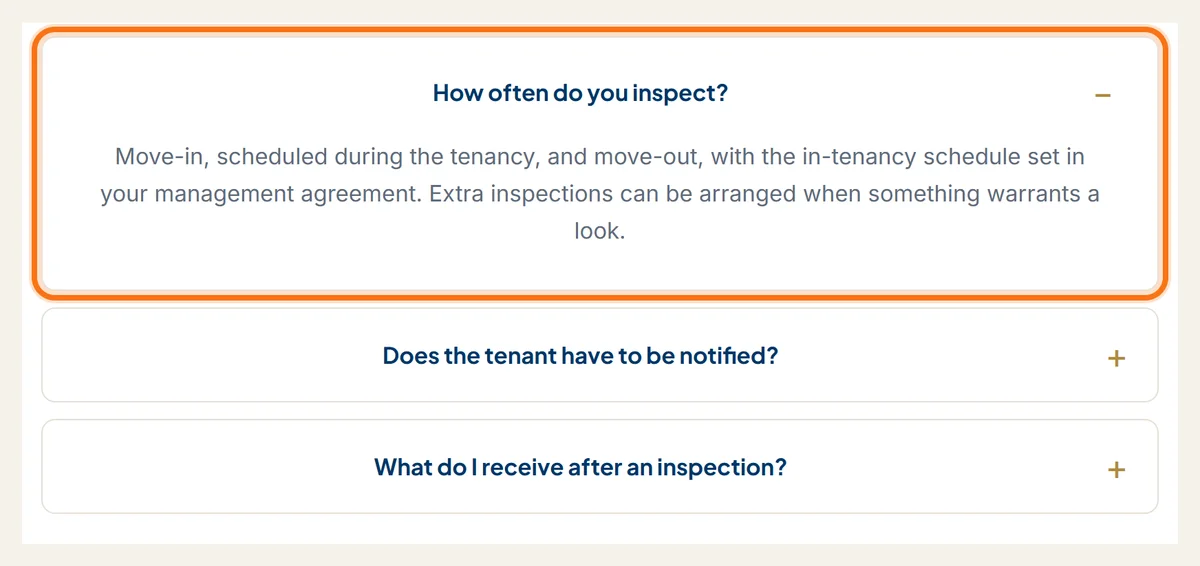
- During the tenancy. Scheduled interior inspections with notice to the tenant, on the schedule set in your management agreement, and extra inspections when something warrants a look.
- What you receive. A photo report in your owner portal with condition notes and recommended actions. Anything found goes to maintenance coordination or to the tenant with a recommendation.
- At the start. An enrollment inspection when we take over a home: included on Full Service, $49 on Standard, $125 on Investor Special.
Our site does not publish a number of visits beyond those, a schedule of exterior checks or a price for an extra inspection. The interval for your house and any charge for a visit beyond the included ones are confirmed in writing before you sign. The inspections page explains the program.
If you want to know what schedule we would recommend for your rental, call 682-593-7033.
The takeaway: The floor is move-in, once a year inside and move-out; above that, frequency should follow the risk of your specific house and be written into the agreement in countable terms.
Questions owners ask
Is a yearly inspection enough for a rental property?
For a long-term tenant with a clean record in a newer home, one interior inspection a year plus a look before renewal is usually adequate. For a new tenant, pets, an older home or a pool, it is not. The right answer depends on the house and the tenant, and the schedule should be revisited at each renewal.
Can a landlord do quarterly inspections in Texas?
Texas has no statute that limits how often a landlord inspects or sets a notice period, so the lease governs. A lease that provides for periodic inspections on stated notice supports quarterly visits. The Texas State Law Library notes that courts read a right of quiet enjoyment into every lease, which a landlord may breach by entering more often than necessary or at unreasonable times. This is general information, not legal advice.
Does a property manager inspect before renewing a lease?
A good one does. A renewal decision made without a recent look inside is a guess about how the tenant is keeping the home. The visit confirms condition, catches changes nobody approved and gives the owner a documented basis for the renewal recommendation. Our renewal work starts 120 days before the lease ends, which leaves time for it.
Do I get charged for each inspection?
It depends on the agreement. Some managers include a set number of interior inspections in the monthly fee and bill extra visits; others bill each one. On our price sheet the annual property inspection is listed on every plan, and the one-time enrollment inspection is included on Full Service, $49 on Standard and $125 on Investor Special. Ask for every inspection fee to be listed in the agreement.
How much notice does a property manager have to give before an inspection in Texas?
No Texas statute sets a notice period for a landlord's entry, so the answer is whatever the lease says. The Texas State Law Library puts it plainly: there are no state laws that regulate a landlord's entry, and the lease may or may not require prior notice. Read the entry clause in your lease, and expect a careful manager to give written notice and a time window anyway.
How many times a year should a rental property be inspected?
At least once inside during each year of the lease, on top of the move-in and move-out inspections. A new tenant, pets, an older home or a pool justify two or three interior visits in the first year. A long-term tenant with a clean record in a newer home rarely needs more than one. The number should be written in the management agreement.
Do I get the inspection photos, or just a summary?
Ask before you sign, because practice varies between managers. Our inspections page states that after an inspection you receive a photo report in your owner portal with condition notes and any recommended actions: maintenance items, lease-violation follow-ups, or nothing at all, which is also good to know.
Related services
Property management in Keller, North Richland Hills and Fort Worth. How full-service management works in Tarrant County →