Key takeaways
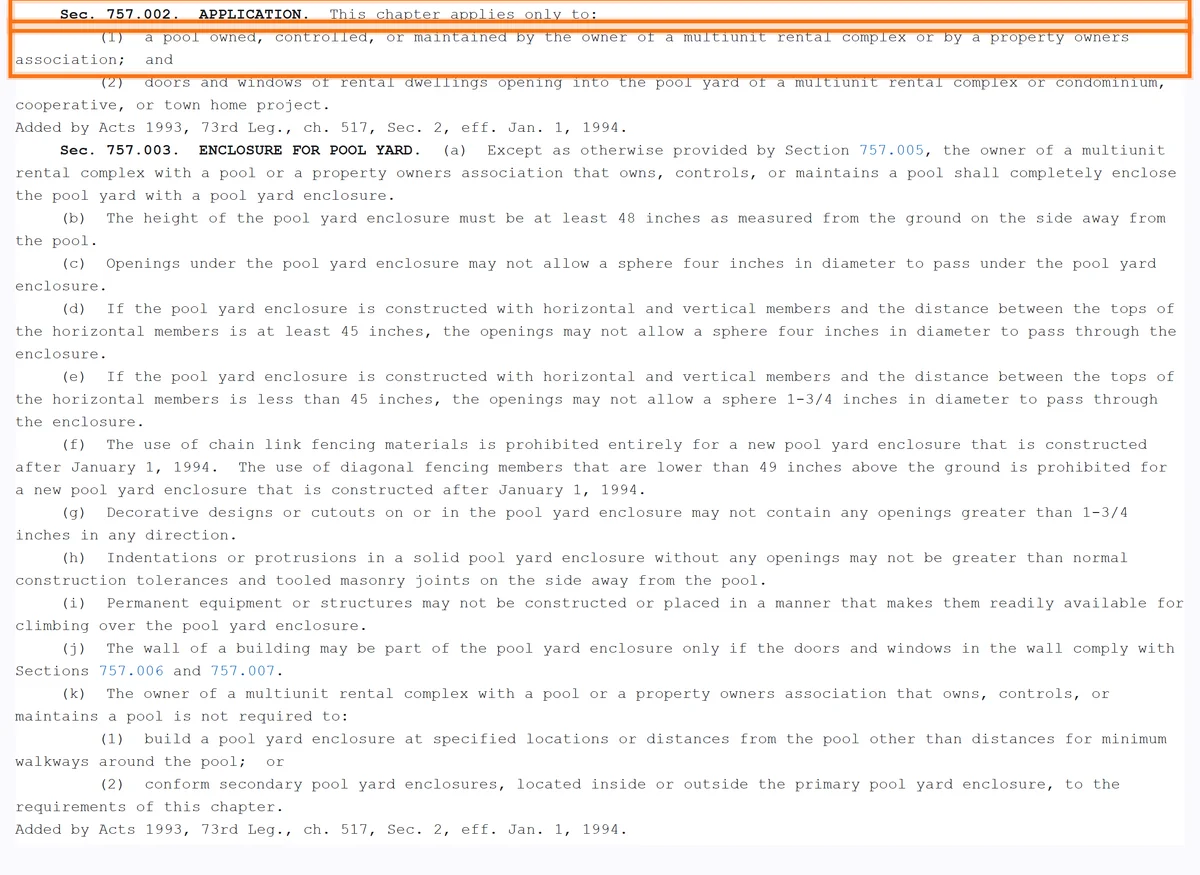
- The state pool yard law (Health and Safety Code chapter 757) covers apartment complexes and HOA pools, not a private pool at a rented house.
- A house pool falls under your city's pool fence ordinance; Local Government Code 214.101 lets a city set penalties of up to $1,000 per violation.
- The owner's landlord policy answers for the owner's liability; a tenant's renters policy covers the tenant's liability, at about $20 a month on average in Texas according to TDI.
- Put the pool on a weekly professional service paid by the owner; never hand chemistry or equipment to a tenant.
- A signed pool addendum sets the tenant's daily duties and safety rules; it does not replace the barrier or the insurance.
Yes, you can rent out a house with a pool in Keller, Southlake, Colleyville or Fort Worth, and a well-kept pool helps it lease in a North Texas summer. Four things have to be in place first: a barrier that meets your city's pool fence ordinance, a landlord insurer that knows about the pool and the rental, a weekly professional pool service paid by the owner, and a signed pool addendum. Renters insurance on the tenant's side adds a layer, but only for the tenant's own liability.
This guide covers the decision to rent with the pool at all, which pool law actually applies to a house, how insurance splits a pool injury, why the pool service is non-negotiable, equipment and freezes, the addendum, fair housing and pricing.
Decide first: rent with the pool, or remove it
Before anything else, make the pool a deliberate choice. A pool in good condition with modern equipment is an asset in Colleyville, Keller and Southlake, where larger lots and family tenants make it expected. An older pool with a tired plaster finish, a failing pump and a cracked deck can cost more to carry than it adds in rent, and in that case removing it before listing is a legitimate option many owners never consider.
The honest test is whether you would spend what it takes to bring the pool to a condition you would be comfortable having a stranger's children swim in. If the answer is yes, proceed with the rest of this guide. If the answer is no, price the removal and compare it against the service, insurance and repair cost of carrying the pool for the years you plan to own the house. A pool you are not willing to maintain properly should not be rented.
In neighborhoods where pools are common, a well-kept pool is simply what the competing listings have, and a neglected one is the reason a house sits while the others lease.
Safety barriers and local rules in general terms
Barrier rules for a pool at a rented house come from your city, not from one statewide standard. Cities may adopt pool fence and enclosure standards under Local Government Code 214.101, and the specifics vary by city and by when the pool was built. Call the city's building or code department, ask what applies to an existing residential pool that is being rented, and meet it.
Beyond the fence, the items most inspectors and insurers look for are a gate that closes and latches on its own every time, latches placed out of a small child's reach, alarms on house doors that open to the pool area where required, compliant anti-entrapment drain covers, and no climbable objects placed against the fence. Remove a diving board or slide unless you are certain of the depth and the insurer's position.
None of this is optional for a rental. An owner-occupant can take their own risks; an owner renting to a family cannot. This is general information, not legal advice.
Which Texas pool rules apply to a rented house
Owners often assume the state pool fence law covers every rental. It does not. Here is what applies to a private pool at a single-family rental in Tarrant County, and what does not:
| Rule | Applies to a rented house with its own pool? | What it means for you |
|---|---|---|
| Health and Safety Code chapter 757, pool yard enclosures | No, it applies only to pools of multiunit rental complexes and property owners associations (757.002) | Its 48-inch enclosure and self-latching gate standards are still a useful benchmark |
| Your city's pool fence ordinance, under Local Government Code 214.101 | Yes, where the city has adopted one | The city can order repairs after notice and a hearing, set a penalty of up to $1,000 per violation and charge its repair costs as a lien |
| Your landlord insurance policy | Yes | The carrier decides whether it covers a rented pool home and on what conditions |
| The tenant's renters insurance | Only if the lease requires it and the tenant buys it | Its personal liability part covers the tenant's liability, not the owner's |
| The pool addendum to the lease | Yes, once signed | Sets the tenant's daily duties and safety rules |
How to read this table: the first row is the one most owners get wrong. Chapter 757 is written for apartment and HOA pools, so the rule that binds your backyard is the city's own ordinance. Call your city's building or code department and ask what it requires for an existing residential pool before you list.
Insurance in general terms
Tell your insurance agent the house has a pool and that it is being rented. Some carriers decline pool rentals, some require specific barriers, and some rate the policy differently. A pool the insurer does not know about is a claim that may not be paid. Ask about the liability limit on the landlord policy and whether the carrier wants a diving board, slide or spa removed or disclosed. Many pool owners add an umbrella policy over the landlord policy.
Pool insurance for renters is the other half. The Texas Department of Insurance describes renters insurance as covering the tenant's belongings, extra living costs after a covered loss, and personal liability that protects the tenant if someone is injured in their home. It costs about $20 a month on average in Texas. That liability coverage answers for the tenant's own negligence, such as a guest hurt while the tenant left the gate propped; a claim about the pool's condition or the barrier is still aimed at the owner.
So ask the tenant to carry renters insurance with personal liability, and keep your own policy right. Our guide to requiring renters insurance covers the lease wording and proof. This is general information, not insurance advice; confirm with your agent.
The pool service is not optional
Do not make the tenant responsible for pool chemistry, filter cleaning or equipment. Tenants do not know how, do not want to, and will not tell you when the water turns green. The result is a damaged plaster finish, a burned-out pump running dry and a pool that is unsafe to swim in. The cost of a weekly service is small next to a resurfacing.
Hire a weekly professional service paid by the owner and priced into the rent. The service tests and balances the water, cleans the skimmer and pump baskets, brushes the walls, backwashes or cleans the filter on schedule and reports equipment problems. Ask for a brief written report each visit, by text or app, so there is a record of water condition and of anything the technician flagged. Say rent would be $2,800 a month without a pool, as an illustrative example; adding an amount that covers the service and a share of the equipment risk is normal and is what the pool is worth to the right tenant.
The tenant's role is daily: skim leaves, empty the skimmer basket between visits, keep the water level up, keep the gate closed and report anything unusual the same day. That is the split that works. Our maintenance coordination works with vetted vendors under spending limits the owner sets, with the original invoice in the owner portal.
Equipment, leaks and the freeze problem
The pump, filter, heater and automation are the items that fail, and they fail in summer when the pool is in use and in winter when nobody is watching. Record the age and model of each piece of equipment, keep the manuals in the property file and plan replacement of the pump and filter on an age basis the same way you plan a water heater.
Pools lose water to evaporation, which is normal, and to leaks, which are not. A pool that drops more than a modest amount in a day with the equipment off has a leak in the shell, the plumbing or the equipment pad, and it belongs to a leak detection specialist rather than the weekly technician. Ask the service to note the water level at each visit so a trend is visible.
In a hard freeze, pool equipment is exposed on the pad. Most systems have freeze protection that runs the pump when the air temperature drops, which only works if the power is on and the setting is enabled. During an outage, the pump must be drained or the lines will split. Put the pool on the freeze instruction list from the freeze prep guide, and have the pool service confirm the freeze setting every fall.
The pool addendum: what it covers
A pool addendum is a separate signed document, not a line in the lease. Commonly used Texas lease forms offer one, and it should cover at minimum:
- That the owner provides a weekly service and the tenant allows access on the service day without notice.
- The tenant's daily duties: skimming, baskets, water level, keeping the gate closed and latched, reporting problems the same day.
- Safety rules: no one swims alone, children are supervised at all times, no glass in the pool area, no diving, the gate is never propped, no changes to the fence or barriers.
- No alterations to equipment settings, no draining of the pool, no additions such as slides, inflatable structures or heaters without written consent.
- The tenant's acknowledgment that they have inspected the barriers and that they accept responsibility for guests.
- Pet and party rules as they affect the pool area.
Walk the tenant through the addendum at the pool during move-in, show them the gate latch, the skimmer basket and the equipment shutoff, and photograph the barrier and the equipment pad for the condition report. The lease addenda guide covers the rest of the packet. Confirm the final wording with your lease form or an attorney.
Tenant selection within fair housing
Owners sometimes ask whether they can avoid renting a pool home to families with young children. The answer is no. Familial status is a protected class under fair housing law, and a policy that excludes or discourages families from a pool home is a violation, not a safety measure. The same applies to listing language that hints at it.
What you can do is apply the same written criteria to every applicant, require renters insurance, require the signed pool addendum, and explain the pool rules at the showing so every applicant knows what they are agreeing to. Applicants who do not want a pool self-select out; applicants who do want one accept the terms. The fair housing guide covers how consistent criteria protect the owner.
Screening for a pool home is otherwise standard screening. A tenant with a strong rental history who has kept a previous home well is the same tenant you want for any house; the pool does not change the criteria, only the addendum.
Inspections and the paper trail
A pool home needs its periodic inspection to include the pool area specifically: the fence and gate operation, the latch height, door alarms if present, the drain covers, the deck condition, the equipment pad and the water condition on that day. Photograph each item every time. The weekly service reports are the second layer of the record, and together they show that the pool was maintained and the barriers were intact throughout the tenancy.
That record matters if there is ever an injury claim, and it matters for the deposit at move-out when the question is whether a cracked skimmer lid or a bent gate was the tenant's doing. It also catches the slow problems: a gate that is starting to not latch, a deck that is lifting, a pump that is louder than it was. Our inspection program sends photo reports to the owner portal, so the pool area can be compared visit to visit.
Pricing and marketing a pool home
A pool commands a premium from the right tenant in the right season and almost none from the wrong tenant in winter. List a pool home to go on the market in spring or early summer where you can control the timing, and set the lease term so the next renewal lands in the same window. Photograph the pool clean, full and in sunlight, with the fence and gate visible in at least one shot, since serious applicants with children look for that.
In the listing, state plainly that weekly pool service is included and that a pool addendum applies. That language attracts the tenant who values the pool and is willing to follow the rules, and it discourages the one who expected to run it themselves. Everything else about pricing follows the normal process; a free rental analysis will show what the pool adds in your neighborhood against comparable homes with and without one.
The takeaway: Put a weekly service on the pool, a compliant gate around it, adequate insurance behind it and a signed addendum in front of the tenant, and a pool becomes the feature that rents the house instead of the risk that keeps you up at night.
Questions owners ask
Should I rent out a house with a pool?
Yes, if the pool is in a condition you would let a stranger's children swim in, you are willing to pay for a weekly service, your insurer accepts a pool rental, and the barriers meet your city's rules. If any of those is a no, fix it first or consider removing the pool before listing.
Who maintains the pool in a rental?
The owner, through a weekly professional service priced into the rent. The tenant handles daily items like skimming, emptying baskets, keeping the water level up and keeping the gate closed, and reports problems the same day. Never make a tenant responsible for chemistry or equipment.
Can I refuse to rent a pool home to families with children?
No. Familial status is protected under fair housing law, and excluding or discouraging families is a violation regardless of the safety motive. Apply the same criteria to everyone, require renters insurance and a signed pool addendum, and explain the rules at the showing.
What insurance do I need to rent a house with a pool?
A landlord policy whose carrier knows about the pool and the rental, with a liability limit your agent considers adequate, often paired with an umbrella policy. Ask the tenant to carry renters insurance with personal liability, which covers the tenant's own liability for injuries in the home but not the owner's. Confirm the specifics with your agent.
What should a pool addendum include?
Owner-provided service and access, the tenant's daily duties, safety rules on supervision, glass, diving and the gate, a ban on altering equipment or barriers, the tenant's acceptance of responsibility for guests, and acknowledgment that they inspected the barriers at move-in. Use your lease form's addendum and confirm with an attorney.
Will a property manager take a rental house with a pool?
Most will, provided the owner keeps the pool in condition: a weekly professional service paid by the owner, a barrier that meets the city's ordinance, a landlord policy whose carrier knows about the pool and a signed pool addendum. Perpetual's leases use current Texas forms with the addenda a property needs, including a pool addendum, and our inspections report condition with photos to the owner portal.
Does renters insurance cover pool injuries?
The personal liability part of a renters policy protects the tenant if someone is injured in their home and the tenant is found liable, according to the Texas Department of Insurance. It does not cover the owner. A claim that the fence, gate or pool equipment was unsafe is aimed at the owner and goes to the owner's landlord policy.
Does the Texas pool fence law apply to a rented house?
Health and Safety Code chapter 757 applies only to pools of multiunit rental complexes and property owners associations, under section 757.002. A pool at a rented house falls under the city's own pool fence ordinance, which Local Government Code 214.101 allows, so ask your city what it requires.
Property management in Keller, North Richland Hills and Fort Worth. How full-service management works in Tarrant County →