Key takeaways
- An umbrella policy is extra liability insurance: the Texas Department of Insurance (TDI) says it kicks in after your auto or home insurance stops paying.
- Check the layer underneath first. The Texas Office of Public Insurance Counsel says a dwelling policy usually does not cover liability claims, so a landlord has to add that coverage.
- An umbrella pays for other people's injuries and property damage. It does not repair your rental house or replace the tenant's belongings.
- Insurance is on the IRS list of rental expenses (Schedule E, line 9), so the part of a premium that covers a rental is generally deductible; your CPA handles the split.
- TDI does not publish umbrella prices. Your agent or insurance company gives the quote.
Umbrella insurance for landlords is a second layer of liability coverage. The Texas Department of Insurance describes an umbrella policy as extra liability insurance that kicks in after your home or auto policy stops paying. On a rental in Keller, North Richland Hills or Fort Worth, it matters when an injury claim is larger than the liability limit on the policy that insures the house, because whatever is left over comes from you.
This guide explains what an umbrella adds, where the gaps with landlord coverage are, whether the premium is deductible, and what to ask an agent. Insurance facts here come from TDI and the Texas Office of Public Insurance Counsel (OPIC). It is general information, not insurance advice.
Landlord policy, renters policy, umbrella: which pays for what
Here is what each policy around a rental house usually pays for, according to the two Texas state insurance offices:
| Policy | Who buys it | What it usually pays for | What it does not pay for |
|---|---|---|---|
| Dwelling policy on the rental | The owner | The house and other structures, such as a garage or fence (OPIC) | Liability claims, medical bills for someone hurt at the house, personal items (OPIC), unless you add that coverage |
| Liability coverage added to the landlord policy | The owner | Someone else's injuries and damage to their property, up to the limit on the policy | Anything above that limit |
| Renters insurance | The tenant | The tenant's belongings, and liability claims for accidents caused by the tenant, their property, family or pets (OPIC) | The building itself, inside or outside |
| Umbrella policy | The owner | Extra liability: medical bills, property damage and certain lawsuits after the policy underneath stops paying (TDI) | Repairs to your own rental house; anything the policy excludes |
How to read this table: an umbrella is the top layer, so it is only as good as the rows under it. Start at the first two rows and confirm that the policy on your rental actually includes liability coverage, then ask what an umbrella adds above that limit.
What an umbrella policy adds
An umbrella is extra liability coverage. It does not pay first. In TDI's words, most insurance policies, like home and auto, only pay up to a certain amount for liability coverage, and an umbrella policy kicks in after that insurance stops paying. TDI lists what it can pay for: medical bills, property damage, certain lawsuits, and uninsured or underinsured auto claims.
TDI's examples will sound familiar to any rental owner: your dog bites someone, a child is hurt in your yard, pool or trampoline, someone falls in your home and is hurt. According to TDI, umbrella coverage usually starts around $300,000 and pays up to at least $1 million, it covers everyone in your household, and it might also cover claims such as false arrest, defamation and slander.
An illustrative example makes the structure clear. Say a guest is seriously injured on a deck that gave way and the claim settles above the liability limit on the policy that covers the rental. That policy pays to its limit and the umbrella pays the rest, up to its own limit. Without the umbrella, the amount above the first limit comes out of the owner's own assets.
One caution: TDI's page describes a personal umbrella above home and auto policies. It does not say how an umbrella treats a rental house, and policies differ. Whether your rental is covered is the first question for your agent.
The gaps a landlord policy leaves on its own
Owners assume the policy on a rental includes liability coverage. It may not. OPIC's description of a dwelling policy, the kind commonly written on a house you rent out, says it usually covers the house and other structures, and does not cover liability claims or medical bills for someone hurt at the house. A homeowners policy usually does include both. So the first gap is not above the landlord policy but inside it.
The situations that produce large claims at rentals are not exotic:
- A fall on a step, a deck or a wet floor.
- A dog bite by a tenant's animal.
- A pool or trampoline injury, which is why a pool changes the whole liability picture. See pools at rentals: liability and maintenance.
- A fire or water loss that spreads to a neighboring property.
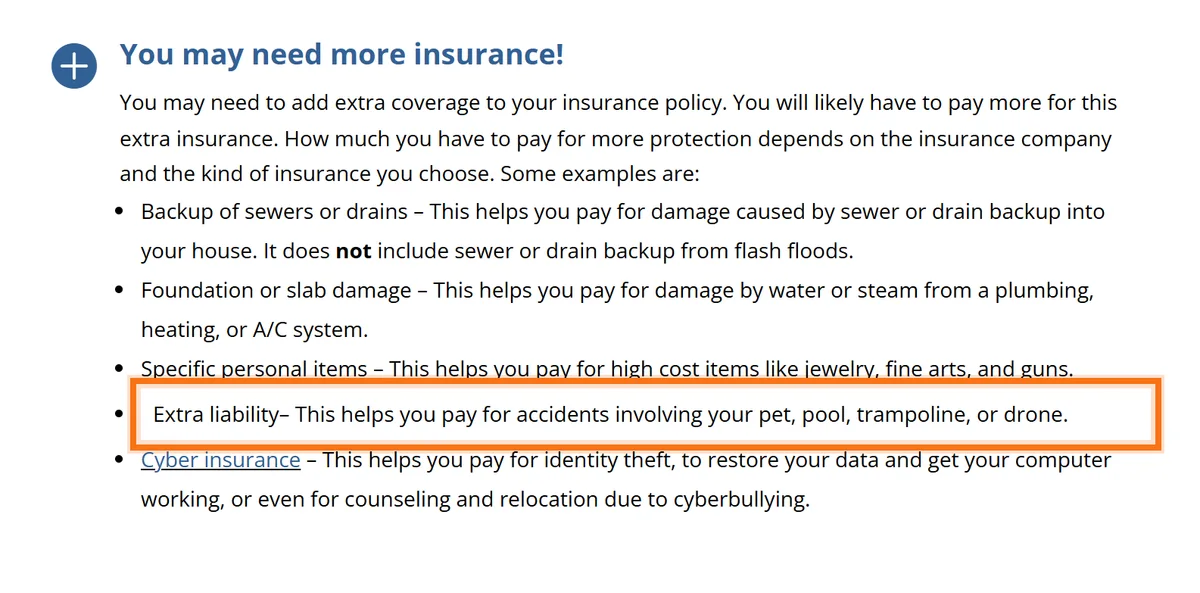
OPIC lists extra liability for a pet, pool, trampoline or drone as coverage you may need to add and pay more for. The landlord insurance guide covers what the underlying policy itself should include; this guide is about what sits above it.
How the umbrella and the landlord policy work together
The two policies have to fit, and the fit is where coverage quietly fails. Neither state office publishes rules for this, because it depends on the insurer's own policy form, so treat each point below as something to confirm in writing.
The liability limit underneath. An umbrella pays after the policy under it stops paying. Ask what liability limit the umbrella expects on the rental's policy, and confirm your landlord policy carries it. If it carries less, or carries no liability coverage at all, the difference is yours.
Every property named. Ask whether each rental has to be listed on the umbrella. If it does, make adding a newly bought rental part of your closing checklist.
Same company or different. Ask whether the umbrella can sit above another company's landlord policy. An agent who sees all of your policies at once catches mismatches that two separate agents miss.
Entity ownership. If a rental is owned by an LLC, ask who the named insured is on each policy and whether a personal umbrella covers a property titled to the entity or a commercial umbrella is needed. The LLC overview explains why the named insured has to match the owner of record.
When a rental owner usually needs one
No rule fits everyone, but the pattern among owners who buy umbrellas is consistent:
- A pool, a trampoline or a hot tub at the rental. These change the probability and the size of injury claims, and a pool in particular should be the first thing you mention to the agent.
- More than one property. Each door is another chance for a claim, so ask whether one umbrella can cover all of them.
- Meaningful personal assets. Savings, investments and other properties are what a judgment above the underlying limit can put at risk. Which assets Texas law protects from a judgment is a question for an attorney.
- Tenants with children or frequent visitors. More people on the property, more exposure.
- Older houses with stairs, decks, uneven walks or systems that are past their prime.
If none of those apply, a single modern house with liability coverage on the landlord policy and documented maintenance may be adequately covered. That is a conversation to have with an agent, not a conclusion to reach from a guide.
A useful way to frame the decision: list what a judgment above the underlying limit could reach, then ask your agent or insurance company for a quote and compare the annual premium with the cost of losing any one of those items. TDI does not publish prices, so the quote is the only real number.
What an umbrella does not do
The name invites misunderstanding. An umbrella is liability coverage only. It does not pay for:
- Damage to your own rental house. That is the property coverage on the dwelling policy.
- Rent you lose after a loss. Ask your agent whether your landlord policy includes that coverage.
- The tenant's belongings. OPIC says renters insurance usually covers the tenant's personal items, which is why many leases require it.
- Whatever the policy excludes. Ask which exclusions matter for rentals: animals, pools, business activity, short-term rentals.
Read the exclusions with the agent before you rely on the policy. An umbrella raises the limit on claims that are covered; it does not turn an excluded claim into a covered one.
Are umbrella policies deductible for real estate investors?
The federal answer starts with the IRS list. Publication 527, Residential Rental Property, lists insurance among the most common rental expenses, and Schedule E (Form 1040) reports it on line 9. Rental expenses are generally deducted in the year you pay them. If you pay a premium for more than one year in advance, Publication 527 says you deduct only the part that applies to each year.
The complication is that a personal umbrella is not only about the rental. TDI describes it as coverage above your home and auto policies for everyone in your household, and insurance on your own home and cars is a personal expense. So the part of an umbrella premium that covers a rental is the part to discuss as a rental expense. How that share is worked out is a question for your CPA, not for a property manager.
Texas has no state income tax, so this is a federal question only. The other deductions on a rental are covered in whether property management fees are tax deductible. This is general information, not tax advice.
Lowering the odds of the claim in the first place
Insurance pays after the injury. The cheaper strategy is fewer injuries, and that comes from the way the property is run.
Require renters insurance in the lease. OPIC says a renters policy usually covers liability claims for accidents caused by the tenant, their property, family or pets, as well as the tenant's belongings. The renters insurance guide explains how to make it a lease requirement and how to verify it.
Fix the things people trip on. Loose railings, rotted deck boards, uneven walkways, poor exterior lighting. These are the items a documented inspection catches and a work order closes.
Respond to repair requests and keep the record. If a claim is ever made, you will want to show what was reported, when, and when it was fixed. A work-order history with dates and photos does that. Our documented inspections and maintenance process exist for the tenant's sake and the house's, and they produce that record as a by-product.
What to look for in an umbrella policy to avoid gaps with landlord coverage
Bring this list and the meeting takes twenty minutes.
- Does each landlord policy include liability coverage at all, what is the limit, and does it meet what the umbrella requires underneath?
- Is every rental listed on the umbrella, including any bought since the last renewal?
- Does the umbrella cover properties owned by an entity, or only properties in my name?
- Does the umbrella follow the underlying exclusions, and which exclusions matter for rentals: animals, pools, business pursuits, short-term rentals?
- Are defense costs inside or outside the limit?
- What underlying limits would lower the umbrella premium, and what would the higher underlying limit cost?
- If I add a property or move one into an LLC, what do I need to tell you and when?
Write the answers down with the policy numbers and keep them with the rest of your rental records. The rental team guide describes how the insurance agent fits with the CPA, the attorney and the manager so that nobody assumes someone else handled it.
Review it once a year, and whenever something changes
Umbrella coverage goes stale quietly. A rental gets a pool. A second property closes. A title moves into an LLC. A tenant brings a large dog the lease did not anticipate. Each one changes the exposure, and none of them trigger a call from the carrier.
Put a yearly review on the calendar, ideally at the same time as the landlord policy renewal, and add a standing rule: any change in what you own or how you own it gets reported to the agent that week. A manager can help by flagging the changes that happen at the property, such as a new pet on the lease or an inspection finding that affects risk.
If you are turning your own home into a rental, tell your insurer before the tenant moves in; the steps are in converting your primary home into a rental. Policy forms differ, and the only answer that counts is the one in your policy, so confirm coverage with a licensed agent. This is general information, not insurance advice.
How Perpetual handles this
Perpetual Property Management is a broker-owned management company, not an insurance agency, so we do not sell or quote insurance. Our office is at 5755 Rufe Snow Dr in North Richland Hills, and we manage homes in Keller, North Richland Hills, Fort Worth and nearby. What we do is run the property in a way that leaves a record.
Tenants report maintenance through their online portal with photos, which creates a documented record of what was reported and when. Every plan includes an annual property inspection. Under The Perpetual Promise, subject to its Guarantee Addendum, you get 360-degree move-in and move-out inspections and photo or video proof of every completed repair over $500. Pets are allowed only at the owner's discretion under our published rental criteria, so the decision about a dog at your rental stays with you.
Which policies you carry, and their limits, are decisions for you and your licensed agent. If you want to see how the inspection and maintenance record works on a house we manage, read the full-service management page or call 682-593-7033.
The takeaway: The landlord policy sets the ceiling, the umbrella raises it, and a well-run property with documented maintenance is what keeps you from ever needing either. Confirm the liability layer under the umbrella first.
Questions owners ask
Does a landlord need umbrella insurance?
Not every landlord, but many should consider it. The liability limit on the policy that covers the rental is the ceiling on what insurance pays for an injury claim, and a serious claim can exceed it. Owners with pools, multiple properties, older houses or meaningful personal assets are the most common buyers. A licensed agent can assess your exposure and quote a landlord umbrella insurance policy.
Does umbrella insurance cover rental properties?
It can, but confirm it. The Texas Department of Insurance describes a personal umbrella as extra liability coverage above home and auto policies, and its page does not address rentals. Ask your agent whether each rental must be listed, what liability limit the rental's own policy must carry, and whether a property owned by an LLC needs a commercial umbrella instead.
What is the difference between landlord insurance and an umbrella policy?
Landlord insurance covers the house itself and, if you add it, liability up to a limit. A landlord insurance umbrella policy covers liability only, above that limit, after the landlord policy has stopped paying. The umbrella does not pay for damage to your property or for the tenant's belongings.
How much umbrella coverage should a landlord carry?
There is no single right number. The Texas Department of Insurance says umbrella coverage usually starts around $300,000 and pays up to at least $1 million. Owners generally size it to the personal assets a judgment could reach and to the risks at the property, such as a pool or several doors. An agent can quote the options against your underlying policies.
Does the tenant's renters insurance protect the landlord?
Partly. The Texas Office of Public Insurance Counsel says renters insurance usually covers the tenant's belongings and liability claims for accidents caused by the tenant, their property, family or pets. It does not pay to fix the building, and it does not replace your own landlord and umbrella coverage.
Are umbrella policies deductible for real estate investors?
Insurance is on the IRS list of common rental expenses in Publication 527 and is reported on line 9 of Schedule E, so the part of a premium that covers a rental is generally deductible in the year paid. A personal umbrella also covers your own home, cars and household, which are personal, so ask your CPA how much of the premium belongs to the rentals. This is general information, not tax advice.
Can I get an umbrella policy for renters, as a tenant?
Ask your agent. The Texas Department of Insurance describes an umbrella policy as extra liability insurance that kicks in after your auto or home insurance stops paying, and it covers everyone in the household. A tenant's first layer is renters insurance, which usually includes liability coverage. Whether an umbrella can sit above a renters policy depends on the insurance company.
If I switch my home to a rental, can I convert my homeowners policy to landlord insurance and add an umbrella?
Talk to your insurer before the tenant moves in. A homeowners policy and a dwelling policy cover different things: per the Texas Office of Public Insurance Counsel, a dwelling policy usually leaves out liability claims and personal items. Ask for liability coverage on the new landlord policy, then ask whether your umbrella will cover the house once it is a rental, even for a 10-month lease.
Property management in Keller, North Richland Hills and Fort Worth. How full-service management works in Tarrant County →