Key takeaways
- Texas law does not require renters insurance, but a landlord may make it a lease condition.
- The tenant's liability coverage can pay for damage the tenant negligently causes to your house; the policy does not cover the building itself.
- The Texas Department of Insurance puts the average Texas renters policy at about $20 a month.
- List the owner or manager as an interested party so the insurer tells you about a cancellation.
- Most tenant policies exclude flood, which the Texas flood notice in every lease (Property Code 92.0135) now tells tenants.
Should you require renters insurance on a rental in Fort Worth, Keller or North Richland Hills? Yes. A tenant's renters policy covers their belongings and, more important to you, their liability for damage they cause to others, including to your house. That keeps the tenant's mistakes off your landlord policy and your deductible. Texas law does not require renters insurance, so the requirement has to be in your lease, with proof collected before keys.
A tenant leaves a pan on the stove, the kitchen burns, and the smoke damage runs through the house. Who pays? If the tenant has renters insurance, their liability coverage can pay for the damage they caused. If they do not, the claim goes on your policy, you pay the deductible, your premium may go up, and you try to collect the balance from a tenant who just lost everything they own.
That is the whole argument for requiring renters insurance, and it is why we recommend making it a lease condition rather than a suggestion. This guide covers what the policy does, what it does not do, how to write the requirement, how to verify it and what to do when it lapses.
What a renters policy actually covers
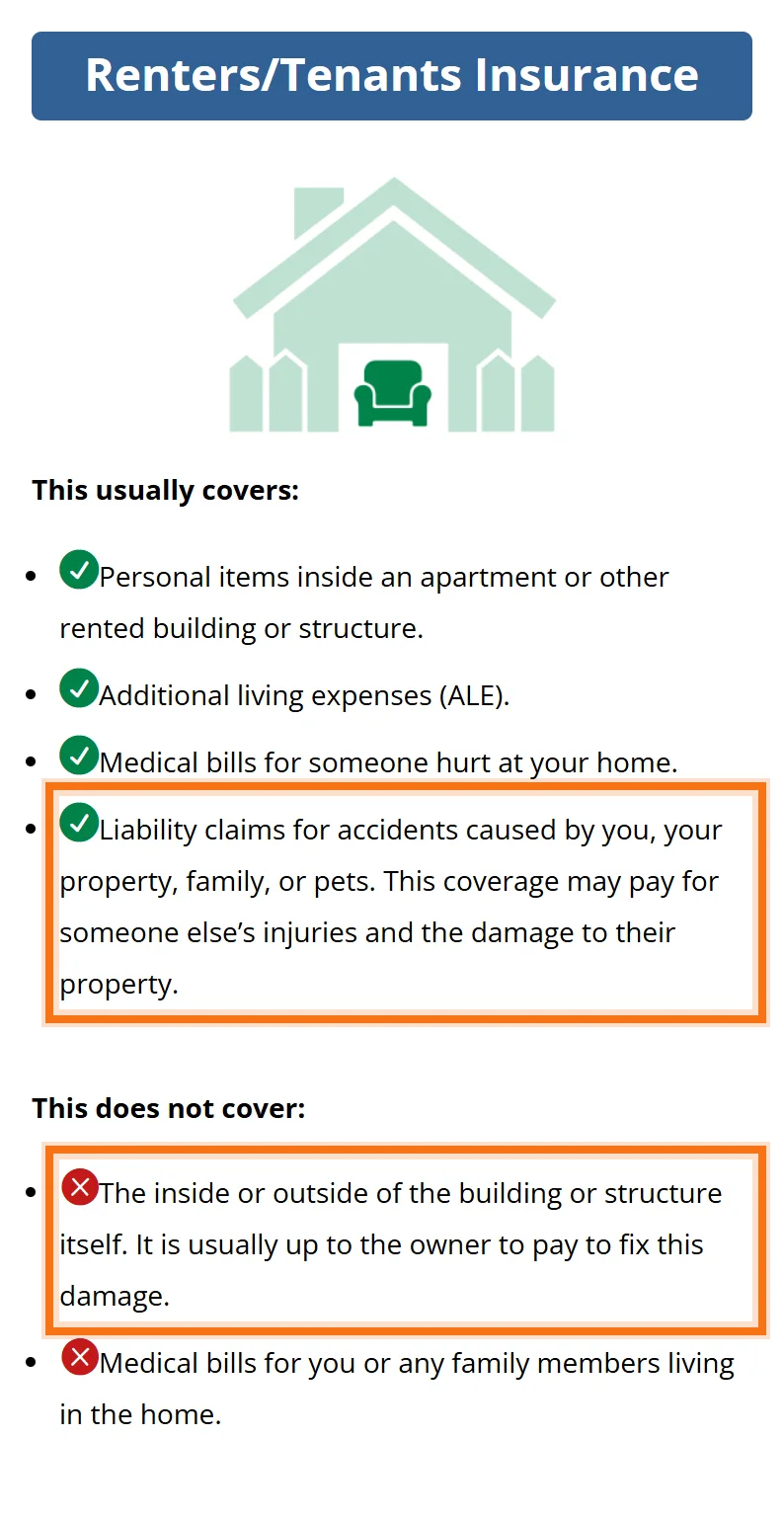
A standard renters policy has three parts. Personal property covers the tenant's belongings against fire, theft, water damage from a burst pipe and similar perils. Liability covers damage or injury the tenant causes to others, including damage to your home, up to the policy limit. Loss of use pays for a hotel or temporary rental if the home becomes uninhabitable after a covered loss.
The liability part is the one that matters most to the owner. It is what responds when the tenant's negligence damages the house, when the tenant's dog bites a visitor, or when a guest is hurt because the tenant left something on the stairs. The loss-of-use part matters too, in a quieter way: a tenant with somewhere to stay after a fire is far less likely to turn on the owner.
The policy is written for the tenant's household, so it covers the named tenants and usually their relatives in the home. Roommates who are not related typically need their own policies, which is one more reason every adult should be a signing tenant.
How the tenant's policy keeps claims off yours
Your landlord policy covers the structure and your liability as the owner. It is not meant to be the first stop for damage a tenant causes, and every claim on it has a cost: the deductible, the premium at renewal, and over time the insurability of the home. Insurers notice a property with repeated claims.
When a tenant has liability coverage, the sequence changes. The tenant's insurer pays for the tenant's negligence up to the limit. If your insurer does pay first, it can pursue the tenant's insurer to recover, which is far more productive than pursuing a tenant personally. Either way the loss lands where it belongs.
The owner's own coverage still has to be right. A homeowner policy on a rented house is a common and expensive gap, explained in landlord insurance vs homeowners insurance. Renters insurance is a second layer, not a substitute.
Which policy usually answers first, by type of loss
Here is where common losses in a rented house usually land when the tenant carries renters insurance and the owner carries a landlord policy. Policies differ, so treat this as the usual pattern, not a promise of coverage:
| What happens | Usually answers first | Why |
|---|---|---|
| Tenant's cooking fire damages the kitchen | Tenant's renters policy, liability part | Damage the tenant negligently caused to someone else's property |
| Hail damages the roof | Owner's landlord policy | Renters insurance does not cover the building |
| Tenant's furniture is stolen | Tenant's renters policy, personal property part | The landlord policy never covers the tenant's belongings |
| Guest trips on a broken step the owner knew about | Owner's landlord policy, liability | A claim about the property's condition is against the owner |
| Creek flooding ruins the floors and the tenant's things | Separate flood policies, if any | Most renters and landlord policies exclude flood |
| Carpet worn or stained over the lease | Neither; security deposit or owner | Wear and gradual damage are not sudden losses |
How to read this table: the tenant's policy matters most in the first and third rows, where the tenant's own actions or belongings are involved. Everything about the building and its condition stays with your landlord policy, which is why renters insurance is a second layer, not a substitute.
What renters insurance does not replace
Owners sometimes assume that a tenant's policy means they can carry less themselves. It does not work that way.
- It does not cover the structure. A roof lost to hail, a foundation leak or a storm-damaged fence is the owner's policy, not the tenant's.
- It does not cover the owner's liability as the owner. A guest hurt because of a defective step is a claim against you, and the tenant's policy may not respond.
- It does not replace the security deposit. Wear beyond normal, unpaid rent and cleaning are deposit matters; insurance covers sudden, accidental losses.
- It does not cover floods. Since January 1, 2022, Property Code 92.0135 has required Texas landlords, apart from leases under 30 days, to give a signed flood notice that tells the tenant most tenant insurance policies do not cover flood loss. Flood is a separate policy for everyone.
For an owner with more than one rental or significant assets, a personal umbrella policy sits on top of all of this. The reasoning is in umbrella insurance for landlords.
Lease language that makes the requirement enforceable
A requirement that lives in a conversation at signing is not a requirement. The lease, or a separate insurance addendum, should state:
- The tenant must carry a renters policy with a minimum liability limit, in force for the entire term and any renewal or holdover.
- The owner, or the management company on the owner's behalf, is to be listed as an interested party or additional interest so the insurer notifies you of cancellation.
- Proof is due before keys are released, and again at each renewal or on request.
- Failure to maintain coverage is a lease default, with any lease-specified consequence stated plainly.
The minimum liability limit is a judgment call made with your insurance agent; it should be high enough to cover a serious kitchen fire or water loss. Consistency matters: the same requirement for every tenant, in every lease. The full set of addenda worth carrying is covered in lease addenda for Texas landlords, and the signing process under leasing.
Verifying coverage at move-in without slowing the move-in
The verification is a declarations page or a certificate showing the insured names, the property address, the liability limit, the effective dates and the interested party. Three details get missed: the address on the policy is the old apartment, the policy is in one roommate's name only, or the effective date is after the lease start.
Build it into the move-in sequence. The lease is signed, the deposit and first rent are paid, the certificate is uploaded to the portal, and then keys are released. In that order. Once keys are out, the leverage is gone and the follow-up is a chore for months.
Tenants who arrive without a policy can usually buy one online in minutes. The Texas Department of Insurance puts the average Texas renters policy at about $20 a month, which is a useful number to quote when a tenant objects. The move-in sequence as a whole, with everything else that must be in the file before keys, is laid out in the move-in process.
When the policy lapses mid-lease
Policies lapse because the tenant changed cards, canceled to save money, or let an annual policy expire without noticing. If you are listed as an interested party, the insurer sends you the cancellation notice, which is the entire reason for that listing. Without it, you find out after the loss.
The response is a written notice through the official channel citing the lease clause, a short deadline to provide proof of a reinstated or new policy, and the consequence if not. Most tenants fix it within days. Some leases allow the owner to place a policy and bill the tenant; whether that is available and advisable depends on the lease and the program, so check with your manager or agent.
Treat a lapse as a lease compliance item, logged like any other, and reconfirm coverage at every renewal. Renewal is the natural checkpoint, and our lease renewal conversations start 60 to 90 days before the lease ends, which leaves time to collect a current declarations page.
Pets, dogs and the liability conversation
The most likely liability claim in a rental home with a dog is a bite. A tenant's renters policy may cover dog liability, exclude certain breeds, or exclude animal liability altogether, and tenants rarely know which. When you allow a pet, ask the tenant to confirm in writing that their policy covers it, and keep that confirmation with the pet addendum.
Your own landlord policy may also have animal restrictions, and those should be the basis for any breed or size limits in your pet policy rather than guesswork. The screening side, including deposits and pet rent, is covered in pets in your rental. Assistance animals are a separate category under fair housing law and cannot be refused or charged for as pets, but the tenant's liability coverage question still applies and can still be asked.
The objections tenants raise and the answers that work
"I don't own anything worth insuring." The requirement is about liability, not belongings. A kitchen fire does not care how much furniture they have.
"The owner's insurance covers the house." It covers the structure for the owner. It does not cover the tenant's belongings, their hotel after a fire, or the damage they cause.
"It's too expensive." The Texas Department of Insurance puts the average Texas renters policy at about $20 a month, and the lease requires it for every tenant equally. Point them to an online quote and move on.
Applicants who refuse outright are telling you something about how they will treat other lease terms. The requirement should appear in the listing and the application so nobody is surprised at signing. A manager who has had this conversation a thousand times makes it routine, which is part of the value of tenant screening and leasing being handled by the same team.
What to do after a loss when both policies exist
When something happens, the order of operations matters. Make the home safe first, document everything with photos and a written account from the tenant, and notify your own insurer promptly as your policy requires, even if you expect the tenant's policy to pay. Ask the tenant for their claim number and adjuster contact, and provide yours to them.
Let the insurers sort out who pays; that is what the interested-party listing and the two claim files are for. Keep the lease running: rent is still due unless the home is uninhabitable and the lease or Texas law says otherwise, and the deposit is still held until move-out. Water events in particular tend to grow if the first week is handled slowly, and the specifics for North Texas homes are in water leaks and mold in Texas rentals.
This is general information, not legal or insurance advice; confirm coverage questions with your insurance agent and lease questions with an attorney.
The takeaway: Require renters insurance in every lease, collect the certificate before keys, list yourself as an interested party, and reconfirm it at every renewal so the tenant's policy, not yours, answers for the tenant's mistakes.
Questions owners ask
Can a landlord require renters insurance in Texas?
Yes. Texas law does not require tenants to carry renters insurance, and the Texas Department of Insurance notes that some landlords require it. Put the requirement in the lease or an addendum, apply it to every tenant equally, and collect proof before keys are released.
How much renters insurance should a landlord require?
Set a minimum liability limit with your insurance agent that would cover a serious fire or water loss in your home. The personal property amount is the tenant's choice. Whatever limit you choose, apply it consistently across all leases.
What does it mean to list the landlord as an interested party?
The insurer adds the owner or manager to the policy as a party to be notified of cancellation or non-renewal. It does not give the owner coverage under the tenant's policy. It simply means you learn about a lapse when it happens instead of after a loss.
What happens if a tenant lets their renters insurance lapse?
It is a lease default under a properly written clause. Send a written notice with a short deadline to provide proof of reinstated coverage and note the consequence in the lease. Most tenants fix it within days once reminded.
Does renters insurance cover damage the tenant causes to the house?
The liability portion generally covers damage the tenant negligently causes to the home, up to the policy limit, such as a kitchen fire or an overflowed tub. It does not cover ordinary wear or deliberate damage, which remain deposit and lease matters.
Should I require my tenants to have renters insurance?
Yes, as a lease condition rather than a suggestion. The tenant's liability coverage can pay first when the tenant causes a fire, a flood from an overflowing tub or an injury, which keeps the claim off your landlord policy. The policy also covers the tenant's belongings and temporary housing after a covered loss, which removes the pressure to blame the owner. Put the requirement in the lease with a minimum liability limit, collect the certificate before keys are released, list the owner or manager as an interested party, and reconfirm it at every renewal.
How much does renters insurance cost in Texas?
The Texas Department of Insurance puts the average renters policy in Texas at about $20 a month. The price depends on the coverage amounts, the deductible and the company, and a tenant can usually buy a policy online the same day, so cost is rarely a good reason to waive the requirement.
Related services
Property management in Keller, North Richland Hills and Fort Worth. How full-service management works in Tarrant County →