
Key takeaways
- The manager works the house; the policyholder works the policy. Filing, settlement and signing stay with the owner.
- The Texas Department of Insurance (TDI) says to make only temporary repairs before the insurer sees the damage, and to photograph everything first.
- TDI lists the insurer's deadlines: 15 business days to accept or deny once it has all the information, then 5 business days to pay.
- If you have a mortgage, the repair check is made out to you and the lender, and the money is usually released as the work is done.
- Texas Property Code 92.054 decides what happens to the lease and the rent when a casualty makes the home unusable.
Will a property manager coordinate with your insurer during a claim? Yes, and on a rental in Fort Worth, Keller or North Richland Hills a good manager does most of the work at the house: stopping the damage, documenting it, getting the adjuster in and overseeing the repair. What the manager cannot do is be you. The policy is yours, the claim is filed in your name, the deductible is your decision and the check is written to you, often with your lender's name beside it.
This guide follows a claim in the order it happens, with the Texas deadlines and rules at each step.
An insurance claim on a rental: who does what at each step
Here is each step of a property damage claim on a rental house, what the manager does at the property and what stays with the owner:
| Step | Manager, at the house | Owner, as policyholder |
|---|---|---|
| Stop the damage | Sends a vendor for temporary repairs: water off, roof tarped, drying started | Approves anything above the spending limit you set in advance |
| Document the loss | Dated photos and video before cleanup; keeps damaged parts and every receipt | Keeps a copy with the policy |
| Report the claim | Gives you the facts and a contractor estimate | Decides whether to file and calls the insurer |
| Adjuster inspection | Arranges access with the tenant and has the records ready | Names the manager as the contact for the property |
| Settlement | Compares the adjuster's estimate with contractor bids, line by line | Accepts the offer, disputes it or asks for an appraisal |
| Repair | Schedules the work around the tenant, checks it, files invoices and photos | Signs the repair contract and pays the deductible |
| Payment | Supplies the invoices and completion photos the insurer and lender ask for | Endorses the check and deals with the lender |
How to read this table: the middle column is work at the property that a manager can take off your hands, and the right column is the policy side that only the named insured can do.
Property claims management on a rental: the manager works the house, you own the policy
A claim has two halves. One is the house: stopping the damage, documenting it, keeping the tenant informed, getting bids and getting the work done right. The other is the policy: notifying the insurer, deciding whether to claim at all and accepting or disputing the settlement.
A manager can own the first half completely. On the second half the manager is your support and your record-keeper, not your representative. The insurer deals with the named insured, and that is you, though you can tell the insurer that the manager may arrange access and answer questions about the property.
The first 48 hours: stop the loss with temporary repairs and document everything
Two instructions from TDI shape the first two days, and they pull in opposite directions. Protect the property: the agency warns that an insurer may deny a claim if you do not. But make only temporary repairs: the insurer might also deny the claim if permanent repairs are made before it sees the damage. A burst supply line at 2 a.m. needs a vendor that night who understands the difference.
- Temporary repairs first: water shut off at the main, roof tarped, broken window boarded, standing water removed and drying started. TDI notes that mold can start growing within a day after a leak.
- Photos and video before cleanup: every affected room, close-ups of the source, wide shots showing the extent.
- Keep the evidence: the failed fitting, the section of pipe, the shingles. TDI says not to throw away damaged items until the adjuster has seen them.
- Keep every receipt, including materials bought for temporary repairs.
- A written timeline: who reported it, when the vendor arrived, what was done.
A manager with a 24-hour emergency process does this unasked; what happens when there is a water leak in the middle of the night walks through the most common case.
Filing: the manager brings the facts, you make the call
Once the house is secured, the manager calls you with the facts: what happened, what has been done and the cost so far. Then the decision is yours, because filing is not automatic.
Compare the repair estimate with your deductible before you call. The Office of Public Insurance Counsel (OPIC) gives this example of a percentage deductible: a home insured for $200,000 takes $7,000 of hail damage. With a 1% deductible you pay $2,000 and the insurer pays $5,000. With a 3% deductible you pay $6,000 and the insurer pays $1,000. The percentage applies to the amount of insurance on the home, not to the size of the claim. A quick contractor estimate from the manager makes that comparison possible.
If you file, do not wait. TDI says to tell your company as soon as possible, that most companies have deadlines, and that hidden water damage usually must be reported within days after you first see it. File it yourself, name the manager as the contact for the property, and ask your agent how a claim affects your premium. The guide to landlord insurance explains why a homeowner's policy on a rented house is a problem to find before this moment.
The adjuster inspection: access, the walkthrough and your records
The insurer sends an adjuster to look at the damage and estimate the cost to repair or replace it, and the insurer bases its payment on that estimate. TDI's advice is to try to be there, with your contractor.
On a rental the tenant controls the door, so decide in advance who attends. What a manager contributes:
- Arranging the appointment with the tenant under the lease's access terms.
- Showing every affected area, including the ones that have dried out.
- Handing over the move-in condition report and the most recent inspection report, which show the damage is new.
- Asking for a written copy of the adjuster's estimate so contractor bids can be compared with it.
A dated photo of an undamaged ceiling from an earlier inspection ends the argument about whether the stain was there before the storm. If the damage turns out to be worse than the adjuster first thought, TDI says you or your contractor can talk to the adjuster about raising the estimate.
How long the insurer has: the Texas deadlines
These are the deadlines TDI's home insurance guide lists for an insurance company after you file a claim:
| What the insurer must do | Deadline |
|---|---|
| Tell you it received your claim | Within 15 days |
| Accept or deny the claim | Within 15 business days after it has all the information it needs from you |
| Send the check | Within 5 business days after it agrees to pay |
| If it needs more time to decide | It can take 45 days, and must tell you the reason for the delay |
How to read this table: the second clock starts only when the insurer has everything it asked for, so the fastest way to a decision is a complete file on day one. TDI adds that deadlines may be longer after a major disaster.
The tenant during a claim: what Texas Property Code 92.054 says about rent
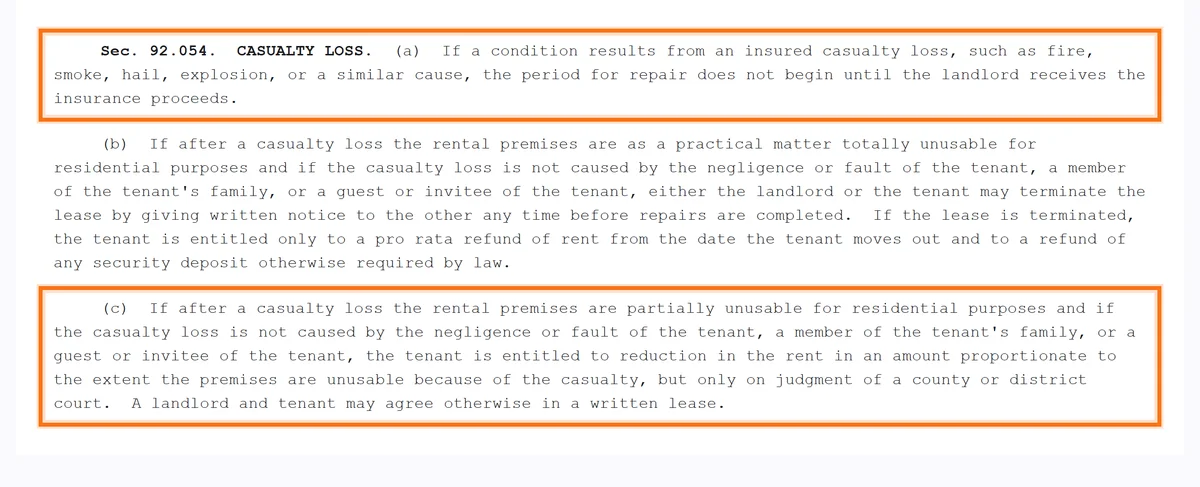
The tenant did not cause the storm and still has a lease. Three parts of Texas Property Code 92.054 decide what happens next:
- The repair clock. When a condition results from an insured casualty loss such as fire, smoke, hail or explosion, the period for repair does not begin until the landlord receives the insurance proceeds.
- Totally unusable. If the home is as a practical matter totally unusable and the tenant, the tenant's family or guests did not cause the loss, either the landlord or the tenant may end the lease by written notice any time before repairs are completed. The tenant then gets a pro rata refund of rent from the move-out date and the deposit refund the law otherwise requires.
- Partially unusable. The tenant is entitled to a rent reduction in proportion to the unusable part, but only on judgment of a county or district court, unless the written lease provides otherwise.
So have the manager read the lease's casualty clause before anyone promises the tenant a rent credit or a move-out date.
Two insurance points belong here. OPIC explains that renters insurance usually covers the tenant's personal items and additional living expenses, one reason to require renters insurance. And ask your agent whether your own policy pays for rent you lose while the home cannot be lived in; if it does, the manager's rent ledger is the proof. This is general information, not legal or insurance advice.
Estimates, scope and the repair itself
The adjuster's estimate and the contractor's bid rarely match on the first pass. The manager's job is to get bids, compare them with the adjuster's estimate line by line and tell you where the gaps are, so you can take them to the adjuster with an itemized bid and photos.
OPIC's checklist for this stage is short: get a written estimate, hire a qualified and insured contractor, review any contract before signing, make sure the repairs are completed and keep records of every communication.
Once the scope is agreed, the manager runs the repair like any other job: scheduled with the tenant, checked during and after, invoiced with photos. You sign the contract, because the contractor's agreement is with the owner. Maintenance coordination should work the same way on a storm repair as on a water heater.
The money: the deductible, two checks and the lender
TDI describes how the money moves, and it is slower than owners expect:
- The lender is on the check. If you owe money on the home, the insurer makes the repair check out to you and your mortgage company. You endorse it and send it to the mortgage company, which in most cases deposits it and releases money as the work is done.
- The lender has a deadline too. It may ask for the list of work, cost estimates, who is doing the work and timelines. After it gets that information, it must release all or some of the money within 10 days.
- Replacement cost usually means two checks. The first is the estimated repair cost minus depreciation and your deductible. The amount held back for depreciation is paid after the insurer gets the bill for the finished job, and repairs usually must be completed within a set time.
- The deductible is yours. OPIC warns that it is illegal for a contractor to offer to waive it without the insurer's consent, and that the insurer may ask for proof you paid it.
Each step runs on paperwork the manager produces: the scope, completion photos and the final invoice.
If you disagree with the insurer, and what to settle in advance
If you disagree with the adjuster's estimate or the amount offered, tell the insurer why. If that does not settle it, TDI lists the next options:
- Appraisal, for disputes about the amount, not about whether the policy covers the loss. Each side hires an appraiser, the two choose an umpire whose decision is binding, and you pay your appraiser and half of the umpire's expenses.
- A public insurance adjuster, who works for you for a fee and must hold a TDI license. Public adjusters cannot give legal advice or take part in the repair.
- A written complaint to TDI, or a lawsuit. A claim under $20,000 can go to justice court.
None of these is a manager's decision. Before a loss, settle the practical points with your manager in writing: who attends the adjuster's inspection, what the manager may spend on temporary repairs without calling you, and who pays the contractor. The guide to hail and roof damage covers the most common North Texas claim.
How Perpetual handles this
Perpetual Property Management is broker-owned, with our office at 5755 Rufe Snow Dr in North Richland Hills, and we manage homes in Keller, North Richland Hills, Fort Worth and nearby. What our site commits to that matters in a claim:
- 24/7 emergency response on every plan. Active leaks, electrical hazards, no heat in winter and no AC in extreme heat follow a 24/7 process.
- A spending limit you set. Repairs under it go ahead without waiting; anything larger comes to you with a description, photos and a recommendation.
- A "before" record. Every move-in and move-out gets a 360-degree condition inspection, and every plan includes an annual property inspection, with photo reports in your owner portal. See inspections and reporting.
- Proof of the repair. Every completed repair over $500 gets photo or video proof in your portal, next to the original vendor invoice. The 360-degree inspections and the repair proof are part of our written guarantees, subject to the Guarantee Addendum.
Filing, settlement and signing stay with you as the policyholder. Our site does not describe claim handling, so whether we attend the adjuster's inspection, whether the coordination charge on our price sheet applies to an insured repair, any other fee for claim work and how repair money is paid to the contractor are confirmed in writing before you sign.
If you want to talk through how a claim would run on your rental, call 682-593-7033.
The takeaway: A manager runs the house during a claim, from temporary repairs and documentation to adjuster access and the finished repair, while filing, settlement and signing stay with you as the policyholder.
Questions owners ask
Can a property manager coordinate with my insurer during a property damage claim?
Yes. A manager handles the property side: temporary repairs, photos and video, tenant communication, access for the adjuster, contractor bids and oversight of the repair. You remain the policyholder, so deciding whether to claim, filing, signing contracts and receiving the check stay with you.
Should I file an insurance claim for every repair on my rental?
No. Get a contractor estimate and compare it with your deductible first. A percentage deductible is based on the insured value of the home, not the size of the claim, so a mid-sized loss can fall mostly or entirely on you. Ask your agent how a claim affects your premium, and make the decision yourself.
Does my tenant still pay rent while the house is being repaired?
It depends on how usable the house is and what the lease says. Under Texas Property Code 92.054, if a casualty the tenant did not cause leaves the home totally unusable, either side may end the lease by written notice before repairs are completed, with a pro rata rent refund. If the home is partly unusable, a proportionate rent reduction takes a court judgment unless the written lease provides otherwise. This is general information, not legal advice.
Who pays the contractor after an insurance claim on a rental?
The owner, from the claim payment and the deductible. If the home has a mortgage, TDI explains that the repair check is made out to you and the mortgage company, which usually releases the money as the work is done, and must release all or some of it within 10 days after it gets the information it asks for. Agree before work starts who pays the contractor and from which account.
What records make an insurance claim on a rental go faster?
A move-in condition report and recent inspection photos that show the damage is new, dated photos and video of the loss before cleanup, receipts for temporary repairs, a written timeline, and the rent ledger if your policy covers lost rent.
How long does an insurance company have to pay a claim in Texas?
TDI's home insurance guide lists the deadlines: the insurer must tell you it received the claim within 15 days, accept or deny it within 15 business days after it has all the information it needs, and send the check within 5 business days after it agrees to pay. An insurer that needs more time can take 45 days to decide and must tell you why.
Can a contractor waive my insurance deductible in Texas?
No. OPIC states that the deductible is part of your insurance agreement and that it is illegal for a contractor to offer to waive it without your insurer's consent. The insurer may also ask for proof that you paid it before releasing the rest of a replacement cost payment.
Related services
Property management in Keller, North Richland Hills and Fort Worth. How full-service management works in Tarrant County →