Key takeaways
- Authority comes first. A lease signed by a family member who has no legal power to sign it is the most expensive mistake on this list.
- A Texas statutory durable power of attorney that grants real property powers lets the agent lease the home and manage it (Estates Code 752.102).
- A power of attorney ends when the parent dies (Estates Code 751.131). After that, authority moves to the executor or the heirs, not the former agent.
- The homestead exemption depends on the owner living in the home. Texas Tax Code 11.13(l) protects an owner who moved to a care facility, so ask the appraisal district before you lease.
- Rent from a living parent's house is the parent's money. Among siblings who own the house, put the split and the decision rules in writing.
To rent out a parent's home in Fort Worth, Keller or North Richland Hills, settle one question before anything else: who has the legal right to sign the lease. It is the parent, an agent under a durable power of attorney that covers real property, a trustee, a court-appointed guardian, or the executor once an estate is opened. Then come the belongings, the condition of the house, the property tax exemption and the family's written agreement on money.
The leasing part is straightforward. The family part, who decides, whose furniture it is, who gets the rent and who drives over when the tenant calls, is where it comes apart. This guide takes both in the order that works.
Who can sign the lease on a parent's Texas home: six situations
This table shows who has authority to lease a parent's home in each common situation, and the paper a property manager will ask to see:
| Situation | Who signs the lease | What a manager asks for | Check first |
|---|---|---|---|
| Parent is living and able to manage their affairs | The parent | The parent's signature on the management agreement | Nothing else is needed, although a power of attorney signed now saves trouble later |
| Parent is living and signed a durable power of attorney | The agent named in it, signing as agent for the parent | A copy of the power of attorney | That it is durable and grants real property powers (Estates Code 751.0021, 752.102) |
| Parent can no longer manage their affairs and never signed one | A guardian of the estate appointed by a court | The court papers showing the appointment | Talk to an elder-law or probate attorney; this takes a court case |
| The home is held in a trust | The trustee, signing as trustee | The pages of the trust that name the trustee and the trustee's powers | What the trust says about leasing |
| Parent has died and an estate is open | The executor or administrator the court appointed | The court letters naming that person | Ask the probate attorney whether court approval is needed for a lease |
| Title has already passed to several children | Every co-owner, or one person the others authorize in writing | Each owner's signature, or the written authority | The deed records, so nobody with a share is left out |
How to read this table: find your row and gather the document in the third column before you call anyone about rent. If you sit between two rows, for example a parent whose capacity is in question, treat it as the harder row and ask an attorney. This is general information, not legal advice.
Who can legally sign the lease
Before any family conversation about rent or tenants, answer this one: who has the legal right to lease the property? The answer depends on the situation.
- Parent is living and able to decide. The parent signs, or signs a power of attorney naming a child as agent. A manager will ask for a copy.
- Parent is living but can no longer manage their affairs. A durable power of attorney signed earlier governs. Without one, a court-appointed guardian is usually the only route, and that is an attorney conversation.
- The home is held in a trust. The trustee has the authority the trust document gives. The lease and the management agreement are signed by the trustee as trustee.
- Parent has passed. Authority sits with the executor or administrator once a court has appointed one. If title has already passed to several children, the lease should be signed by, or on behalf of, all of them.
Can you rent out a parent's house with a power of attorney? In Texas, usually yes, and the statute is specific. A power of attorney is "durable" only if it contains words such as "This power of attorney is not affected by subsequent disability or incapacity of the principal" (Estates Code 751.0021). If it is the Texas statutory form and grants authority over real property transactions, Estates Code 752.102 lets the agent lease the property and perform any act of management, including hiring help, making repairs and insuring the home.
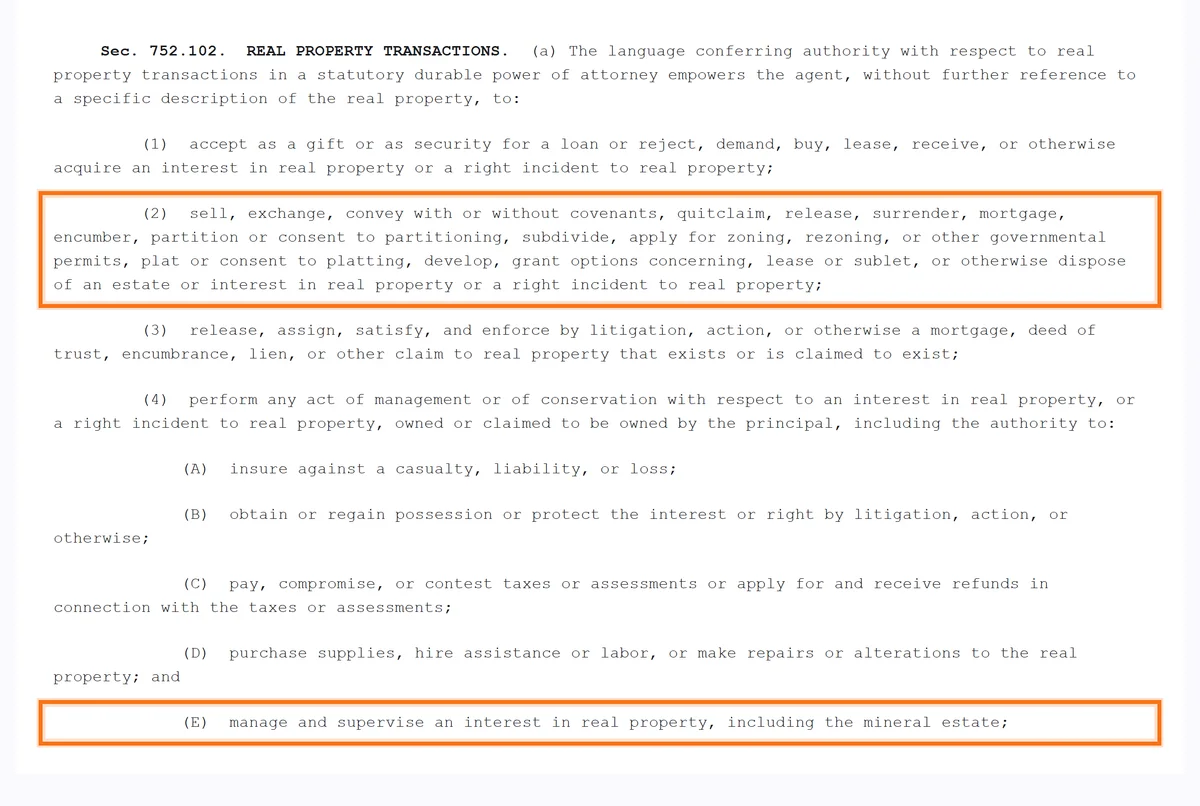
Three limits matter. A power of attorney written by a lawyer may grant more or less than the statutory form, so read the real property section of the actual document. The agent signs as agent for the parent, never as the owner. And a power of attorney ends when the parent dies, or when a permanent guardian of the estate is appointed (Estates Code 751.131). A child who keeps signing as agent after the funeral has no authority.
Getting this wrong means a lease that may not be enforceable and a tenant who can later question who their landlord is. Settle it first. If the question is inheritance and not a living parent, inherited house: rent or sell covers the estate side in more depth. This is general information, not legal advice.
One family member speaks for the house
Three siblings on a group text is not a management structure. Pick one person to be the single point of contact for the manager, the tenant and the vendors, and write it down. That person does not get to make every decision alone. They are the one who carries decisions to the others and brings answers back.
How to make it fair:
- Set a dollar limit under which the contact person, or the manager, acts without asking. Above it, the family decides.
- Agree how the family decides: majority, unanimous, or the person with the power of attorney after hearing everyone.
- Put a response window on decisions, such as three days, so a repair or a renewal is not stuck waiting for someone's reply.
- Rotate the role annually if that helps, but never share it mid-lease.
The tenant should know exactly one name and one number. That is usually the manager. The family's internal arrangement is invisible to the tenant, which is how it should be.
What to do with forty years of belongings
This is the step families underestimate. A house full of a parent's things is not a rental until it is empty, and emptying it is emotional, slow and prone to disagreements over objects that have no cash value and enormous personal value.
What works: set a date by which the house will be clear, and work backward. Walk the house together once, with a list, and let each person name what they want. Where two people want the same thing, decide by a method you agree on in advance, such as taking turns or drawing lots, rather than arguing in the room. Photograph everything of sentimental value before it leaves, so the record exists regardless of who keeps the object.
Then separate the rest into keep for the rental, sell, donate and dispose. An estate sale company or a clean-out service costs money but removes weeks of weekends. Nothing of the parent's stays in the rental, including the garage and the attic. A tenant should never be living around a family's unresolved decisions.
What condition it needs, honestly
A parent's home is often well kept and quietly out of date. Deferred items pile up over decades: the water heater that still works but is past its life, the original windows, the carpet that was fine for one careful occupant, a roof that was patched after the last hail storm instead of replaced.
Walk it the way a tenant will, then the way an inspector will. The tenant sees paint, flooring, kitchen and bath, and smell. The inspector sees the electrical panel, the plumbing supply lines, the HVAC age, the attic insulation and the foundation. A rental needs both to pass. Grab bars, ramps and medical equipment that were added for the parent should come out unless they are permanent and tidy.
If the home sits in Fort Worth, check the city's rental registration page before listing, and in any city ask the HOA, if there is one, whether it has leasing rules. Decide the budget with the whole family before the work starts, because this is where the money disagreements usually begin. One sibling wants it rented as-is next month; another wants it renovated. The honest middle is a make-ready that brings it to clean, safe and neutral, and leaves bigger upgrades for a later turnover once rent is coming in. The full scope is in the make-ready guide.
Put the money and the rules in writing
If the parent is living, the rent is the parent's money, and the written agreement is simple: it goes to the parent's account or to whoever manages their finances, and expenses come out first. If the home belongs to several siblings, write a short agreement that covers:
- How rent after expenses is split, and when it is distributed.
- Who funds repairs beyond the reserve, and in what shares.
- Who is credited for unpaid work, such as the sibling who does the clean-out or the one who meets contractors, and whether that is paid, credited or simply thanked.
- What happens if one sibling wants out: a right of first refusal for the others, a valuation method, a timeline.
- When the family will revisit renting versus selling, such as at each lease end.
An attorney can turn this into an enforceable co-ownership agreement. Even an informal signed page prevents most of the misunderstandings, because the disagreement is usually about what was said, not what was meant. Statements from a manager, shared with every sibling, keep the money transparent, and property management for co-owned rentals covers how several owners work with one manager. The flow is explained in owner reserves and disbursements.
Insurance, taxes and the homestead exemption
Start with insurance. The parent's homeowners policy was written for a home the parent lives in. Call the carrier before a tenant moves in, say the house will be rented, and ask which policy fits a tenant-occupied home. If the parent moved to assisted living and the house sat empty for a while, ask the carrier in the same call whether the vacancy affected coverage. Landlord insurance versus homeowners insurance explains the difference.
Then the property tax bill. Under Texas Tax Code 11.13(j), a residence homestead is a home occupied as the principal residence by an owner. A parent who is 65 or older also has an extra $60,000 school district exemption under 11.13(c) and a ceiling on school taxes under 11.26. When the home stops being the parent's homestead, those go with it, and the tax bill rises.
One rule helps families here. Tax Code 11.13(l) says a home does not lose its homestead character when the owner stops living in it because of residency in a facility that provides services related to health, infirmity or aging, as long as the owner has not established a different principal residence. The statute does not say what happens once that home is leased to a tenant, so ask the Tarrant Appraisal District in writing before you sign a lease.
If the exemption does end, Tax Code 11.43(g) requires the owner to notify the appraisal office in writing before May 1 after the entitlement ends. Plan the rent and the reserve around the new bill. The general picture is in the homestead exemption when you rent your home.
If your parent receives Medicaid long-term care benefits or may apply for them, talk to an elder-law attorney before the home is leased. How rent and a leased home are treated is a question for that attorney, and we will not guess at it here.
The income tax side depends on who owns the home and how. This is general information, not legal or tax advice; a CPA and, where an estate or trust is involved, an attorney should confirm the specifics before the first rent check arrives.
Why a manager works well as the neutral party
Families are not well suited to being each other's property manager. The sibling who lives closest does the work and resents it. The sibling who lives farthest questions the invoices. The parent, if living, worries. A manager who answers to the owner on paper, and not to whichever sibling called last, changes that dynamic.
Concretely, a manager collects the rent and pays it out with a statement anyone in the family can read, documents the home's condition with photos at move-in and at inspections, takes the tenant's calls, and gives one professional answer when the family asks what the house needs. The invoices are the invoices, the photos are the photos, and nobody has to take a sibling's word for it.
Ask any manager you interview how they handle a home with several owners or an agent signing for a parent: who signs the agreement, who receives the statements and who approves repairs. Our property management page describes the service, and we answer those three questions in writing before you sign.
The first tenant in a house with history
Families often want a tenant who will treat the home the way the parent did. That is a fair wish but not a screening criterion. What you can do is screen every applicant against the same written criteria, which is what fair housing law expects and the best predictor of care: verified income, credit, rental history, employment and a criminal background check.
Prepare the family for the fact that a tenant will live in the house differently than the parent did. Furniture goes where it fits them. The garden may not be kept the same way. The best protection is not a particular tenant but a thorough move-in condition report, routine documented inspections and a lease that is clear about what the tenant maintains. Our process is described in tenant screening, and the criteria themselves are published on our rental criteria page: income of at least three times the rent, applied to every applicant without exceptions.
Revisit the decision at each lease end, not every week
Renting a parent's home is often a bridge, not a destination. It keeps the asset producing while the family decides, while the parent's care needs become clear, or while the market moves. The healthy pattern is to agree that the rent-versus-sell question comes up at a set point, such as sixty days before each lease ends, and not in between.
At that point, look at the numbers from the statements, the condition from the inspection reports and the family's situation, and decide together. If the answer is keep, renew the tenant or re-lease. If it is sell, plan it around the tenant's lease and the tax picture. If you want an outside number for what the house would rent for before the family meets, a free rental analysis gives everyone the same starting point.
How Perpetual handles this
We start with a free rental analysis: a rent range from leased comparables, demand notes for the neighborhood, make-ready guidance on which improvements raise rent and which only cost money, and a written management quote. It gives every sibling the same numbers before the family meets, whether or not you hire us.
Before we sign a management agreement we ask who has authority to sign it and for the document that shows it, because the lease we sign with a tenant rests on that authority. If the paperwork is not in place yet, we will tell you, and that is a conversation for your attorney, not for us.
Once we manage the home, tenants are screened against our published rental criteria, the move-in and move-out are documented with 360-degree inspections, and statements, documents and disbursement history sit in an online owner portal. Under The Perpetual Promise, subject to its Guarantee Addendum, rent collected is disbursed by the 10th or that month's management fee is waived. Every fee is on our pricing page and is confirmed in writing before you sign.
We are broker-owned, with our office at 5755 Rufe Snow Dr in North Richland Hills, and we manage homes in Keller, North Richland Hills, Fort Worth and nearby. To talk through a parent's home, call 682-593-7033.
The takeaway: Settle authority, clear the house, agree the money on paper and let a neutral party hold the keys, and a parent's home stays a family asset instead of a family argument.
Questions owners ask
Can I rent out my parent's house if I have power of attorney?
In Texas, usually yes. The power of attorney must be durable and must grant authority over real property transactions. Under Estates Code 752.102, that authority in a statutory durable power of attorney covers leasing the property and managing it. Read the actual document, or have an attorney read it, before signing anything. A manager will ask for a copy, and you sign the lease and the management agreement as agent for your parent. The authority ends when your parent dies.
Who gets the rent from a parent's house?
If the parent owns the home, the rent is the parent's and should go to their account or to whoever manages their finances, after expenses. If the home has passed to several children, the split normally follows each owner's share unless the family agrees otherwise in writing; the attorney handling the estate can confirm the shares. Keep the agreement on paper and share the statements with everyone.
What should we do with our parent's belongings before renting?
Clear the house completely, including the garage and attic. Walk it together with a list, let each person name what they want, decide ties by a method agreed in advance, and photograph sentimental items before they leave. Sell, donate or dispose of the rest. A tenant should not be living around family belongings.
Does renting a parent's home affect the homestead exemption?
It can. Under Texas Tax Code 11.13, a residence homestead is a home an owner occupies as a principal residence, so a home that becomes a rental stops qualifying, and the over-65 school exemption and tax ceiling go with it. Section 11.13(l) keeps the homestead for an owner who moved to a care facility and has no other principal residence, but it does not address a leased home. Ask the Tarrant Appraisal District in writing before you lease. This is general information, not tax advice.
Should siblings manage a parent's rental themselves?
It can work, but it tends to put all the work on the sibling who lives closest and all the suspicion on the invoices. A neutral manager gives the family one statement, documents condition with photos and handles the tenant, so the family is deciding on facts and not on one sibling's account of them.
Can I rent out my deceased parent's house?
Not on your own signature until authority is settled. A power of attorney ended when your parent died (Texas Estates Code 751.131), so it no longer lets you sign. Authority sits with the executor or administrator a court appoints, or with the heirs once title has passed to them. Ask the probate attorney who may sign a lease and whether court approval is needed before you list the house.
Can I rent out my mother's house while she is in a nursing home or assisted living?
Yes, if she signs the lease herself or you hold a durable power of attorney that covers real property. Before you list it, do three things: ask the appraisal district how a lease affects her homestead exemption, since Tax Code 11.13(l) protects an owner who moved to a care facility; tell her insurance carrier the house will be tenant-occupied; and, if Medicaid is involved or may be, ask an elder-law attorney first.
Property management in Keller, North Richland Hills and Fort Worth. How full-service management works in Tarrant County →