Key takeaways
- Confirm abandonment or surrender first: keys, utilities, mail, neighbors and your attempts to make contact.
- Follow the lease's abandoned-property clause exactly: its notice, its waiting period and its delivery method.
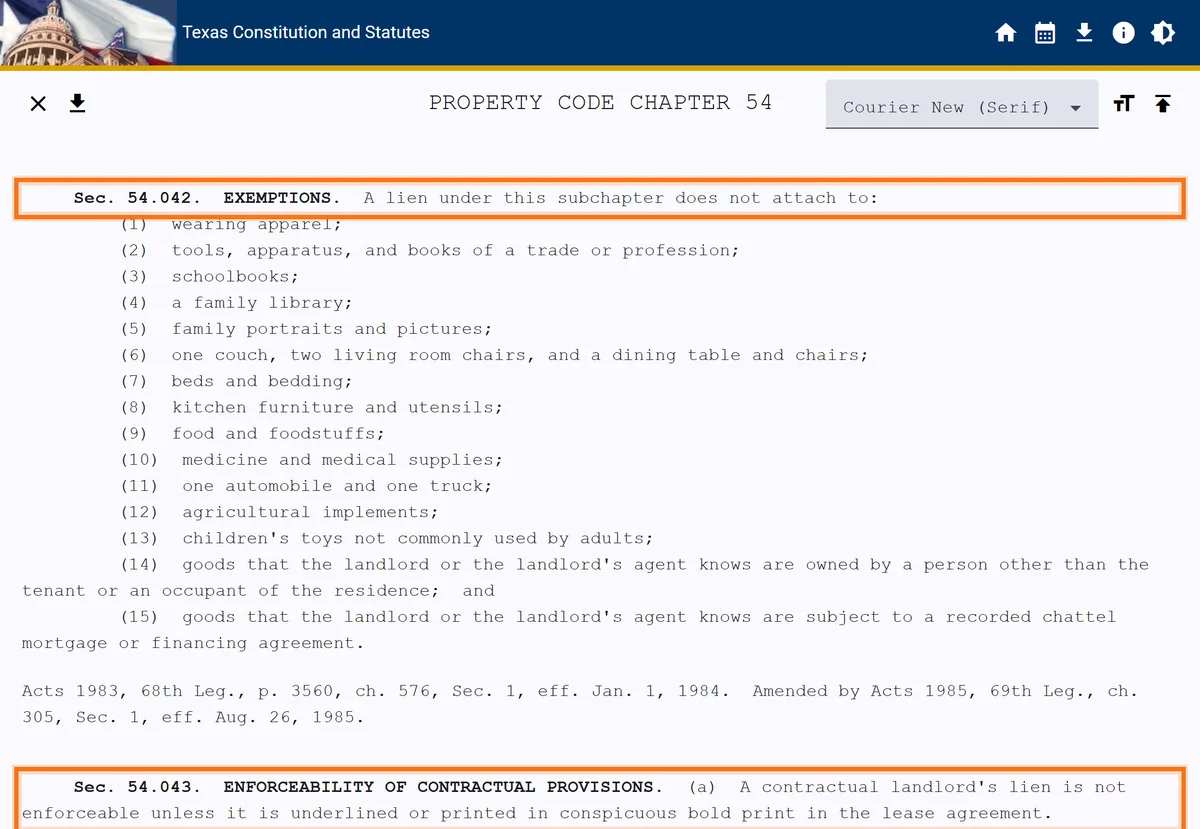
- The landlord's lien is a separate tool: it must be underlined or in conspicuous bold in the lease (Property Code §54.043) and never reaches exempt items such as clothing, beds, kitchen items, medicine or one car and one truck (§54.042).
- Selling seized property needs lease authority and 30 days' notice by first class and certified mail (§54.045).
- After an eviction, the writ of possession and the constable set the rules, not the lease.
In Texas, what you may do with belongings a tenant leaves behind is decided mainly by your lease, because the statutes do not set out a step-by-step procedure for an ordinary move-out. A well-drafted lease defines abandonment, lets you remove and store what is left after written notice, and allows disposal after a stated waiting period; after an eviction, the writ of possession procedure sets the rules instead. The owner's instinct is to call a junk hauler and start the make-ready, and the risk is that the tenant reappears a week later claiming the items were worth thousands and that you had no right to touch them.
This guide covers how to tell whether the home is actually abandoned, what the lease clause should provide, the notice and storage steps that protect you, and what changes after an eviction.
First question: is the home actually abandoned
Belongings left behind only become abandoned property when the tenancy has ended or the tenant has abandoned the home. Those are different situations and the first job is to identify which one you have:
- Tenancy ended, keys returned. The tenant moved out at the end of the lease or after notice, returned keys, and left items. This is the cleanest case.
- Tenancy ended, no keys, no word. The lease end date passed, the tenant is not responding, and the home looks vacated. You need evidence before you act.
- Mid-lease disappearance. Rent stops, the tenant goes silent, and the home appears empty. This is where the lease's abandonment definition matters most.
- Eviction. A writ of possession was executed and the constable supervised removal. Separate rules apply.
Evidence of abandonment is a pattern, not one fact: utilities shut off, mail piling up, neighbors reporting a moving truck, no response to calls and written notices, most furniture and clothing gone, food spoiled. A home with a made bed, a stocked pantry and a car in the driveway is not abandoned even if nobody answers the door.
Five situations and what decides each one
Find your row before you move a single box:
| Situation | What decides your rights | First step | Biggest risk |
|---|---|---|---|
| Lease ended, keys returned, items left | The lease's surrender and abandoned-property clause | Photograph and inventory, then send the written notice the lease requires | Discarding items before the notice period runs |
| Lease ended, no keys, no contact | The lease's abandonment definition | Gather evidence: utilities, mail, neighbors, written notices | Treating an occupied home as abandoned |
| Rent stopped mid-lease and the home looks empty | The lease's abandonment definition; §54.044(d) once abandoned | Written notice, then a documented entry | Clearing the home too early, which can amount to an illegal lockout |
| Unpaid rent and you want to hold property for it | The landlord's lien, Property Code §54.041 to §54.045 | Check the lien clause is underlined or bold, and check the exempt list | Seizing exempt items, or selling without 30 days' notice |
| Tenant removed by eviction | The writ of possession, Property Code §24.0061 | Follow the constable's instructions on the day | Keeping or selling items as if they were yours |
How to read this table: the first three rows are cleanup questions governed by the lease, the fourth is a debt collection remedy with strict notice rules, and the fifth belongs to the court process. The costly mistakes happen when an owner treats the third row as if it were the first, or the fourth as if it were cleanup.
What the lease should say about abandonment and property
Because Texas does not spell out a step-by-step procedure for ordinary move-out situations, the lease fills the gap. The residential lease forms most Texas brokers use include an abandonment clause that, in general terms, does three things:
- Defines when the landlord may treat the home as abandoned, usually a combination of unpaid rent, no occupancy and no response to notice for a stated period.
- Authorizes the landlord to remove and store property left behind after the tenant has surrendered, abandoned or been evicted from the home.
- Authorizes the landlord to dispose of stored property after giving written notice and allowing a stated time for the tenant to claim it, and to charge the tenant for removal and storage.
If your lease has no such clause, you are relying on general property law, which is far less clear and far less favorable. Read the clause before you move a single box, and follow it exactly: the notice it requires, the period it allows, the method of delivery it names. The guide on Texas residential lease essentials covers the other clauses that do this kind of quiet work.
The landlord's lien is a separate and narrow tool
Owners sometimes ask whether they can keep or sell the belongings to cover unpaid rent. Texas law does allow a landlord's lien on certain tenant property for unpaid rent, but only when the lease contains a lien clause that is conspicuously set out, and only against property the statute does not exempt. The exempt list is long and includes things like clothing, tools of a trade, children's items, basic furniture and food, in general terms.
Seizing property under the lien has its own notice and sale requirements, and a landlord who seizes exempt property or skips the procedure can owe the tenant damages and attorney's fees. In practice, the lien is rarely worth using on a single-family home. The items left behind are usually either exempt or not worth the risk, and the unpaid rent is better pursued through the deposit and, if needed, a judgment.
The point is to keep the two concepts separate. Removing and storing abandoned property under the lease clause is a cleanup authority. Seizing property for rent under a lien is a collection remedy with strict rules. Do not blur them, and do not sell anything to recover rent without an attorney's say-so.
Notice, storage and the waiting period
Once you have determined the home is abandoned or surrendered and the lease authorizes action, the sequence is straightforward:
- Send written notice to the tenant at the forwarding address if you have one, the property address, and any email or phone on file, stating what was left, that it will be stored, and the date after which it will be disposed of under the lease.
- Photograph and inventory everything before it is moved. Room by room, with wide shots and close-ups of anything that looks valuable.
- Move the items to storage, which can be the garage of the home if the make-ready can proceed around it, or a rented unit if not. Record the location and the cost.
- Wait the period the lease requires. If the tenant contacts you, arrange a pickup, and you may condition release on payment of reasonable removal and storage costs if the lease allows.
- After the period passes with no claim, dispose of the items as the lease permits, and document that too.
Reasonableness is the standard throughout. A lease that allows disposal after a short period is still read against what a court considers fair, and the cost of waiting a little longer is small. The move-out inspection is the right moment to capture the inventory, since you are already photographing every room.
Items that get special handling
A few categories deserve more care than a general cleanup, regardless of what the lease allows:
- Identity documents, passports, mail and medications. Hold them, do not discard them, and make a serious effort to return them. Mail should go back through the postal service, not the trash.
- Photographs, personal papers and items of obvious sentimental value. Low resale value, high dispute value.
- Firearms. Do not store or dispose of these yourself. Contact the police department for guidance.
- Vehicles. An abandoned vehicle has its own process involving the city or a licensed tow operator, not the junk hauler.
- Pets. Call animal control immediately. A pet left in a vacated home is a welfare emergency, not an abandoned property question.
- Food and perishables. Discard right away and note it; nobody will claim them and they create a health hazard.
Trash is trash. Broken furniture, used mattresses and obvious refuse can be hauled as part of the make-ready once the home is confirmed surrendered, but photograph it first so the record shows what it was.
What changes after an eviction
When a tenant is removed under a writ of possession, Texas law provides a specific procedure. In general terms, the constable supervises the removal of the tenant's belongings from the home, the landlord may place them outside the premises or in a storage facility, and if the landlord stores them, the tenant may reclaim them subject to the storage charges, with notice requirements and a holding period set by statute. A warehouse that stores the items may acquire a lien for its charges.
The important difference from a voluntary move-out is that the writ process sets the rules, not the lease. Follow the constable's instructions on the day, document what is removed and where it goes, and do not deviate because the tenant's cousin shows up and asks for something. The guide on the Texas eviction timeline walks through the stages that lead to that day.
Owners sometimes assume that after an eviction, anything left is theirs to keep. It is not. The property still belongs to the tenant until it is lawfully disposed of, and the same restraint applies.
The record that ends the argument
Every abandoned property dispute I have seen was decided by the quality of the record, not by what actually happened. The file should contain:
- The evidence of abandonment or surrender: returned keys, the final notice and proof of delivery, photos of the empty home, utility shutoff confirmation, the dates of attempted contact.
- The dated, time-stamped photo inventory, before anything was moved.
- The written notice to the tenant about the stored property, with proof of how and where it was sent.
- Storage location, dates and costs, and any communication with the tenant about pickup.
- The disposal record: date, method, and photos.
That file is also what supports deducting removal and storage costs from the security deposit, which Texas law allows only with a written itemization. The guide on Texas security deposit rules covers that itemization and the timing it has to meet.
How a manager handles it
At Perpetual, abandoned property is a checklist, because improvisation is how an owner ends up in a small claims hearing over a used television. The move-out inspection captures the inventory. The lease clause drives the notice. Storage goes in the garage where possible so the make-ready crew can work. The owner sees the photos and the timeline on the owner portal and approves the disposal date.
What the owner never does is make the call alone, in the driveway, with a hauler waiting. That is where the mistakes happen, and it is a good part of what documented inspections and a managed turnover are for. If you have a vacated home right now and are not sure what the lease allows, that is worth a call to Perpetual before the first box moves.
This article is general information, not legal advice. Confirm the details of your situation with a Texas attorney.
The takeaway: Confirm the home is truly surrendered or abandoned, follow the lease clause to the letter, photograph everything before it moves, give written notice, wait the period, and keep the file.
Questions owners ask
How long does a landlord have to keep a tenant's belongings in Texas?
For an ordinary move-out, the lease sets the period, because Texas statute does not spell one out for that situation. A typical lease allows disposal after written notice and a stated waiting period. After an eviction, the statute sets its own notice and holding rules for property placed in storage.
Can a landlord throw away a tenant's belongings in Texas?
Only after the tenancy has ended or the home has been abandoned, and only as the lease or, after an eviction, the statute allows. The landlord should give written notice, photograph and inventory everything, store it for the required period and then dispose of it, keeping a record of each step.
Can a landlord keep or sell abandoned property to cover unpaid rent?
Texas allows a landlord's lien for unpaid rent only when the lease contains a conspicuous lien clause, and many items are exempt from it. The lien has strict seizure and sale procedures, and misuse exposes the owner to damages. For a single-family rental it is rarely worth using; pursue rent through the deposit and a judgment instead.
What counts as abandonment of a rental property in Texas?
The lease usually defines it, commonly as a combination of unpaid rent, the home being unoccupied and no response to the landlord's notice for a stated period. Evidence such as shut-off utilities, removed furniture, piled mail and neighbor reports supports the conclusion. A home that still looks lived in is not abandoned.
How does a property manager handle a house the tenant has abandoned?
A manager first confirms the home is truly abandoned, using a pattern of evidence such as shut-off utilities, piled mail, removed furniture and no response to written notice. The lease's abandonment clause then drives each step: written notice to the tenant, a dated photo inventory before anything moves, storage for the period the lease requires, and documented disposal only after that period passes. Identity documents, medications, firearms, vehicles and pets get special handling rather than a junk hauler. At Perpetual this runs as a checklist, with the move-out inspection capturing the inventory and the owner approving the disposal date from the photos in the owner portal.
What property can a Texas landlord's lien never take?
Property Code §54.042 exempts clothing, tools and books of a trade, schoolbooks, a family library, family portraits and pictures, one couch, two living room chairs and a dining table and chairs, beds and bedding, kitchen furniture and utensils, food, medicine and medical supplies, one automobile and one truck, agricultural implements, children's toys, and goods the landlord knows belong to someone else or are financed.
Related services
Property management in Keller, North Richland Hills and Fort Worth. How full-service management works in Tarrant County →