Key takeaways
- Texas has no set number of days that makes a rental house abandoned; the lease defines it.
- Locking out a tenant who has not actually left is costly: the tenant can recover one month's rent plus $1,000, actual damages and attorney's fees (Property Code 92.0081(h)).
- Once the premises are abandoned, the landlord or its agent may remove the contents (54.044(d)); selling or disposing of them needs authority in a written lease (54.045).
- A landlord has a duty to mitigate when a tenant abandons, and a lease cannot waive it (91.006).
- The deposit itemization waits for the tenant's written forwarding address, but the tenant's right to it is not lost (92.107).
A property manager handles an abandoned house in a fixed order: confirm the tenant is actually gone, secure the property, document its condition, deal with anything left behind, account for the deposit and the rent still owed, and get the house back on the market. The order matters because the two expensive mistakes, changing the locks on a tenant who has not really left and leaving an empty house unsecured for weeks, both come from skipping a step.
Tenants lose jobs, split up, get transferred, or simply stop answering once they are behind on rent. Here is how it runs on a house in Keller, North Richland Hills or Fort Worth from the moment the manager suspects the tenant is gone, with the Texas Property Code section behind each step.
The six steps for an abandoned rental house in Texas, at a glance
Here is the order a manager follows on an abandoned rental in Tarrant County and the Texas rule that sits behind each step:
| Step | What the manager does | Texas rule behind it |
|---|---|---|
| 1. Confirm | Works the lease definition of abandonment, posts notice, logs every contact attempt | Property Code 92.0081: a wrongful lockout costs one month's rent plus $1,000, actual damages and attorney's fees |
| 2. Secure | Rekeys, checks for leaks, sets the thermostat, confirms utilities | Only after step 1: 92.0081(b) restricts keeping a tenant out of a home that is not abandoned |
| 3. Document | Dated photos of every room, meter readings, keys, a damage list | Supports deposit deductions; normal wear and tear cannot be charged (92.104(b)) |
| 4. Belongings | Inventories, removes and stores; sells or disposes only as the lease allows | 54.044(d) and 54.045: sale needs written lease authority and 30 days' notice |
| 5. Account | Applies the deposit, prepares the itemization, documents the balance | 92.104 and 92.107: itemization is due once the tenant gives a written forwarding address |
| 6. Re-let | Make-ready, pricing, listing | 91.006: duty to mitigate, which a lease cannot waive |
How to read this table: the right column is why the order cannot be shuffled. Step 1 protects you from a lockout claim, and step 6 protects your claim for the unpaid rent. A manager who skips to rekeying, or who leaves the house dark while billing the old tenant, has put one of those two at risk.
Confirming the house is really abandoned
The first job is proving the tenant left, not assuming it. The signs are familiar: rent stops, calls and texts go unanswered, the house is dark at night, cars are gone, mail piles up, a neighbor mentions a moving truck. None of those alone is enough. A tenant in the hospital, on a long work assignment or caring for a relative out of state looks the same from the curb.
So the manager works the lease. Texas has no statute that sets a number of days for a residential rental, so the lease defines abandonment, usually as some combination of unpaid rent, a period of absence, removal of most belongings and a written notice that goes unanswered for a stated number of days. The manager gives that notice, calls every number on the application including the emergency contact, emails, and keeps a dated log of each attempt.
Getting this wrong has a price in the statute. Property Code 92.0081(b) bars a landlord from intentionally keeping a tenant out except by judicial process, with narrow exceptions that include removing the contents of premises the tenant has abandoned. If the tenant had not abandoned, 92.0081(h) lets the tenant recover possession or end the lease, and recover a civil penalty of one month's rent plus $1,000, actual damages, court costs and reasonable attorney's fees. When the lease conditions are met and the log shows the attempts, the house is treated as surrendered.
Securing the house the same day it is confirmed
An empty house in North Texas deteriorates fast. The same day abandonment is confirmed, the manager rekeys the locks, walks the whole house for active leaks, sets the thermostat so the air conditioning keeps humidity down in summer or the heat keeps pipes from freezing in winter, and checks that electricity, water and gas are on. If the tenant had the utilities disconnected, they go into the owner's or manager's name right away. Looking after an empty house covers the vacant-check routine that follows.
Perishables and trash go out, broken windows get boarded, and the yard gets mowed so the house does not advertise that nobody is home. The manager also tells you to call your insurance agent, because many landlord policies limit coverage once a house sits empty beyond a set period. That call is yours to make, but you should not have to remember it on your own.
Documenting condition before anything is touched
Before anyone cleans or hauls, the manager runs the same documented move-out inspection a normal departure would get: dated photos of every room, every wall, every appliance, the meter readings, the keys and remotes present, and a written damage list separated from ordinary wear. Documented inspections are what make the deposit accounting defensible and what support any later claim for the balance.
This is also where the manager notes anything that affects the next steps: a vehicle in the driveway, a pet left behind, prescription bottles, financial papers, firearms. Each of those changes who gets called next, and each needs to be on the record from the first visit.
What happens to belongings left behind
What the manager may do with furniture, clothes and boxes depends on the lease and on two sections of the Property Code. Section 54.044(d) says that if the tenant has abandoned the premises, the landlord or the landlord's agent may remove its contents. Selling or disposing of what was removed is a separate question: under 54.045, property taken under the landlord's lien may not be sold or otherwise disposed of unless a written lease authorizes it, and a sale needs notice to the tenant at least 30 days ahead, by both first class and certified mail to the last known address.
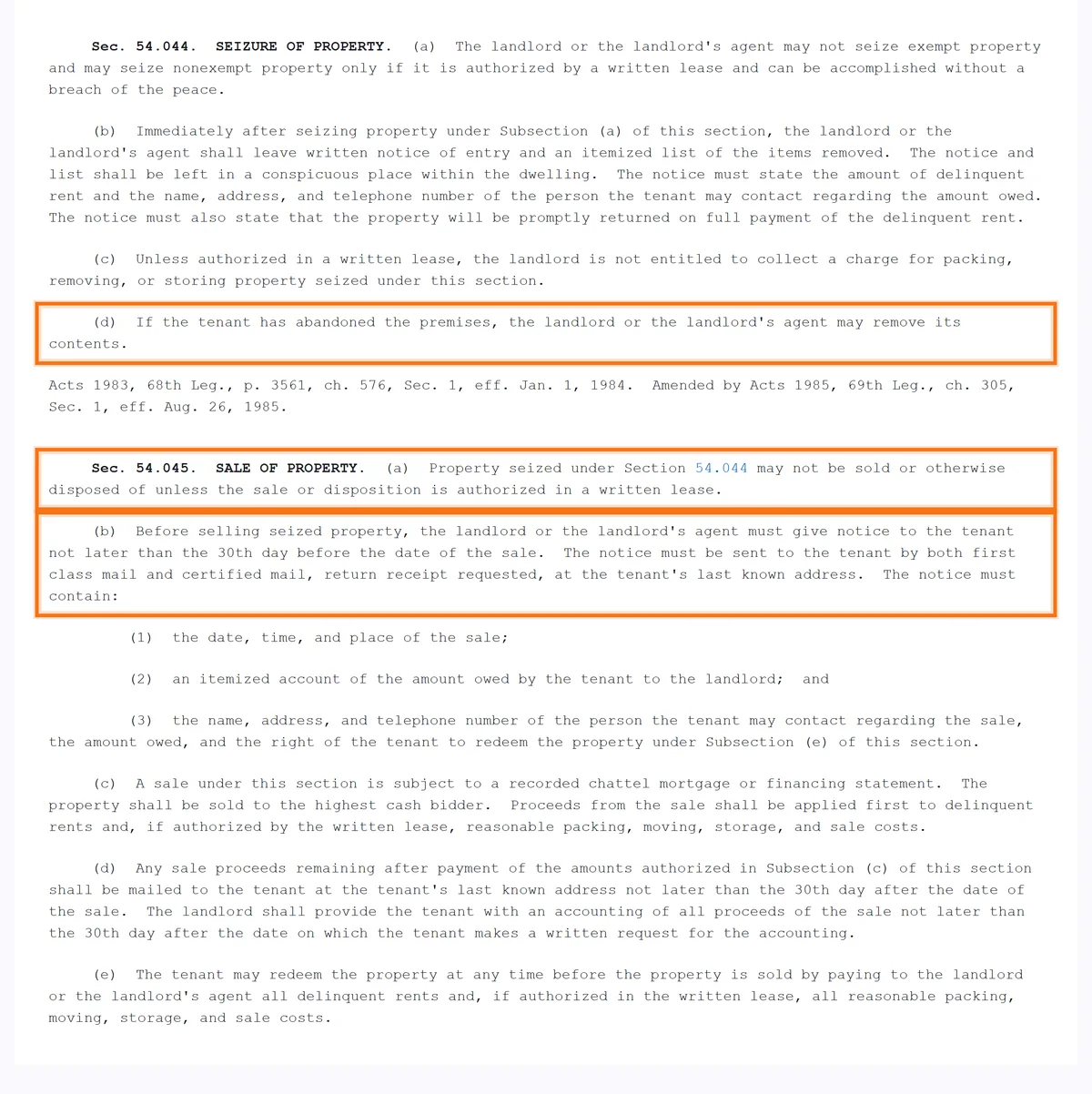
Packing, removal and storage charges follow the same logic: 54.044(c) allows them only when a written lease authorizes them. So the manager inventories everything with photos, stores what has value, sends the notice the lease and the statute call for, and only disposes of items once the notice period runs.
The details, including the landlord's lien and the items that are exempt from it, are in the guide to belongings left behind after a Texas tenant leaves. The short version for an owner: nothing is thrown out on day one, and nothing is sold to cover rent unless the lease and the law specifically allow it.
Rent, the deposit and the duty to re-let
A tenant who abandons a house still owes rent under the lease, but the landlord cannot simply let the meter run. Property Code 91.006 gives a landlord a duty to mitigate damages if a tenant abandons the leased premises in violation of the lease, and says a lease provision that tries to waive that duty is void. So the manager cannot leave the house dark and bill the former tenant for the whole remaining term. Re-letting quickly protects you twice: it restores income and it keeps your claim clean.
The deposit is applied to unpaid rent, cleaning and damage beyond normal wear and tear, which 92.104(b) says can never be charged. The manager prepares the itemized accounting the same way it would for any move-out. Under 92.107 the landlord is not obligated to return the deposit or send the itemization until the tenant gives a written forwarding address, but the tenant does not forfeit the right to either by failing to give one. The file is prepared and held.
Any balance beyond the deposit becomes a written demand and, if it is large enough to be worth it, a claim in Justice Court. The guide to tenants breaking a lease walks through reletting charges and how the balance is calculated.
This is general information, not legal advice. Confirm deposit and abandonment questions against your lease or with a Texas landlord attorney.
Getting the house back on the market
Once the house is secured and documented, it is a vacancy, and vacancies are measured in days. The manager scopes the make-ready from the inspection photos, gets it quoted and started, prices the house against what is actually leasing nearby, and has photos and the listing ready to go live when the work is done. Many abandoned houses are not badly damaged; they are dirty, half-empty and unmowed, and how long the turn takes depends on what the photos show.
The owner's decisions in this stretch are the ones with money attached: whether to do the deferred items you had been putting off while the house is empty anyway, and where to set the rent. A free rental analysis based on homes that actually leased nearby, not asking prices, is the right input for that second decision.
How Perpetual handles this
We are a broker-owned company with our office at 5755 Rufe Snow Dr in North Richland Hills, and we manage houses in Keller, North Richland Hills, Fort Worth and nearby. Three things we publish apply directly to an abandoned house. Every move-out gets a 360-degree condition inspection, with the photo report in your owner portal. A market-ready home is live on every major rental platform within 5 business days, or we waive the first month's management fee. And if a tenant we placed breaks the lease within the first 6 months, we find you a new tenant with no additional leasing fee.
Those commitments are in The Perpetual Promise and are subject to its Guarantee Addendum. We use Texas-compliant leases, so the abandonment and belongings terms the steps above depend on are in the lease from the start. Our leasing service prices the house from leased comparables and handles the listing, and every fee is listed in writing before you sign. To talk through a house that has gone quiet, call 682-593-7033.
The takeaway: An abandoned house is handled in a strict order, confirm, secure, document, clear, account and re-let, and the manager who follows it protects you from a lockout claim on one side and weeks of needless vacancy on the other.
Questions owners ask
How long does a tenant have to be gone before a rental is considered abandoned in Texas?
Texas law does not set a number of days for a residential rental. Abandonment is defined by the lease, which usually combines unpaid rent, a stated period of absence, removal of most belongings and an unanswered written notice. A manager follows those lease terms exactly and keeps a dated log of every contact attempt before treating the house as surrendered.
Can I change the locks if I think my tenant has left?
Not on a hunch. Property Code 92.0081 bars a landlord from keeping a tenant out except through the courts, with narrow exceptions, and a tenant who was wrongly excluded can recover one month's rent plus $1,000, actual damages and attorney's fees. Confirm abandonment under the lease first, document the attempts to reach the tenant, and only then rekey. If the tenant is behind on rent but still living there, the path is a notice to vacate and, if needed, an eviction.
Does the tenant still owe rent after abandoning the house?
Yes. The tenant owes rent under the lease, plus any reletting charge the lease allows, but Property Code 91.006 gives the landlord a duty to mitigate, so rent from a replacement tenant reduces the claim. The faster the house is back on the market, the cleaner the claim. The deposit is applied first and any balance can be pursued with a demand letter or in Justice Court.
Who pays to clean out an abandoned rental?
The owner pays the vendors up front, and the cost is charged against the tenant's deposit and added to any balance owed, provided the lease allows it and the manager has photos and invoices to support each charge. Items with real value are stored rather than discarded until the notice period runs, and storage costs may also be chargeable under a lease that says so.
What is lease abandonment in Texas?
Lease abandonment is a tenant leaving the rental before the lease ends without the landlord's agreement, usually while rent is unpaid. For a house, the lease itself defines when the home counts as abandoned. Once it does, Property Code 54.044(d) lets the landlord or its agent remove the contents, and 91.006 requires the landlord to mitigate by trying to re-let.
Can a landlord throw away belongings left in an abandoned rental in Texas?
Only as the written lease allows. Property Code 54.044(d) lets the landlord remove the contents of abandoned premises, but 54.045 says the property may not be sold or otherwise disposed of unless a written lease authorizes it, and a sale requires notice at least 30 days ahead by first class and certified mail. Inventory and photograph everything first.
Related services
Property management in Keller, North Richland Hills and Fort Worth. How full-service management works in Tarrant County →