Key takeaways
- Each unit has its own lease, deposit and tenant, but the roof, sewer line, yard and often the water meter are shared. Every shared thing needs the same written rule in every lease.
- If you agreed to pay a utility and it is cut off for nonpayment, Property Code 92.301 lets the tenant pay it and deduct from rent, or terminate the lease.
- Property Code 92.008 bars shutting off water, gas or electric service to collect rent.
- Smoke alarms, locks and rekeying are counted per dwelling unit.
- Fort Worth says registration is voluntary for one- and two-family rentals with no violations. For three or four units, confirm with the city.
A duplex or fourplex is one building with two to four leases, and everything the units share is where management gets harder than a house. To rent one out in Fort Worth, Keller or North Richland Hills, treat each unit as its own tenancy under Texas law and treat the building as one system: one roof, one sewer line, often one water meter, one yard and one driveway, serving tenants who did not choose each other.
This guide covers the Texas rules for a multiunit building, shared systems and utilities, tenant mix, living in one unit, common areas, city registration, lease timing, insurance and pricing.
Texas rules that apply to a duplex or fourplex, at a glance
These are the Texas statutes a small multiunit building runs into most often, and what each one means with two to four units:
| Topic | What the statute says | What it means for a duplex or fourplex |
|---|---|---|
| Utilities you agreed to pay | Property Code 92.301: if service is cut off, or about to be, because the landlord did not pay, the tenant may pay it and deduct from rent, or terminate the lease | A shared meter in your name is your bill to keep current, for every unit |
| Shutting off utilities | Property Code 92.008: no interrupting water, wastewater, gas or electric service except for bona fide repairs, construction or an emergency | Unpaid rent is never a reason to turn off water |
| Late fees | Property Code 92.019: up to 12 percent of the month's rent is considered reasonable in a structure with not more than four dwelling units | Same ceiling as a house. Above four units it is 10 percent |
| Smoke alarms | Property Code 92.255: at least one in each bedroom, one in a corridor serving several bedrooms, one on each level of the dwelling unit | Counted unit by unit, and tested at the start of each tenant's possession (92.258) |
| Locks and rekeying | Property Code 92.153 and 92.156: security devices on each dwelling, rekeyed at the landlord's expense within seven days after each tenant turnover date | Rekey the unit that turned over, each time |
| Parking rules | Property Code 92.0131: in a multiunit complex, the tenant gets a copy of the parking rules before signing | Two rented units on one lot under one owner fit the definition in 92.151 |
| Emergency phone number | Property Code 92.020: a landlord without an on-site office must still give tenants a telephone number for reporting emergencies | No unit threshold. Every tenant gets a number |
How to read this table: the first two rows are about money and are where owners of shared-meter buildings get hurt. The rest are per-unit duties that are easy to do for one unit and forget for the others. This is general information, not legal advice.
One building, two to four leases, and one owner in the middle
Every lease on the building is a separate contract with its own tenant, deposit, term and obligations. The building, however, behaves as one thing. A sewer backup affects every unit at once. A roof leak over unit B is paid for by the whole property's income. A loud tenant in unit A costs you the quiet tenant in unit C.
The owner, or the manager, is the only party who sees the whole building, and the only one who can set the rules. Anything shared needs to be written into every lease the same way: who mows, where each unit parks, where trash goes, what hours are quiet. The upside is real: with four units, one vacancy is a quarter of the income, not all of it.
Shared systems: roof, sewer, water heaters, panels and the things nobody owns
Start with an inventory of what serves more than one unit. In older North Texas duplexes and fourplexes that often includes:
- A single main sewer line fed by every unit's drains. A root intrusion or a collapse takes all units down at once.
- One water meter and one main shutoff, so a repair in one unit means a shutoff for all.
- Shared or stacked water heaters, sometimes in a common closet.
- One electrical service with a sub-panel per unit, or a single panel with poorly labeled circuits.
- One roof, one slab, and party walls that carry sound and sometimes plumbing.
Document each one with a photo and a note on age and condition, and build the preventive maintenance calendar around the shared items first, because that is where a failure multiplies.
Shared utilities: separate meters, a written method, and what Texas law says
If each unit has its own electric, gas and water meter, put every utility in the tenant's name and the problem is solved. Many small multifamily buildings here are separately metered for electricity but share one water meter. That leaves three options: keep the shared utility in your name and include it in rent, install a submeter for each unit and bill actual use, or divide the bill by a written formula in every lease, such as square footage or occupant count.
What the Texas Water Code covers. The state's submetering and allocation rules, Water Code chapter 13, subchapter M, are written for an "apartment house", which section 13.501 defines as one or more buildings containing five or more dwelling units. A duplex or fourplex is below that number, so on a small building the lease wording carries the weight. Before you bill a tenant for water, confirm with the state utility commission or an attorney how the rules apply to your building.
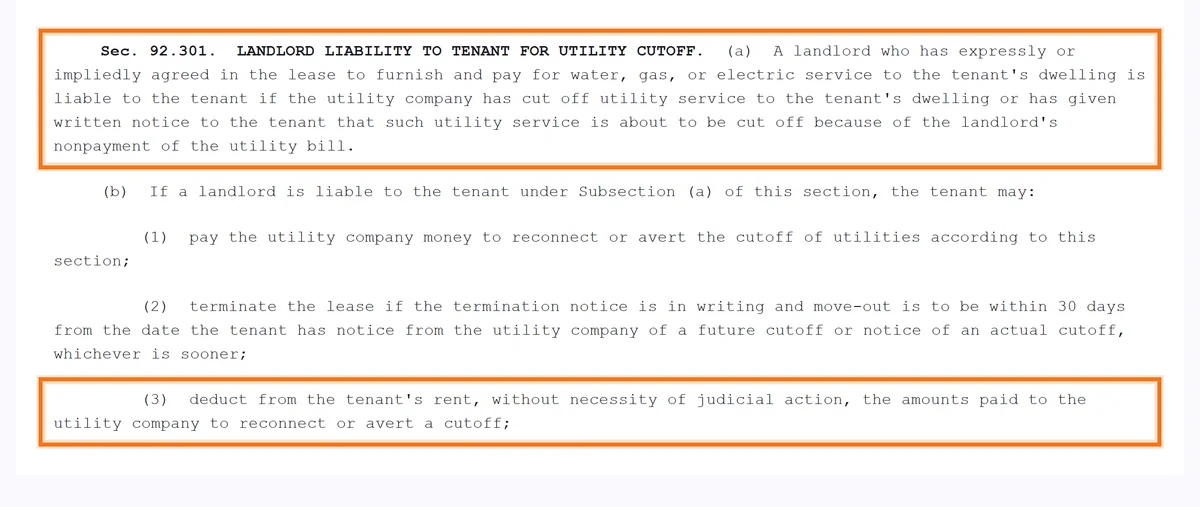
If the bill is in your name, keeping it paid is your duty. Under Property Code 92.301, a landlord who agreed in the lease to furnish and pay for water, gas or electric service is liable to the tenant if the utility cuts service, or gives written notice that it is about to, because the landlord did not pay. The tenant may pay the utility and deduct that amount from rent, terminate the lease in writing, and recover actual damages.
You cannot shut a utility off to collect. Property Code 92.008 bars a landlord from interrupting water, wastewater, gas or electric service furnished to a tenant unless the interruption results from bona fide repairs, construction or an emergency. The one exception in the section is for electricity the landlord submeters or allocates, and it requires a written lease term and a detailed notice procedure.
What to avoid is the informal version: splitting the bill by text message each month. The guide to who pays utilities in a Texas rental has more. This is general information, not legal advice.
Tenant mix: screening for the building, within fair housing
Tenants in a fourplex live closer together than neighbors in a subdivision, and a late-shift worker above a family with a newborn creates complaints no lease clause fully resolves. The answer is not to choose tenants by who you think will get along, which runs straight into fair housing law. Apply the same written screening criteria to every applicant and document each decision.
What you can do is enforce the rules that make close living work: quiet hours, pet limits per unit, parking assignments, and a complaint process that routes through you, not through the neighbors' front doors. The fair housing guide for Texas landlords covers the boundaries.
Living in one unit: what changes and what does not
Buying a duplex or fourplex and living in one unit while renting the others is a common first step for North Texas investors. You oversee the property directly, and the tenants now live beside their landlord. Loan terms for an owner-occupied building are a question for your lender.
What does not change is Texas landlord-tenant law. Repair duties, deposit rules, notice requirements and the eviction process apply to the units you rent regardless of where you sleep. One narrow detail: the smoke alarm subchapter does not apply to a dwelling unit occupied by its owner, no part of which is leased to a tenant (Property Code 92.253), so your own unit is outside it and every rented unit is inside it. Fair housing questions on an owner-occupied building belong with an attorney.
Practically, decide how available you will be. A tenant who can knock on your door at 10 p.m. will. A written maintenance request process and stated hours for non-emergencies keep the arrangement from becoming a second job in your own hallway.
Yard, trash, parking and common areas: write every rule down
Shared outdoor space is the most common source of friction in a small multifamily, because responsibility is ambiguous unless you make it explicit. Decide each of these and put the answer in every lease identically:
- Lawn: owner-provided service is the arrangement that works reliably with more than one tenant. The lawn care responsibility guide explains the trade-offs.
- Trash and recycling: how many carts, where they live, who rolls them out.
- Parking: assigned spaces per unit, guest parking, and what happens to a car in someone else's space.
- Shared entries, stairs and hallways: who cleans and what may be stored there (usually nothing).
- Spigots, shared laundry and a fenced yard: who has use of what.
Parking has its own statute. Under Property Code 92.0131, a tenant in a multiunit complex must be given a copy of any towing or parking rules before the lease is signed, and a change during the lease needs written notice. Once the rules are written, enforce them evenly. The tenant in unit A will notice if unit D's third car never draws a notice.
City registration for a duplex or fourplex in Fort Worth
City rules for rental buildings are written by unit count. Fort Worth's Rental Registration page, as it reads in November 2026, says registration is voluntary for one- and two-family rentals with no violations. It is mandatory for one- and two-family rentals with fire safety or public health and sanitation code violations, at an annual fee of $200 for each unit with violations. Out-of-state owners must name a local agent to accept legal service and a contact for local emergencies.
The page speaks only of one- and two-family rentals and does not say how a triplex or fourplex is treated, so for three or four units, confirm with Fort Worth Code Compliance. For Keller, North Richland Hills and other cities, confirm with the city before the first lease. Our guide to city rental registration in Tarrant County covers the wider picture.
Stagger lease end dates so turnover never hits all at once
Four leases that all end in July produce a summer in which the whole building turns over at once, with four make-readies, four listings and four vacancies competing for the same showings. Stagger the end dates across the year instead. That spreads the work, keeps most of the income flowing during any one turnover, and lets each renewal be priced on the current market for that unit.
You get there over time by offering renewal terms of different lengths, say ten, twelve and fourteen months, until the dates separate, then holding them apart.
Insurance notes for two to four units
Tell your insurance agent exactly what the building is: the number of units, which are rented and whether you live in one. The policy has to be written for that occupancy. Ask about liability limits and loss of rent coverage, because a shared-system failure can empty several units at once. Whether to require tenants to carry their own policy is covered in requiring renters insurance. This is general information, not insurance advice.
Pricing units that are not identical
The units in a fourplex are rarely worth the same rent, and dividing the building's target income evenly is how owners end up with one unit that never leases and one that is underpriced. Price each unit on its own features: floor level, square footage, bedroom count, a private yard or balcony, updated kitchen, covered parking, washer and dryer connections.
Compare against other small multifamily units and smaller apartments nearby, not single-family homes, and look at what has leased, not what is listed. Owners with several units should also read portfolio pricing for multiple rentals.
How Perpetual handles a duplex or fourplex
Perpetual Property Management is broker-owned, with our office at 5755 Rufe Snow Dr in North Richland Hills. We manage single-family homes, townhomes and small multifamily in Keller, North Richland Hills, Fort Worth and nearby. A duplex or fourplex gets the same process as a house, unit by unit: every adult applicant screened against the same published rental criteria, a 360-degree condition inspection at every move-in and move-out, an annual property inspection, and 24/7 emergency response on every plan.
Repairs under the spending limit you pre-approve are done without waiting, and the vendor's original invoice is always in your owner portal. Renewals start 120 days before each lease ends, one lease at a time.
Our plans are Full Service at 10% of monthly rent and Standard at 9%. The Investor Special at 7% is for portfolios of 5 or more units, so a duplex or a single fourplex is below it on its own. The final fee is set after a free rental analysis, which can price each unit separately, and how fees apply to each unit is confirmed in writing before you sign. See pricing and full-service management.
The rules are easier to set before the first lease than after. To talk through your building, call 682-593-7033.
The takeaway: Inventory everything the units share, write every shared rule into every lease identically, bill utilities by a written method, stagger the lease calendar, and price each unit on its own features.
Questions owners ask
How do you split utilities in a duplex or fourplex?
Put separately metered utilities in each tenant's name. For a shared water or gas meter, include it in rent, install submeters, or divide the bill by a written formula in every lease. The Texas Water Code submetering and allocation rules are written for buildings of five or more units (section 13.501), so on a duplex or fourplex the lease wording matters most. Confirm with an attorney before billing.
Who takes care of the yard in a duplex?
Owner-provided lawn service is the arrangement that works reliably with more than one tenant. Assigning mowing to one unit breeds resentment and assigning it to all produces an unmowed yard. Build the cost into the rent and write the arrangement into every lease.
Do landlord-tenant laws apply if I live in one unit of my fourplex?
Yes. Texas repair duties, deposit rules, notices and the eviction process apply to every unit you rent regardless of where you live. The smoke alarm subchapter excludes only a unit occupied by its owner with no part leased to a tenant (Property Code 92.253). For fair housing questions on an owner-occupied building, ask an attorney.
Should all the leases in a fourplex end at the same time?
No. Stagger end dates across the year by offering renewal terms of different lengths until they separate. That spreads make-ready work and keeps most of the income flowing during any one turnover.
How do I set rent for different units in the same building?
Price each unit on its own features: floor level, size, bedrooms and baths, private outdoor space, updates, parking and laundry connections. Use leased comparables from nearby small multifamily units. If one unit sits while the others fill, that unit's price is wrong, not the building's.
Do I have to register a duplex or fourplex as a rental in Fort Worth?
Fort Worth's Rental Registration page says registration is voluntary for one- and two-family rentals with no violations, and mandatory, at $200 a year per unit with violations, for those with fire safety or public health code violations. The page does not say how a triplex or fourplex is treated, so for three or four units confirm with Code Compliance.
Can I turn off the water to one unit if that tenant does not pay rent?
No. Texas Property Code 92.008 bars a landlord from interrupting water, wastewater, gas or electric service furnished to a tenant unless it results from bona fide repairs, construction or an emergency. A tenant whose service is wrongly cut may terminate the lease and recover actual damages, one month's rent plus $1,000, attorney's fees and court costs.
Property management in Keller, North Richland Hills and Fort Worth. How full-service management works in Tarrant County →