Key takeaways
- In Texas a home warranty is a "residential service contract". The provider must be registered with the Texas Department of Licensing and Regulation (TDLR) under Occupations Code chapter 1304.
- The contract must state that, under normal circumstances, the provider will initiate service within 48 hours of the request (1304.156(f)). Starting service is not the same as finishing the repair.
- Your tenant's clock is separate: Property Code 92.056 presumes seven days is a reasonable time to repair a condition that materially affects health or safety.
- Use the warranty for expensive, non-urgent failures. Pay a vendor directly for leaks, no heat, sewage, electrical hazards and AC in summer heat.
- You can cancel a service contract at any time; after the first 30 days the refund is prorated and the cancellation fee cannot exceed $50 (1304.1581).
Will a property manager work with your home warranty company? Most will, on a rental in Fort Worth, Keller or North Richland Hills, with one condition that should be in writing: when the warranty company's contractor cannot meet the repair timeline your tenant and Texas law expect, the manager sends its own vendor and you pay directly. The warranty is a contract with its own clock, and the lease is a legal relationship with a different one. A manager's job is to keep the first from breaking the second.
This guide covers how a claim runs, what Texas law requires of the warranty company, which failures to file and which to pay for directly, and how to set the rule with your manager before the first summer breakdown.
Home warranty claim or your manager's vendor: which failure goes where
Here is how common failures at a rental house are usually routed, and why:
| What failed | Usual route | Why |
|---|---|---|
| Dishwasher, microwave, garbage disposal | Warranty claim | The tenant can live with a wait of several days |
| Water heater or HVAC in a vacant home | Warranty claim | No tenant is waiting, and the repair is expensive |
| HVAC in mild weather | Warranty claim, with a wait limit | A covered compressor or replacement is worth a short wait |
| AC in summer heat, no heat in a freeze | Manager's vendor, owner pays | A condition that can affect health or safety should not sit in a claim queue |
| Active water leak, sewage backup | Manager's vendor, owner pays | Every hour adds damage that costs more than the claim saves |
| Electrical hazard, no hot water | Manager's vendor, owner pays | Health or safety, and hot water is named in Property Code 92.052 |
| Same system failed twice after warranty visits | Manager's vendor, owner pays | The wait has already been spent |
How to read this table: the first three rows are where a warranty can save you money, and the last four are where waiting on it costs more than it saves. Write the split into your management agreement so nobody has to call you in July to ask.
How a home warranty claim runs on a rental
A claim follows the same path whether the home is your residence or a rental, and the path is the problem. You, or the manager on your behalf, open a claim and pay the deductible the contract states, often called a service fee. The warranty company assigns a contractor from its own network. The technician diagnoses and reports back to the company, which approves, denies or approves part of the repair. Parts are ordered. A second visit completes the work.
Illustrative example only, not a prediction: a tenant reports a dead dishwasher on a Monday. The claim is opened Monday, the contractor comes Wednesday, authorization arrives Friday, the part lands the following Wednesday and the second visit happens Thursday. That is ten days for a dishwasher with nobody doing anything wrong.
In a house you live in, that is an inconvenience. In a rental, each step involves a tenant who has to be home, a manager who has to coordinate and a clock that started the day the tenant reported the problem. The warranty company's timeline is not your tenant's timeline, and nothing in the warranty contract makes it so.
What Texas law requires of a home warranty company
The Texas statute does not use the words "home warranty". Occupations Code 1304.003 defines a residential service contract: an agreement under which a provider services, repairs or replaces a structural component, an appliance, or an electrical, plumbing, heating, cooling or air-conditioning system of a residential property after an operational failure, a defect or normal wear. TDLR states that regulation of home warranties moved to it from the Texas Real Estate Commission on September 1, 2021. These are the rules that matter to a landlord:
| Rule | What the statute says | Section |
|---|---|---|
| Registration | A provider or administrator may not operate in Texas unless registered with TDLR | 1304.101 |
| Response time | The contract must state that, under normal circumstances, the provider will initiate the performance of services not later than 48 hours after the request | 1304.156(f) |
| What must be in writing | The amount of any deductible, every limitation, exception and exclusion, the holder's duties, and whether preexisting conditions are excluded | 1304.156(a) |
| Payment instead of repair | The contract may provide reimbursement or payment when a part, appliance or technician is unavailable | 1304.003(a)(4)(C) |
| Cancellation | The holder may cancel at any time: full refund before the 31st day, prorated after, with a cancellation fee of no more than $50 | 1304.1581 |
How to read this table: the 48 hours is a duty to start service, not to finish the repair, and it applies "under normal circumstances". Nothing in the chapter ties the warranty company's schedule to your tenant's lease.
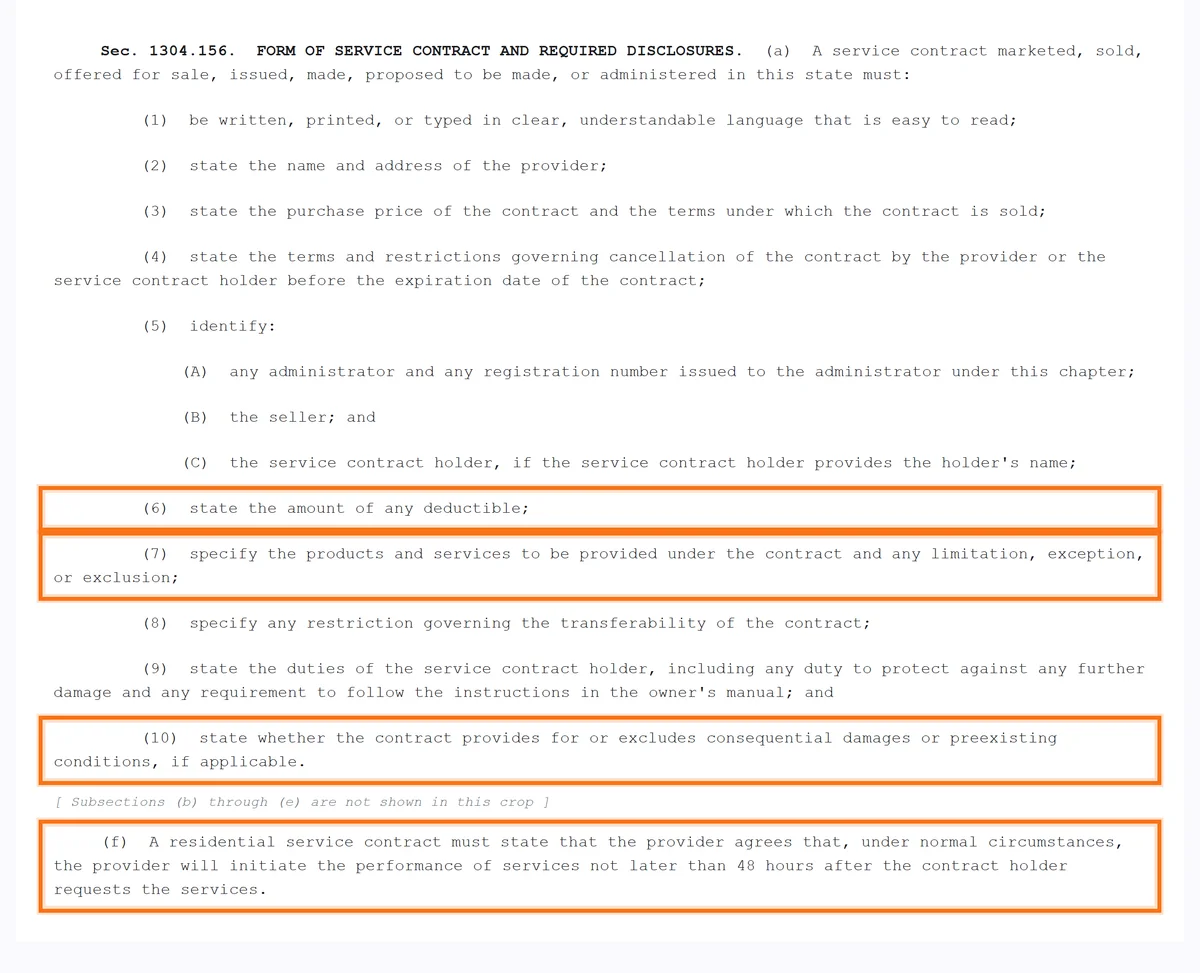
If a provider will not perform, TDLR suggests contacting the provider first, which must give you its complaint resolution procedures, and then filing a complaint with TDLR. You can also check a provider's registration with TDLR's license search before you buy or renew. This is general information, not legal advice.
Where the warranty collides with a rental in Texas
The collisions are predictable:
- The repair duty. Under Property Code 92.052 a landlord must make a diligent effort to repair a condition that materially affects the physical health or safety of an ordinary tenant, and 92.056(d) presumes seven days is a reasonable time. A diagnosis, an authorization and a parts order can use up most of that. The duty is covered in Texas landlord repair obligations.
- Nights and weekends. A burst water heater at nine on a Friday night cannot wait for a claim to be assigned.
- Contractor choice. You get whoever is assigned, and the manager has no history with them.
- Exclusions. The contract lists its limitations, exceptions and exclusions and says whether preexisting conditions are covered. A denial after a week of waiting leaves you starting over.
- Partial coverage. The part may be covered while an item the contract excludes is not, and the owner pays the difference after the delay.
- Tenant availability. Every visit needs access, and the tenant did not sign up for three appointments to fix one dishwasher.
None of this makes a warranty useless. It makes it the wrong tool for anything urgent in an occupied house.
When filing the claim is the right call
Warranties earn their keep on failures that are expensive, non-urgent and clearly within the contract:
- An appliance the tenant can live without for several days: dishwasher, microwave, garbage disposal.
- A water heater or HVAC failure in a vacant home.
- An HVAC failure in mild weather, when the claim could cover a compressor or a full replacement.
- Pool equipment or another covered system where the repair cost is high and the tenant's daily life is not affected.
In these cases the manager files the claim, pays the deductible from your owner funds, schedules the contractor with the tenant, follows up on authorization and documents the outcome like any repair. If the company offers payment instead of a repair, which the statute allows when a part or technician is unavailable, taking it and using a known vendor is often the faster result. Whether to keep providing appliances at all is covered in appliances in rentals.
When paying a vendor directly is the better call
Some situations should never wait on a claim, and a manager should be authorized in advance to skip it:
- AC failure in summer heat. No Texas statute names air conditioning, but the lease and the health or safety standard in 92.052 can both apply. See how fast a broken AC should be fixed.
- Active water leaks and sewage backups.
- No heat in a freeze, no hot water, electrical hazards.
- A claim likely to be denied, such as an old system the contract's exclusions clearly reach.
- Repeat failures on the same system after two warranty visits.
Here the manager sends its own vendor and the owner pays the invoice. Ask the warranty company in advance, in writing, whether an outside repair can be submitted for reimbursement and what documentation it requires. Some contracts allow it and some do not.
What a manager will and will not do
A manager that works with warranties will typically file the claim, pay the deductible from your account, schedule with the tenant, chase the authorization, escalate when the contractor does not show and record everything in the work order. A warranty claim takes more staff time than a direct dispatch, so some managers charge for it. Ask, and get the answer in the fee schedule.
What a good manager will not do is let a claim push a health or safety repair past the point where the tenant has remedies. Under 92.056 those can include ending the lease or repairing and deducting from rent. A good manager also keeps the tenant from dealing with the warranty company directly: the tenant is not the contract holder and cannot authorize anything. How a vendor bench is built is described in how property managers handle vendors.
Set the rule with your manager before the first claim
Write the warranty rule into the management agreement or a maintenance addendum. It should cover:
- The provider, the contract number, the deductible and the covered systems and appliances.
- The failures the manager files first: the non-urgent list.
- The failures the manager sends its own vendor to without asking: the urgent list.
- A maximum wait. If the warranty contractor has not diagnosed within a set number of days, or finished within a set number, the manager goes direct.
- Whether the manager may accept payment instead of a repair on your behalf.
- Any coordination fee.
This takes ten minutes at signing and prevents the July call asking whether to wait on a claim while the tenant sits in a hot house.
Is a home warranty worth keeping on a rental?
It depends on what is in the house and what you would do without it. A warranty makes the most sense when the home has several aging, expensive systems you could not comfortably replace out of pocket, and the least sense when the systems are newer or you keep a healthy repair reserve.
Run the math from the contract in front of you: the purchase price plus the deductible on each claim, against the repairs you actually expect, after reading the exclusions. Then count the cost no brochure mentions, which is the tenant who does not renew because the dishwasher took ten days.
If you decide against it, Texas makes the exit simple. Under Occupations Code 1304.1581 you may cancel at any time. Before the 31st day you get the full purchase price back with no cancellation fee. After that the refund is prorated for the remaining term and the fee cannot exceed $50. In both cases the provider may subtract claims it has paid. A warranty is also not your landlord insurance: it answers for failure and normal wear, not for fire, hail or a burst pipe's damage, which is what landlord insurance is for.
How Perpetual handles this
Perpetual Property Management is broker-owned, with our office at 5755 Rufe Snow Dr in North Richland Hills, and we manage homes in Keller, North Richland Hills, Fort Worth and nearby. Our site does not describe home warranty claims, so here is what it does state about repairs:
- Tenants report problems through their portal with photos, which creates a dated record.
- Emergencies follow a 24/7 process on every plan: active leaks, no AC in extreme heat, no heat in winter and electrical hazards.
- Repairs under the spending limit you pre-approve are fixed without waiting. Anything larger comes to you with a description, photos and a recommendation.
- Owners can usually use their own vendor if that vendor is insured and reliable, and we say so honestly if one is causing problems.
- The original vendor invoice is in your owner portal, and every completed repair over $500 gets photo or video proof, one of our written guarantees, subject to the Guarantee Addendum.
Whether we file claims with your warranty company, how long we wait before sending our own vendor and any charge for coordinating a claim are confirmed in writing before you sign. The coordination charges we publish are on the price sheet, and maintenance coordination explains the rest of the process.
If you have a warranty on a rental and want to agree the rule before the next breakdown, call 682-593-7033.
The takeaway: A home warranty can pay for expensive, non-urgent repairs, and the only way it works in a rental is with a manager who knows exactly when to stop waiting on it.
Questions owners ask
Will a property manager work with my home warranty company?
Most will, with a written limit. The manager files the claim, pays the deductible from your funds, schedules the warranty company's contractor with the tenant and follows up on authorization, but only for failures that can wait. For an active leak, a summer AC outage or another health or safety condition, the manager sends its own vendor and you pay directly. Some managers charge for claim coordination, so ask before signing.
Who pays the home warranty service fee on a rental?
The owner, unless the lease says otherwise. Texas law calls it a deductible, and Occupations Code 1304.156 requires the contract to state the amount. The manager usually pays it from the owner's funds when the claim is opened, and it appears on the monthly statement like any repair charge.
Can my tenant call the home warranty company directly?
They should not. The tenant is not the contract holder, cannot authorize a repair or accept payment in place of one, and does not know what the contract excludes. Repair requests go to the manager, who files the claim and keeps the tenant informed at each step.
Does a home warranty cover a rental property?
Only the contract can answer that. Occupations Code 1304.156 requires a service contract to specify what is covered and every limitation, exception and exclusion. Read it for anything about tenant-occupied homes, and if you bought it while you lived in the house, ask the provider in writing whether coverage continues now that it is rented.
What if the home warranty contractor takes too long to fix the AC?
Your manager should send its own HVAC vendor once the wait limit in your management agreement is reached, or right away in summer heat, and you pay that invoice. Texas requires a residential service contract to promise that service will be initiated within 48 hours under normal circumstances, which is not a promise to finish. Ask the provider in advance whether an outside repair can be reimbursed.
Are home warranty companies regulated in Texas?
Yes. A home warranty is a residential service contract under Occupations Code chapter 1304, and a provider may not operate in Texas unless it is registered with the Texas Department of Licensing and Regulation. TDLR states that it took over regulation from the Texas Real Estate Commission on September 1, 2021. Complaints go to the provider first and then to TDLR.
Can I cancel a home warranty on my rental and get a refund in Texas?
Yes. Occupations Code 1304.1581 says a service contract must allow the holder to cancel at any time. Cancel before the 31st day and the provider refunds the full purchase price with no cancellation fee. Cancel later and the refund is prorated for the remaining term, with a cancellation fee of no more than $50. The provider may subtract claims it has already paid.
Related services
Property management in Keller, North Richland Hills and Fort Worth. How full-service management works in Tarrant County →